This article is published on an independent advisory platform (not a law firm) and does not imply an attorney-client relationship. Legal services are only provided by licensed attorneys under a separate engagement.
What if the most critical factor in your cross-border family law case isn’t just the evidence you present, but how you structure your legal budget? Many international families feel overwhelmed by the prospect of unpredictable billing in foreign currencies and the fear of hidden costs when managing a case between the US and IL. It’s a valid concern, as the financial logistics of paying a legal team across different banking systems can feel as complex as the law itself. You’ll learn how to transform these financial hurdles into a manageable strategy by exploring payment plans for international family lawyers that offer predictability and transparency. We will examine structured billing models, including global retainers and step-by-step options, to help you budget for a multi-year case with confidence. This guide provides the clarity you need to prioritize legal strategy over immediate liquidity concerns while ensuring your family’s future remains secure.
Key Takeaways
- Understand the full scope of cross-border legal fees, including jurisdictional filing costs and the expenses associated with expert witnesses.
- Evaluate the pros and cons of different billing models to determine which structure offers the best financial transparency for your situation.
- Discover how structured payment plans for international family lawyers allow you to manage costs through predictable, milestone-based installments.
- Identify strategies for budgeting international divorce or custody cases, including the use of mediation to minimize total legal spend.
- Learn how an independent advisory review can provide a clear roadmap of financial risks before you commit to a legal team.
This article is published on an independent advisory platform (not a law firm) and does not imply an attorney-client relationship. Legal services are only provided by licensed attorneys under a separate engagement.
The Financial Realities of US-Israel Cross-Border Family Law
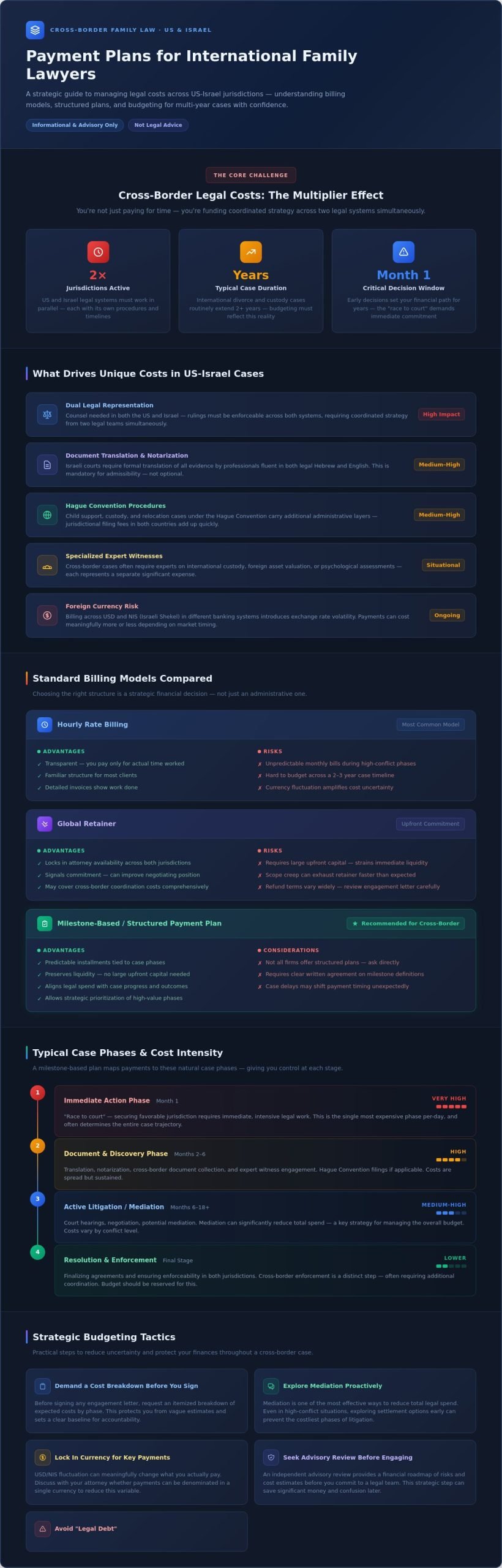
Cross-border legal fees are far more complex than standard domestic billing. These costs encompass direct representation, specialized expert witnesses, and the administrative burden of jurisdictional filing fees in both the US and IL. Because these cases involve two distinct legal systems, they often exceed the budgets of local matters. The “multiplier effect” is a common reality; you aren’t just paying for time, but for the coordination of legal strategies that must work simultaneously in two different countries. Understanding Standard Billing Models is the first step toward gaining control over these expenses.
The Israeli legal system introduces unique procedural requirements that can impact your total spend. For example, the “race to the court” often necessitates immediate, intensive legal work to secure the most favorable jurisdiction. This urgency requires a significant initial financial commitment. It’s why many families look for payment plans for international family lawyers to help manage these high-intensity phases without exhausting their immediate savings. Seeking clarity on these costs early prevents the stress of unexpected invoices later in the process.
To better understand how fees can shift during a family law case, watch this helpful video:
Why International Cases Carry Unique Costs
Coordination is a major cost driver in transnational litigation. You’re often required to manage a collaborative effort between counsel in the US and IL to ensure that a ruling in one country is enforceable in the other. Procedural requirements under the Hague Convention for child support or relocation add layers of administrative expense. Israeli courts also require formal document translation and notarization by professionals who are fluent in both legal Hebrew and English. These steps are mandatory for your evidence to be admissible, and they represent a significant portion of the budget that domestic cases simply don’t face.
The Importance of Early Financial Planning
The decisions you make in the first month of a case often dictate your financial path for the next two years. Proactive budget management helps you avoid “legal debt,” which happens when your case expenses grow faster than your available cash flow. Before you sign an engagement letter, you should demand a detailed breakdown of expected costs. Finding payment plans for international family lawyers that offer structured, milestone-based billing can provide the stability you need. This approach allows you to focus on the long-term legal strategy rather than worrying about how to cover the next unexpected court filing.
Get clarity before you commit. Request a confidential consultation.
This article is published on an independent advisory platform (not a law firm) and does not imply an attorney-client relationship. Legal services are only provided by licensed attorneys under a separate engagement.
Standard Billing Models for International Legal Representation
Choosing the right billing structure is a strategic decision that affects your long-term liquidity. In the context of US-Israel legal matters, most firms rely on the traditional hourly rate. This model provides transparency because you only pay for the actual time spent on your case. However, it can lead to unpredictable monthly expenses during high-conflict phases. To counter this, some families now look for payment plans for international family lawyers that allow for more structured budgeting. Understanding how these models function helps you avoid financial surprises as your case progresses through the Israeli court system.
One specific challenge often overlooked by domestic firms is currency volatility. When you manage a case between the US and IL, you’re dealing with the fluctuation between the US Dollar and the Israeli Shekel (ILS). If your legal fees are quoted in Shekels but paid from a US bank account, the actual cost to you can change every month based on the exchange rate. It’s helpful to review a firm’s pricing structure to see how they handle international wire fees and currency conversions, as these “small” costs can add up to thousands of dollars over a multi-year case.
Hourly vs. Fixed-Fee Structures
Fixed-fee arrangements are highly effective for predictable, standalone tasks. For example, drafting a prenuptial agreement or a simple will often fits a flat-fee model. However, complex custody or relocation cases rarely work this way because the total hours required depend on the other party’s actions. In an hourly model, lawyers typically bill in six-minute increments. This means every email, phone call, or court filing is tracked precisely. While this ensures you aren’t overcharged for work not performed, it requires you to be disciplined about communication to keep costs under control.
Retainer Management Across Borders
Many international firms utilize an “Evergreen Retainer” to manage ongoing litigation costs. This system requires you to maintain a minimum balance in a trust account. As the lawyer works, they draw from this fund, and you’re expected to replenish it once it hits a certain threshold. Managing this from a US account requires planning; international wires can take several days to clear. Requesting a regular “statement of account” is the best way to maintain transparency. This document should detail every task performed and the remaining balance in your trust account.
If you’re unsure which billing model fits your specific needs, you might find it helpful to speak with an advisor about your options.
This article is published on an independent advisory platform (not a law firm) and does not imply an attorney-client relationship. Legal services are only provided by licensed attorneys under a separate engagement.
Structured Payment Plans vs. Traditional Upfront Retainers
Traditional retainers in international law can be substantial. They often require five-figure sums to be deposited into a trust account before any work begins. A legal payment plan offers a modern alternative by breaking these large commitments into manageable parts. Instead of one massive transfer from a US account to IL, costs are distributed over time. This approach is becoming more common as families seek payment plans for international family lawyers to align their legal spending with their actual monthly cash flow. It’s a shift from paying for potential work to paying for progress.
Milestone-based payments are a specific type of structured plan that many find helpful. In this model, you pay when specific stages of the case are reached. For example, you might pay a set amount upon the initial filing, another at the conclusion of mediation, and a final portion before a trial begins. This ensures your capital isn’t tied up for months without active progress. For those who require ongoing guidance during a separation, monthly subscription or installment models for advisory services provide a way to keep a consultant available without the friction of constant invoicing. You can find more details on how these structures work by reviewing our process for international clients.
In high-asset international divorces, third-party legal funding is an emerging option. This involves an external company covering legal costs in exchange for a portion of the final settlement. While it’s a complex arrangement, it can be a strategic choice when one spouse controls all the liquid assets. It allows the other spouse to maintain high-quality representation without immediate liquidity.
Benefits of Choosing a Payment Plan
Choosing a structured plan helps preserve your liquidity. Divorce is expensive, and you still need to cover daily living expenses, housing, and school fees for children in IL. By spreading out the cost, you reduce immediate financial pressure. This lower stress level often leads to better strategic decision-making. You can focus on the long-term outcome of your case rather than worrying about an empty bank account. For expat families on a fixed budget, predictable monthly outgoings are essential for maintaining financial stability throughout a multi-year process.
Potential Risks and Considerations
You must understand the full terms of any agreement before you commit. Some payment plans for international family lawyers may include interest rates or administrative fees that increase the total cost of representation. It’s also vital to know what happens if a payment is missed. In active litigation, a sudden stop in legal work due to non-payment can be catastrophic for your case. Finally, ensure the plan covers both attorney fees and third-party disbursements, such as court fees or expert witness reports. You don’t want to be hit with unexpected “out-of-pocket” requests in the middle of a hearing.
This article is published on an independent advisory platform (not a law firm) and does not imply an attorney-client relationship. Legal services are only provided by licensed attorneys under a separate engagement.
Strategic Budgeting for International Divorce and Custody
Effective financial management in a cross-border case requires more than just tracking hours. You must actively identify potential “financial leaks” that can drain your budget without advancing your legal position. These leaks often include redundant administrative tasks, such as multiple international courier fees for physical documents or uncoordinated filings in both the US and IL courts. By streamlining these logistics early, you can allocate your resources toward high-impact legal work. Mediation and Alternative Dispute Resolution (ADR) are essential strategies for cost containment. These methods can resolve disputes in a fraction of the time required for traditional litigation, which drastically reduces the long-term need for payment plans for international family lawyers.
An independent advisory service helps you navigate these choices by offering a neutral perspective on your financial path. This guidance allows you to separate the emotional aspects of your case from the commercial reality of legal spending. For additional insights into managing the financial side of your case, you can find expert cost-saving strategies on the Israel Family Law YouTube channel. This resource provides practical advice on how to handle the unique complexities of the Israeli system while maintaining your financial stability.
Questions to Ask About Fees During a Consultation
When you meet with potential counsel, clarity should be your primary objective. You need to know if the firm offers milestone-based billing for international filings, as this structure provides better predictability than a standard hourly invoice. Ask specifically how travel expenses and international communication are billed; some firms charge for every cross-border call, while others include this in their standard overhead. Finally, confirm the currency requirements. Ask if you can pay in USD or if you are required to pay in ILS, as this will impact your planning regarding exchange rates and wire transfer fees.
Assessing Risk vs. Reward in Legal Spending
Strategic budgeting involves a constant assessment of risk versus reward. There are times when a high-cost strategy is necessary, particularly when protecting significant business interests or complex international assets. In these instances, you must evaluate the “cost of losing” against the cost of high-level representation. Investing in a robust legal defense today can prevent much larger financial losses in the future. We believe in total pricing and fee transparency to help you make these critical decisions with confidence. Balancing your immediate cash flow with your long-term financial security is the key to a successful outcome.
If you’re ready to build a financial roadmap for your case, contact us to discuss your strategy.
This article is published on an independent advisory platform (not a law firm) and does not imply an attorney-client relationship. Legal services are only provided by licensed attorneys under a separate engagement.
The Advisory Model: Seeking Financial Clarity Before You Commit
An independent advisory platform provides a neutral environment to assess the economic impact of your case without the immediate pressure of a litigation retainer. Traditional law firms focus on representation, but an advisor focuses on your strategy and risk exposure. This distinction is vital when evaluating payment plans for international family lawyers. By analyzing your situation from a commercial perspective, you can determine if a proposed fee structure is sustainable for the long-term duration of a US-Israel matter. This neutral oversight ensures that your legal spending aligns with your actual goals rather than just fueling endless litigation.
Strategy-first thinking is the most effective way to protect your interests in IL. Engaging a full-service law firm before you have a clear roadmap often leads to reactive spending. You might find yourself paying for motions or hearings that don’t serve your primary objective. An advisory model allows you to map out these financial risks early. It helps you understand the significant differences between legal cultures and how they influence billing practices. Securing your rights shouldn’t be prevented by a fear of costs; instead, it should be guided by a clear understanding of your financial options.
How the Advisory Process Works
The main difference between an advisory and a traditional retainer is the scope of engagement. While a law firm handles the day-to-day filings, an advisory provides the high-level strategic framework. You can learn more about how the advisory works to see how it complements your legal team. This process results in a roadmap that identifies critical milestones in your US-Israel family law matter. It allows you to enter the legal system with a plan rather than just a hope for a favorable outcome.
Taking the Next Step with Confidence
Preparing for a cross-border case requires meticulous organization of your financial documents. You’ll need to gather records from both jurisdictions to provide a complete picture of your assets. The value of a confidential case review lies in its ability to translate these complex facts into a budget plan. This review identifies where your case is most vulnerable to cost overruns. It empowers you to choose a legal team and a payment structure that fits your reality.
Get clarity before you commit. Request a confidential consultation.
This article is published on an independent advisory platform (not a law firm) and does not imply an attorney-client relationship. Legal services are only provided by licensed attorneys under a separate engagement.
Securing Your Financial Future in Cross-Border Matters
Navigating the US-Israel legal landscape requires more than just legal knowledge; it demands a strategic financial plan that protects your long-term stability. We’ve explored how moving beyond traditional upfront retainers toward structured billing can preserve your liquidity during complex litigation. By understanding the nuances of currency volatility and jurisdictional fees, you can transform a daunting legal process into a manageable series of milestones. Identifying the right payment plans for international family lawyers is essential for maintaining a multi-year case without exhausting your immediate resources.
Our transparent advisory model focuses on strategy and risk-based decision making, providing specialized expertise across both jurisdictions to ensure you aren’t caught off guard. We help you bridge the gap between divergent legal cultures while maintaining focus on your commercial and personal goals. You don’t have to navigate these multi-jurisdictional complexities alone. By prioritizing financial transparency and proactive budgeting, you can manage your case with the confidence that your family’s interests are protected throughout the process.
Get clarity before you commit. Request a confidential consultation.
This article is published on an independent advisory platform (not a law firm) and does not imply an attorney-client relationship. Legal services are only provided by licensed attorneys under a separate engagement.
Frequently Asked Questions
Do international family lawyers usually offer payment plans?
Yes, many firms provide structured options like milestone billing or installment based retainers to help manage costs. These payment plans for international family lawyers are becoming more common as firms recognize the financial strain that cross-border litigation places on families. You should ask about these options during your initial consultation to see if they align with your cash flow and long-term financial strategy. It’s important to get these specific terms in writing before the case begins.
Can I pay my Israeli lawyer using a US credit card or bank account?
Most international firms in IL accept US credit cards and bank wires to facilitate payments for clients living abroad. You should be aware of currency conversion fees and wire transfer costs that may apply to these transactions. These administrative expenses are typically the responsibility of the client and can fluctuate based on the exchange rate between the USD and ILS. Always ask for a clear breakdown of how currency fluctuations affect your monthly invoice before making a payment.
What is the average retainer for a cross-border divorce between the US and Israel?
Retainers vary significantly based on the complexity of assets and whether custody is contested by the other party. While domestic cases might have lower entry points, international matters often require a more substantial initial deposit to cover the intensive work involved in dual jurisdiction filings and preliminary strategy. This initial commitment ensures your legal team can respond quickly to urgent developments, such as a “race to the court” scenario between the US and IL systems.
Are there additional fees for managing assets in two different countries?
Yes, you should expect additional costs for foreign law opinions, specialized valuations of international property, and coordinating with financial experts in both the US and IL. These fees are separate from the attorney’s hourly rate and are necessary to ensure that any property division is legally binding in both jurisdictions. Managing assets across borders requires a high level of technical precision that domestic cases simply don’t demand, which often impacts the total budget.
What happens if my case takes longer than the payment plan duration?
If a case extends beyond the initial plan, lawyers typically require an amendment to the fee agreement or a replenishment of the trust account. It’s essential to have a strategy for long-term funding, as international litigation can often span several years due to the procedural requirements of two different legal systems. Proactive communication with your legal team about your budget limitations can help prevent a sudden stop in representation during a critical phase of the litigation.
Can I negotiate a fixed fee for an international child custody case?
Fixed fees are rare for contested custody matters because the total amount of work depends heavily on the actions of the other party. However, you may be able to negotiate fixed fees for specific stages, such as the initial filing or a specific mediation phase, to maintain better control over your budget. This approach allows for greater financial predictability while acknowledging the inherent uncertainty of high conflict international family law disputes that involve multiple jurisdictions.
Do payment plans include the cost of expert witnesses and court fees?
Usually, payment plans for international family lawyers cover only the professional fees of the attorney, while third party costs like court fees and expert witnesses are billed separately. You should clarify whether these disbursements can be integrated into your monthly budget or if they require immediate, separate payment. Understanding these distinctions early prevents the shock of receiving a large invoice for psychological evaluations or court mandated translation services required by the courts in IL.
Is it cheaper to hire a lawyer in the US or in Israel for a cross-border matter?
The cost depends on where the primary litigation is taking place and the specific hourly rates of the practitioners involved. Hiring a lawyer in IL is often necessary if the case is filed in an Israeli court, but you may save on total costs by selecting a multi qualified practitioner who understands both systems. This can reduce the need for redundant local counsel and minimize the hours spent explaining foreign legal concepts to different members of your legal team.

Article by
Gabriel Lior
A Personal Journey That Became a Mission
The advisory was founded by an American father Gabriel Lior, LLB, MBA , global entrepreneur, and cross-border advisor who spent more than a decade navigating the Israeli family court system firsthand and now lives in Singapore with his son.
As a divorced parent in a cross-border family, Gabriel faced nearly every legal challenge a foreign parent can encounter in Israel — including child custody disputes, child support proceedings, property matters in Israel and abroad, false accusations, and complex immigration and relocation proceedings.
Over the years, he learned the hard way how difficult it is for non-Israeli parents to understand the system, identify the right legal strategy, and choose the right legal representation — especially when language, culture, and jurisdictional differences are involved. He also witnessed how foreign parents and new immigrants are often disadvantaged or taken advantage of by service providers and institutions simply because they lack local knowledge or fluency.
From Client to Advisor
To truly understand — and survive — the system, Gabriel pursued formal legal education in Israel, completing two Israeli law degrees, alongside a BA and MBA earned in the United States. This was never about becoming a practicing attorney, but about gaining a deep, structural understanding of how the system works — and where it breaks down for foreign parents.
This rare combination of:
Firsthand client experience
Israeli legal and US business education
International business and negotiation training
Decades of commercial execution
created a unique perspective – one that understands both sides of the table.
After years of litigation, persistence, and at times self-representation, he ultimately succeeded in securing custody of his son and relocating abroad through a rare legal victory in the Israeli Supreme Court — becoming one of the first fathers in Israel to do so under these circumstances.
Disclaimer
Important Disclaimer:
The information provided on this website and in its content is for general informational and educational purposes only and does not constitute legal advice, legal opinion, or legal representation.
Gabriel Lior is not licensed to practice law in Israel (nor is he interested in doing so) and does not provide legal services, despite having completed 2 Law Degrees. The services offered are advisory in nature and are intended to provide general guidance, strategic insight, and information regarding cross-border family law considerations.
No attorney-client relationship is formed by accessing this website, reading its content, or communicating with us.
Any decisions made based on this information are at your own discretion and risk. For legal advice specific to your situation, you should consult a licensed attorney in the relevant jurisdiction.
Where appropriate, we may refer clients to independent, licensed attorneys or professionals. Such referrals do not constitute legal representation and no liability is assumed for services provided by third parties.