For international couples contemplating the dissolution of a marriage, the initial question of where to file is not merely procedural-it is a critical strategic decision with profound and lasting consequences. The complexities of israel divorce jurisdiction present a formidable challenge, particularly given the country’s unique dual system of civil and religious courts. This multi-jurisdictional landscape often creates significant uncertainty and anxiety, as the choice of forum can dramatically influence the final outcome of your case, from asset division to child custody arrangements.
This comprehensive guide provides the clarity required to navigate this intricate legal terrain. We will delineate the key factors that determine whether an Israeli Family Court, a Rabbinical Court (Beit Din), or a foreign court has the authority to adjudicate your divorce. Understanding these principles is the first step toward making a calculated, informed decision, protecting your interests, and securing a more favorable position in any cross-border family law proceeding.
Key Takeaways
- Israel operates a unique dual system of Civil Family Courts and religious Rabbinical Courts, and the choice between them carries significant strategic implications for your case.
- Understanding the specific criteria courts use to establish israel divorce jurisdiction-such as residency and citizenship-is the foundational step in developing a successful legal strategy.
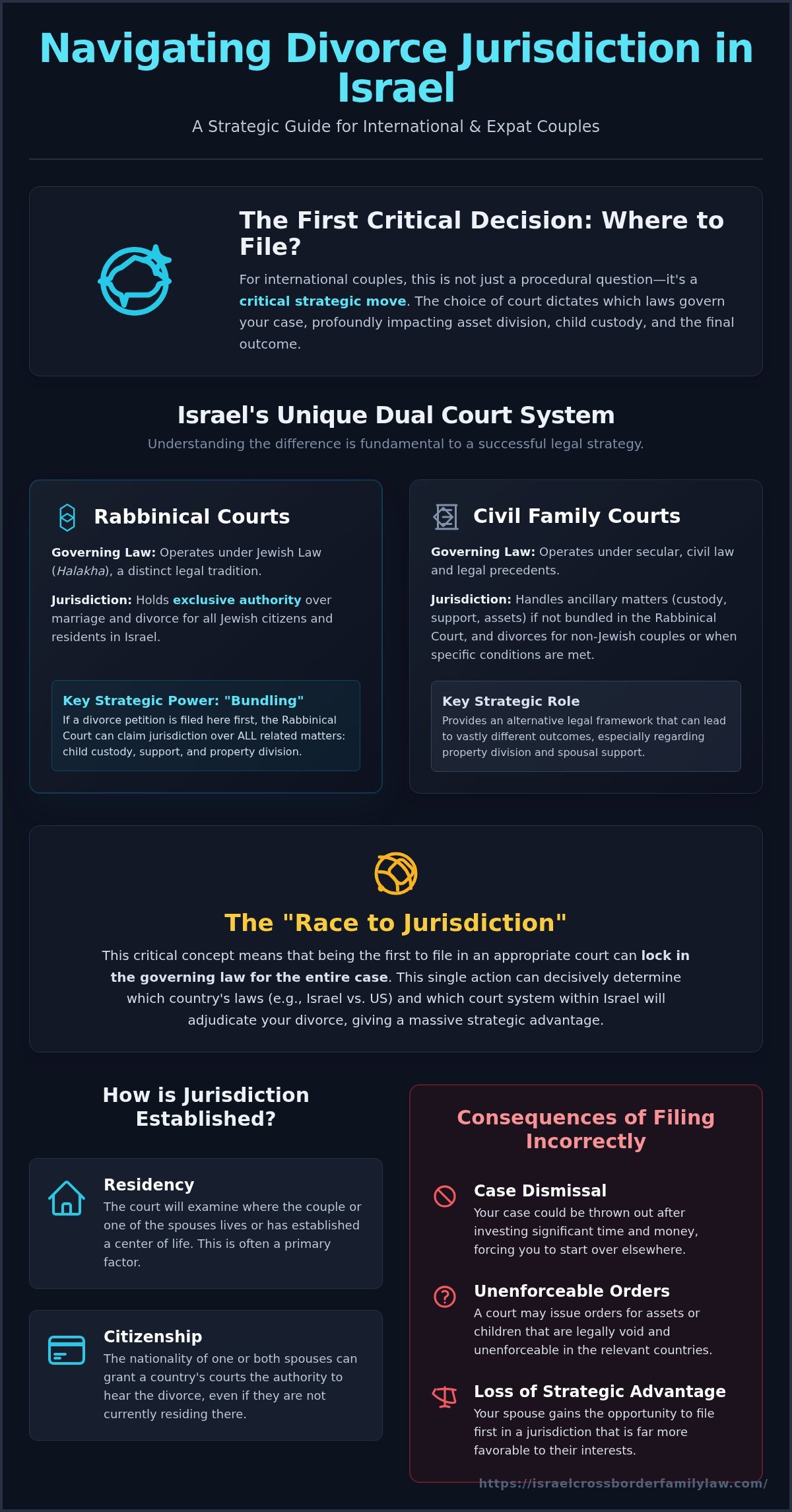
- In complex international cases, the “race to jurisdiction” is a critical concept; being the first to file in the appropriate court can decisively determine which country’s laws will govern your divorce.
- When multiple countries have a potential claim over a divorce, specific legal principles govern which court’s authority will prevail in the multi-jurisdictional dispute.
Understanding Jurisdiction in an Israeli Divorce: Why It’s the First Critical Step
For expatriates and international couples, navigating a divorce requires confronting a critical preliminary question: which country’s courts have the authority to hear your case? This concept, known as legal jurisdiction, is the foundational pillar upon which your entire divorce proceeding rests. Before any discussion of asset division or custody can begin, you must first establish the correct israel divorce jurisdiction. This determination dictates not only where you will file but which set of laws will govern the outcome, profoundly impacting everything from financial settlements to your future relationship with your children.
To further clarify the initial choices you face within the Israeli system, the following video provides a concise overview:
The stakes in this initial phase are exceptionally high. A decision to file in Israel versus another country, such as the United States or the UK, can lead to vastly different results. Moreover, Israel presents a unique layer of complexity with its dual court system. Depending on your religion and circumstances, your case may be heard in either the civil Family Court or a religious tribunal, such as the Rabbinical Court for Jewish couples. This dual-track system is a direct result of the complex framework governing Marriage and divorce laws in Israel, where personal status matters are often tied to religious affiliation. Each court operates under different rules and legal precedents, making the initial choice of venue a strategic decision of paramount importance.
What is Legal Jurisdiction in Family Law?
In the context of family law, jurisdiction is a court’s fundamental legal power and authority to hear a case and issue orders that are legally binding on the parties involved. It is a threshold question that must be resolved before a court can even consider the merits of your case-such as who is at fault or how assets should be divided. Without proper jurisdiction, any action taken by the court is legally void.
The Consequences of Filing in the Wrong Jurisdiction
Selecting the incorrect jurisdiction is not a minor procedural error; it can have severe and irreversible consequences for your case. The potential repercussions include:
- Case Dismissal: Your case could be dismissed after you have already invested significant time and incurred substantial legal fees in ₪, forcing you to start the entire process over in the correct country.
- Unenforceable Orders: A court may issue orders regarding property or children that are ultimately unenforceable in the country where your assets are held or where your children reside.
- Loss of Strategic Advantage: It creates an opportunity for your spouse to file in a jurisdiction that is more favorable to their interests, potentially placing you at a significant strategic and financial disadvantage from the outset.
The Dual Court System: Rabbinical Courts vs. Civil Family Courts
Navigating family law in Israel presents a unique challenge due to its parallel court system, a structure deeply rooted in the nation’s history and legal framework. For expatriates and international couples, understanding this dualism is the first critical step in any divorce proceeding. The determination of which court holds authority is not merely a procedural formality; it has profound strategic implications for the outcome of your case, dictating the applicable laws, procedures, and even the fundamental approach to matters of personal status. This complex landscape makes expert legal guidance essential when establishing israel divorce jurisdiction.
The Authority of the Rabbinical Courts
The Rabbinical Courts (Batei HaDin HaRabbani’im) hold exclusive jurisdiction over the marriage and divorce of all Jewish citizens and residents in Israel, irrespective of their level of religious observance. These courts operate under Jewish Law (Halakha), a sophisticated legal tradition distinct from secular civil law. Critically, if a divorce petition is filed first in the Rabbinical Court, it can also acquire jurisdiction over ancillary matters-such as child custody, spousal support, and property division-by “binding” them to the divorce action. Recent legislation has also confirmed the extended jurisdiction of Israeli rabbinical courts to handle cases for Jewish couples abroad who cannot otherwise obtain a religious divorce (Get).
When the Civil Family Court Has Jurisdiction
In parallel, the Civil Family Courts (Batei Mishpat L’Mishpacha) operate under secular Israeli statutes. These courts have primary jurisdiction over:
- Divorces involving interfaith, non-Jewish, or non-religiously affiliated couples.
- All ancillary matters not already bound to a Rabbinical Court proceeding, including child custody, support payments, and the division of marital assets.
The legal framework applied in the Civil Family Court is based on modern, secular principles of equity and fairness, which can differ significantly from the Halakhic principles governing the Rabbinical Court.
Jurisdiction by Consent and the ‘Race to Jurisdiction’
While couples can sometimes consent to a specific forum for ancillary matters, disputes over jurisdiction are common. This gives rise to a critical strategic concept known as the “race to jurisdiction.” The spouse who files their claim first in their preferred court system often secures that forum’s authority over the entire case. Because the legal standards and potential outcomes can vary dramatically between the Rabbinical and Civil courts, this initial filing is arguably one of the most important decisions in the entire process of establishing israel divorce jurisdiction. Acting decisively and with informed legal counsel is paramount.
Key Factors That Determine Divorce Jurisdiction in Israel
Navigating the complexities of israel divorce jurisdiction requires a deep understanding of the specific criteria applied by both the Family Courts and the Rabbinical Courts. For expats and foreign nationals, these rules are paramount, as they determine whether an Israeli court has the authority to adjudicate their divorce proceedings. The determination is not arbitrary; it is based on a structured analysis of several key connecting factors that link the couple or the marriage to the State of Israel.
Citizenship and Residency of the Spouses
The most definitive factor is citizenship. If both spouses are Israeli citizens, Israeli courts will almost certainly have jurisdiction over their divorce, even if the couple resides abroad. When residency is the primary connection, the courts apply a ‘center of life’ test. This is a comprehensive assessment of where an individual’s primary personal, social, and economic ties are located-it looks beyond a mere physical address to evaluate the true substance of their connection to Israel. In complex cases involving one Israeli and one foreign citizen, the ‘center of life’ of at least one spouse becomes a critical element in establishing jurisdiction.
The Last Common Marital Domicile
A couple’s ‘domicile’ is considered their permanent home with the intent to remain, a concept more profound than a temporary residence. If a couple’s last shared and established marital home was in Israel, this can be a powerful basis for jurisdiction, even if they have subsequently moved abroad. For example, a couple who lived in Tel Aviv for a decade before accepting a two-year work assignment in London may find that Israel retains jurisdiction, particularly if one spouse returns to Israel to file the divorce claim. The court will view their time abroad as temporary, with the marital ‘center of life’ remaining in Israel.
The Defendant’s Place of Residence
A foundational principle in many legal systems is that a legal claim can be filed in the location where the defendant resides. This holds true for divorce in Israel. If your spouse (the defendant) lives in Israel, you can typically file a divorce claim there, even if you (the plaintiff) are living abroad. This factor becomes more complex in cross-border disputes, often requiring sophisticated international service of process. Recognizing these challenges, recent legal developments have addressed such multi-jurisdictional scenarios, as evidenced by the extended jurisdiction of Israeli rabbinical courts to handle cases where a Jewish divorce (Get) cannot be processed in a foreign country.
The ‘Race to Jurisdiction’: Why Filing First Can Be Decisive
In the complex arena of international family law, the “race to jurisdiction” is a critical strategic concept. It refers to the scenario where spouses have connections to multiple legal systems, and each could potentially initiate divorce proceedings in a different location. The principle is straightforward yet powerful: the first court to be properly and legally seized of a divorce case generally retains the authority to adjudicate it. This initial filing can decisively determine not only where the divorce is heard, but also which laws will govern ancillary matters such as property division, child custody, and spousal support.
How the ‘Race’ Works in Israel’s Dual System
Israel’s unique dual-system of civil and religious courts adds a significant layer of complexity to this race. A particularly potent strategy involves one spouse filing a comprehensive divorce claim in the Rabbinical Court. By “binding” (kericha) all related matters-including child custody, child support, and the division of marital assets-to the main divorce suit, that spouse can effectively grant the Rabbinical Court exclusive jurisdiction over the entire case. This maneuver can prevent the other party from seeking relief on these same issues in the Civil Family Court, which may operate under different legal principles.
Strategic Implications for International Couples
For international and expatriate families, the stakes in securing a favorable israel divorce jurisdiction are exceptionally high. The choice between the Rabbinical Court and the Civil Family Court is not merely procedural; it can dramatically alter the legal framework and the ultimate outcome of your case. Filing first provides the strategic advantage of selecting the legal ground that is more aligned with your objectives. Navigating this multi-jurisdictional challenge requires a sophisticated understanding of both legal systems and proactive legal counsel. Our firm provides a deep understanding of the strategic approach to divorce for international families, ensuring your rights are protected from the outset.
Given the decisive impact of the initial filing, seeking immediate, expert legal advice is paramount. If you are an expat considering divorce in Israel, understanding these procedural nuances can be the difference between a favorable and an unfavorable outcome. Contact our team to develop a proactive strategy tailored to your unique cross-border circumstances.
Cross-Border Jurisdiction: When US or Other Foreign Courts Are Involved
For expatriate and international couples, divorce proceedings are rarely confined to a single country. When spouses have significant ties to both Israel and another nation, such as the United States, a complex web of multi-jurisdictional legal questions arises. Determining which court has the authority to grant a divorce, divide assets, or issue custody orders is a sophisticated challenge that demands a strategic, global approach. The potential for conflict between two national court systems requires meticulous legal planning to protect your rights and assets across borders.
Can a US Court Handle a Divorce for Residents of Israel?
A US court may assert jurisdiction if one spouse meets the state’s residency requirements, which typically involve living there for a set period (e.g., six months in states like New York or California). However, even if jurisdiction is technically possible, a US court might decline to hear the case under the doctrine of forum non conveniens if it determines that Israel is the more appropriate and convenient forum for the litigation, particularly if the children and primary marital assets are located in Israel.
Recognition and Enforcement of Foreign Judgments
Obtaining a divorce decree from a foreign court does not guarantee its automatic recognition in Israel. The foreign judgment must be formally presented to the Israeli Family Court for recognition and registration with the Ministry of Interior. This process is governed by specific legal criteria, and recognition can be denied if the foreign ruling contradicts Israeli public policy. Enforcing specific orders presents further challenges; for example, complex international treaties and local laws govern the enforcement of cross-border child support orders.
Navigating Parallel Proceedings
Initiating simultaneous divorce actions in two countries-a common tactic in contentious separations-creates significant risks. This “race to the courthouse” can lead to:
- Contradictory court orders regarding child custody and asset division.
- Substantially increased legal costs and procedural delays.
- Complex legal disputes over which judgment takes precedence.
Successfully managing the intricacies of israel divorce jurisdiction alongside foreign litigation is an absolute necessity. Engaging a law firm with proven, hands-on experience in multi-jurisdictional family law is imperative to developing a coordinated strategy that safeguards your interests in every relevant venue.
For expert guidance on navigating your complex international divorce matter, contact our legal team to discuss your case.
Strategic Counsel for Complex Jurisdictional Challenges in Israeli Divorce
Navigating the complexities of an international divorce in Israel requires a profound understanding of its unique legal landscape. As we have detailed, the choice between the Rabbinical and Civil Family Courts, coupled with the critical implications of the ‘race to jurisdiction,’ can decisively shape the outcome of your case.
Establishing the correct israel divorce jurisdiction is not merely a procedural step; it is the strategic foundation upon which your entire case is built, particularly when assets and family are located across international lines.
Our firm provides strategic guidance on the most complex jurisdictional challenges. With deep expertise in multi-jurisdictional divorce cases and a team of bilingual attorneys qualified to practice in both Israel and the U.S., we are uniquely positioned to protect your interests. Secure your legal standing with a Confidential Case Review.
Taking this decisive first step can provide the clarity and confidence needed to move forward.
Frequently Asked Questions
Can non-citizens get divorced in Israel if they live there?
Yes, non-citizens can file for divorce in Israel provided they meet certain residency requirements. Jurisdiction is not solely determined by citizenship but rather by the couple’s “center of life.” The Israeli Family Court or relevant religious court may assume jurisdiction if the couple’s last common marital residence was in Israel, or if the petitioning spouse has resided in Israel for a sufficient period, demonstrating a substantive connection to the state. This requires a detailed factual assessment.
What happens if my spouse and I are of different religions?
Matters of interfaith marriage dissolution present complex jurisdictional questions within Israel’s legal framework. Typically, if the parties do not belong to the same recognized religious community, jurisdiction for the dissolution of the marriage itself falls to the Family Court. This court is specifically empowered to adjudicate these sophisticated cross-denominational cases, applying civil law principles to navigate the intricacies of the couple’s differing religious statuses and ensure a legally binding resolution.
Does the Rabbinical Court always have jurisdiction over child custody and property for Jewish couples?
No, not exclusively. While the Rabbinical Court holds sole jurisdiction over the act of divorce for Jewish couples, ancillary matters such as child custody, support, and property division are subject to a “jurisdictional race.” The court-either the Rabbinical Court or the civil Family Court-that is first properly seized of these matters will retain jurisdiction. This dynamic underscores the necessity for swift and strategic legal action when initiating divorce proceedings in Israel.
How long do I need to live in Israel to establish residency for a divorce case?
There is no single, statutorily defined period for establishing residency. Israeli courts conduct a qualitative assessment to determine if a party’s “center of life” is in Israel. Factors considered include the duration of stay, intent to remain, location of assets and employment, and community ties. Establishing residency is a critical component for asserting israel divorce jurisdiction, and the evidence required to satisfy the court can be highly specific to the individual circumstances of the case.
Is a divorce decree obtained in the United States automatically valid in Israel?
A U.S. divorce decree is not automatically recognized in Israel and requires a formal validation process. To be enforced, the foreign judgment must be submitted to the Israeli Family Court for a recognition order. The court will review the foreign proceedings to ensure that the U.S. court had proper jurisdiction and that its ruling does not contradict Israeli public policy. This cross-border legal procedure is essential for the foreign decree to have legal effect within Israel.
What if my spouse files for divorce in Israel while I am living abroad?
Immediate legal action is imperative. If you are served with a divorce petition from an Israeli court while residing abroad, you must engage counsel to represent your interests. It may be possible to challenge the court’s authority based on jurisdictional grounds. Failing to respond in a timely manner can result in a default judgment against you, potentially impacting matters of property, support, and child custody. Protecting your rights requires a proactive and strategic response.

Article by
Gabriel Lior
A Personal Journey That Became a Mission
The advisory was founded by an American father Gabriel Lior, LLB, MBA , global entrepreneur, and cross-border advisor who spent more than a decade navigating the Israeli family court system firsthand and now lives in Singapore with his son.
As a divorced parent in a cross-border family, Gabriel faced nearly every legal challenge a foreign parent can encounter in Israel — including child custody disputes, child support proceedings, property matters in Israel and abroad, false accusations, and complex immigration and relocation proceedings.
Over the years, he learned the hard way how difficult it is for non-Israeli parents to understand the system, identify the right legal strategy, and choose the right legal representation — especially when language, culture, and jurisdictional differences are involved. He also witnessed how foreign parents and new immigrants are often disadvantaged or taken advantage of by service providers and institutions simply because they lack local knowledge or fluency.
From Client to Advisor
To truly understand — and survive — the system, Gabriel pursued formal legal education in Israel, completing two Israeli law degrees, alongside a BA and MBA earned in the United States. This was never about becoming a practicing attorney, but about gaining a deep, structural understanding of how the system works — and where it breaks down for foreign parents.
This rare combination of:
Firsthand client experience
Israeli legal and US business education
International business and negotiation training
Decades of commercial execution
created a unique perspective – one that understands both sides of the table.
After years of litigation, persistence, and at times self-representation, he ultimately succeeded in securing custody of his son and relocating abroad through a rare legal victory in the Israeli Supreme Court — becoming one of the first fathers in Israel to do so under these circumstances.
Disclaimer
Important Disclaimer:
The information provided on this website and in its content is for general informational and educational purposes only and does not constitute legal advice, legal opinion, or legal representation.
Gabriel Lior is not licensed to practice law in Israel (nor is he interested in doing so) and does not provide legal services, despite having completed 2 Law Degrees. The services offered are advisory in nature and are intended to provide general guidance, strategic insight, and information regarding cross-border family law considerations.
No attorney-client relationship is formed by accessing this website, reading its content, or communicating with us.
Any decisions made based on this information are at your own discretion and risk. For legal advice specific to your situation, you should consult a licensed attorney in the relevant jurisdiction.
Where appropriate, we may refer clients to independent, licensed attorneys or professionals. Such referrals do not constitute legal representation and no liability is assumed for services provided by third parties.