The dissolution of a cross-border marriage introduces a sophisticated matrix of legal and financial challenges, particularly concerning spousal support. International couples often face profound uncertainty: Will Israeli or foreign law apply? How will Israel’s unique dual system of civil and religious courts impact the outcome? And critically, can a support order issued in one country be effectively enforced in another? These multi-jurisdictional questions demand authoritative guidance. This comprehensive guide is engineered to provide that clarity, specifically addressing the complexities of spousal support israel international couples must navigate. We will delineate the pivotal rules that establish court jurisdiction, demystify the calculation of alimony when foreign income and global assets are involved, and explain the established protocols for enforcing judicial orders between Israel and nations like the United States. By exploring these key financial factors and procedural frameworks, you will gain the confidence needed to take decisive steps toward securing your financial future during this challenging transition.
The Foundation: Spousal Support Principles in Israeli Law
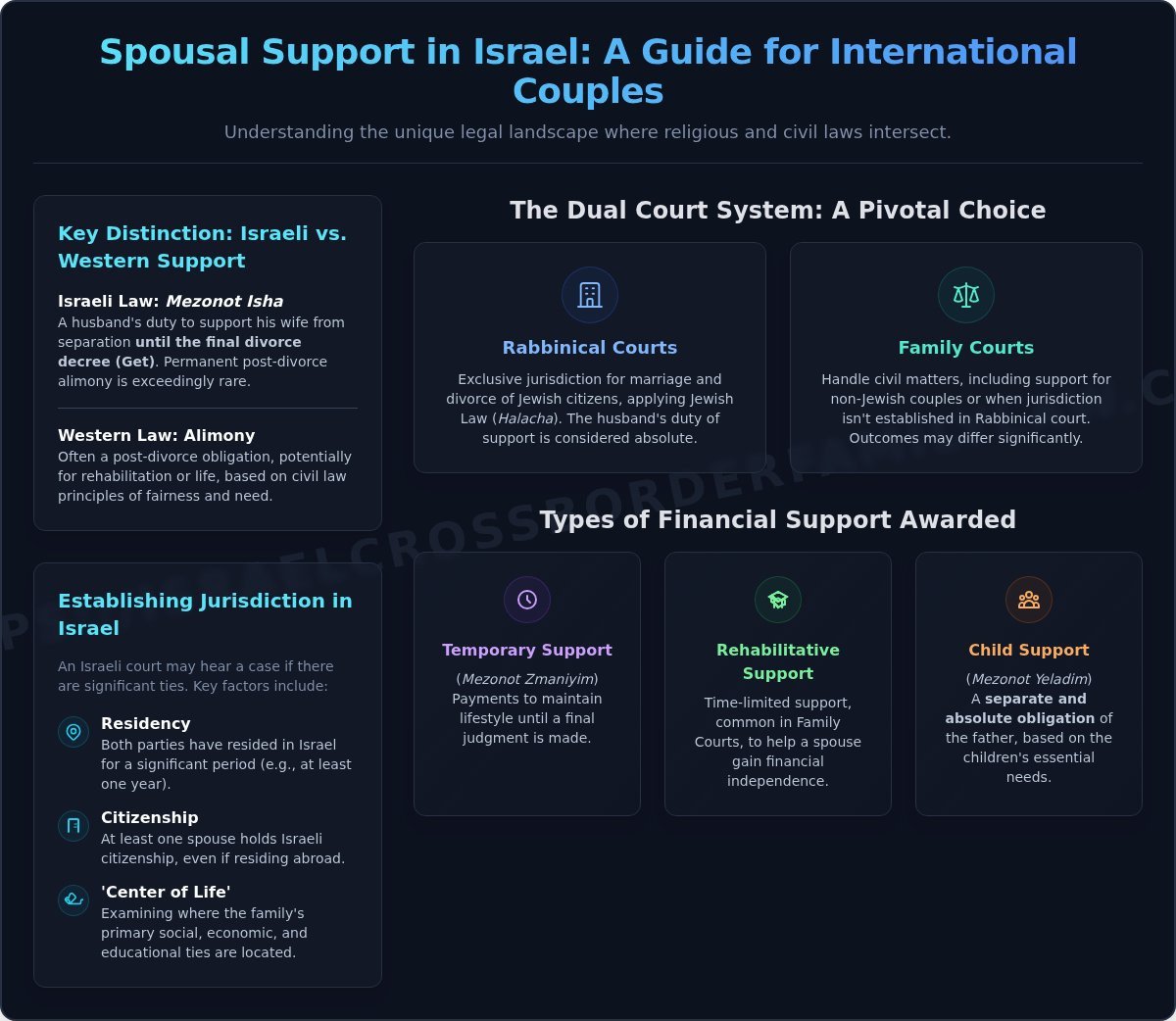
In Israel, the concept of spousal support, known traditionally as mezonot isha (wife’s maintenance), is a financial obligation rooted deeply in religious law. It is fundamentally distinct from the Western notion of post-divorce alimony. This obligation requires a husband to support his wife from the moment of separation until the final divorce decree (the Get) is granted. Navigating the complexities of spousal support israel international disputes therefore requires a deep understanding of a unique legal landscape where religious and civil statutes intersect, and where a couple’s religious affiliation dictates the applicable legal framework. For a detailed overview of these principles, the following video provides valuable insights:
The Dual Court System: Rabbinical vs. Family Courts
Israel operates a parallel court system for family law, a critical factor in any spousal support case. The Rabbinical Courts hold exclusive jurisdiction over the marriage and divorce of Jewish citizens, applying Jewish law (Halacha). Under Halacha, a husband’s duty of support is absolute, provided the wife has not committed an act that would forfeit her right. In contrast, Family Courts handle civil matters, including support claims for non-Jewish couples or when jurisdiction has not been established in the Rabbinical Court. The choice of forum is a pivotal strategic decision, as the legal principles and potential outcomes can differ substantially between the two systems, a core tenet of Israeli Marriage and Divorce Law.
Types of Financial Support in an Israeli Divorce
Understanding the specific forms of financial relief available is essential for anyone involved in cross-border divorce proceedings. The primary types of support awarded in Israel include:
- Temporary Support (Mezonot Zmaniyim): These are payments ordered by the court at the beginning of proceedings to maintain the dependent spouse’s standard of living until a final judgment is rendered. The amount is determined based on the family’s lifestyle during the marriage.
- Rehabilitative Support: More common in Family Court rulings, this is a time-limited form of support designed to enable a dependent spouse to acquire education or skills to become financially independent. It is not a lifelong entitlement.
- Child Support (Mezonot Yeladim): It is crucial to distinguish spousal support from child support. Child support is a separate and absolute obligation of the father under Israeli law, calculated based on the children’s essential needs.
Notably, permanent, long-term alimony post-divorce is exceedingly rare in Israel, a significant departure from the legal frameworks in many Western countries. This makes the strategic handling of a spousal support israel international case, particularly during the separation period, of paramount importance.
Jurisdiction: Can an Israeli Court Decide Your International Case?
For international couples facing divorce, the immediate and most critical question is often which country’s court will preside over the proceedings. This question is governed by the legal principle of jurisdiction-the authority of a court to hear and decide a case. The determination of jurisdiction is a foundational step that profoundly impacts every subsequent aspect of the divorce, from property division to spousal support. Factors such as the residency of each spouse, where the marital home was located, and where legal proceedings were first initiated are paramount in this complex analysis. Navigating these multi-jurisdictional challenges without expert legal guidance can lead to costly errors. The practice of ‘forum shopping’-attempting to file a lawsuit in a jurisdiction perceived to be more favorable-is fraught with risk and can result in your case being dismissed or subject to protracted and expensive legal battles over procedural matters before the substantive issues are even addressed.
Establishing Jurisdiction in Israel for Foreign Residents
An Israeli court may assert jurisdiction over a divorce and related claims for spousal support even if one or both parties are foreign nationals. The authority to hear a case involving spousal support israel international dynamics typically hinges on several key factors:
- Residency: If both parties have resided in Israel for a specified period, typically at least one year, jurisdiction can often be established.
- Israeli Citizenship: The Israeli citizenship of one spouse can be a sufficient basis for an Israeli court to hear the case, even if that spouse currently resides abroad.
- ‘Center of Life’: Courts will examine where the couple’s “center of life” was located. This is a fact-intensive inquiry considering factors like where children attended school, where the family’s primary assets are held, and the couple’s social and economic ties.
However, an Israeli court may decline jurisdiction if the connection to Israel is deemed too tenuous, for instance, if the parties have lived abroad for many years with minimal ties to the state.
Conflict of Laws: When US and Israeli Courts Collide
It is not uncommon in cross-border cases for divorce proceedings to be initiated simultaneously in both Israel and another country, such as the United States. This creates a “race to the courthouse” scenario where the first court to be properly seized of the matter often prevails. Courts generally operate under the principle of ‘comity,’ a doctrine of mutual respect for the legal proceedings of foreign courts. A definitive ruling on jurisdiction is essential, as it directly impacts the enforceability of any orders, a matter addressed by frameworks like the Hague Convention on the International Spousal Support Enforcement. An ambiguous or improperly established jurisdictional foundation can render a spousal support order unenforceable abroad. Jurisdictional disputes are complex. Consult with an expert to secure your position.
Calculating Support: Key Factors for International Couples
Determining spousal support in a domestic context is a complex undertaking; however, when international elements are introduced, the process becomes a multi-jurisdictional challenge requiring sophisticated financial analysis. Israeli family courts mandate complete transparency and full financial disclosure from both parties, encompassing all assets and income sources worldwide. This global perspective is fundamental to reaching a fair and equitable determination in high-net-worth or cross-border divorce proceedings.
Assessing Global Income and Earning Capacity
The court’s analysis extends far beyond an Israeli pay stub (tlush maskoret). It involves a rigorous examination of international financial documents, including foreign tax returns, corporate records for overseas businesses, and pay stubs from U.S. or European employers. Income earned in foreign currencies, such as USD or EUR, is converted to Israeli Shekels (ILS) for a standardized assessment. The court evaluates not only the actual income but also the ‘earning potential’ of each spouse. Furthermore, complex compensation structures, including bonuses, restricted stock units (RSUs), and stock options, are meticulously valued and factored into the calculation. The court may also consider the significant cost-of-living differences between Israel and another country, such as the United States, when determining the needs of the recipient spouse and the capacity of the paying spouse.
Valuing International Assets and Marital Property
A critical component of calculating spousal support israel international cases involves the identification and valuation of the complete marital estate, regardless of where assets are located. This often requires engaging specialized professionals, such as forensic accountants and expert appraisers, to value foreign real estate, international business interests, or complex investment portfolios. The meticulous valuation of these global assets is critical, as the resulting support order is intended to be enforceable across borders, a principle reinforced by frameworks such as the U.S.-Israel Support Enforcement Agreement, which facilitates the collection of support. Retirement accounts held abroad, like a U.S.-based 401(k) or pension plan, are also considered marital property subject to division or consideration. Premarital assets located abroad are typically excluded, provided they were kept separate and not commingled with marital funds.
Standard of Living and Duration of Marriage
The Israeli courts consider several key personal factors to ensure a just outcome. The standard of living established during the marriage serves as a primary benchmark for determining the level of support required to maintain a reasonably comparable lifestyle post-divorce. Other significant considerations include:
- Duration of the Marriage: A long-term marriage often results in a more substantial and longer-lasting spousal support obligation, recognizing the interdependence developed over many years.
- Age and Health: The court assesses the age and physical and emotional health of each spouse, which can impact their ability to become self-supporting.
- Non-Financial Contributions: Significant weight is given to the non-financial contributions of one spouse, such as managing the household and raising children, which enabled the other spouse to advance their career and earning capacity.
Enforcement Across Borders: Making Support Orders Effective
A court order granting spousal support is a significant legal victory, but its true value is realized only through enforcement. When the paying spouse resides in a different country, collection becomes a complex, multi-jurisdictional challenge. Fortunately, a framework of international treaties and domestic laws exists to bridge this gap, providing sophisticated legal mechanisms to ensure that financial obligations are met across borders. The process, however, differs significantly depending on whether you are enforcing an Israeli order abroad or a foreign order within Israel.
Enforcing an Israeli Support Order in the United States
To enforce an Israeli spousal support order in the US, the judgment must first be “domesticated” or registered in a US state court, effectively converting it into a local order. Many states utilize frameworks like the Uniform Interstate Family Support Act (UIFSA) to recognize and enforce foreign support decrees. However, the paying spouse may raise defenses, such as a claim that the Israeli court lacked jurisdiction or that there was a violation of due process, to contest enforcement. Once domesticated, powerful collection tools like wage garnishment become available to the receiving spouse.
Enforcing a US Support Order in Israel
Conversely, enforcing a US support judgment in Israel is governed by the Foreign Judgments Enforcement Law, 1958. An Israeli court will recognize and enforce the US order provided certain critical conditions are met. The key requirements include:
- The US court must have had proper international jurisdiction to issue the order.
- The judgment must be final and no longer subject to appeal in the US.
- The obligation must be enforceable under Israeli law and not contradict Israel’s public policy (takanat hatzibur).
- The principle of reciprocity is considered, meaning an Israeli judgment would be similarly enforced in that US state.
Successfully navigating these distinct legal pathways requires a deep understanding of both Israeli and foreign procedural law. Whether enforcing a judgment from Tel Aviv in New York or bringing a Californian order before an Israeli court, the complexities of spousal support israel international cases demand experienced counsel with a proven track record in multi-jurisdictional litigation. A strategic approach is critical to overcoming potential defenses and ensuring financial orders are honored. For a confidential consultation on your specific enforcement matter, please contact our legal team.
Strategic Planning for International Spousal Support
Navigating spousal support in a cross-border divorce between Israel and another country, such as the United States, demands more than reactive legal defense; it requires a sophisticated, proactive strategy. The complexities of multi-jurisdictional law, conflicting legal precedents, and international enforcement protocols mean that foresight and meticulous planning are paramount. A well-executed strategy can protect assets, ensure fair outcomes, and provide clarity in an otherwise uncertain process. Addressing the issue of spousal support israel international cases early is the most effective way to secure your financial future.
The Power of International Prenuptial Agreements
A prenuptial or postnuptial agreement is one of the most powerful tools for managing cross-border financial risk. A properly drafted agreement can pre-determine, limit, or even waive spousal support, providing predictability for both parties. However, for such an agreement to be effective, it must be meticulously structured to be enforceable in both Israel and the other relevant jurisdiction. This requires counsel adept in the laws of both nations, ensuring that procedural requirements, such as independent legal representation for each party and full financial disclosure, are rigorously met to prevent future challenges to its validity.
Why Specialized Cross-Border Counsel is Non-Negotiable
Engaging a local family lawyer who lacks international experience is a critical misstep in these complex cases. An attorney without a deep understanding of international treaties, jurisdictional rules, and foreign enforcement mechanisms cannot effectively advocate for your interests. Specialized cross-border counsel serves as the central coordinator, harmonizing legal strategies across multiple countries to ensure that actions taken in one jurisdiction do not inadvertently harm your position in another. This expertise is essential for navigating the intricate cultural and legal nuances that define international family law. If you are facing a potential international divorce involving spousal support, taking decisive action with the right legal team is essential. We offer the following guidance:
- Document Everything: Gather and secure all financial records, including assets, income, and debts held in all relevant countries.
- Seek Early Counsel: Do not wait for proceedings to be initiated. Early legal advice allows for the development of a comprehensive strategy before key decisions are made.
- Avoid Unilateral Actions: Refrain from moving assets, changing residency, or making significant financial decisions without consulting an expert in international family law.
The stakes in matters of spousal support israel international disputes are exceptionally high, demanding an unparalleled level of legal acumen. Protect your future. Schedule a confidential consultation with our cross-border team.
Strategic Counsel for Complex International Spousal Support
Navigating the intricacies of spousal support for international couples in Israel demands a sophisticated understanding of legal jurisdiction, financial calculations, and cross-border enforcement. As this guide has illustrated, determining whether an Israeli court can preside over your case and ensuring a subsequent order is honored abroad are significant challenges that require meticulous strategic planning. The outcome of your case hinges on a deep knowledge of how these distinct legal systems interact, a critical factor in matters of spousal support israel international agreements. These multi-jurisdictional complexities require counsel with proven, specialized expertise. Our firm is uniquely positioned to provide this guidance, offering deep expertise in Israeli-American family law. With a proven track record in enforcing foreign judgments in Israel and a distinguished team of attorneys licensed to practice in both Israel and the United States, we provide a seamless and powerful advantage for our clients. Protect your financial future by securing authoritative legal representation. Facing an international divorce? Contact our experienced US-Israel family law attorneys for a strategic consultation. Let us help you navigate this complex process with confidence and clarity.
Frequently Asked Questions
Can I receive spousal support in Israel if my marriage was not religious?
Yes. While jurisdiction for Jewish couples married religiously often lies with the Rabbinical Courts, civil marriages are recognized in Israel, and spousal support claims from these unions are adjudicated by the Family Courts. These courts apply principles of civil contract law and fairness to assess the need for support, focusing on financial disparity and the need for rehabilitative assistance, independent of the marriage’s religious status or where it was performed.
How long does a spouse typically have to pay alimony in an Israeli divorce case?
The duration of spousal support in Israel is not fixed but is determined on a case-by-case basis, considering factors such as the length of the marriage, the recipient’s age, health, and earning potential. Courts often award “rehabilitative support” for a limited period to enable a spouse to become financially independent. Indefinite alimony is increasingly rare and typically reserved for long-term marriages where a significant, unbridgeable income gap exists between the parties.
Does my US citizenship impact my rights or obligations for spousal support in Israel?
While an Israeli court will apply Israeli law if it has jurisdiction, your US citizenship is a significant factor in multi-jurisdictional cases. It impacts the court’s assessment of your global assets, income streams, and earning capacity located in the United States. Furthermore, it raises complex questions regarding which jurisdiction is most appropriate for the proceedings and the subsequent international enforcement of court orders, requiring sophisticated legal strategy to navigate effectively.
What happens if my ex-spouse stops paying support and moves to another country?
Enforcing a spousal support israel international order requires a strategic, cross-border legal approach. Israel is a signatory to international treaties, such as the Hague Convention, which facilitate the recognition and enforcement of support orders in other member countries. The process involves registering the Israeli judgment in the foreign jurisdiction and utilizing that country’s local legal mechanisms to compel payment, a complex procedure our firm is equipped to navigate for our clients.
Is spousal support taxable in Israel, and how does that coordinate with US tax laws?
In Israel, spousal support payments are generally not considered taxable income for the recipient, nor are they tax-deductible for the payer. For US persons, navigating the interplay between these two tax regimes and the US-Israel Tax Treaty is critical to ensure compliance and avoid adverse tax consequences, particularly given recent changes in US tax law. Professional guidance on these complex cross-border tax obligations is essential for all parties involved.
Will an Israeli court consider my future inheritance when determining alimony?
Israeli courts typically determine spousal support based on the parties’ current financial circumstances and proven earning capacity. A potential future inheritance is generally considered too speculative to be factored into a present alimony calculation. However, if an inheritance is certain and its receipt is imminent, the court may exercise its discretion to consider it as a future financial resource that could impact the duration or amount of the support obligation.
Can a spousal support order be modified if my or my ex-spouse’s financial situation changes?
Yes, spousal support orders in Israel are not immutable and can be modified by the court upon demonstrating a “material change in circumstances” since the original order was issued. Such changes can include a significant and involuntary loss of income, a substantial promotion, a debilitating illness, or the recipient’s remarriage. A formal application must be filed with the court to request a review and subsequent modification of the existing support arrangement.

Article by
Gabriel Lior
A Personal Journey That Became a Mission The advisory was founded by an American father Gabriel Lior, LLB, MBA , global entrepreneur, and cross-border advisor who spent more than a decade navigating the Israeli family court system firsthand and now lives in Singapore with his son.
As a divorced parent in a cross-border family, Gabriel faced nearly every legal challenge a foreign parent can encounter in Israel — including child custody disputes, child support proceedings, property matters in Israel and abroad, false accusations, and complex immigration and relocation proceedings. Over the years, he learned the hard way how difficult it is for non-Israeli parents to understand the system, identify the right legal strategy, and choose the right legal representation — especially when language, culture, and jurisdictional differences are involved. He also witnessed how foreign parents and new immigrants are often disadvantaged or taken advantage of by service providers and institutions simply because they lack local knowledge or fluency. From Client to Advisor To truly understand — and survive — the system, Gabriel pursued formal legal education in Israel, completing two Israeli law degrees, alongside a BA and MBA earned in the United States. This was never about becoming a practicing attorney, but about gaining a deep, structural understanding of how the system works — and where it breaks down for foreign parents. This rare combination of: Firsthand client experience Israeli legal and US business education International business and negotiation training Decades of commercial execution created a unique perspective – one that understands both sides of the table. After years of litigation, persistence, and at times self-representation, he ultimately succeeded in securing custody of his son and relocating abroad through a rare legal victory in the Israeli Supreme Court — becoming one of the first fathers in Israel to do so under these circumstances.
Disclaimer
Important Disclaimer: The information provided on this website and in its content is for general informational and educational purposes only and does not constitute legal advice, legal opinion, or legal representation. Gabriel Lior is not licensed to practice law in Israel (nor is he interested in doing so) and does not provide legal services, despite having completed 2 Law Degrees. The services offered are advisory in nature and are intended to provide general guidance, strategic insight, and information regarding cross-border family law considerations. No attorney-client relationship is formed by accessing this website, reading its content, or communicating with us. Any decisions made based on this information are at your own discretion and risk. For legal advice specific to your situation, you should consult a licensed attorney in the relevant jurisdiction. Where appropriate, we may refer clients to independent, licensed attorneys or professionals. Such referrals do not constitute legal representation and no liability is assumed for services provided by third parties.