The dissolution of a marriage is a complex emotional and financial process, a challenge compounded significantly when assets are spread across international borders like the US and Israel. For individuals facing this multi-jurisdictional reality, the fear that a spouse is concealing wealth can be paralyzing, intensified by the complexity of navigating two distinct legal systems. The critical task of finding hidden assets overseas divorce proceedings is often where the battle for a fair settlement is won or lost, yet many feel overwhelmed and uncertain of where to begin.
This strategic guide is engineered to replace that uncertainty with clarity and confidence. We provide a definitive framework for identifying and tracing concealed international property-from undisclosed Israeli bank accounts and US investment portfolios to sophisticated corporate structures. You will gain a deep understanding of the legal and forensic tools available in both jurisdictions, empowering you to work with your legal counsel to ensure a truly equitable division of all marital property. The goal is not just discovery, but securing the financial future you are rightfully owed.
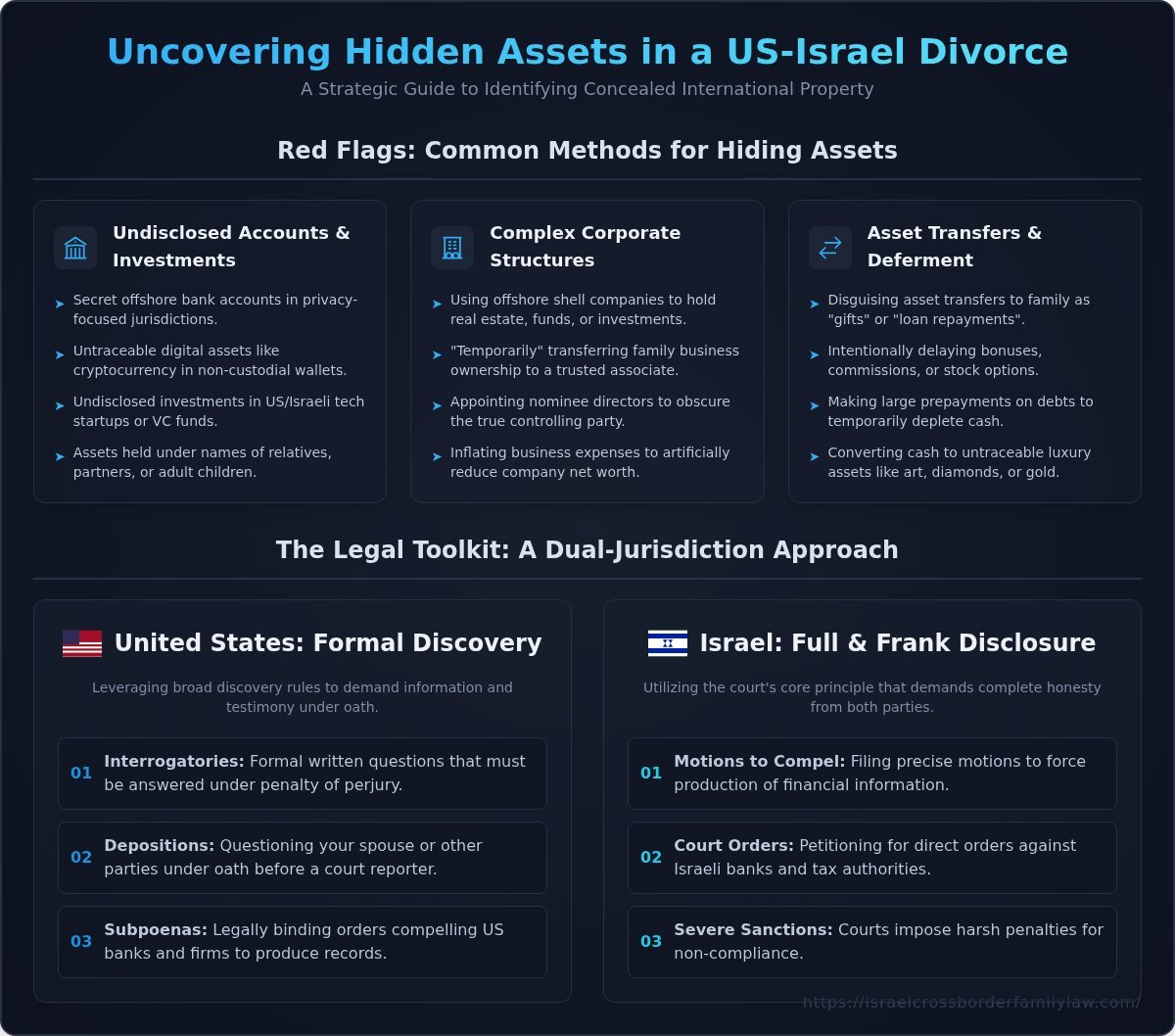
Red Flags: Common Methods for Hiding Assets in a US-Israel Divorce
In high-stakes, cross-border divorces involving significant assets in both the United States and Israel, the suspicion that a spouse is concealing wealth is a frequent and valid concern. Your intuition is often the first indicator; a sudden change in financial behavior, increased secrecy, or unexplained transactions can signal a deliberate attempt to obscure the true marital estate. The process of finding hidden assets overseas divorce begins with recognizing these red flags. High-net-worth individuals may employ sophisticated, multi-jurisdictional strategies designed specifically to frustrate discovery and devalue marital property.
To better understand the complexities of property division and the importance of full disclosure, consider the insights in the following video:
Undisclosed Financial Accounts and Investments
One of the most direct methods of concealment involves diverting funds to accounts unknown to the other spouse. These tactics are often international in scope, leveraging global financial systems to create layers of secrecy. Common examples include:
- Opening secret bank accounts in jurisdictions with stringent bank privacy laws.
- Purchasing difficult-to-trace digital assets, such as cryptocurrency, and holding them in non-custodial wallets.
- Making undisclosed investments in Israeli “start-up nation” tech companies or US venture capital funds.
- Using the names of trusted relatives, business partners, or even adult children to open accounts and hold assets.
Complex Corporate Structures and Shell Companies
Beyond simple bank accounts, a spouse may utilize sophisticated corporate vehicles to hold and obscure assets. These structures create a veneer of legitimacy while making true ownership exceptionally difficult to trace without expert forensic analysis. These are some of the common methods for hiding assets that parallel money laundering techniques. Watch for:
- Creation of offshore companies in jurisdictions like the British Virgin Islands or Panama to hold real estate, investments, or liquid funds.
- Transferring partial or full ownership of a family business to a trusted associate with a verbal agreement to return it post-divorce.
- Appointing nominee directors to corporate boards to obscure the identity of the true controlling party.
- Systematically inflating business expenses with personal costs to artificially reduce a company’s net worth and reported income.
Asset Transfers and Deferment of Income
This strategy focuses on manipulating the timing and form of assets to remove them from the marital balance sheet before or during divorce proceedings. This makes marital wealth appear smaller than it is, impacting the final settlement. Key tactics include:
- Transferring title of real estate or significant funds to close family members or a new partner, disguised as gifts or loan repayments.
- Intentionally delaying expected promotions, large commissions, bonuses, or the exercising of stock options until after the divorce is finalized.
- Making large, unnecessary prepayments on legitimate debts or taxes to temporarily deplete cash reserves.
- Converting cash into high-value, easily transportable assets like fine art, diamonds, luxury watches, or gold bullion that can be stored without a paper trail.
The Legal Toolkit: How We Uncover Hidden International Assets
Successfully navigating the complex process of finding hidden assets overseas divorce necessitates a sophisticated, multi-pronged legal strategy. It is not enough to suspect that assets exist; one must compel their disclosure through formal legal channels. Our firm is uniquely positioned with a deep, nuanced understanding of both the expansive discovery procedures in the United States and the robust disclosure obligations within the Israeli legal system. This dual expertise allows us to craft a comprehensive approach, leveraging the strengths of each jurisdiction to build an undeniable financial picture and ensure a just and equitable division of the marital estate.
Formal Discovery Process in the United States
The U.S. legal system provides a powerful framework for initial evidence gathering, often serving as the foundation for our international investigation. Its broad discovery rules empower us to demand information and testimony from your spouse and third parties. Key tools include:
- Interrogatories and Requests for Documents: Formal written questions and demands for financial records that your spouse must answer under penalty of perjury.
- Depositions: The opportunity to question your spouse or other relevant parties under oath before a court reporter, locking in their testimony.
- Subpoenas: Legally binding orders compelling US-based banks, brokerage firms, employers, and other financial institutions to produce records.
Israeli Legal Mechanisms for Financial Disclosure
The Israeli Family Court operates on a foundational principle of a duty of “full and frank disclosure” from both parties. We leverage this principle by filing precise motions to compel the production of financial information directly from Israeli sources. Understanding the common ways assets are hidden allows us to petition the court for specific orders against Israeli banks, the Israel Tax Authority, and corporate registries. Israeli courts view non-compliance with extreme prejudice, often imposing severe sanctions and drawing adverse inferences against a non-compliant spouse.
Bridging Jurisdictions: Letters Rogatory and International Treaties
When evidence located in Israel is required for a U.S. court proceeding, we bridge the jurisdictional gap using formal international legal instruments. The primary tool is the Letter Rogatory, a formal request from a U.S. court to its Israeli counterpart seeking judicial assistance. Governed by frameworks like the Hague Evidence Convention, this process allows us to compel an Israeli bank to produce records for a U.S. divorce case. Executing these cross-border procedures requires meticulous attention to detail and a law firm with established experience in navigating these complex, multi-jurisdictional protocols.
The Role of Forensic Accountants in Cross-Border Divorce
In the sophisticated and often contentious process of a multi-jurisdictional divorce, a forensic accountant is an indispensable member of your legal team. They are financial detectives, uniquely trained to scrutinize complex financial data and trace assets across international borders. The critical role of forensic accountants is to provide the objective, hard evidence needed to support your claims in court, which is paramount when finding hidden assets overseas divorce. We maintain close, collaborative relationships with preeminent forensic experts in both the United States and Israel to ensure our clients have access to the highest level of financial investigation.
Tracing the Flow of Money
A forensic expert’s primary function is to follow the money, no matter how convoluted the path. They meticulously analyze years of bank statements, credit card records, and complex business ledgers to identify unusual transfers or withdrawals. Their expertise is crucial for untangling sophisticated international corporate structures-from Delaware C-corps to Israeli trusts-and creating a clear financial picture, even when presented with incomplete or deliberately falsified records. This investigative work forms the bedrock of your financial disclosure case.
Valuing Complex International Assets
Ensuring an equitable division requires an accurate valuation of every asset. Our partnered experts possess deep experience in valuing complex cross-border holdings, such as determining the true worth of an interest in a Tel Aviv tech start-up or assessing sophisticated compensation packages like US-based stock options or carried interest. They provide expert, defensible valuations for unique assets, including luxury real estate in Herzliya valued at millions of shekels (₪) or fine art collections, ensuring that every asset is precisely accounted for in the marital estate.
Providing Expert Testimony
The forensic accountant’s work culminates in their role as an expert witness. They prepare detailed, court-ready reports that distill complex financial data into clear, understandable findings. In court, their credible testimony serves to educate the judge on the financial realities of the case, from explaining the mechanics of an offshore account to presenting the valuation methodology for a private business. This authoritative testimony is often the decisive factor in securing a favorable judgment and a just financial settlement.
Navigating the financial complexities of an international divorce requires a strategic, multi-disciplinary approach. Our firm integrates this level of financial expertise directly into your legal strategy from day one.
[
Download
](https://getautoseo.com/screenshots/getautoseocom_1768957838_KDRRRuoI.jpg)
Feedback & Recreate
Delete

Consequences and Remedies: What Happens When Assets Are Found?
The discovery of concealed international assets represents a pivotal inflection point in any divorce proceeding. It materially alters the legal landscape, shifting leverage significantly in favor of the wronged party. Courts in both Israel and the United States maintain a stringent policy of zero tolerance for financial dishonesty during divorce. The objective extends beyond mere discovery; our focus is on ensuring these newly found assets are integrated into the marital estate and subjected to a fair and just division through robust legal remedies.
Successfully finding hidden assets overseas divorce proceedings is not the end of the process, but rather the beginning of securing an equitable outcome. The consequences for the non-disclosing spouse can be severe and multi-faceted.
Re-evaluation of the Marital Estate
Once assets are identified, the court will immediately incorporate them into the marital estate for division. This triggers a comprehensive recalculation of the entire property settlement. Critically, Israeli Family Courts possess the discretion to penalize fraudulent non-disclosure by awarding a disproportionately larger share of the total marital pot-including the newly discovered assets-to the innocent spouse. This ensures that the deceptive party does not profit from their attempt to defraud their partner and the court.
Court-Ordered Sanctions and Penalties
Beyond an unequal division of property, courts can impose a range of powerful sanctions designed to penalize misconduct and deter future concealment. These legal remedies are formidable and can include:
- Allocation of Costs: Ordering the dishonest spouse to pay all legal and expert fees incurred by the innocent party. This can include attorney’s fees and the costs of forensic accountants, which can amount to hundreds of thousands of shekels.
- Financial Penalties: Imposing significant fines for failing to comply with disclosure obligations.
- Contempt of Court: In egregious cases of deliberate concealment or lying under oath (perjury), a spouse may face charges of contempt of court, which can carry severe consequences.
Setting Aside a Final Divorce Decree
What if you uncover hidden assets after your divorce has been finalized? A final divorce decree, or Get, is not an insurmountable barrier when fraud is involved. If compelling evidence of concealed assets emerges post-divorce, it is possible to petition the court to reopen the case. This action can lead to the original property settlement being set aside and replaced with a new, equitable division that accounts for the previously hidden wealth.
Navigating the complexities of post-judgment discovery requires sophisticated legal strategy and a deep understanding of multi-jurisdictional law. If you suspect your former spouse concealed assets during your divorce, it is not too late to seek justice. Contact our expert team for a confidential consultation.
Your Strategic Advantage in a US-Israel Asset Discovery Case
Navigating the dissolution of a US-Israel marriage requires a vigilant eye for the sophisticated methods used to conceal wealth across jurisdictions. From undisclosed Israeli bank accounts and real estate holdings to complex corporate structures, the challenges are significant. However, a proactive legal strategy, leveraging powerful discovery tools from both US and Israeli law alongside the incisive analysis of forensic accountants, can bring these assets to light. The complex process of finding hidden assets overseas divorce is not merely a procedural step; it is a critical component in achieving an equitable and just financial settlement.
Our firm provides the decisive advantage in these demanding cases, built upon decades of combined experience in US-Israel cross-border litigation. Our strategic partnerships with leading forensic accountants in Tel Aviv and New York provide a seamless, integrated approach, and our proven track record in complex, high-net-worth international divorce cases speaks for itself. If you suspect assets are being concealed, do not leave your financial future to chance. Take decisive action with a team that understands both legal landscapes intimately.
We invite you to Schedule a Confidential Consultation to Discuss Your Case and secure the robust representation you deserve.
Frequently Asked Questions About Locating International Assets
What should I do if I only have a suspicion and no concrete proof of hidden assets?
A mere suspicion is a sufficient catalyst for initiating a strategic inquiry. You should immediately consult with experienced legal counsel specializing in complex, cross-border family law. Your legal team can advise on the initial steps, which often include a comprehensive lifestyle analysis and a review of disclosed financial documents for inconsistencies. These preliminary actions are critical for building a foundation to compel further disclosure or to engage forensic experts for a more in-depth investigation.
How long does the process of finding hidden assets overseas typically take?
The timeline for locating international assets is highly variable and contingent upon the complexity of the asset structures and the jurisdictions involved. A straightforward case may resolve in several months, whereas a multi-jurisdictional investigation involving sophisticated corporate veils or offshore trusts can extend for over a year. Factors such as the level of cooperation from foreign institutions and the necessity of engaging in foreign legal proceedings significantly impact the duration of this complex process.
Is it possible to find assets hidden in countries known for strict bank secrecy laws?
While challenging, it is certainly possible to uncover assets in jurisdictions with stringent bank secrecy laws. Success depends on leveraging sophisticated legal instruments, such as letters rogatory or applications under the Hague Evidence Convention, to compel disclosure from foreign financial institutions. Our firm navigates these international treaties and collaborates with our established network of local counsel to enforce Israeli court orders abroad, effectively piercing the veil of secrecy in these complex financial environments.
What is the difference between a forensic accountant and a private investigator in a divorce case?
A forensic accountant and a private investigator serve distinct yet complementary roles. The forensic accountant is a financial expert who meticulously analyzes complex financial records, bank statements, and business valuations to trace the flow of funds and identify anomalies. Conversely, a private investigator gathers evidence related to a spouse’s lifestyle and activities, which can provide crucial context or leads for the forensic accountant’s examination. Both are vital in a comprehensive asset search strategy.
Can a court issue an order to freeze assets if I suspect my spouse is about to move them?
Yes, the Israeli Family Court can issue an urgent ex-parte injunction, known as a Tzav Menia Zmani, to freeze assets and prevent their dissipation. To secure such an order, your legal counsel must present credible evidence suggesting a genuine risk that your spouse intends to transfer, conceal, or liquidate assets to frustrate the division of marital property. This is a powerful, proactive measure to preserve the marital estate pending a final resolution of your matter.
What happens if hidden assets are discovered after our divorce has already been finalized?
The discovery of concealed assets post-judgment constitutes a serious breach of fiduciary duty and can be grounds for reopening the divorce settlement on the basis of fraud or misrepresentation. The court has the authority to re-evaluate the asset division and may award a significant portion, or even all, of the newly discovered asset to the innocent spouse, along with legal fees. The consequences underscore the importance of a thorough process for finding hidden assets overseas divorce from the outset.

Article by
Gabriel Lior
A Personal Journey That Became a Mission
The advisory was founded by an American father Gabriel Lior, LLB, MBA , global entrepreneur, and cross-border advisor who spent more than a decade navigating the Israeli family court system firsthand and now lives in Singapore with his son.
As a divorced parent in a cross-border family, Gabriel faced nearly every legal challenge a foreign parent can encounter in Israel — including child custody disputes, child support proceedings, property matters in Israel and abroad, false accusations, and complex immigration and relocation proceedings.
Over the years, he learned the hard way how difficult it is for non-Israeli parents to understand the system, identify the right legal strategy, and choose the right legal representation — especially when language, culture, and jurisdictional differences are involved. He also witnessed how foreign parents and new immigrants are often disadvantaged or taken advantage of by service providers and institutions simply because they lack local knowledge or fluency.
From Client to Advisor
To truly understand — and survive — the system, Gabriel pursued formal legal education in Israel, completing two Israeli law degrees, alongside a BA and MBA earned in the United States. This was never about becoming a practicing attorney, but about gaining a deep, structural understanding of how the system works — and where it breaks down for foreign parents.
This rare combination of:
Firsthand client experience
Israeli legal and US business education
International business and negotiation training
Decades of commercial execution
created a unique perspective – one that understands both sides of the table.
After years of litigation, persistence, and at times self-representation, he ultimately succeeded in securing custody of his son and relocating abroad through a rare legal victory in the Israeli Supreme Court — becoming one of the first fathers in Israel to do so under these circumstances.
Disclaimer
Important Disclaimer:
The information provided on this website and in its content is for general informational and educational purposes only and does not constitute legal advice, legal opinion, or legal representation.
Gabriel Lior is not licensed to practice law in Israel (nor is he interested in doing so) and does not provide legal services, despite having completed 2 Law Degrees. The services offered are advisory in nature and are intended to provide general guidance, strategic insight, and information regarding cross-border family law considerations.
No attorney-client relationship is formed by accessing this website, reading its content, or communicating with us.
Any decisions made based on this information are at your own discretion and risk. For legal advice specific to your situation, you should consult a licensed attorney in the relevant jurisdiction.
Where appropriate, we may refer clients to independent, licensed attorneys or professionals. Such referrals do not constitute legal representation and no liability is assumed for services provided by third parties.