The realization that your child has been wrongfully removed to or retained in Israel without your consent is a moment of profound crisis, initiating a period of intense fear and uncertainty. Confronting a foreign legal system while navigating the complexities of international law can feel overwhelming, leaving you unsure of where to turn or what to do first. In these critical first hours, securing immediate and expert legal help for child abduction to Israel is the most decisive action you can take to protect your parental rights and your child’s well-being. This emergency guide is designed to provide authoritative direction in this challenging cross-border dispute. We will provide a clear, step-by-step action plan for parents, explaining your legal rights under the Hague Convention and offering sophisticated insights into the Israeli family court system. Our goal is to equip you with the essential knowledge required to navigate this complex process, engage the right legal representation, and initiate the formal proceedings for the safe and prompt return of your child to their country of habitual residence.
Immediate First Steps: What to Do in the First 48 Hours
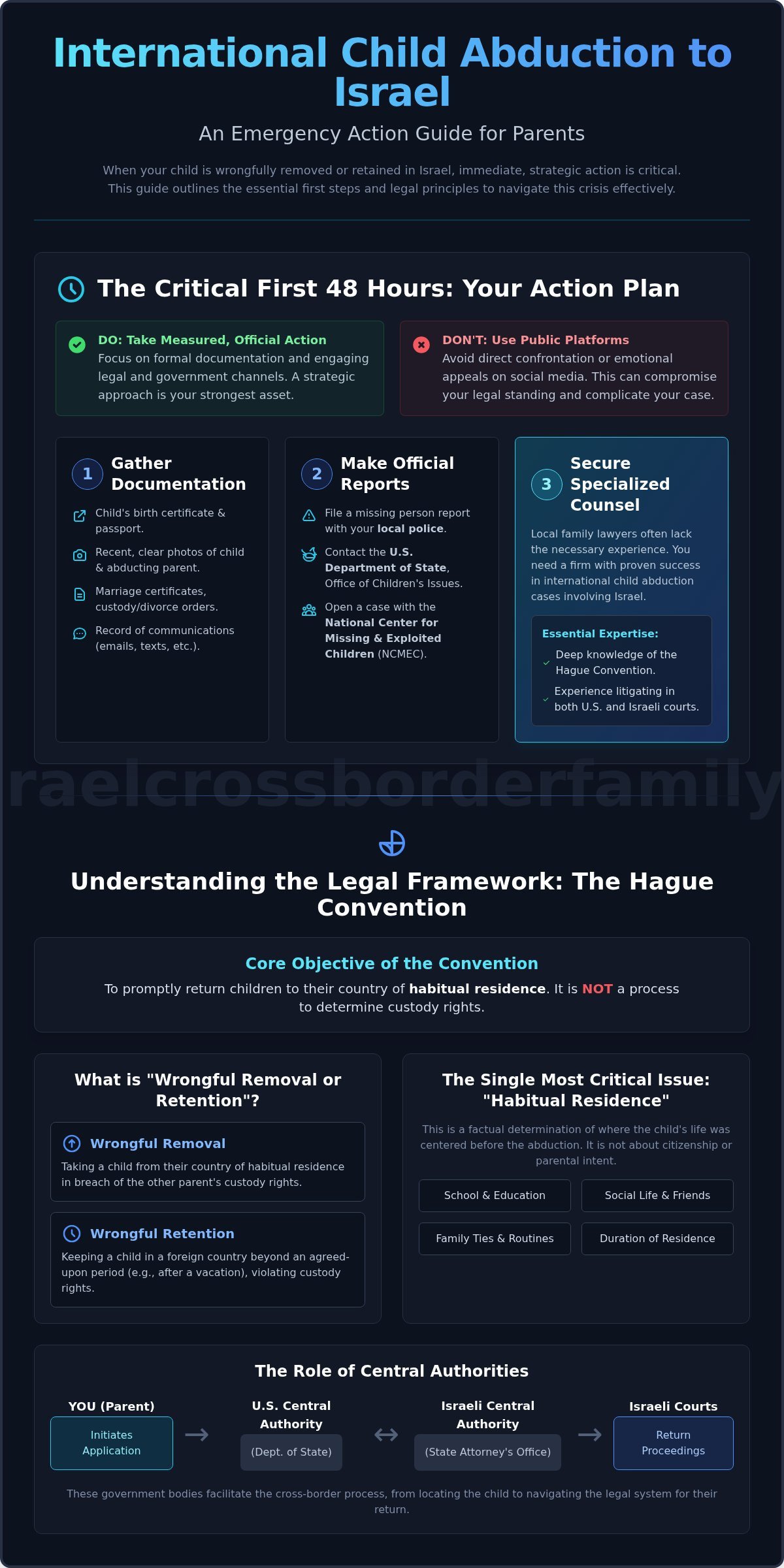
In the event of an international child abduction to Israel, the initial 48 hours represent a critical window for action. The steps you take during this period can profoundly influence the trajectory and ultimate outcome of your case. It is imperative to approach this crisis with a strategic and measured response, focusing on official documentation and legal channels rather than direct confrontation or emotional appeals on public platforms like social media, which can inadvertently compromise your legal standing. Your primary objective is to formally establish a record of the wrongful removal and initiate the complex legal process for your child’s return. For a deeper understanding of the immediate legal landscape, we recommend the following overview:
Step 1: Gather Critical Documentation
Your ability to act swiftly and effectively rests on the foundation of comprehensive documentation. Before you can initiate any formal proceedings, you must compile an evidentiary file. This collection of documents serves as the official proof of your parental rights and the circumstances of the abduction. Organize these materials meticulously for your legal counsel and official authorities.
- Copies of your child’s birth certificate and passport.
- Recent, clear photographs of your child and the abducting parent.
- Your marriage certificate and any pre-existing court orders concerning custody or divorce.
- A complete record of all recent communications (emails, text messages, social media messages) with the other parent that may indicate intent or location.
Step 2: Make Official Reports
Simultaneously, you must engage the proper authorities to create an official, time-stamped record of the abduction. This is not merely a procedural formality; it activates multi-jurisdictional government resources dedicated to these complex cases. Immediately contact the following agencies to file formal reports and open case files:
- Your local police or law enforcement department to file a missing person report.
- The U.S. Department of State, Office of Children’s Issues.
- The National Center for Missing & Exploited Children (NCMEC).
Step 3: Secure Specialized Legal Counsel
Do not delay in seeking professional guidance. The complexities of international law require immediate and specialized expertise; your local family lawyer, while well-intentioned, will likely lack the specific cross-border experience necessary for these matters. You require dedicated legal help for child abduction to Israel from a firm with a proven record of successfully navigating these sensitive cases. Your legal team must possess a deep understanding of the Hague Convention on the Civil Aspects of International Child Abduction, the primary international treaty governing these situations, and have established experience litigating within both the U.S. and Israeli legal systems.
Understanding the Legal Framework: The Hague Convention
When a child is taken across international borders without permission, the primary legal instrument governing their return is the Hague Convention on the Civil Aspects of International Child Abduction. This multi-jurisdictional treaty provides a streamlined civil remedy for parents seeking the prompt return of their children. As both the United States and Israel are signatories, the Convention establishes a clear, cooperative protocol between the two nations. Its core objective is not to settle custody disputes but to restore the pre-abduction status quo by returning the child to their country of habitual residence, allowing the courts of that country to make custody determinations. Understanding this treaty is fundamental to obtaining effective legal help for child abduction to Israel.
What is ‘Wrongful Removal or Retention’?
The Hague Convention specifically addresses actions defined as “wrongful removal or retention.” This legal term refers to a breach of custody rights under the law of the country where the child was habitually resident immediately before the event. The distinction is critical:
- Wrongful Removal: This involves taking a child from their country of habitual residence in breach of the other parent’s or guardian’s custody rights.
- Wrongful Retention: This occurs when a child is kept in a foreign country beyond an agreed-upon period, such as at the end of a vacation or family visit, thereby violating custody rights.
The Concept of ‘Habitual Residence’
The determination of the child’s “habitual residence” is the single most critical issue in a Hague Convention case. This term refers to the country where the child’s life was centered and established before the wrongful removal or retention occurred. It is a factual determination, not a legal one based on citizenship or parental intent alone. Courts will examine various factors to establish this, including the child’s school and social life, family ties, and the duration and stability of their life in that country. The case’s success often hinges on demonstrating that the child’s habitual residence was, in fact, the country from which they were taken.
The Role of Central Authorities
To facilitate the complex cross-border process, each signatory country designates a Central Authority to manage Hague Convention applications. These governmental bodies act as the primary point of contact, assisting with locating the child, encouraging amicable resolutions, and navigating the legal system. In the United States, this is the Department of State’s Office of Children’s Issues. In Israel, this function is managed by the International Department of the State Attorney’s Office, which provides comprehensive guidelines as detailed by the Israeli Ministry of Justice – Child Abduction. These authorities work in tandem to ensure applications are processed correctly and legal proceedings are initiated efficiently.
The Hague Convention Legal Process in Israel
Israel’s judiciary treats international child abduction with exceptional urgency, as mandated by its deep commitment to the Hague Convention. When you secure legal help for child abduction to Israel, you engage a system designed for swift resolution. By law, proceedings for the return of a child are typically concluded within six weeks from the date of filing. These complex cases are not heard in a general court; instead, they are assigned to a specialized Family Court judge with significant experience in multi-jurisdictional family law. The court’s focus is deliberately narrow and highly specific: its sole objective is to determine whether the child was wrongfully removed from their country of habitual residence and should be promptly returned. Broader disputes regarding custody or parental rights are deferred to the courts of that original jurisdiction.
Filing the Application for Return
The process commences when your legal counsel files a formal application for return with the designated Israeli Family Court. This comprehensive petition includes your sworn affidavit detailing the facts of the abduction, substantial evidence establishing the child’s habitual residence (such as school or medical records), and robust legal arguments grounded in the articles of the Hague Convention. Upon receipt, the court acts immediately, often issuing ex-parte orders to locate the child and the abducting parent and to prevent the child from being removed from Israel.
The Court Hearing
The court hearing is an expedited proceeding, concentrating exclusively on the legal criteria established by the Hague Convention. The judge will not entertain arguments about which parent is “better” or what long-term custody arrangement is in the child’s best interests. Both parents are generally required to provide testimony, and the judge’s primary determination is to establish the child’s habitual residence immediately prior to their removal or retention. This singular focus ensures a rapid and efficient judicial review.
Potential Outcomes and Enforcement
The culmination of the legal process typically results in one of two primary outcomes. It is critical to understand the robust enforcement mechanisms available in Israel.
- Order of Return: For a valid claim where wrongful removal is established, this is the most common and anticipated outcome. The court will order the immediate return of the child to their country of habitual residence.
- Denial of Return: In rare circumstances, the court may deny the return if the abducting parent successfully proves one of the Convention’s limited defenses, such as a grave risk of physical or psychological harm to the child upon return.
If a return order is granted and not voluntarily complied with, Israeli enforcement authorities, including the police and the Execution Office (Hotzaa L’Poal), provide robust assistance to ensure the court’s mandate is carried out effectively and the child is safely returned. [ Download ](https://getautoseo.com/screenshots/getautoseocom_1769392074_HX2GJ6Wx.jpg) Feedback & Recreate Delete 
Common Defenses Raised in Abduction Cases
While the Hague Convention on the Civil Aspects of International Child Abduction mandates the prompt return of a wrongfully removed child, the abducting parent is permitted to raise a limited number of specific defenses. It is crucial to understand that these defenses are interpreted very narrowly by Israeli courts, and the burden of proof rests entirely on the parent opposing the return. The judicial system in Israel maintains a strong presumption in favor of returning the child to their country of habitual residence. Navigating these complex legal arguments requires a sophisticated understanding of both international and Israeli family law. An experienced attorney can anticipate these defenses, challenge the opposing party’s evidence, and build a compelling case for your child’s immediate return. Securing expert legal help for child abduction to Israel is the first step in effectively countering these claims.
Defense 1: Grave Risk of Harm
The most frequently cited defense is that returning the child would expose them to a “grave risk of physical or psychological harm or otherwise place the child in an intolerable situation.” However, this is an exceptionally high standard to meet. The court requires clear and convincing evidence of a serious, imminent danger, not mere speculation or inconvenience. Arguments that are typically deemed insufficient include:
- Economic hardship or a lower standard of living in the home country.
- Changes to the child’s educational or social environment.
- The left-behind parent’s new partner or lifestyle, absent evidence of direct harm.
Defense 2: The Child’s Objection
If a child has attained a certain age and degree of maturity, the court may consider their objection to being returned. There is no specific age threshold in Israel; the court assesses each child individually. The judge must be convinced that the child’s views are independent and not the result of undue influence or coaching by the abducting parent. A court-appointed psychological expert is often utilized to evaluate the child’s maturity and the authenticity of their stated wishes.
Defense 3: Consent or Acquiescence
This defense argues that the left-behind parent either consented to the removal or subsequently acquiesced to it. To prove consent, the abducting parent must present clear and unambiguous evidence that the other parent agreed to the child’s permanent relocation before it occurred. Acquiescence can be argued if the left-behind parent significantly delayed taking legal action after becoming aware of the abduction, thereby implying acceptance. This underscores the critical importance of acting swiftly to protect your parental rights. Successfully refuting these defenses demands a proactive and strategic legal approach. For comprehensive guidance and representation, contact our legal team to discuss the specifics of your case.
Why You Need a Specialized US-Israel Cross-Border Lawyer
Successfully navigating an international child abduction case is a complex, multi-jurisdictional challenge that falls far outside the scope of standard family law. The expedited nature of Hague Convention proceedings demands immediate, precise, and strategically sound legal action. In these high-stakes situations, the selection of your legal counsel is the single most critical decision you will make. Engaging a lawyer without specific cross-border experience is a significant risk when your child’s return is on the line. An attorney specializing in this sophisticated field understands that this is not merely a custody dispute; it is a legal emergency governed by international treaties and the distinct legal cultures of two sovereign nations. This is why specialized legal help for child abduction to Israel is not a luxury, but a necessity.
Expertise in Both Jurisdictions
A true US-Israel cross-border firm provides a seamless legal bridge. Our attorneys possess a deep, nuanced understanding of both U.S. custody law and the unique procedures of Israeli family courts. This dual qualification allows for effective coordination with authorities in both nations and provides invaluable insight into the specific judges who typically preside over Hague Convention cases in Israel, enabling a legal strategy tailored to their judicial temperament and precedents.
Strategic Case Management
The velocity of a Hague case leaves no room for error or delay. A specialized legal team excels at proactive case management, from rapidly assembling the critical evidence of habitual residence to anticipating and systematically refuting common defenses raised by the abducting parent, such as allegations of grave risk. We provide sophisticated counsel, guiding you on every action and communication to ensure your legal position is consistently strengthened throughout the proceedings.
Access to an Essential Network
Effective representation extends beyond legal filings and courtroom advocacy. Our firm maintains an essential network of professionals on the ground in Israel, a critical component for building a comprehensive and compelling case for your child’s return. This network includes:
- Private Investigators to quickly and discreetly locate a child and abducting parent.
- Child Psychologists and Social Workers who can provide expert evaluations and testimony for the court.
- Established Communication Channels with the Israeli Central Authority and other relevant government bodies.
Protecting your parental rights and securing your child’s future requires a legal team with proven experience in this precise field. Contact our firm for an urgent consultation on your case.
Securing Your Child’s Return: Strategic Legal Action is Paramount
Navigating the complexities of an international child abduction requires immediate, decisive action and a profound understanding of the Hague Convention as it is applied within the Israeli legal system. The initial hours are critical for establishing your case, and successfully countering the common defenses raised in Israeli courts demands a sophisticated and proactive legal strategy from the very beginning. Remember, time is of the essence, and the right legal guidance can fundamentally alter the outcome. When you need immediate legal help for child abduction to israel, engaging a firm with a demonstrable command of this multi-jurisdictional landscape is not merely an advantage-it is a necessity. Our firm provides a distinct strategic edge with a team of dual-qualified attorneys in both the U.S. and Israel, who possess a proven track record in successfully litigating Hague Convention return applications. With fully-staffed offices in Tel Aviv and New York, we offer seamless, on-the-ground representation to guide you through this challenging process with authority and care. For immediate assistance with a child abduction to Israel, contact our experienced legal team now. The path to reunification is complex, but with the right, experienced counsel by your side, a positive resolution is achievable.
Frequently Asked Questions
How long does an international child abduction case take in Israel?
Proceedings under the Hague Convention are designed for swift resolution, yet the timeline for a complex cross-border case in Israel can vary. While an initial hearing is often scheduled within weeks, the entire process, including potential appeals to the District Court and Supreme Court, can extend from several months to over a year. Factors such as judicial availability and the complexity of evidence presented significantly influence the ultimate duration of these multi-jurisdictional legal actions.
Can the abducting parent be criminally charged?
Yes, the abducting parent may face criminal charges in addition to the civil proceedings for the child’s return under the Hague Convention. Both the United States and Israel have domestic laws criminalizing parental kidnapping. These criminal actions are pursued by state prosecutors and are entirely separate from our primary objective of securing your child’s prompt return. Our firm focuses on the civil return mechanism while advising on the potential implications of parallel criminal investigations.
What happens to custody orders after my child is returned to the U.S.?
The primary objective of a Hague Convention case is to return the child to their country of habitual residence, thereby restoring the original jurisdiction. Upon your child’s successful return to the United States, the U.S. court that issued the initial custody orders will resume its authority. That court is the proper forum for enforcing the existing order, addressing any violations that occurred, and adjudicating any motions to modify custody arrangements going forward.
Will I have to travel to Israel for the court hearings?
While not legally mandated in every instance, it is profoundly advisable for the left-behind parent to travel to Israel for key court hearings. Your physical presence and direct testimony can be a powerful and persuasive element before the Israeli family court. Our bicultural legal team, with professionals on the ground in Israel, can represent you in all matters, but we strategically guide clients on when their personal attendance is critical to achieving a successful outcome in the litigation.
Can I prevent my child from being taken to Israel if I fear an abduction?
Proactive legal measures are essential to prevent a feared abduction. If you have a credible fear, you should immediately seek experienced legal help for child abduction to Israel to obtain a court order explicitly prohibiting the child’s removal from the U.S. and requiring the surrender of the child’s passports. Additionally, we advise clients to enroll their child in the U.S. State Department’s Children’s Passport Issuance Alert Program to prevent a new passport from being issued without consent.
How are legal fees handled in a Hague Convention case?
In Hague Convention litigation, each party is generally responsible for their own legal fees. However, Israeli law provides a mechanism for the court to order the wrongful remover to reimburse the petitioner’s costs, including legal fees and travel expenses. Legal representation in these complex matters typically requires a retainer, with initial costs often ranging from ₪20,000 to ₪50,000, and we provide a detailed fee structure upon engagement to ensure full transparency for our clients.

Article by
Gabriel Lior
A Personal Journey That Became a Mission The advisory was founded by an American father Gabriel Lior, LLB, MBA , global entrepreneur, and cross-border advisor who spent more than a decade navigating the Israeli family court system firsthand and now lives in Singapore with his son.
As a divorced parent in a cross-border family, Gabriel faced nearly every legal challenge a foreign parent can encounter in Israel — including child custody disputes, child support proceedings, property matters in Israel and abroad, false accusations, and complex immigration and relocation proceedings. Over the years, he learned the hard way how difficult it is for non-Israeli parents to understand the system, identify the right legal strategy, and choose the right legal representation — especially when language, culture, and jurisdictional differences are involved. He also witnessed how foreign parents and new immigrants are often disadvantaged or taken advantage of by service providers and institutions simply because they lack local knowledge or fluency. From Client to Advisor To truly understand — and survive — the system, Gabriel pursued formal legal education in Israel, completing two Israeli law degrees, alongside a BA and MBA earned in the United States. This was never about becoming a practicing attorney, but about gaining a deep, structural understanding of how the system works — and where it breaks down for foreign parents. This rare combination of: Firsthand client experience Israeli legal and US business education International business and negotiation training Decades of commercial execution created a unique perspective – one that understands both sides of the table. After years of litigation, persistence, and at times self-representation, he ultimately succeeded in securing custody of his son and relocating abroad through a rare legal victory in the Israeli Supreme Court — becoming one of the first fathers in Israel to do so under these circumstances.
Disclaimer
Important Disclaimer: The information provided on this website and in its content is for general informational and educational purposes only and does not constitute legal advice, legal opinion, or legal representation. Gabriel Lior is not licensed to practice law in Israel (nor is he interested in doing so) and does not provide legal services, despite having completed 2 Law Degrees. The services offered are advisory in nature and are intended to provide general guidance, strategic insight, and information regarding cross-border family law considerations. No attorney-client relationship is formed by accessing this website, reading its content, or communicating with us. Any decisions made based on this information are at your own discretion and risk. For legal advice specific to your situation, you should consult a licensed attorney in the relevant jurisdiction. Where appropriate, we may refer clients to independent, licensed attorneys or professionals. Such referrals do not constitute legal representation and no liability is assumed for services provided by third parties.