For entrepreneurs and executives with deep ties to both the United States and Israel, the prospect of divorce raises a uniquely complex and significant challenge. The critical question of protecting your US business in an Israeli divorce involves navigating a multi-jurisdictional labyrinth where corporate structures understood in Delaware may be interpreted very differently in a Tel Aviv family court. This uncertainty can jeopardize not only your ownership and control but the very continuity of the enterprise you have painstakingly built, creating a substantial risk of asset liquidation or forced division.
This strategic guide is engineered to provide clarity and a decisive path forward. We will dissect the sophisticated interplay between US corporate law and Israeli family law, outlining the essential legal strategies required to shield your company’s assets, preserve its valuation, and secure your ownership interest. You will gain a comprehensive understanding of the legal risks and discover actionable steps to ensure your commercial assets are properly classified and protected, allowing you to navigate this complex personal transition with confidence and commercial stability.
Jurisdiction: Why Your US Business is Subject to Israeli Divorce Law
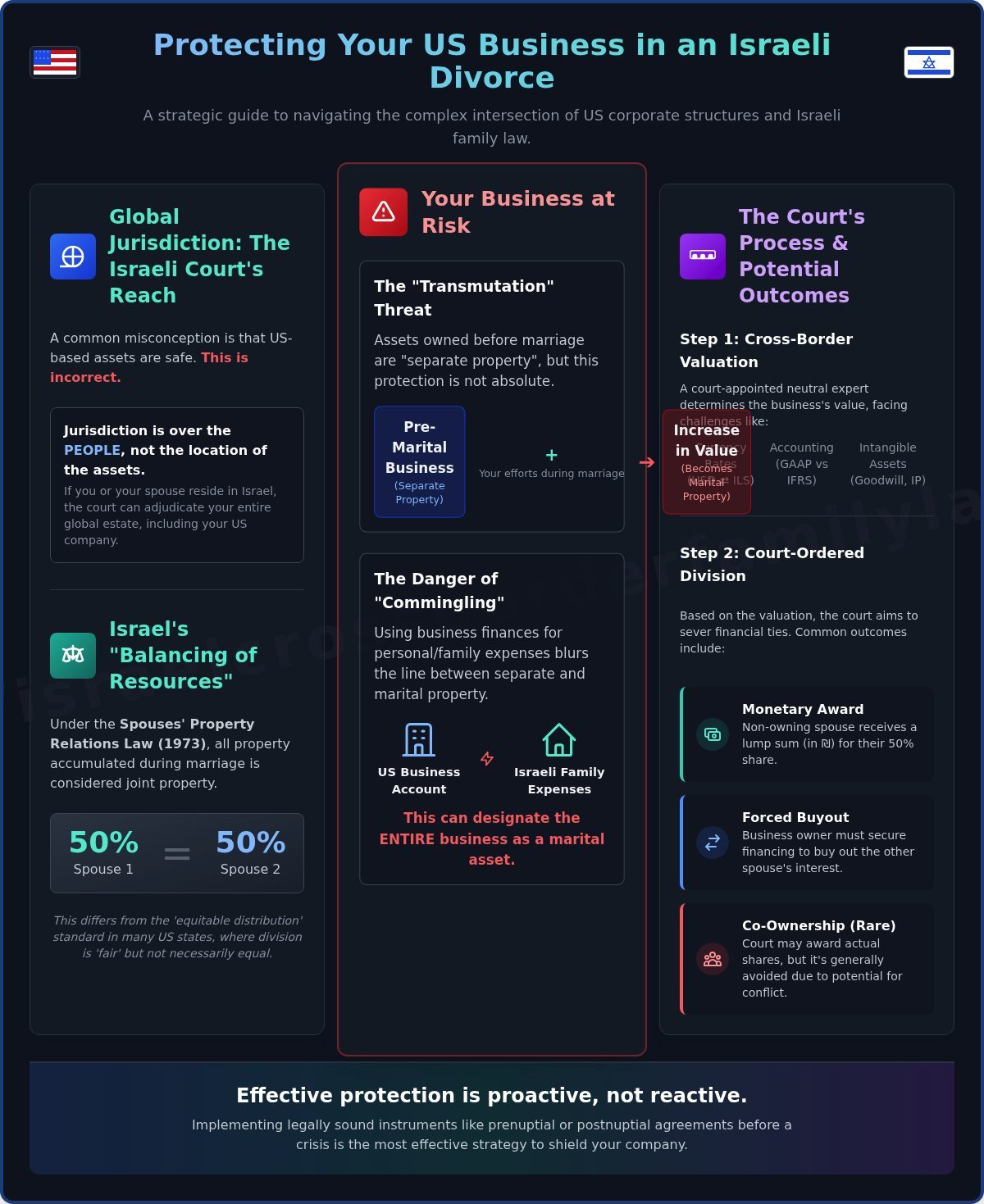
A common, and costly, misconception among US business owners facing divorce in Israel is that their American-based assets are beyond the reach of Israeli courts. This assumption is fundamentally incorrect. The jurisdiction of the Israeli family court is established over the divorcing individuals, not the physical location of their assets. Consequently, if you or your spouse reside in Israel and meet the residency requirements for divorce, the court possesses the authority to adjudicate your entire global estate, including your US-domiciled business interests.
For a foundational understanding of the principles involved in safeguarding business assets during a divorce, the following overview is highly instructive:
Israel’s Spouses’ Property Relations Law (1973) underpins this global reach, mandating that all property accumulated by either spouse during the marriage is considered joint property, subject to division. This multi-jurisdictional approach makes understanding the legal framework a critical first step in the complex process of protecting us business in israeli divorce. Ignoring a summons or order from an Israeli court regarding your US business can lead to severe consequences, including default judgments and international enforcement actions.
The Principle of Community Property in Israel
The Israeli legal system applies a concept known as the ‘balancing of resources’ upon the dissolution of a marriage. This is a form of community property regime where all assets and rights accumulated during the marital period are pooled and divided equally. This includes business shares, retained earnings, and any appreciation in the company’s value during the marriage. This differs significantly from the ‘equitable distribution’ standard in many US states, where a judge divides assets ‘fairly’ but not necessarily equally. A deeper understanding of these division of property principles is essential for any cross-border case.
Distinguishing Between Marital and Separate Property
While assets owned before the marriage, or received as gifts or inheritance during it, are generally classified as separate property, this protection is not absolute. The critical exception arises when separate property, such as a pre-marital business, appreciates in value due to the efforts of either spouse during the marriage. If you actively managed and grew your US business while married, Israeli courts will likely deem that growth-the increase in value-as marital property subject to the balancing of resources. This transmutation of separate assets into the marital estate represents a significant financial risk.
Business Valuation and Asset Division: The Israeli Court’s Process
When a US-domiciled business becomes a focal point in an Israeli divorce, the Family Court’s primary objective is to achieve an equitable distribution of marital assets. The process begins with a meticulous valuation, typically conducted by a court-appointed, neutral expert-such as a certified accountant or business valuator. This expert’s report carries significant weight. However, the multi-jurisdictional nature of the asset introduces profound complexities, making a strategic legal approach essential for protecting us business in israeli divorce proceedings.
The Cross-Border Valuation Challenge
The valuation of a US entity from Israel is fraught with challenges. The expert must navigate fluctuating currency exchange rates (USD to ILS), reconcile disparate accounting standards (e.g., US GAAP vs. Israeli IFRS), and assess market conditions in a foreign jurisdiction. Furthermore, valuing intangible assets like brand goodwill or proprietary intellectual property, which may constitute the bulk of a tech start-up’s value, requires sophisticated, dual-market expertise to arrive at a figure the Israeli court will accept.
Risk of ‘Commingling’ Personal and Business Finances
A significant vulnerability arises from the ‘commingling’ of finances. Using a US business account to pay for personal family expenses in Israel-such as school fees or household bills-blurs the critical line between separate and marital property. This practice can give the non-owning spouse a powerful argument that the entire business should be considered a marital asset. Maintaining immaculate, transparent bookkeeping is not merely good practice; it is a fundamental defensive measure.
Potential Court-Ordered Outcomes for the Business
The Israeli court will typically aim to sever financial ties to prevent future conflict between the parties post-divorce. Based on the expert valuation, the most common outcomes for the business include:
- Monetary Award: The non-owning spouse is awarded a lump sum, often in Israeli Shekels (₪), equivalent to their share (typically 50%) of the determined business value.
- Forced Buyout: The business-owning spouse is ordered to buy out the other’s interest. This often requires the business owner to secure significant financing to pay the monetary award mandated by the court.
- Co-Ownership (Rare): In exceptional circumstances, a court might award the non-owning spouse actual shares or equity in the US company. This outcome is generally avoided due to the high potential for ongoing disputes and operational deadlock.
Proactive Legal Strategies to Shield Your US Company
Effective asset protection is not a reaction to crisis but the result of strategic foresight. For owners of US-based companies facing the complexities of Israeli family law, implementing legally sound instruments before or during the marriage is paramount. The successful strategy for protecting us business in israeli divorce hinges on a multi-layered approach. This section outlines the core defensive mechanisms, focusing on instruments structured to be recognized and enforced by Israeli courts.
Drafting an Enforceable US-Israel Prenuptial or Postnuptial Agreement
This is the single most powerful tool for asset segregation. For a cross-border prenuptial or postnuptial agreement to be upheld in Israel, it must meet stringent criteria. The agreement requires authentication by an Israeli family court or a notary, confirming that both parties understand its full implications and have entered into it freely. It is imperative that both spouses retain independent, qualified legal counsel to avoid future claims of duress or inadequate disclosure. The agreement must explicitly define the US business, its shares, and its future appreciation as separate property, thereby contractually removing it from the marital estate subject to division.
Strategic Corporate Structuring
Beyond a marital agreement, the very structure of your corporation can serve as a formidable defense. Sophisticated planning can create layers of protection that are difficult to penetrate in a divorce proceeding.
- International Asset Protection Trusts: Transferring business ownership to a properly structured offshore trust can place the assets beyond the direct reach of a divorce proceeding, a complex but highly effective strategy requiring expert multi-jurisdictional advice.
- Buy-Sell Agreements: If the business has multiple partners, a comprehensive buy-sell agreement can restrict the transfer of shares. It can stipulate that shares cannot be transferred to an ex-spouse, instead triggering a buyout at a predetermined valuation, preventing an unwilling party from becoming a business partner.
Meticulous Documentation and Financial Separation
The strength of any claim to separate property lies in the evidence. Meticulous record-keeping is non-negotiable. Begin with a professional valuation of your business at the time of marriage to establish a clear baseline value. Document every capital contribution made to the business from your separate, pre-marital funds to trace its non-marital origins. Critically, maintain separate bank accounts and credit lines for the business and personal life. Commingling funds-using business accounts for household expenses-can fatally weaken the argument that the company is a separate asset. Navigating these multi-jurisdictional complexities requires specialized counsel with deep experience in both US corporate law and Israeli family law.
Navigating the Divorce Process: Key Steps for Business Owners
When a US-based business is involved in an Israeli divorce, the litigation process demands a proactive and meticulously planned strategy. Understanding the key phases of the legal proceedings allows you to anticipate challenges, manage risks, and steer the outcome towards a resolution that preserves your company’s value and operational integrity. A reactive approach can expose your business to significant disruption and financial loss.
Assembling Your Cross-Border Legal Team
Successfully navigating a multi-jurisdictional divorce is impossible with counsel limited to a single country’s laws. An Israeli family lawyer may not grasp the complexities of US corporate structures, while a US attorney will be unequipped for the Israeli court system. Your essential team must include legal counsel with demonstrated expertise in both Israeli family law and US corporate law, alongside forensic accountants to accurately trace assets and business valuation experts to provide a defensible assessment of the company’s worth. Our firm specializes in these complex, multi-jurisdictional cases. Contact us for a consultation.
The Discovery and Disclosure Phase
Be prepared for comprehensive requests for financial information. The Israeli family court system mandates full disclosure of all assets, and this obligation extends to your US business interests. You will be required to produce documents such as:
- Profit and loss statements
- Balance sheets and tax returns
- Shareholder agreements and bank records
It is critical to comply transparently under the guidance of your legal team to protect sensitive commercial data. Any attempt to hide assets or understate value will be viewed harshly by the court, resulting in severe penalties and a loss of credibility that can irrevocably damage your case.
Negotiating a Settlement to Preserve the Business
While preparing for litigation is essential, the most effective strategy for protecting us business in israeli divorce is often a negotiated settlement. A lengthy court battle can be costly, public, and unpredictable. A private settlement offers certainty and control. Creative solutions can be structured to satisfy your spouse’s entitlement without forcing a sale or liquidation of the business. Options include trading other marital assets, such as real estate or investment portfolios, for their share of the business equity, or establishing a structured payout over time funded by future profits. This strategic approach ensures business continuity and safeguards your most valuable asset.
Secure Your US Business and Financial Future
Navigating an Israeli divorce as a US business owner presents a complex, multi-jurisdictional challenge where your enterprise is considered part of the marital estate. This guide has underscored critical realities: the extensive reach of Israeli family courts over foreign assets and the absolute necessity of proactive legal structuring. Ultimately, the strategy for protecting us business in israeli divorce is not a reactive measure but a foundational component of your long-term financial security. This intricate process demands more than standard legal counsel; it requires a firm with deep, integrated expertise in both US corporate structures and Israeli family law. Our proven track record in high-value, international divorce cases is built on a strategic approach designed to preserve business continuity and safeguard what you have built.
Frequently Asked Questions: Navigating US Business Interests in Israeli Divorce Proceedings
Can an Israeli court force my US business partner to sell their shares?
An Israeli family court’s jurisdiction is generally limited to the divorcing parties. It cannot directly compel a third-party US business partner, who is not a party to the litigation, to sell their shares. However, the court will value your interest in the US entity and can order you to compensate your spouse for their portion of that value. This may indirectly create financial pressure to liquidate assets, making strategic corporate structuring and shareholder agreements critical components in any cross-border divorce.
Is my US prenuptial agreement automatically valid in an Israeli divorce?
No, a US prenuptial agreement is not automatically enforceable in Israel. For a foreign agreement to be recognized, it must be validated by an Israeli court or an authorized Israeli notary, in accordance with Israel’s Spouses’ Property Relations Law. Without this crucial step, the court is likely to disregard the agreement and apply Israeli community property principles. Proactive validation by experienced multi-jurisdictional counsel is essential for ensuring your prenuptial agreement serves its intended protective purpose.
What happens if my business was a gift from my family before the marriage?
Assets received as a gift or inheritance before the marriage are typically considered separate property under Israeli law and are not subject to division. However, this protection can be compromised if the asset becomes intermingled with marital property or if your spouse contributes significantly to its growth and maintenance during the marriage. Meticulous documentation and maintaining clear financial separation are paramount to preserving the separate character of such a pre-marital asset in a complex divorce proceeding.
How is the ‘goodwill’ of my US professional practice valued in Israel?
In Israel, the goodwill of a professional practice, such as a medical or legal firm, is a divisible marital asset. Israeli courts appoint financial experts who employ sophisticated valuation methodologies, often including excess earnings or capitalization of future income streams, to quantify this intangible asset in shekels. The valuation, which can amount to significant sums, will be based on your professional reputation, client base, and projected future earnings, all of which are subject to rigorous cross-examination.
Can my spouse claim a stake in my US startup’s unvested stock options?
Yes, unvested stock options granted during the marriage are frequently considered marital property in Israel, subject to a time-rule formula for division. The court will determine the portion of the options attributable to the marital partnership, even if they vest post-divorce. Effectively protecting your US business in an Israeli divorce necessitates a sophisticated approach to valuing and dividing these future-contingent assets, a common challenge in complex “start-up nation” dissolutions.
What immediate steps should I take if I suspect my spouse is planning to file for divorce in Israel?
If you anticipate a divorce filing in Israel, immediate strategic action is critical. You must engage experienced cross-border legal counsel to secure your assets and gather essential financial documentation for your US business, including incorporation documents, shareholder agreements, and financial statements. It is also vital to avoid transferring assets or making significant financial changes that could be viewed by the court as an attempt to conceal marital property, which can have severe legal repercussions.

Article by
Gabriel Lior
A Personal Journey That Became a Mission
The advisory was founded by an American father Gabriel Lior, LLB, MBA , global entrepreneur, and cross-border advisor who spent more than a decade navigating the Israeli family court system firsthand and now lives in Singapore with his son.
As a divorced parent in a cross-border family, Gabriel faced nearly every legal challenge a foreign parent can encounter in Israel — including child custody disputes, child support proceedings, property matters in Israel and abroad, false accusations, and complex immigration and relocation proceedings.
Over the years, he learned the hard way how difficult it is for non-Israeli parents to understand the system, identify the right legal strategy, and choose the right legal representation — especially when language, culture, and jurisdictional differences are involved. He also witnessed how foreign parents and new immigrants are often disadvantaged or taken advantage of by service providers and institutions simply because they lack local knowledge or fluency.
From Client to Advisor
To truly understand — and survive — the system, Gabriel pursued formal legal education in Israel, completing two Israeli law degrees, alongside a BA and MBA earned in the United States. This was never about becoming a practicing attorney, but about gaining a deep, structural understanding of how the system works — and where it breaks down for foreign parents.
This rare combination of:
Firsthand client experience
Israeli legal and US business education
International business and negotiation training
Decades of commercial execution
created a unique perspective – one that understands both sides of the table.
After years of litigation, persistence, and at times self-representation, he ultimately succeeded in securing custody of his son and relocating abroad through a rare legal victory in the Israeli Supreme Court — becoming one of the first fathers in Israel to do so under these circumstances.
Disclaimer
Important Disclaimer:
The information provided on this website and in its content is for general informational and educational purposes only and does not constitute legal advice, legal opinion, or legal representation.
Gabriel Lior is not licensed to practice law in Israel (nor is he interested in doing so) and does not provide legal services, despite having completed 2 Law Degrees. The services offered are advisory in nature and are intended to provide general guidance, strategic insight, and information regarding cross-border family law considerations.
No attorney-client relationship is formed by accessing this website, reading its content, or communicating with us.
Any decisions made based on this information are at your own discretion and risk. For legal advice specific to your situation, you should consult a licensed attorney in the relevant jurisdiction.
Where appropriate, we may refer clients to independent, licensed attorneys or professionals. Such referrals do not constitute legal representation and no liability is assumed for services provided by third parties.