When a marriage with deep connections to both the United States and Israel dissolves, it introduces a sophisticated layer of multi-jurisdictional complexity. The prospect of a spouse concealing property overseas, profound uncertainty over which nation’s laws will govern the proceedings, and the risk of a foreign judgment being ignored are not merely theoretical concerns-they are immediate threats to your financial stability. In this high-stakes environment, the central objective becomes how to secure my assets in a cross-border divorce with legal precision and foresight. This comprehensive guide is engineered to replace that uncertainty with strategic clarity. We provide an authoritative framework for navigating the intricate legal systems of both the U.S. and Israel, delivering actionable strategies to identify, value, and protect your international holdings. You will gain a decisive understanding of the process, learn proactive measures to prevent asset dissipation, and be equipped with the knowledge to achieve a fair and, critically, an enforceable financial settlement.
The First Critical Question: Which Country Has Jurisdiction?
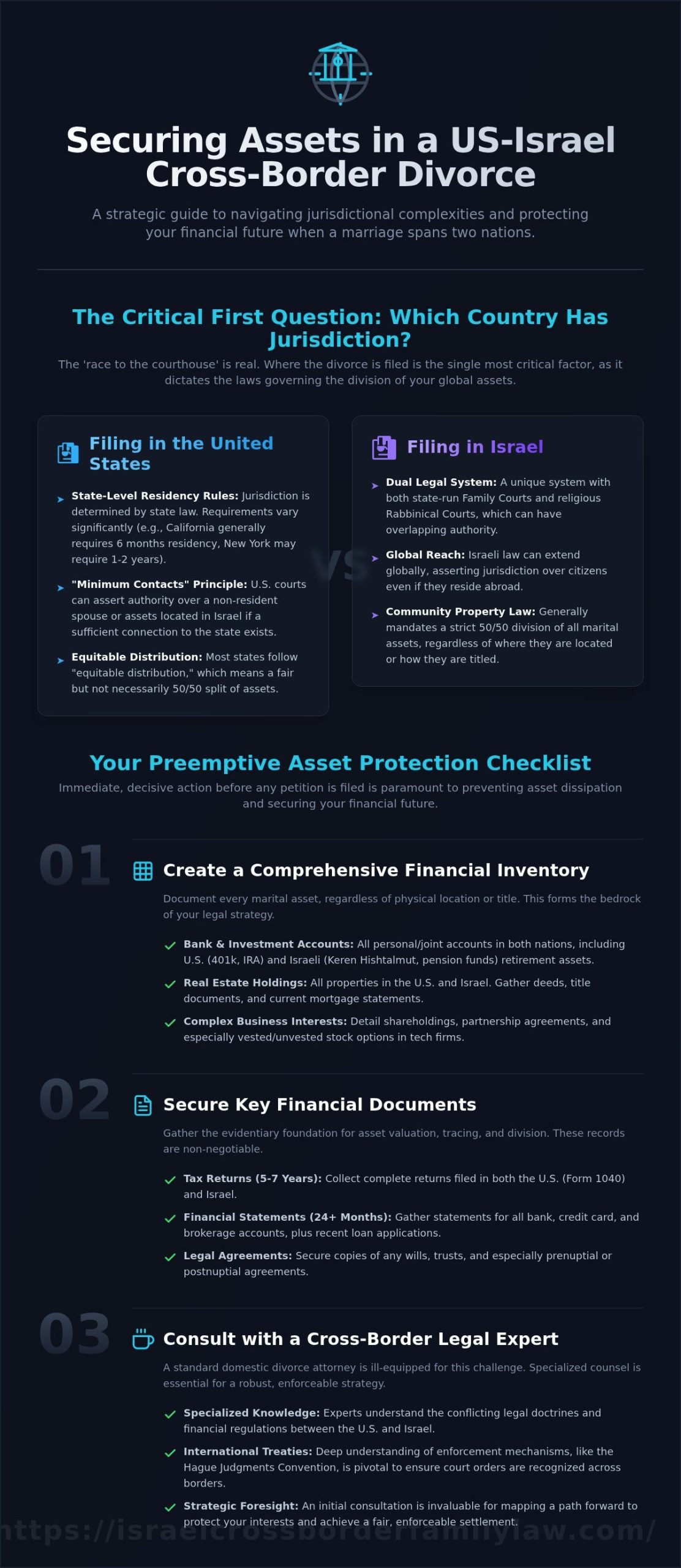
In any complex, multi-jurisdictional marital dissolution involving the United States and Israel, the foundational question is not what will be divided, but where the division will be adjudicated. The determination of jurisdiction-which country’s courts have the legal authority to hear your case-is the single most critical factor that will influence the outcome of your divorce and the ultimate distribution of your global assets. This initial decision sets the stage for all subsequent proceedings, from property division to spousal and child support. To better understand the core principles of asset protection in divorce, the following overview provides valuable context:
Determining Jurisdiction in the United States
In the U.S., jurisdiction for divorce is determined at the state level, with each state imposing its own residency requirements. For example, California generally requires a party to have resided in the state for six months, while New York may require one to two years. U.S. courts also apply the “minimum contacts” principle to assert authority over a non-resident spouse or assets held abroad, including in Israel, provided there is a sufficient connection to the state. A U.S. court can, and often will, issue orders affecting property located internationally.
Establishing Jurisdiction in Israel
Israel presents a unique dual-system jurisdiction with both state-run Family Courts and religious Rabbinical Courts. Israeli law can extend its reach globally, often asserting jurisdiction over its citizens even if they reside abroad. This is profoundly significant due to Israel’s community property laws, which generally mandate a 50/50 division of all marital assets, irrespective of where they are located. Navigating these overlapping legal frameworks requires a deep understanding of the principles of Conflict of laws to determine which jurisdiction’s rules will ultimately prevail.
The ‘Race to the Courthouse’ and Its Consequences
The stark differences between U.S. and Israeli law often create a “race to the courthouse.” The spouse who files first can potentially lock the case into the jurisdiction more favorable to their financial interests-a strategy known as ‘forum shopping.’ The financial outcome of a divorce adjudicated in a U.S. state versus an Israeli court can differ dramatically. To effectively secure my assets in a cross-border divorce, obtaining immediate, sophisticated legal counsel before any petition is filed is not just advisable; it is imperative.
Immediate Proactive Steps to Safeguard Your International Assets
When navigating the complexities of a multi-jurisdictional marital dissolution, the most critical actions are often taken before any legal papers are filed. To effectively secure my assets in a cross-border divorce, one must adopt a strategic and preemptive approach. Delay can result in the obfuscation or transfer of assets across borders, creating significant legal and financial hurdles. Taking immediate, decisive action is paramount to protecting your financial future.
Create a Comprehensive Financial Inventory
A meticulously detailed financial inventory forms the bedrock of your legal strategy. This comprehensive document must account for all marital property, irrespective of its physical location or the jurisdiction under which it is titled. This inventory should include:
- All personal and joint bank accounts held in both the United States and Israel, including investment portfolios and retirement funds such as 401(k)s, IRAs, and Israeli Keren Hishtalmut or pension funds.
- All real estate holdings, complete with copies of deeds, title documents, and current mortgage statements for properties in both countries.
- Complex business interests, detailing shareholdings in private companies, partnership agreements, and particularly, vested and unvested stock options in “start-up nation” technology firms.
Secure Key Financial Documents
Concurrent with inventory creation is the critical task of gathering and securing essential financial documentation. These records provide the evidentiary foundation for asset valuation, tracing, and division. It is imperative to collect:
- Complete tax returns filed in both the U.S. (Form 1040) and Israel for the last five to seven years.
- At least 24 months of statements for all bank accounts, credit cards, and brokerage accounts, along with any recent loan or mortgage applications.
- Copies of any existing wills, trust agreements, and critically, any prenuptial or postnuptial agreements that may govern asset distribution.
Consult with a Cross-Border Legal Expert
A standard domestic divorce attorney is often ill-equipped to handle the sophisticated challenges of international asset division. The conflicting legal doctrines and financial regulations between jurisdictions demand specialized counsel. An expert in this field possesses a deep understanding of international treaties and enforcement mechanisms, such as the Hague Judgments Convention, which are pivotal for ensuring court orders are recognized across borders. This foresight is essential for developing a robust legal strategy. An initial consultation is invaluable for mapping a path forward to protect your interests. Understand your options with a Confidential Case Review.
Legal Tools to Prevent Asset Dissipation in US & Israeli Courts
When navigating a multi-jurisdictional divorce, a primary concern is preventing asset dissipation-the unilateral selling, transferring, encumbering, or hiding of marital assets by one spouse to prevent their fair division. The risk of capital flight is significantly heightened in international cases, a challenge often discussed in analyses of Divorces Involving Dual Citizenship. To effectively secure my assets in a cross-border divorce, it is imperative to take swift and decisive legal action. Both the United States and Israeli legal systems provide robust mechanisms to freeze assets early in the proceedings, ensuring the marital estate remains intact pending a final resolution.
Freezing Orders in the United States
In many U.S. states, including California, the filing of a divorce petition automatically triggers Automatic Temporary Restraining Orders (ATROs). These orders immediately prohibit both parties from making extraordinary expenditures or transferring assets without the other party’s consent or a court order. For more targeted protection, our attorneys can file a motion for a preliminary injunction to freeze specific high-value assets, such as bank accounts or real estate, that are at risk. Violating these court-ordered freezes can result in severe penalties, including fines and findings of contempt of court.
Securing Assets Through Israeli Courts
The Israeli family court system offers a powerful tool known as a S’ad Zmani, or temporary relief order. This injunction can be sought on an ex-parte basis (without the other party present) in urgent situations to prevent irreparable harm. A S’ad Zmani can effectively block the sale of property, freeze bank accounts, and halt the transfer of funds or shares. Critically, Israeli courts possess the authority to issue these orders concerning assets held abroad, providing a vital layer of protection for a global marital estate.
The Power of Full Financial Disclosure
A cornerstone of both the U.S. and Israeli family law systems is the requirement for full and frank financial disclosure. This is not merely a procedural formality; it is a mandatory obligation with severe consequences for non-compliance. Our legal teams utilize sophisticated discovery tools, including interrogatories, depositions, and subpoenas, to uncover a complete financial picture. Failing to disclose assets can lead to significant sanctions, an unequal division of assets in favor of the compliant spouse, and potential criminal charges for perjury. A transparent and rigorous approach to discovery is fundamental to protecting your rights. Learn about our approach to complex international divorce cases and how we ensure a thorough accounting of all marital property.
Valuing and Dividing Common US-Israel Cross-Border Assets
Successfully navigating the financial complexities of a US-Israel divorce requires a sophisticated approach to asset valuation and division. To truly secure my assets in a cross-border divorce, one must account for the unique challenges posed by two distinct economies, legal frameworks, and tax regimes. Factors like fluctuating currency exchange rates (USD to ILS) and disparate tax laws can significantly alter the net value of an asset, demanding a meticulous and expert-led analysis. Engaging qualified professionals, such as forensic accountants and certified appraisers with multi-jurisdictional experience, is not a luxury but a necessity. These experts provide the defensible valuations essential for equitable distribution under both Israeli law, which generally presumes equal division of marital property, and the specific community or separate property rules of the relevant US state.
Real Estate: Tel Aviv Apartments & US Homes
Valuing real estate requires certified appraisals in both Israel and the United States. A Tel Aviv apartment valued at ₪6,000,000 and a US home valued at $800,000 are subject to different marital property rules. We analyze whether each asset is marital or separate property, considering factors like the source of funds for purchase and title registration. Issues such as rental income and cross-border capital gains tax implications are critical components of a comprehensive settlement strategy.
Business Interests & Tech Startup Equity
Valuing a privately held business or equity in an Israeli tech startup involves complex methodologies that go beyond simple balance sheets. Our team collaborates with specialists who understand the “startup nation” ecosystem to accurately value stock options, Restricted Stock Units (RSUs), and carried interest. Dividing these future-value assets requires sophisticated legal instruments to protect the interests of both spouses post-divorce, a crucial step to secure my assets in a cross-border divorce.
Retirement and Investment Accounts
Dividing retirement funds across borders presents significant logistical and tax challenges. We are proficient in managing the division of US-based accounts like 401(k)s and IRAs through Qualified Domestic Relations Orders (QDROs), while also navigating the distinct regulations governing Israeli pension funds (Keren Pensia) and provident funds (Kupat Gemel). Properly structuring these divisions is essential to avoid punitive taxes and penalties associated with transferring funds internationally. For expert guidance on these intricate matters, contact our specialized legal team.
Enforcing Court Orders Across Borders: Making Rulings a Reality
A divorce decree is a powerful legal instrument, but its value is contingent upon its enforceability, particularly in a multi-jurisdictional context. Obtaining a favorable judgment for asset division or support is only the first step; the final, critical phase is ensuring that the order is recognized and executed in the country where your ex-spouse or the assets are located. A strategic approach to enforcement is paramount if you are to successfully secure my assets in a cross-border divorce.
The Principle of Comity and Reciprocity
International enforcement is largely governed by the legal principle of comity, where courts in one sovereign nation respect and give effect to the judicial decisions of another. While not absolute, courts in the United States and Israel share a strong history of reciprocity in family law matters. Enforcement of a foreign order may be refused if it violates local public policy or if the original court lacked proper jurisdiction, but these exceptions are narrowly applied, providing a predictable framework for enforcing legitimate rulings between the two countries.
Practical Enforcement Steps
To make a foreign judgment effective, it must be “domesticated” or registered with a local court. This process transforms the foreign decree into a local order with full legal force.
- Enforcing a US Judgment in Israel: A petition is filed with the Israeli Family Court to recognize the US order. Once declared enforceable, it is executed through the Israeli enforcement office (Hotsa’a LaPoal), enabling actions like seizing bank accounts, placing liens on property, or garnishing wages.
- Enforcing an Israeli Decree in the US: An Israeli judgment must be filed with a state court in the US. The process is governed by state-specific statutes, but once domesticated, the Israeli decree is enforceable with the same authority as a local US court order.
Navigating these complex procedures requires sophisticated local counsel in each jurisdiction. Our firm has extensive experience in these matters. See how we handle cross-border support enforcement.
Addressing Non-Compliance by a Spouse
Should a spouse refuse to comply with a court-ordered obligation, decisive legal action is necessary. The primary remedy is to initiate contempt of court proceedings in the jurisdiction where enforcement is sought. Sanctions for contempt can be severe, including substantial daily fines (potentially thousands of shekels), the issuance of a stay of exit order, and, in egregious cases, imprisonment. A skilled legal team with a global reach can effectively pursue a non-compliant spouse, ensuring that court orders are not merely suggestions but binding legal mandates. Successfully enforcing a judgment is the ultimate step to secure my assets in a cross-border divorce and protect your financial future. To discuss your specific enforcement needs, contact our team of cross-border legal experts.
Strategic Asset Protection in Your US-Israel Divorce
Navigating a multi-jurisdictional divorce between the United States and Israel presents a complex web of legal challenges. As this guide has detailed, successfully protecting your financial interests hinges on two critical pillars: establishing jurisdiction early and taking immediate, proactive measures to prevent asset dissipation. The intricate process of valuing international holdings and enforcing judicial orders across borders demands sophisticated legal counsel. The path to successfully secure my assets in a cross-border divorce is paved not with uncertainty, but with decisive, informed action guided by professionals who understand both legal systems intimately. Our firm provides this specialized expertise in US-Israel family law, offering strategic guidance on multi-jurisdictional asset division backed by extensive experience with high-net-worth international divorce cases. To protect what you have built and move forward with clarity, we invite you to Schedule a Confidential Case Review to Discuss Your Asset Protection Strategy. With a dedicated legal partner, you can navigate this challenging period with confidence and secure your financial future.
Frequently Asked Questions
Can my spouse hide assets in Israel to protect them from a US divorce?
While a spouse may attempt to conceal assets in Israel, both US and Israeli courts possess robust legal mechanisms for international discovery and enforcement. Our firm utilizes established legal instruments and our network in Israel to compel disclosure, freeze accounts, and ensure a comprehensive valuation of the global marital estate. Such concealment tactics often result in severe legal and financial penalties for the non-compliant party, making it a high-risk and ill-advised strategy.
Is my US prenuptial agreement valid and enforceable in Israel?
A US prenuptial agreement is not automatically enforceable within the Israeli legal system. For an Israeli court to recognize its validity, the agreement must typically comply with Israeli legal standards, which often require certification by a court or notary at the time of its execution. Our multi-jurisdictional team provides sophisticated counsel on reviewing and domesticating such agreements, advising on the strategic steps required to uphold their terms under Israeli law.
What is the difference between marital/community property and separate property?
Marital or community property generally encompasses all assets, debts, and income acquired by either spouse during the marriage, regardless of whose name is on the title. In contrast, separate property typically includes assets owned by one spouse prior to the marriage, as well as specific inheritances or gifts received by that individual spouse during the marriage. The precise classification is critical as it dictates how the estate is divided under the applicable laws of each jurisdiction.
How much does a cross-border divorce between the US and Israel typically cost?
The cost of a multi-jurisdictional divorce between the US and Israel is highly variable, reflecting the complexity of each case. Legal and expert fees can range from approximately ₪70,000 for more straightforward matters to well over ₪350,000 for contentious litigation involving substantial assets or custody disputes. Key factors influencing the final cost include the level of cooperation between parties, the need for forensic experts, and the scope of litigation required in both countries.
What role does a forensic accountant play in an international divorce?
In a complex international divorce, a forensic accountant is an indispensable expert. This professional is engaged to conduct detailed financial investigations, tracing and valuing assets across different jurisdictions, uncovering hidden income streams, and analyzing sophisticated business structures. Their expert analysis provides crucial evidence for court proceedings and is fundamental when your primary goal is to secure my assets in a cross-border divorce, especially when financial non-disclosure is suspected.
How long does it take to resolve a financial settlement in a US-Israel divorce?
The timeline for resolving a financial settlement in a US-Israel divorce is contingent upon case-specific variables. An amicable resolution reached through negotiation or mediation may conclude within six to twelve months. However, highly contested cases that involve multi-jurisdictional litigation, complex asset valuation, and disputes over jurisdiction can extend for two years or significantly longer. Strategic legal guidance is essential to navigating the process efficiently and achieving a timely resolution.

Article by
Gabriel Lior
A Personal Journey That Became a Mission The advisory was founded by an American father Gabriel Lior, LLB, MBA , global entrepreneur, and cross-border advisor who spent more than a decade navigating the Israeli family court system firsthand and now lives in Singapore with his son.
As a divorced parent in a cross-border family, Gabriel faced nearly every legal challenge a foreign parent can encounter in Israel — including child custody disputes, child support proceedings, property matters in Israel and abroad, false accusations, and complex immigration and relocation proceedings. Over the years, he learned the hard way how difficult it is for non-Israeli parents to understand the system, identify the right legal strategy, and choose the right legal representation — especially when language, culture, and jurisdictional differences are involved. He also witnessed how foreign parents and new immigrants are often disadvantaged or taken advantage of by service providers and institutions simply because they lack local knowledge or fluency. From Client to Advisor To truly understand — and survive — the system, Gabriel pursued formal legal education in Israel, completing two Israeli law degrees, alongside a BA and MBA earned in the United States. This was never about becoming a practicing attorney, but about gaining a deep, structural understanding of how the system works — and where it breaks down for foreign parents. This rare combination of: Firsthand client experience Israeli legal and US business education International business and negotiation training Decades of commercial execution created a unique perspective – one that understands both sides of the table. After years of litigation, persistence, and at times self-representation, he ultimately succeeded in securing custody of his son and relocating abroad through a rare legal victory in the Israeli Supreme Court — becoming one of the first fathers in Israel to do so under these circumstances.
Disclaimer
Important Disclaimer: The information provided on this website and in its content is for general informational and educational purposes only and does not constitute legal advice, legal opinion, or legal representation. Gabriel Lior is not licensed to practice law in Israel (nor is he interested in doing so) and does not provide legal services, despite having completed 2 Law Degrees. The services offered are advisory in nature and are intended to provide general guidance, strategic insight, and information regarding cross-border family law considerations. No attorney-client relationship is formed by accessing this website, reading its content, or communicating with us. Any decisions made based on this information are at your own discretion and risk. For legal advice specific to your situation, you should consult a licensed attorney in the relevant jurisdiction. Where appropriate, we may refer clients to independent, licensed attorneys or professionals. Such referrals do not constitute legal representation and no liability is assumed for services provided by third parties.