For global investors and individuals who have acquired property in Israel, the belief that a comprehensive foreign will provides adequate protection is a common yet perilous assumption. Relying solely on a non-Israeli document can subject your heirs to a protracted and expensive probate process, potentially freezing assets and creating significant legal hurdles within a foreign jurisdiction. A dedicated israeli will for foreign property owners is therefore not merely an administrative detail but a critical strategic component of any sophisticated cross-border estate plan. This definitive guide is designed to navigate you through the complex nuances of Israeli inheritance law. We will explore why your foreign will may be insufficient to protect your Israeli assets and illuminate the strategic advantages of a dedicated Israeli will. Our objective is to provide you with the clarity needed to ensure a smooth, fast, and cost-effective inheritance process for your heirs, securing your legacy and providing complete peace of mind with a comprehensive, multi-jurisdictional estate strategy.
The Core Challenge: Why Foreign Wills Face Hurdles in Israel
For international investors and individuals holding property in Israel, a primary concern is ensuring the seamless transfer of these assets to their heirs. A common misconception is that a will drafted and validated in one’s home country-be it the United States, the UK, or elsewhere-is automatically recognized and executed in Israel. This is a critical error. In reality, a foreign will has no immediate legal standing over Israeli assets. It must first undergo a complex validation process within the Israeli legal system, a procedure that can be unexpectedly time-consuming and costly for beneficiaries. To better understand the complexities of managing Israeli property from abroad, this overview provides valuable context:
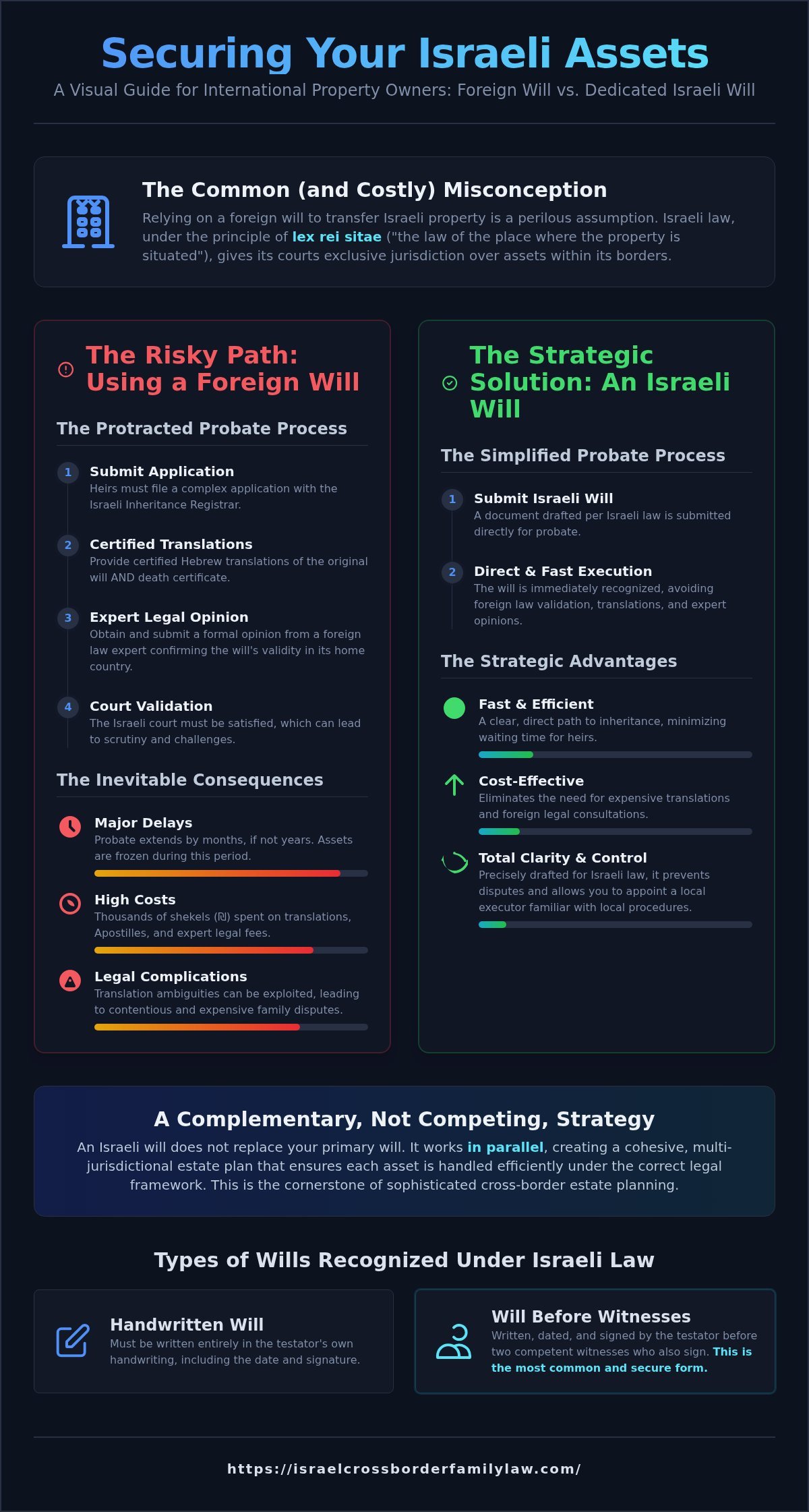
The core of this issue lies in the legal principle of lex rei sitae, or the “law of the place where the property is situated.” This principle dictates that Israeli law governs the succession of real estate located within its borders, regardless of the deceased’s nationality or residence. Consequently, navigating this multi-jurisdictional challenge is paramount for foreign property owners.
Jurisdictional Issues and Israeli Succession Law
The primary legislation governing inheritance in Israel is the Succession Law of 1965. This comprehensive statute grants Israeli courts and the Inheritance Registrar exclusive jurisdiction over the disposition of all assets located within the country. When a foreign will is presented, a conflict of laws often arises. The Israeli court must be satisfied that the will is valid according to the laws of the country where it was drafted. This requires proving foreign law within an Israeli court-a sophisticated legal task. The framework of Israeli succession laws is designed to ensure clear and orderly transfer, and foreign documents must be meticulously adapted to fit this structure.
The Israeli Probate Process for Foreign Wills
Probating a foreign will in Israel is a significantly more intricate process than for a domestic one. Heirs must submit an application to the Inheritance Registrar that includes several critical, and often burdensome, documents:
- The original foreign will, along with a certified Hebrew translation.
- An original or apostilled copy of the death certificate, also with a certified Hebrew translation.
- A formal legal opinion from an expert in the foreign jurisdiction, confirming the will’s validity under that country’s laws.
Securing these documents and expert opinions invariably extends the probate timeline by months, if not longer, compared to the straightforward process for an Israeli will.
Common Pitfalls: Delays, Costs, and Complications
The path to validating a foreign will is fraught with potential obstacles. Document authentication, such as obtaining an Apostille certification, can cause significant delays. The associated costs for certified translations and expert legal opinions can quickly accumulate, often reaching many thousands of shekels (₪). Furthermore, any ambiguity in the will’s language, when translated, can be exploited, leading to contentious and expensive legal disputes among heirs. An effective israeli will for foreign property owners is specifically drafted to preempt these cross-border complications and ensure a smooth, predictable inheritance process.
The Strategic Solution: A Dedicated Will for Your Israeli Assets
For individuals holding property and investments across multiple jurisdictions, a sophisticated estate plan is not a luxury but a necessity. The most effective strategy for navigating the complexities of cross-border inheritance is to create a dedicated Israeli will. This is a separate, stand-alone legal instrument dealing exclusively with your assets situated within the State of Israel. It is crucial to understand that this document does not replace or invalidate your primary will executed in your home country; rather, it operates in parallel, forming a cohesive and robust international estate plan. This bifurcated approach is the preferred solution for an israeli will for foreign property owners, as it dramatically simplifies the probate process for your heirs and provides clarity for the Israeli authorities, mitigating the risk of costly delays and legal challenges.
How an Israeli Will Operates
An Israeli will is meticulously drafted in accordance with the Israeli Inheritance Law of 1965, ensuring its immediate validity and enforceability within the local legal system. To prevent jurisdictional conflicts, the document must explicitly state that its scope is strictly limited to assets located in Israel, such as real estate, bank accounts, or securities. This precise demarcation is critical for avoiding contradictions with your primary will. Furthermore, this instrument allows you to appoint a local executor-an individual or institution familiar with Israeli administrative and legal procedures-to manage the disposition of your Israeli estate efficiently, providing a significant advantage in navigating the local bureaucracy.
Types of Wills Recognized Under Israeli Law
Israeli law provides for several methods of creating a valid will, each with distinct formal requirements. A comprehensive understanding of these options is essential for selecting the most secure and appropriate format for your circumstances. According to the Global Property Guide’s overview of Israeli inheritance and tax laws, the primary types include:
- Handwritten Will: Must be written entirely in the testator’s own handwriting, including the date and signature.
- Will Before Witnesses: The most common and secure form, this will is written, dated, signed by the testator, and declared as their will before two competent witnesses who also sign the document.
- Will Before an Authority: Made by oral declaration or submission of a written will to a judge, registrar of the Inheritance Court, or a notary.
For any israeli will for foreign property owners, we strongly advise the execution of a will before witnesses, drafted by experienced legal counsel to ensure it is unambiguous and legally sound.
Coordinating with Your Primary Estate Plan
A successful multi-jurisdictional estate strategy hinges on seamless coordination. It is imperative that both your primary will and your Israeli will are “aware” of each other. The Israeli will should contain a clause referencing the existence of a primary foreign will and clarifying that it only governs Israeli assets. Correspondingly, your primary will can acknowledge the separate Israeli will, confirming that it does not intend to revoke it. This reciprocal recognition creates a clear and defensible legal framework, preventing potential conflicts and ensuring your global testamentary intentions are executed as planned.
Key Benefits of an Israeli Will for Foreign Property Owners
For international investors and property holders, navigating the complexities of cross-border inheritance can be a formidable challenge. An Israeli will is not merely a document; it is a strategic instrument designed to provide clarity, efficiency, and security for your assets located in Israel. By proactively establishing an israeli will for foreign property owners, you replace uncertainty with a clear, legally sound directive that protects your legacy and your beneficiaries from protracted and costly legal proceedings.
Expediting the Probate Process
The primary advantage is the dramatic acceleration of the probate (Tzav Kiyum Hesstama) process. A foreign will must first be authenticated in its country of origin and then validated by an Israeli court, a multi-layered procedure that can extend for years. This protracted delay freezes Israeli bank accounts and prevents heirs from managing, renting, or selling real estate. In contrast, an Israeli will is drafted for direct submission to the Israeli Inheritance Registrar, reducing the entire process to a matter of months and empowering your appointed executor to manage the estate’s local affairs without delay.
Significant Cost Reduction
The financial benefits of a localized will are substantial. Navigating the probate of a foreign will in Israel invariably incurs significant and often avoidable expenses. Key savings include:
- Elimination of Translation and Notarization Costs: Certified Hebrew translations of complex foreign legal documents and their authentications can cost thousands of shekels.
- Avoidance of Foreign Law Expert Opinions: The Israeli court requires a legal opinion from an expert in the foreign jurisdiction to confirm the will’s validity, a service that frequently costs ₪15,000 to ₪30,000 or more.
- Reduction in Legal Fees: A streamlined, domestic probate process requires fewer billable hours from your legal counsel, directly lowering overall administrative costs.
- Mitigation of Financial Losses: Swift access to assets prevents potential losses from unmanaged properties or inaccessible investment accounts.
Providing Legal Certainty and Minimizing Disputes
An Israeli will provides unparalleled legal certainty by being drafted in full compliance with the Israeli Succession Law, 1965. This removes any ambiguity regarding your intentions for your Israeli assets, a common issue with foreign wills that may contain provisions unenforceable under Israeli law. By clearly stipulating the distribution of specific properties and accounts, the document significantly minimizes the risk of costly and emotionally draining challenges from estranged or disgruntled heirs. Ultimately, a properly executed israeli will for foreign property owners serves as a definitive and incontestable roadmap for your estate, ensuring your wishes are carried out precisely as you intended.
Essential Considerations Before Drafting Your Israeli Will
Drafting a legally sound will in Israel involves navigating a distinct set of legal and practical challenges, particularly for non-residents. The process demands meticulous attention to detail to ensure your final wishes are executed efficiently and without complication. For the many expats and foreign nationals with assets in Israel, understanding these nuances is the first step toward securing your legacy and protecting your beneficiaries.
Choosing an Executor for Your Israeli Estate
The selection of an executor (or Menahel Izavon) is a critical decision. While you can appoint anyone, naming an Israeli resident or a local law firm offers significant strategic advantages. A local executor can efficiently navigate Israeli probate courts, manage communications with government agencies like the Land Registry Office, and handle practical tasks without the logistical burdens of international travel and time zone differences. A foreign-based executor often faces substantial delays and complexities, making an Israeli-based professional a more effective choice. It is also prudent to appoint an alternate executor to prevent complications should your primary choice be unable to serve.
Identifying and Listing All Israeli Assets
Precision is paramount when detailing your assets. An effective israeli will for foreign property owners must include a comprehensive and unambiguous inventory of all holdings within Israel. This schedule of assets should go beyond general descriptions and provide specific, verifiable details:
- Real Estate: Include the full address along with the official block and parcel numbers (Gush v’Helka).
- Bank Accounts: List the bank name, branch, and full account numbers for all savings, checking, and investment accounts.
- Business Interests: Specify company names, registration numbers, and the nature of your shareholdings.
- Investment Portfolios: Detail the managing institution and relevant account identifiers.
This level of clarity minimizes the risk of assets being overlooked during probate and prevents potential disputes among heirs.
Language and Clarity of the Document
While an Israeli will can be written in English, there are compelling reasons to consider drafting it in Hebrew or as a bilingual document. A Hebrew will can be processed more quickly by the Israeli courts, which operate exclusively in Hebrew. If an English-only will is submitted, it will require a certified translation, adding time and cost to the probate process. A professionally drafted bilingual version offers the ideal solution, providing absolute clarity for your English-speaking heirs while satisfying the procedural requirements of the Israeli legal system. Engaging experienced legal counsel ensures the language used is precise, legally robust, and free from ambiguities that could challenge the will’s validity. To navigate these complex requirements and draft an enforceable will that protects your Israeli assets, securing professional legal guidance is indispensable.
Why Expert Cross-Border Legal Counsel is Non-Negotiable
Drafting an Israeli will for foreign property owners involves navigating a sophisticated matrix of international laws, succession rules, and tax regulations. The complexities inherent in multi-jurisdictional estate planning mean that generic legal advice or do-it-yourself solutions are not merely insufficient-they are fraught with risk. Engaging a legal team with demonstrated expertise in both Israeli and foreign law is imperative to protect your assets, honor your intentions, and safeguard your beneficiaries from unforeseen legal and financial complications.
Harmonizing Multiple Wills to Prevent Revocation
A significant danger in cross-border estate planning is the risk of “accidental revocation,” where a new will drafted in one country unintentionally invalidates a pre-existing will in another. Our specialists meticulously craft legal language to ensure your Israeli will complements, rather than conflicts with, your other testamentary documents. This proactive approach prevents costly and emotionally draining legal battles over which will is valid, ensuring your estate is distributed according to your precise wishes. Learn about our advisory services for complex cases.
Navigating Tax Implications in Both Jurisdictions
While Israel does not levy an inheritance or estate tax, this benefit does not automatically extend to your home country. For beneficiaries residing in jurisdictions with estate taxes, such as the United States or the United Kingdom, the structure of your will and the distribution of your Israeli assets can trigger significant tax liabilities. Expert counsel is essential for structuring a tax-efficient estate plan, often requiring strategic coordination with tax professionals in both countries to minimize the financial burden on your heirs.
Ensuring a Smooth Process for Your Loved Ones
The ultimate objective of a well-crafted estate plan is to provide clarity and remove the legal burden from your family during a time of grief. A properly structured israeli will for foreign property owners is a final act of care, providing your loved ones with a clear, legally sound roadmap to follow. Expert guidance delivers the peace of mind that comes from knowing your legacy is secure and your wishes will be honored seamlessly across borders. Let our experts help you craft a seamless cross-border estate plan that protects what matters most.
Navigating Your Cross-Border Inheritance with Strategic Precision
Owning property in Israel as a foreign national presents unique and complex inheritance challenges. As we have explored, relying on a foreign will often leads to significant legal hurdles and prolonged probate proceedings within the Israeli court system. The strategic implementation of a dedicated will for your Israeli assets is not merely a convenience; it is a fundamental necessity for ensuring a seamless transfer of your property and unequivocally protecting your legacy. Drafting a legally sound israeli will for foreign property owners requires a nuanced understanding of both Israeli inheritance law and the potential conflicts with your home jurisdiction’s legal framework. With decades of focused experience in international family and inheritance law, our firm provides sophisticated guidance for clients across multiple jurisdictions. Our specialized expertise in US-Israel cross-border law ensures your estate plan is both comprehensive and enforceable. To secure your assets and provide peace of mind for your beneficiaries, we invite you to Schedule a Confidential Case Review to discuss your cross-border estate plan. Take the definitive step today to protect your investment and ensure your intentions are honored without complication.
Frequently Asked Questions
Does Israel have an inheritance tax or estate tax?
No, Israel does not impose an inheritance or estate tax. This tax was formally abolished in 1981, which presents a significant advantage for international clients holding property in the country. However, it is crucial to understand that while the inheritance itself is not taxed, beneficiaries may be subject to Capital Gains Tax (Mas Shevach) upon the future sale of the inherited real estate. Strategic cross-border estate planning can effectively mitigate such future tax liabilities.
What happens to my Israeli property if I die without any will (intestate)?
In the absence of a valid will, a situation legally defined as intestacy, your Israeli assets are distributed according to the default provisions of Israel’s Succession Law of 1965. This statute mandates a specific hierarchy of heirs, typically prioritizing the surviving spouse and children. This statutory distribution may not align with your specific intentions or the sophisticated requirements of a multi-jurisdictional estate, underscoring the critical need for a formally executed will to ensure your wishes are honored.
Can my executor from the United States manage my Israeli assets directly?
An executor appointed in a foreign jurisdiction, such as the United States, does not have automatic authority over assets located in Israel. The foreign appointment must first be recognized and validated by an Israeli court through a formal legal proceeding. A more streamlined and effective strategy is to appoint an Israeli-based executor or co-executor within your will. This ensures a professional with local expertise is empowered to navigate the Israeli probate process, banking regulations, and property registries efficiently.
How does an Israeli will interact with a trust I’ve established in my home country?
The interplay between an Israeli will and a foreign trust is a complex matter demanding sophisticated legal analysis. While Israeli law recognizes trusts, its legal framework can differ substantially from common law jurisdictions like the U.S. or UK. It is imperative that your Israeli will is drafted to complement your foreign trust, preventing conflicts and ensuring Israeli assets are handled according to your overarching estate plan. Expert cross-border counsel is essential to harmonize these legal instruments effectively.
Is a will I create in Israel valid for my assets in other countries?
While a will validly executed in Israel may be recognized abroad, relying on it to govern your global estate is a perilous strategy. Each nation maintains its own distinct succession laws, probate procedures, and legal formalities. The established best practice for individuals with a multi-jurisdictional portfolio is to create separate, jurisdiction-specific wills. This “situs will” approach preempts legal conflicts and dramatically simplifies the estate administration process for your heirs in each country where assets are held.
How often should I review or update my Israeli will?
We advise clients to conduct a comprehensive review of their Israeli will every three to five years, or immediately following any significant life event. Such events include marriage, divorce, the birth of children or grandchildren, a material change in your financial portfolio, or the acquisition of new property in Israel. An outdated israeli will for foreign property owners can create unintended consequences and complex legal challenges, undermining the very security it was designed to provide.
Can I use my Israeli will to name a guardian for my minor children living in Israel?
Yes, nominating a guardian for your minor children residing in Israel is a critical function of your will. While the Israeli family court makes the final appointment in the child’s best interests, your expressed nomination carries substantial legal weight and is a primary factor in the court’s decision. For expatriates and international families, a clear guardianship provision is an indispensable part of a comprehensive israeli will for foreign property owners, providing vital protection and direction for your children’s future.

Article by
Gabriel Lior
A Personal Journey That Became a Mission The advisory was founded by an American father Gabriel Lior, LLB, MBA , global entrepreneur, and cross-border advisor who spent more than a decade navigating the Israeli family court system firsthand and now lives in Singapore with his son.
As a divorced parent in a cross-border family, Gabriel faced nearly every legal challenge a foreign parent can encounter in Israel — including child custody disputes, child support proceedings, property matters in Israel and abroad, false accusations, and complex immigration and relocation proceedings. Over the years, he learned the hard way how difficult it is for non-Israeli parents to understand the system, identify the right legal strategy, and choose the right legal representation — especially when language, culture, and jurisdictional differences are involved. He also witnessed how foreign parents and new immigrants are often disadvantaged or taken advantage of by service providers and institutions simply because they lack local knowledge or fluency. From Client to Advisor To truly understand — and survive — the system, Gabriel pursued formal legal education in Israel, completing two Israeli law degrees, alongside a BA and MBA earned in the United States. This was never about becoming a practicing attorney, but about gaining a deep, structural understanding of how the system works — and where it breaks down for foreign parents. This rare combination of: Firsthand client experience Israeli legal and US business education International business and negotiation training Decades of commercial execution created a unique perspective – one that understands both sides of the table. After years of litigation, persistence, and at times self-representation, he ultimately succeeded in securing custody of his son and relocating abroad through a rare legal victory in the Israeli Supreme Court — becoming one of the first fathers in Israel to do so under these circumstances.
Disclaimer
Important Disclaimer: The information provided on this website and in its content is for general informational and educational purposes only and does not constitute legal advice, legal opinion, or legal representation. Gabriel Lior is not licensed to practice law in Israel (nor is he interested in doing so) and does not provide legal services, despite having completed 2 Law Degrees. The services offered are advisory in nature and are intended to provide general guidance, strategic insight, and information regarding cross-border family law considerations. No attorney-client relationship is formed by accessing this website, reading its content, or communicating with us. Any decisions made based on this information are at your own discretion and risk. For legal advice specific to your situation, you should consult a licensed attorney in the relevant jurisdiction. Where appropriate, we may refer clients to independent, licensed attorneys or professionals. Such referrals do not constitute legal representation and no liability is assumed for services provided by third parties.