Navigating a cross-border divorce presents a labyrinth of legal and financial challenges, particularly for international couples facing the complexities of the Israeli legal system. The financial uncertainty is often the most daunting aspect, with questions surrounding spousal support-or alimony in Israel-at the forefront of these multi-jurisdictional disputes. This uncertainty is compounded by Israel’s unique dual-jurisdiction framework, where both civil family courts and religious tribunals can preside over matrimonial matters, each with distinct approaches to determining spousal support obligations and entitlements. This comprehensive guide is engineered to provide critical clarity, guiding you through the intricate framework governing these proceedings. We will dissect how religious law impacts calculations and duration, clarify your specific rights and obligations as a foreign national, and equip you with the strategic knowledge necessary to confidently approach legal negotiations. Our objective is to empower you to understand your position, secure your financial future, and navigate this complex transition with authoritative legal insight.
Key Takeaways
- Understand how Israel’s dual legal system, which incorporates principles of Jewish Law (‘Mezonot Isha’), fundamentally shapes spousal support obligations in divorce proceedings.
- Grasp the key factors Israeli courts consider when determining support awards, which are based on the marital standard of living rather than a rigid mathematical formula.
- For international couples, successfully navigating the complexities of alimony in Israel requires a strategic approach to the critical preliminary issue of legal jurisdiction.
- Recognize why securing expert legal counsel is essential for protecting your rights and financial interests in complex, multi-jurisdictional spousal support disputes.
Foundations of Alimony in Israel: Understanding the Dual Legal System
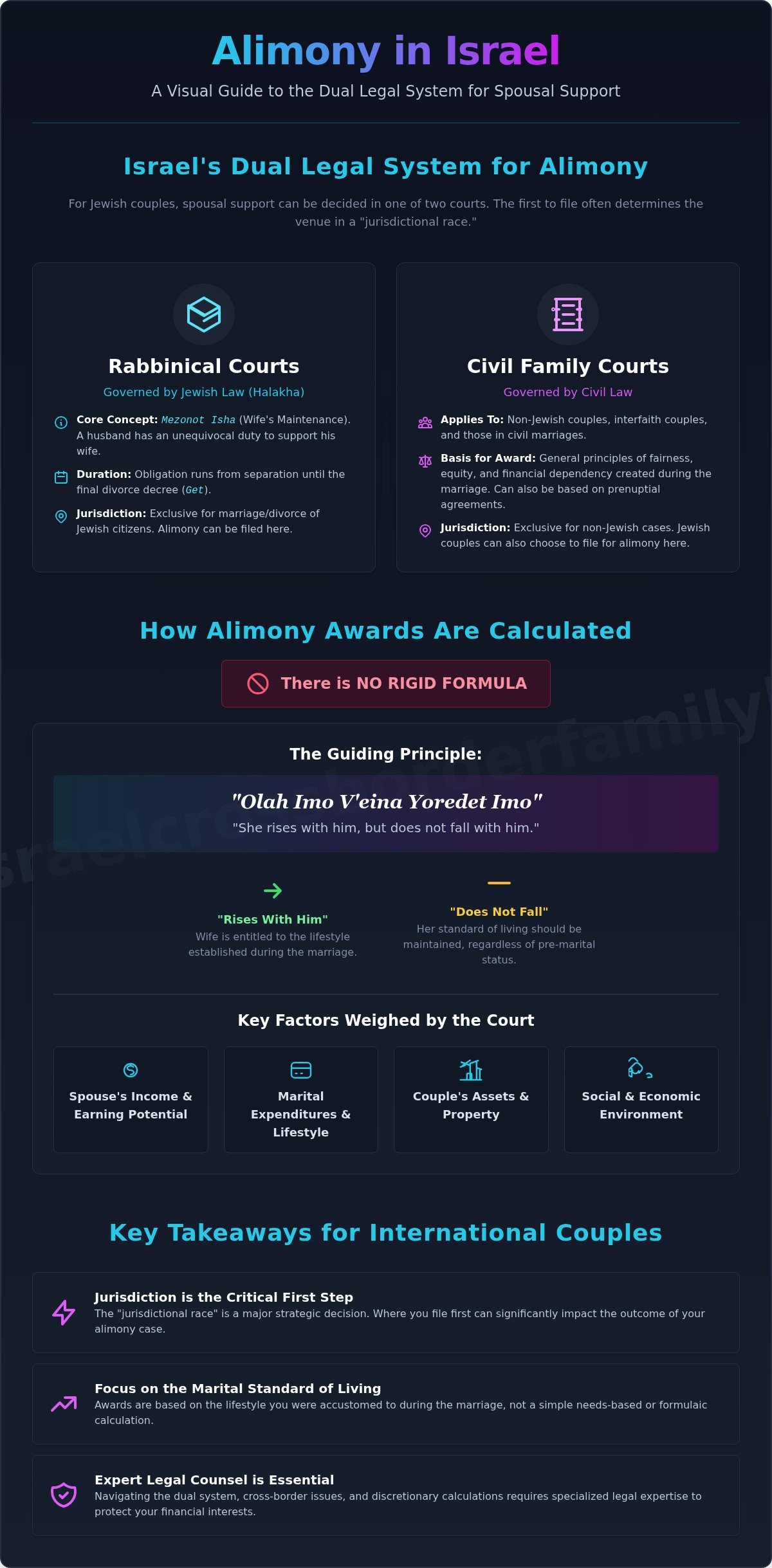
Navigating spousal support, commonly known as alimony, requires a deep understanding of Israel’s unique legal framework. Unlike in many Western countries, family law in Israel operates under a dual system, where matters can be adjudicated in either civil Family Courts or religious Rabbinical Courts. This distinction is paramount when addressing spousal support, which is a financial obligation entirely separate from child support payments. Understanding which court holds jurisdiction and the legal principles each applies is the foundational first step in any divorce proceeding involving a claim for alimony in israel. For a detailed overview of this complex topic, the following video provides valuable insights:
What is Spousal Alimony (Mezonot Isha)?
For Jewish couples, the primary concept governing spousal support is Mezonot Isha (wife’s maintenance). Under Jewish Law (Halakha), a husband has an unequivocal duty to financially support his wife at a level commensurate with the lifestyle established during the marriage. This obligation is not contingent on fault and continues from the moment of separation until the marriage is formally dissolved by a final divorce decree, known as a Get. It is critical to distinguish this from child support, which is calculated separately and addresses the children’s needs. Child support is an intricate matter in itself, often requiring a dedicated cross-border enforcement strategy in international cases.
Rabbinical Courts vs. Family Courts: Who Has Jurisdiction?
The Rabbinical Courts hold exclusive jurisdiction over the acts of marriage and divorce for Jewish citizens. However, claims for alimony can be filed in either the Rabbinical Court or the civil Family Court. This creates a “jurisdictional race,” where the party who files first can often determine the venue. The choice of court is a significant strategic decision, as each operates under different legal principles and may yield different outcomes. This structure, often referred to as the Israeli dual legal system for support, creates a complex legal landscape that demands expert navigation to protect one’s financial interests.
Alimony for Non-Jewish or Civil Marriages
For non-Jewish couples, interfaith couples, or those in civil marriages, matters of alimony in israel are adjudicated exclusively in the Family Courts. These courts apply civil law principles rather than religious doctrine. Spousal support may be awarded based on contractual obligations, such as a prenuptial agreement, or on general principles of fairness, equity, and the financial dependency created during the marriage. While the legal basis differs from Mezonot Isha, the Family Court recognizes the fundamental need to provide support for a financially disadvantaged spouse post-separation.
How Israeli Courts Calculate Alimony Awards
Unlike jurisdictions that rely on rigid mathematical formulas, the calculation of spousal support or alimony in Israel is a discretionary process guided by a fundamental principle: maintaining the standard of living established during the marriage. The Family Court or Rabbinical Court undertakes a comprehensive evaluation of the couple’s unique circumstances, ensuring that the final award is equitable rather than mechanically derived. This approach demands a sophisticated understanding of both the family’s financial landscape and prevailing legal precedents.
The Guiding Principle: ‘She Rises With Him, But Does Not Fall’
Rooted in Talmudic law, the concept of ‘Olah Imo V’eina Yoredet Imo’ is a cornerstone of Israeli alimony decisions. It translates to “She rises with him, but does not fall with him,” meaning a wife is entitled to the lifestyle she became accustomed to during the marriage, irrespective of her pre-marital status. The court assesses this standard by examining evidence of income, expenditures, assets, and the couple’s social and economic environment throughout their shared life, a distinct departure from purely needs-based calculations seen elsewhere.
Key Factors Influencing the Alimony Amount
The court’s discretionary power is exercised by weighing a complex matrix of personal and financial factors. The specific weight of these elements is a sophisticated process, as detailed in resources like the comprehensive Israel Family Law Guide, and requires a nuanced understanding of legal precedents. Key considerations include:
- The husband’s income and earning potential: The court evaluates not only current earnings but also the capacity to generate future income.
- The wife’s income, assets, and needs: Her ability to support herself, her assets (including those from the marital property division), and her established needs are scrutinized.
- The duration of the marriage: Longer marriages, particularly those where one spouse sacrificed career opportunities, often result in more substantial and longer-term support awards.
- The division of marital property: The size and nature of the asset distribution directly impact the recipient’s need for ongoing support.
What an Alimony Award Typically Includes
An award for alimony in Israel is designed to cover the specific, demonstrable expenses required to maintain the marital standard of living. While every case is unique, a typical award provides for essential costs, which can range from several thousand to tens of thousands of shekels per month. These often encompass:
- Housing Costs: Rent or mortgage payments for a residence comparable to the marital home.
- Household Expenses: Utilities, groceries, transportation, and general upkeep.
- Personal Needs: Budgets for clothing, medical care, and other personal necessities.
- Social Standing: Costs associated with maintaining the family’s social life, including vacations, club memberships, and educational expenses, if these were part of the established lifestyle.
Duration and Termination of Spousal Support
A common misconception is that spousal support is a lifelong entitlement. In reality, the framework for alimony in Israel is structured with clear, albeit sometimes complex, termination points. The obligation is designed to provide for a spouse during the separation period and is not intended to be indefinite. Understanding the specific circumstances that end, reduce, or alter this financial duty is critical for both parties navigating the complex divorce process.
When Does the Obligation to Pay Alimony End?
The primary event that terminates the husband’s obligation to pay spousal support under Jewish law is the finalization of the religious divorce. This occurs upon the issuance of a Get, the official Jewish divorce decree, by the Rabbinical Court. It is crucial to recognize that the period between physical separation and the delivery of the Get can be lengthy, and the alimony obligation remains in full effect throughout this time. The obligation also ceases upon the death of either spouse.
Grounds for Denying or Reducing Alimony
While the obligation is firm during the separation period, the Rabbinical Court may deny or reduce alimony payments under specific circumstances where the wife forfeits her right to support. These grounds are rooted in Jewish law and include:
- Sufficient Independent Means: If the wife has her own income or assets sufficient for her needs, the court may rule that she does not require support.
- Adultery (Ma’aseh Kichur): A wife proven to have committed adultery loses her right to alimony.
- Rebellious Wife (Moredet): This term applies to a wife who leaves the marital home without just cause or refuses to cohabit, thereby forfeiting her support.
- Refusal of a Get: If the Rabbinical Court has ordered a divorce and the wife refuses to accept the Get without a valid reason, her alimony may be terminated.
Rehabilitative Alimony in Modern Cases
Separate from the traditional framework, Israeli Family Courts have increasingly applied the concept of rehabilitative alimony. This is a more modern, time-limited form of support designed to enable a dependent spouse to acquire education, professional skills, or work experience to become financially independent post-divorce. This approach is particularly common in civil law cases, for couples married in shorter-term unions, or where one spouse needs a transitional period to re-enter the workforce. Unlike traditional alimony in Israel, its duration is fixed and goal-oriented.
Critical Considerations for International & Cross-Border Cases
For expats, U.S. citizens, and binational couples, divorce proceedings introduce a layer of multi-jurisdictional complexity that fundamentally alters the legal landscape. The standard rules for spousal support are compounded by critical preliminary questions of legal venue, international law, and the enforcement of foreign judgments. Navigating these sophisticated challenges requires a strategic approach from the outset.
Jurisdiction: The Importance of Where You File
In international divorce, the question of where to file is often the most consequential decision you will make. This frequently leads to a “race to the courthouse,” where the first spouse to initiate proceedings in their preferred jurisdiction gains a significant strategic advantage. The outcome for alimony in Israel can differ substantially from an award granted in a U.S. state, which may have more formulaic, long-term support structures. This choice dictates the applicable law and profoundly impacts the entire case.
Rights and Obligations for Expats & Foreign Nationals
A common concern for foreign nationals is whether they are entitled to spousal support within the Israeli legal system. The answer is unequivocally yes. Israeli law extends its protections to residents regardless of their citizenship. Your legal status, duration of residency in Israel, and the location of marital assets are all factors that will be considered by the court. These elements require careful legal analysis to build a robust case. For a detailed review, see our guide on divorce for expats and foreign nationals.
Enforcement of US Alimony Orders in Israel
Securing an alimony order in a U.S. court is only half the battle if your former spouse resides or holds assets in Israel. A foreign judgment is not automatically enforceable. It must first be formally recognized by an Israeli court through a specific legal process, guided by international treaties and the legal principle of comity. This procedure demands sophisticated legal counsel with deep expertise in the legal systems of both countries to ensure compliance and successful execution. Successfully navigating a divorce for international families requires this dual-jurisdictional expertise.
Navigating the Alimony Process with Expert Legal Counsel
Determining spousal support in a cross-border divorce is one of the most complex legal challenges a family can face. The intricate interplay of religious law, civil statutes, and multi-jurisdictional financial considerations makes professional legal representation not merely advisable, but absolutely essential. Successfully navigating the process of securing or challenging alimony in israel requires a strategic approach grounded in deep legal expertise to protect your financial future.
Why a Cross-Border Specialist is Crucial
An attorney specializing in US-Israel family law provides a decisive advantage. These professionals possess a sophisticated understanding of how Israel’s religious Rabbinical Courts and civil Family Courts interact, a critical factor in shaping case strategy. They are uniquely qualified to advise on the pivotal decision of jurisdiction-whether to file in Israel or the United States-and are equipped to manage the complex enforcement of financial judgments across international borders, ensuring compliance with any court order.
Preparing Your Financial Documentation
A successful alimony case is built on a foundation of clear and comprehensive financial disclosure. It is imperative to begin organizing all relevant documents to present a complete financial picture to the court. Key documents include:
- Tax returns (both Israeli and foreign) for the past several years
- Recent pay stubs or proof of income
- Bank, investment, and retirement account statements
- Valuations of significant assets, such as real estate or business interests
- A detailed list of monthly expenses and liabilities
Attempting to hide or misrepresent assets carries severe legal consequences in Israel, including financial penalties and a loss of credibility before the court, which can irrevocably damage your case.
Securing a Favorable Outcome
While litigation is sometimes unavoidable, many successful outcomes for alimony in israel are achieved through skilled negotiation. An experienced attorney can work towards a comprehensive divorce agreement, or global settlement, that resolves not only spousal support but also complex issues of child support and the division of marital property in a single, binding contract. This approach provides clarity, finality, and control over the outcome. The stakes are high, and your financial stability is on the line. Request a confidential case review to protect your interests.
Secure Your Financial Future with Expert Guidance on Alimony in Israel
Navigating the landscape of alimony in Israel is an inherently complex endeavor, defined by its dual legal system and nuanced calculation methodologies. For international and cross-border couples, these challenges are magnified by multi-jurisdictional issues concerning asset location, enforcement of foreign orders, and conflicting legal standards. Achieving a favorable and secure outcome requires a sophisticated understanding of how these distinct legal frameworks intersect and influence one another. Effectively protecting your interests demands more than just standard legal advice; it requires strategic guidance from counsel possessing deep expertise in both US and Israeli family law. Our team of bilingual and bicultural attorneys serves as a critical bridge between these two legal systems, providing the sophisticated representation necessary to manage the most complex international divorce proceedings and secure your financial stability. We invite you to schedule a consultation to discuss your cross-border alimony case. Taking this decisive step is the first move toward achieving clarity and a favorable resolution.
Frequently Asked Questions About Alimony in Israel
What is the difference between alimony and child support in Israel?
In the Israeli legal framework, alimony (mezonot isha) is a spousal maintenance obligation intended to uphold the dependent spouse’s standard of living established during the marriage, rooted in the couple’s personal religious law. Child support (mezonot yeladim), conversely, is a separate and absolute financial obligation owed directly to the children. It is calculated based on the children’s specific needs and is governed by a distinct statutory and judicial framework, independent of the spousal support determination.
Can a man receive alimony from a woman in Israel?
Historically, under the framework of Jewish religious law, a husband is not entitled to alimony from his wife. However, Israeli civil courts have developed the concept of ‘rehabilitative support’ or contractual alimony. In specific circumstances, such as long-term relationships where a spouse sacrificed career opportunities for the family unit, a court may order a woman to provide financial support to her ex-husband based on principles of equity and good faith, which is distinct from traditional religious law.
Is alimony taxable in Israel?
Under current regulations set by the Israel Tax Authority, court-ordered alimony payments are generally not considered taxable income for the recipient. Correspondingly, the paying spouse is not permitted to deduct these support payments as an expense from their own taxable income. This clear tax treatment provides financial certainty for both parties when structuring divorce settlements. It is crucial, however, to ensure the payments are properly defined as alimony in the court order or agreement to avoid complications.
What happens if my ex-spouse refuses to pay a court-ordered alimony award?
Failure to comply with a court-ordered alimony award enables the recipient to initiate enforcement proceedings through the Israeli Execution Office (Hotza’a Lapoal). This state body has broad authority to compel payment through various mechanisms, including wage garnishment, seizure of bank accounts and assets, liens on property, and even the imposition of a travel ban preventing the non-compliant party from leaving Israel until the debt is settled. Prompt legal action is essential to enforce your rights effectively.
Does a prenuptial agreement override Israeli alimony laws?
Yes. A properly executed and legally validated prenuptial agreement is a binding contract that can override the default statutory and religious laws concerning spousal support. For an agreement to be enforceable, it must be approved by the Family Court or a certified notary. This proactive measure allows couples to define their own financial terms for a potential separation, providing clarity and pre-empting complex litigation over the issue of alimony in Israel in the future.
How long does it take to get an alimony ruling from an Israeli court?
The timeline is contingent upon case complexity and the court’s docket. A motion for temporary alimony can often yield a preliminary ruling within several weeks to a few months to address immediate needs. However, obtaining a final, comprehensive judgment on the matter of alimony in Israel as part of the overall divorce proceedings is a more protracted process, often taking many months and, in highly contested multi-jurisdictional cases, potentially extending over a year.

Article by
Gabriel Lior
A Personal Journey That Became a Mission The advisory was founded by an American father Gabriel Lior, LLB, MBA , global entrepreneur, and cross-border advisor who spent more than a decade navigating the Israeli family court system firsthand and now lives in Singapore with his son.
As a divorced parent in a cross-border family, Gabriel faced nearly every legal challenge a foreign parent can encounter in Israel — including child custody disputes, child support proceedings, property matters in Israel and abroad, false accusations, and complex immigration and relocation proceedings. Over the years, he learned the hard way how difficult it is for non-Israeli parents to understand the system, identify the right legal strategy, and choose the right legal representation — especially when language, culture, and jurisdictional differences are involved. He also witnessed how foreign parents and new immigrants are often disadvantaged or taken advantage of by service providers and institutions simply because they lack local knowledge or fluency. From Client to Advisor To truly understand — and survive — the system, Gabriel pursued formal legal education in Israel, completing two Israeli law degrees, alongside a BA and MBA earned in the United States. This was never about becoming a practicing attorney, but about gaining a deep, structural understanding of how the system works — and where it breaks down for foreign parents. This rare combination of: Firsthand client experience Israeli legal and US business education International business and negotiation training Decades of commercial execution created a unique perspective – one that understands both sides of the table. After years of litigation, persistence, and at times self-representation, he ultimately succeeded in securing custody of his son and relocating abroad through a rare legal victory in the Israeli Supreme Court — becoming one of the first fathers in Israel to do so under these circumstances.
Disclaimer
Important Disclaimer: The information provided on this website and in its content is for general informational and educational purposes only and does not constitute legal advice, legal opinion, or legal representation. Gabriel Lior is not licensed to practice law in Israel (nor is he interested in doing so) and does not provide legal services, despite having completed 2 Law Degrees. The services offered are advisory in nature and are intended to provide general guidance, strategic insight, and information regarding cross-border family law considerations. No attorney-client relationship is formed by accessing this website, reading its content, or communicating with us. Any decisions made based on this information are at your own discretion and risk. For legal advice specific to your situation, you should consult a licensed attorney in the relevant jurisdiction. Where appropriate, we may refer clients to independent, licensed attorneys or professionals. Such referrals do not constitute legal representation and no liability is assumed for services provided by third parties.