The geographical distance between you and your child is daunting enough. When compounded by a difficult ex-partner, the challenges of cross-border parenting can feel insurmountable, leaving you feeling powerless amidst constant conflict and confusing multi-jurisdictional legal questions. Effectively navigating the complexities of how to co-parent with a difficult ex overseas requires more than just patience; it demands a sophisticated, strategic approach grounded in a clear understanding of both Israeli and international family law. The persistent fear of parental alienation and the worry for your child’s emotional health are valid concerns that necessitate decisive, informed action. This comprehensive guide is engineered to provide you with that strategic framework. We will delve into actionable communication protocols designed to de-escalate conflict and establish a predictable, business-like rapport with your former partner. Furthermore, we will illuminate the critical legal insights necessary to protect your parental rights across borders, empowering you to establish a stable parenting routine, ensure your consistent involvement in your child’s life, and ultimately, safeguard their well-being from the fallout of parental discord. Discover the legal and practical tools to regain control and foster a healthier future for your child.
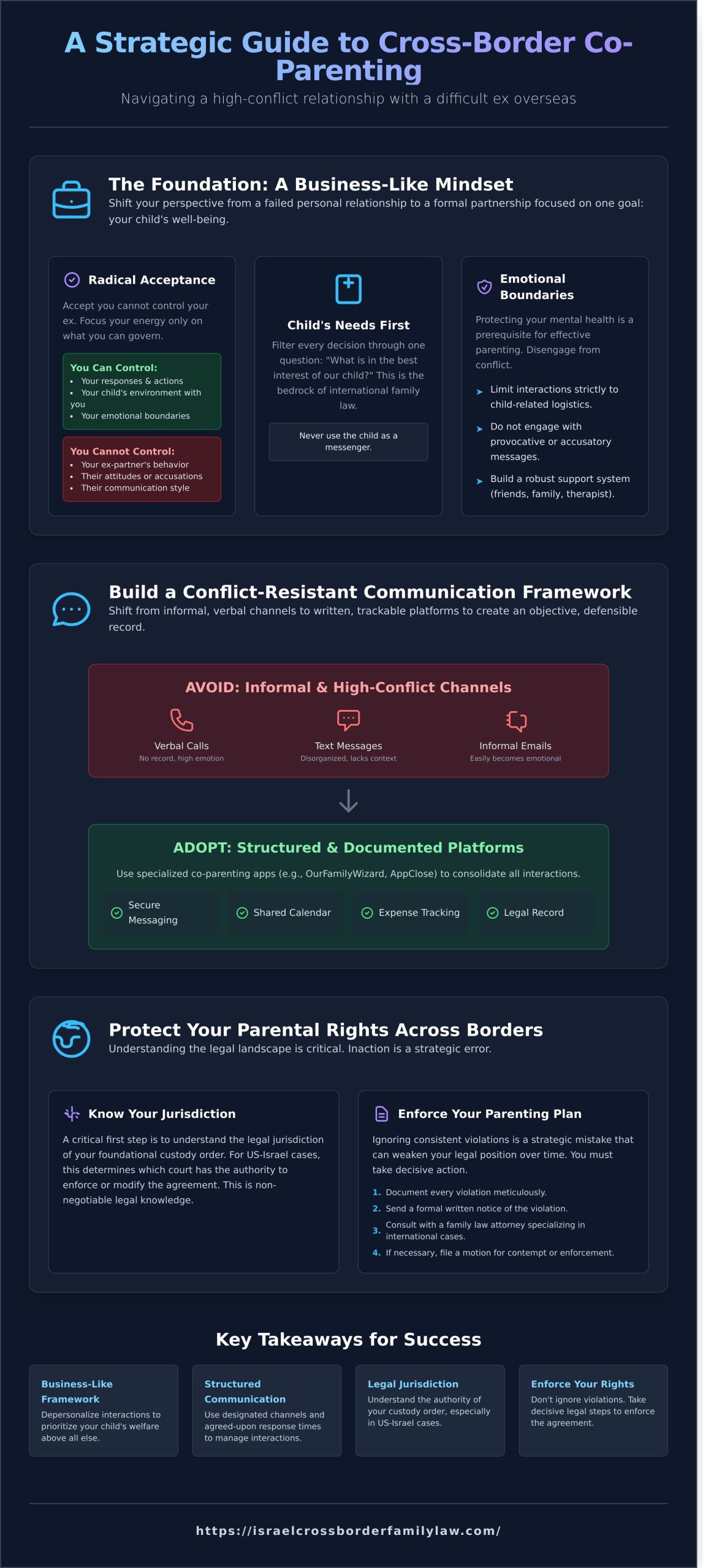
Key Takeaways
- Adopt a business-like framework to depersonalize interactions and prioritize your child’s welfare amidst the unique complexities of international co-parenting.
- Establish a structured, conflict-resistant communication protocol, utilizing designated channels and agreed-upon response times to manage cross-border interactions effectively.
- A critical component of learning how to co-parent with a difficult ex overseas involves understanding the legal jurisdiction of your foundational custody order, particularly in complex US-Israel cases.
- Discover why ignoring consistent violations of your parenting plan is a strategic error and learn the decisive legal steps required to enforce the agreement and protect your parental rights.
The Foundation: Adopting a Business-Like Mindset for International Co-Parenting
Navigating a cross-border parenting arrangement requires a fundamental shift in perspective. The most effective strategy for managing this complex dynamic is to treat co-parenting not as a continuation of a failed personal relationship, but as a formal, business-like partnership. The ‘business’ is the successful and healthy upbringing of your child. This professional framework is essential when dealing with the unique stressors of international logistics, including significant time zone differences, potential cultural gaps, and the inherent challenges of physical distance. The objective is not to rekindle friendship but to establish a stable, predictable, and peaceful co-existence that serves the child’s best interests. Understanding how to co-parent with a difficult ex overseas begins with this strategic emotional detachment. For a deeper understanding of the challenging dynamics you may face, this video provides valuable insights:
Radical Acceptance: Focusing on What You Can Control
A core principle in managing high-conflict, long-distance co-parenting is accepting that you cannot control your ex-partner’s actions, attitudes, or communications. You can only govern your own responses. Instead of expending energy on their behavior, redirect your focus toward creating a secure and loving environment for your child during your designated time. This involves strategically letting go of minor disagreements to conserve your emotional and mental resources for the truly significant issues that impact your child’s welfare.
Prioritizing the Child’s Needs Above All Else
Every decision and communication must be filtered through a single, critical question: “What is in the best interest of our child?” This principle is the bedrock of international family law, reflected in accords like the Hague Convention on the Civil Aspects of International Child Abduction, which underscores the importance of a child’s stability. When possible, present a united front on major decisions regarding health and education. Critically, you must never use the child as a messenger or a source of information about your ex-partner, as this places them in an untenable and emotionally damaging position.
Establishing Strong Emotional Boundaries
Protecting your own mental health is not selfish; it is a prerequisite for effective parenting. This requires establishing and enforcing firm emotional boundaries. Learn to disengage from provocative, accusatory, or emotionally charged emails and messages. Limit your interactions strictly to logistical and child-related topics. To maintain this discipline, it is vital to develop a robust support system, whether it consists of trusted friends, family, or a qualified therapist who can provide objective guidance and help you navigate the complexities of this arrangement.
Building a Conflict-Resistant Communication Framework Across Borders
Navigating a high-conflict co-parenting relationship across international borders demands a strategic and meticulously documented approach to communication. When direct interaction is fraught with difficulty, establishing a structured, non-emotional framework is not merely advisable-it is essential for protecting your child’s well-being and your own legal standing. The core principle is to shift all interactions from verbal and informal channels to written, trackable platforms. This creates an objective record, minimizes ambiguity, and provides a defensible history of communication should multi-jurisdictional legal intervention become necessary.
Leveraging Co-Parenting Apps and Technology
Specialized co-parenting applications such as OurFamilyWizard, AppClose, or 2houses are indispensable tools for managing complex international arrangements. These platforms consolidate all communication into a single, secure channel, providing documented and unalterable records of every message. Features like shared expense trackers, which allow for transparent management of costs from school fees to travel expenses, and integrated calendars for scheduling remove common sources of conflict. Investing in a premium subscription, often costing between ₪300-₪500 annually, is a strategic expense for maintaining clarity and accountability.
Mastering Parallel Parenting and Written Communication
For those grappling with how to co-parent with a difficult ex overseas, the parallel parenting model is often the most effective strategy. This approach intentionally minimizes direct interaction, focusing instead on business-like, written exchanges. All communication should adhere to the BIFF method:
- Brief: Keep messages concise and to the point.
- Informative: Stick to objective facts and logistics concerning the child.
- Friendly: Maintain a neutral, polite tone.
- Firm: State your position or decision clearly and without wavering.
This disciplined method strips emotion and past grievances from the conversation, centering it exclusively on the child’s welfare.
Creating a Detailed International Parenting Plan
A comprehensive, court-ratified international parenting plan is the foundational document for successful cross-border co-parenting. This plan must go beyond standard custody agreements to address the unique complexities of distance. It should specify the precise frequency, timing, and platform for virtual communication (e.g., “FaceTime calls every Sunday at 18:00 Israel time”). Furthermore, it must outline exact logistics for international travel, including which parent bears the cost, who accompanies the child, and how passports are managed. This plan must also acknowledge international custody laws; for parents with ties to the United States, the U.S. Department of State international child abduction resources offer critical guidance on preventative measures.
Navigating Key Co-Parenting Challenges from Abroad
When co-parenting across international borders, geographical distance can transform routine disagreements into significant legal and logistical obstacles. The fundamental challenge of how to co-parent with a difficult ex overseas is the magnification of conflict due to differing time zones, cultures, and legal jurisdictions. Success in this complex environment hinges on meticulous, proactive planning. Establishing clear, legally binding protocols for major decisions, travel, and finances is not merely advisable; it is essential for maintaining stability for your child and mitigating conflict.
Making Major Decisions (Health, Education, Religion)
Your Israeli divorce agreement or court order should explicitly define which parent holds legal custody for making critical decisions regarding the child’s health, education, and religious upbringing. When a decision is required, present all relevant information and options to your ex-partner in a formal, documented manner, such as via email. If a consensus cannot be reached, your parenting plan must stipulate the agreed-upon mechanism for dispute resolution, whether it be mediation, a parenting coordinator, or another specified legal process.
Managing International Travel, Passports, and Visitations
Cross-border visitation requires a robust framework. Your agreement must clearly state who holds the child’s Israeli and any foreign passports and outline the protocol for their exchange. Travel arrangements, including flight costs which can run into thousands of shekels (e.g., ₪3,000-₪6,000 per flight), and logistical responsibilities should be planned and agreed upon months in advance. Crucially, always secure a notarized letter of consent from the other parent before traveling internationally with your child to prevent any issues at border control.
Handling Financial Disagreements and Child Support
Financial clarity is paramount in any co-parenting arrangement, especially one that spans multiple countries. Maintain meticulous, shared records of all child support payments and agreed-upon expenses, such as school fees or unforeseen medical costs. Utilize a transparent reimbursement system to prevent disputes. When child support payments are delinquent, understand that enforcing child support across borders is a complex legal matter with specific international treaties and protocols that must be expertly navigated.
Understanding the Legal Landscape of US-Israel Co-Parenting
When co-parenting spans the distance between the United States and Israel, the legal framework becomes a sophisticated, multi-jurisdictional challenge. Your original divorce decree or custody order remains the foundational document, but its authority is subject to a complex interplay of international treaties and the domestic laws of both nations. Unilateral actions, such as relocating a child without the other parent’s explicit consent or a court order, can trigger severe legal consequences, including accusations of international child abduction. Successfully understanding how to co-parent with a difficult ex overseas requires a precise and strategic approach to this intricate legal environment.
Jurisdiction: Which Country’s Court Has Authority?
The primary factor in determining which country’s courts have authority over custody matters is the child’s ‘habitual residence.’ This is a complex legal determination that goes far beyond simply where the child is physically located at any given moment; it involves an analysis of the child’s established life and ties. Filing motions in the wrong country is not merely a procedural error-it is a costly mistake that can result in significant delays and wasted legal fees, potentially amounting to tens of thousands of shekels.
The Role and Limits of Your Existing Court Orders
A custody order issued by a court in the United States is not automatically enforceable in Israel, and the reverse is also true. For a US order to have legal effect in Israel, it must typically be recognized and registered-a process often referred to as ‘domestication’-by an Israeli court. This procedure ensures the foreign order aligns with Israeli public policy and law. Navigating these multi-jurisdictional challenges, particularly in complex international custody and relocation cases, demands specialized legal counsel experienced in both legal systems.
The Hague Convention and International Child Abduction
Both the United States and Israel are signatories to the Hague Convention on the Civil Aspects of International Child Abduction. This treaty provides a critical legal mechanism for the prompt return of a child who has been wrongfully removed from or retained outside their country of habitual residence in breach of custody rights. It is not a forum to re-litigate custody; rather, its sole purpose is to return the child to the proper jurisdiction so that local courts can resolve the dispute. A thorough understanding of the Hague Convention on Child Abduction is absolutely vital for any parent facing this distressing situation. Protecting your parental rights across international borders requires proactive and informed legal strategy. For guidance on your specific circumstances, it is essential to consult with counsel specializing in cross-border family law. For a confidential consultation, contact our firm today.
When Communication Fails: Strategic Next Steps and Legal Options
When a parenting plan is consistently violated by an uncooperative ex-partner, decisive action is not merely an option-it is a necessity. Ignoring breaches, such as missed video calls or unilateral decisions, establishes a detrimental precedent that can be exceedingly difficult to reverse. The foundational step in protecting your parental rights is to meticulously document every single violation with dates, times, and objective, factual details. This record becomes the critical evidence required for any future professional or legal intervention, which is often indispensable when grappling with the complexities of how to co-parent with a difficult ex overseas.
International Mediation as a First Step
Before escalating to litigation, international mediation presents a strategic and effective alternative. Conducted virtually with a certified mediator specializing in cross-border family disputes, this process is significantly less adversarial and more cost-effective than court proceedings, which can cost tens of thousands of shekels. Successful mediation can result in a revised, mutually recognized parenting agreement that addresses the core issues and provides a more stable path forward for you and your child.
Seeking Modification or Enforcement of Court Orders
If mediation fails or your ex refuses to participate, pursuing legal action through the appropriate court becomes the necessary recourse. You may file a motion for enforcement to compel compliance with the existing order or a motion for modification if circumstances have fundamentally changed. To succeed with a modification, you must provide substantial, documented evidence proving a “material change in circumstances” that directly impacts the child’s welfare, a high legal standard that underscores the importance of rigorous record-keeping.
When to Consult with a Cross-Border Family Lawyer
Engaging with sophisticated legal counsel is critical when facing specific high-stakes challenges. Immediate consultation is advised if your ex-partner:
- Threatens to relocate the child to another country without your consent.
- Systematically obstructs or denies your scheduled communication with your child.
- Consistently fails to make child support payments as mandated by court order.
Navigating the multi-jurisdictional landscape of international family law requires specialized expertise. Before the situation deteriorates further, it is imperative to understand your legal standing and strategic options. We provide expert guidance on how to co-parent with a difficult ex overseas, beginning with a confidential case review to assess your unique circumstances and formulate a robust legal strategy.
Securing Stability in Your Cross-Border Co-Parenting Arrangement
Successfully navigating the complexities of international co-parenting demands a disciplined and strategic framework. As we have explored, this begins with establishing a business-like emotional distance and implementing a structured, conflict-resistant communication protocol. A foundational understanding of the multi-jurisdictional legal landscape, particularly between the U.S. and Israel, is paramount. Ultimately, mastering how to co-parent with a difficult ex overseas is not merely about managing conflict, but about proactively structuring an arrangement that safeguards your child’s well-being across borders. When direct strategies are insufficient and legal intervention becomes necessary, securing expert counsel is critical. Our firm provides sophisticated guidance on the most complex US-Israel cross-border family law matters, including international custody disputes, relocation cases, and the strategic enforcement of international court orders. We invite you to schedule a confidential case review to understand your legal options and protect your parental rights. With the right strategy and support, you can build a stable and predictable future for you and your child, no matter the distance.
Frequently Asked Questions
What can I do if my ex stops all communication and blocks me?
When an ex-partner unilaterally ceases communication, it may constitute a breach of court-ordered co-parenting obligations. Your immediate course of action should be to document all attempts to communicate. We advise engaging legal counsel to file a motion for contempt or to enforce communication protocols through the Israeli Family Court. This formal legal step compels a response and establishes a record of non-compliance, which is critical for protecting your parental rights in any future multi-jurisdictional disputes.
How do we handle emergency medical decisions when we are in different time zones?
A robust, multi-jurisdictional parenting plan is essential for navigating such critical situations. This plan must explicitly delegate authority, outlining who holds final decision-making power in a medical emergency if the other parent is unreachable within a specified timeframe. It should also establish an emergency communication protocol. If disputes arise, an urgent application can be made to the Family Court in the child’s country of residence-in this case, Israel-to secure a determinative ruling on the required medical treatment.
Is an international parenting plan legally enforceable in both the US and Israel?
Enforceability depends on the plan’s legal foundation. For maximum cross-border efficacy, a parenting plan should be ratified as a court order in both jurisdictions-a process often referred to as obtaining a ‘mirror order.’ While Israel and the US are both signatories to the Hague Convention, which facilitates the recognition of custody orders, domesticating a foreign order in the Israeli Family Court system requires a specific legal process. Engaging counsel with deep experience in both US and Israeli family law is paramount.
My ex is ignoring the visitation schedule. What are my immediate options?
Immediate documentation of every missed visitation is your first critical step. Following this, your legal counsel in Israel should file an urgent motion to enforce the existing custody and visitation order with the Family Court. The court has various remedies, including ordering make-up visitation time, imposing financial sanctions which could be several hundred shekels per violation, and, in cases of persistent non-compliance, reconsidering the primary custody arrangement. Swift legal action demonstrates to the court the severity of the breach.
How can I protect my relationship with my child from parental alienation from so far away?
Combating parental alienation from overseas requires a proactive and multi-faceted strategy. Legally, your parenting plan must mandate frequent, unimpeded video and phone contact. If alienation is suspected, we can petition the Israeli court to appoint a child psychologist or social worker to evaluate the situation. Effectively learning how to co-parent with a difficult ex overseas in this context means using the legal system to enforce your child’s right to maintain a meaningful relationship with you.
What if my ex wants to move to a third country with our child?
An international relocation with a minor child requires either your explicit written consent or a court order from the jurisdiction of the child’s habitual residence, which is Israel. Without this, such a move may be considered international child abduction under the Hague Convention. If your ex proposes a move, you must seek immediate legal counsel to file an objection and a ne exeat order (an order preventing the child from leaving the country) with the Israeli Family Court.

Article by
Gabriel Lior
A Personal Journey That Became a Mission The advisory was founded by an American father Gabriel Lior, LLB, MBA , global entrepreneur, and cross-border advisor who spent more than a decade navigating the Israeli family court system firsthand and now lives in Singapore with his son.
As a divorced parent in a cross-border family, Gabriel faced nearly every legal challenge a foreign parent can encounter in Israel — including child custody disputes, child support proceedings, property matters in Israel and abroad, false accusations, and complex immigration and relocation proceedings. Over the years, he learned the hard way how difficult it is for non-Israeli parents to understand the system, identify the right legal strategy, and choose the right legal representation — especially when language, culture, and jurisdictional differences are involved. He also witnessed how foreign parents and new immigrants are often disadvantaged or taken advantage of by service providers and institutions simply because they lack local knowledge or fluency. From Client to Advisor To truly understand — and survive — the system, Gabriel pursued formal legal education in Israel, completing two Israeli law degrees, alongside a BA and MBA earned in the United States. This was never about becoming a practicing attorney, but about gaining a deep, structural understanding of how the system works — and where it breaks down for foreign parents. This rare combination of: Firsthand client experience Israeli legal and US business education International business and negotiation training Decades of commercial execution created a unique perspective – one that understands both sides of the table. After years of litigation, persistence, and at times self-representation, he ultimately succeeded in securing custody of his son and relocating abroad through a rare legal victory in the Israeli Supreme Court — becoming one of the first fathers in Israel to do so under these circumstances.
Disclaimer
Important Disclaimer: The information provided on this website and in its content is for general informational and educational purposes only and does not constitute legal advice, legal opinion, or legal representation. Gabriel Lior is not licensed to practice law in Israel (nor is he interested in doing so) and does not provide legal services, despite having completed 2 Law Degrees. The services offered are advisory in nature and are intended to provide general guidance, strategic insight, and information regarding cross-border family law considerations. No attorney-client relationship is formed by accessing this website, reading its content, or communicating with us. Any decisions made based on this information are at your own discretion and risk. For legal advice specific to your situation, you should consult a licensed attorney in the relevant jurisdiction. Where appropriate, we may refer clients to independent, licensed attorneys or professionals. Such referrals do not constitute legal representation and no liability is assumed for services provided by third parties.