For a mother contemplating a new life abroad after a separation or divorce, the process of leaving Israel with a child can seem insurmountable, fraught with emotional and legal challenges. The fear of being accused of parental abduction, coupled with uncertainty about the judicial process, can leave you feeling trapped. Successfully navigating the intricate legal framework that governs a mother’s rights to relocate with a child from Israel requires more than just desire; it demands strategic preparation and a sophisticated understanding of the court’s expectations.
This comprehensive legal guide is designed to provide that essential clarity and empower you to move forward with confidence. We will demystify the complex criteria Israeli family courts use to evaluate relocation petitions, with a primary focus on the child’s best interests. You will learn the necessary steps for filing a successful application, understand the key factors that strengthen your case, and gain the insight needed to protect your child’s relationship with the other parent throughout this cross-border legal journey.
Key Takeaways
- Understand that Israeli family law prioritizes the ‘Best Interests of the Child’ (Tovat HaYeled) as the sole legal standard, shifting the focus from parental rights to the child’s welfare in any relocation petition.
- Discover the specific, multi-faceted criteria the court evaluates, from the parent-child relationship to the opportunities in the destination country, and how to strategically build a compelling case.
- Successfully navigating the complex legal framework governing a mother’s rights to relocate with child israel requires a precise understanding of the step-by-step petitioning process, from initial filings to expert evaluations.
- Recognize the severe legal consequences of unauthorized relocation, including potential violations of the Hague Convention on International Child Abduction and significant civil penalties.
The Legal Standard: Is Relocation a Mother’s ‘Right’ in Israel?
A critical misconception in cross-border family law is the notion of an inherent parental “right” to relocate with a child. In Israel, the legal framework is structured not around parental entitlements, but around one paramount principle: the welfare of the child. When navigating the complex issue of a mother’s rights to relocate with child israel, it is essential to understand that Israeli courts do not grant an automatic right to the custodial parent. Unilateral relocation is strictly prohibited. The father’s explicit consent or a comprehensive court order, granted only after a rigorous judicial review, is an absolute prerequisite for any international move.
To better understand the complexities and the preventative measures available in these situations, the following overview is highly instructive:
Understanding the ‘Best Interests of the Child’ Doctrine
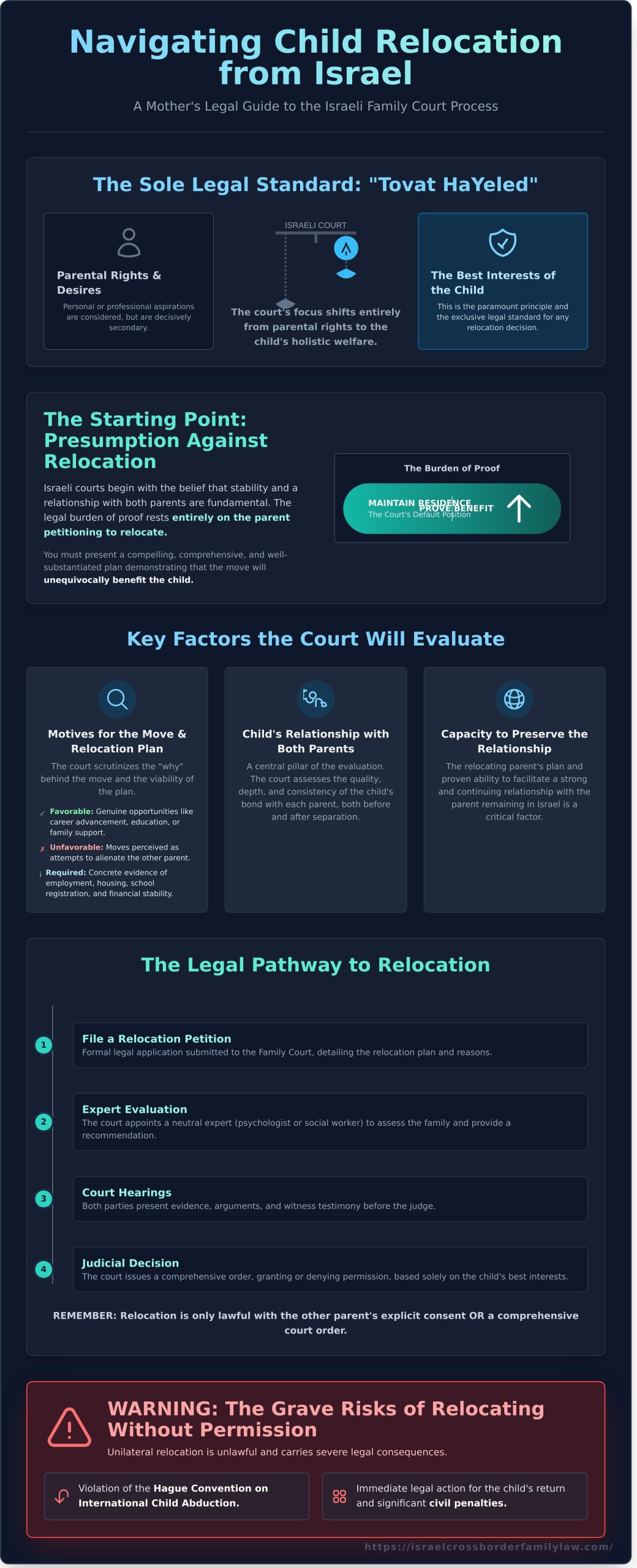
The court’s entire analysis is filtered through the lens of Tovat HaYeled, or the “Best Interests of the Child.” This is not an abstract concept but a detailed, holistic assessment of how the proposed move will impact every facet of the child’s life. The family court meticulously evaluates a wide range of factors, including the child’s physical, emotional, and educational well-being; the quality of their relationship with each parent; the child’s own preferences (commensurate with their age and maturity); and the capacity of the relocating parent to facilitate a strong and continuing relationship with the parent remaining in Israel. The parents’ personal or professional aspirations, while considered, are decisively secondary to these primary considerations.
Presumption Against Relocation: The Starting Point
Israeli courts typically begin with a judicial presumption that favors maintaining the child’s habitual residence in Israel. This starting point is grounded in the established legal belief that stability and the preservation of a meaningful, consistent relationship with both parents are fundamental to a child’s welfare. Consequently, the legal burden of proof rests entirely on the parent petitioning to relocate. You must present a compelling, comprehensive, and well-substantiated relocation plan demonstrating that the move will unequivocally benefit the child. This legal framework is also designed to prevent unilateral actions that could trigger complex international disputes under treaties like the Hague Convention on International Child Abduction, which provides a remedy for the wrongful removal of children across borders. Without the father’s explicit consent or a court order, any attempt to relocate is unlawful and carries severe legal consequences.
Key Factors the Israeli Family Court Will Evaluate
When adjudicating a child relocation case, the Israeli Family Court operates under the paramount principle of the child’s best interest (tovat ha’yeled). The court’s decision is not based on a single, decisive issue but rather a comprehensive and holistic analysis of multiple, interconnected factors. Understanding these criteria is essential for a mother to self-assess the strengths of her case and prepare the necessary evidence. Successfully navigating the complexities of a mother’s rights to relocate with child israel depends on presenting a compelling, evidence-based argument across each of these key areas.
The Motives for the Move and the Relocation Plan
The court will scrutinize the underlying reasons for the proposed relocation. A move motivated by a genuine opportunity-such as a significant career advancement, enrollment in a specialized educational program, or the need to be near a critical family support system-is viewed far more favorably than a move perceived as an attempt to alienate the child from the other parent. Crucially, this motive must be supported by a meticulously detailed and viable relocation plan. This includes concrete evidence of secured employment, confirmed school registration, appropriate housing, and a stable financial framework.
The Child’s Relationship with Both Parents
A central pillar of the court’s evaluation is the existing quality, nature, and frequency of the child’s relationship with both parents, particularly the non-relocating parent. The judge will assess how the move will impact this vital bond. A history of consistent and meaningful involvement by the ‘left-behind’ parent will make obtaining permission to relocate more challenging. This factor is a cornerstone consideration in all international custody and relocation cases, as the court seeks to protect the child’s right to a relationship with both parents.
The Proposed Contact Plan with the ‘Left-Behind’ Parent
The relocating parent bears the burden of proposing a realistic, generous, and meaningful plan to preserve the child’s relationship with the other parent. A vague proposal is insufficient. The plan must be specific, detailing the frequency and duration of in-person visits, a schedule for regular video and phone calls, and a clear financial arrangement for travel costs. Presenting a comprehensive plan demonstrates good faith and a commitment to mitigating the geographical distance, a key point in avoiding any perception of wrongful removal, an issue governed by principles detailed by the Israeli Ministry of Justice on Child Abduction.
The Child’s Age, Maturity, and Wishes
The court will consider the child’s own preferences, with the weight of these wishes increasing with the child’s age and level of maturity. While the desires of a young child are noted, they are not decisive. For older children and adolescents, their expressed wishes can be highly influential. The court may appoint an independent expert, such as a social worker or psychologist, to interview the child to ascertain their genuine, uncoerced views and report back to the judge.
The Legal Process for Seeking Relocation Permission
Navigating the Israeli legal system for child relocation requires a strategic and meticulously executed approach. The process is designed to thoroughly evaluate the child’s best interests before permitting a move abroad. A mother seeking to move must understand that this journey can follow two distinct paths: achieving a mutual, legally-ratified agreement with the other parent or, failing that, pursuing a formal court order. This complex legal undertaking often arises within the broader context of a divorce or separation for international families, adding layers of cross-border legal considerations.
Step 1: Negotiation and Mediation with the Other Parent
The Israeli Family Court strongly encourages parents to reach an amicable agreement. Pursuing a negotiated settlement through direct discussion or professional mediation is the preferred first step. This approach is less adversarial, more cost-effective, and preserves the co-parenting relationship. If a consensus is reached, the terms must be formalized in a written, notarized agreement. This document is then submitted to the court for approval, which grants it the legal authority of a binding court judgment.
Step 2: Filing a Claim with the Family Court
When negotiations fail and consent is not given, the relocating parent must initiate formal legal proceedings by filing a “Claim for Emigration” (Tvia LeHagira) with the Family Court. This comprehensive legal document must articulate the compelling reasons for the move, detail the proposed living, educational, and social arrangements in the new country, and present a robust, practical plan for preserving the child’s meaningful relationship with the left-behind parent. The non-relocating parent will then file a statement of defense outlining their objections to the move.
Step 3: The Role of Expert Opinions and Reports
Once a claim is filed, the court’s central task is to determine what is in the child’s best interests. To do this, it will almost invariably appoint a neutral, court-certified expert, such as a child psychologist or an experienced social worker, to conduct a thorough assessment. This expert will interview both parents and the child (depending on age), evaluate the family dynamics, and analyze the potential impact of the relocation. The expert then submits a detailed report with a professional recommendation to the court. This report carries immense weight and significantly influences the judge’s final ruling on a mother’s rights to relocate with child israel.
Building a Strong Relocation Case: A Strategic Checklist
Successfully petitioning the Israeli Family Court for relocation requires more than a desire to move; it demands a comprehensive, well-documented strategy. A meticulously prepared case demonstrates foresight and a profound commitment to the child’s welfare, which is the court’s primary consideration. This proactive approach is fundamental when asserting a mother’s rights to relocate with child israel, transforming your application from a mere request into a compelling argument that the move is unequivocally in your child’s best interest.
Develop a Meticulous Relocation Plan
Your relocation plan must be concrete and detailed, leaving no room for judicial speculation. This involves extensive, practical research into the life your child will lead in the destination country. Your presentation to the court should include:
- Logistical Details: Specific neighborhoods, potential schools, and registration with a local healthcare fund in the destination country.
- Financial Stability: A formal employment offer, a detailed business plan, or other proof of sufficient income to support your child without financial hardship in the new location.
- Support System: Evidence of a strong, supportive network of family or close friends in the destination country who will provide emotional and practical stability for you and your child.
Gather Comprehensive Documentation
Tangible evidence is the cornerstone of a persuasive case. The court requires proof, not promises. Your evidentiary file should be thorough and organized, containing documents that substantiate every claim made in your relocation plan. Essential items include:
- Signed employment contracts and lease agreements for housing in the destination country.
- Preliminary acceptance letters or correspondence from schools in the destination country.
- Financial statements, bank records, and a detailed monthly budget for the new location.
- Documentation demonstrating the child’s anticipated ties and benefits in the destination country, such as information on schools, extracurricular activities, or family support networks.
Propose a Detailed and Generous Visitation Schedule
Demonstrating a commitment to preserving and fostering the child’s relationship with the non-relocating parent is critical. A vague proposal is insufficient; the court expects a detailed and generous plan that facilitates meaningful contact. This plan should clearly specify:
- A proposed annual calendar for the other parent’s visitation, including school holidays, summer breaks, and special occasions.
- A clear financial arrangement for travel, outlining who is responsible for estimated flight costs and other related expenses.
- A robust schedule for regular remote communication via video calls (e.g., Zoom, WhatsApp) and other digital means.
Navigating these complex requirements is fundamental to successfully establishing a mother’s rights to relocate with child israel. For guidance on building a compelling relocation petition, our experienced team at Israel Cross Border Law Firm provides strategic cross-border legal support.
The Grave Risks of Relocation Without Permission
While navigating the complexities of your legal options, it is imperative to understand that relocating a child from Israel without the explicit written consent of the other parent or a definitive court order is not a viable strategy. Such an action is legally defined as international child abduction, a serious offense with severe and far-reaching consequences. Our firm’s counsel is grounded in a commitment to responsible legal practice, ensuring our clients understand that circumventing the proper legal channels will irrevocably damage their case and, most importantly, is not in the best interest of the child. A full appreciation of a mother’s rights to relocate with child israel must include a sober understanding of these profound risks.
Understanding the Hague Convention on Child Abduction
Israel, the United States, and numerous other countries are signatories to the Hague Convention on the Civil Aspects of International Child Abduction. This international treaty provides a robust legal framework for addressing wrongful removals. Its primary and overriding objective is not to decide custody, but to secure the prompt return of a child to their country of “habitual residence,” allowing the courts of that jurisdiction to make determinations regarding custody and relocation. Learn more about the specifics of the Hague Convention on Child Abduction and its application in Israeli law.
Legal Consequences of Unilateral Relocation
A unilateral decision to remove a child from Israel will trigger a swift and severe legal response, fundamentally jeopardizing your parental rights. The potential consequences are extensive and include:
- Immediate Hague Petition: The left-behind parent can file a petition under the Hague Convention in the destination country, compelling the child’s immediate return to Israel.
- Criminal Charges: You may face serious criminal charges for parental kidnapping in both Israel and, potentially, the country to which you have relocated.
- Damaged Future Claims: This act of wrongful removal will be viewed extremely unfavorably by any court, severely undermining your credibility and all but eliminating the possibility of a future court-approved relocation.
The legal and personal costs of such an action are catastrophic. If you are considering relocation or are concerned about a potential abduction, it is critical to seek immediate, experienced legal advice to protect your rights and your child’s welfare. Request a confidential case review to discuss your situation with our cross-border family law specialists.
Securing Your Child’s Future Across Borders
Navigating the intricate legal landscape of international child relocation from Israel requires meticulous preparation and strategic legal insight. As this guide has established, the court’s paramount consideration is always the child’s best interests, not an inherent parental right to move. Successfully petitioning the Israeli Family Court involves presenting a robust, evidence-based case that addresses every judicial concern, from the child’s welfare to the preservation of the non-relocating parent’s relationship. Understanding the full scope of a mother’s rights to relocate with child israel is the critical first step in this complex, multi-jurisdictional process.
The stakes are exceptionally high, and proceeding without expert guidance can jeopardize your case. Our firm offers specialized expertise in US-Israel cross-border family law, providing clients with a deep understanding of the Israeli Family Court system and the strategic counsel necessary for complex international custody cases. For expert legal guidance on your international relocation case, schedule a confidential consultation.
With the right legal partnership, you can confidently pursue your goals while ensuring your child’s future is secure.
Frequently Asked Questions About Child Relocation
What if the father and I have joint custody in Israel?
In Israel, a joint custody (משמורת משותפת) arrangement grants both parents equal legal authority. Consequently, you cannot relocate with your child, either internationally or domestically, without the father’s explicit consent. If he objects, you must petition the Family Court for permission. The court’s paramount consideration will be the child’s best interests, meticulously evaluating how the proposed move impacts the child’s welfare and relationship with the non-relocating parent, making joint custody a significant factor in the judicial analysis.
How long does the court process for child relocation typically take in Israel?
The timeline for judicial proceedings concerning child relocation in Israel can vary substantially, typically ranging from six months to over two years. The duration is contingent upon the complexity of the case, the court’s docket, the necessity for expert opinions from psychologists or social workers, and the level of conflict between the parties. Expedited hearings are reserved for exceptional circumstances and are not the standard for these sophisticated legal matters, demanding strategic patience and preparation.
Can a father legally prevent a mother from moving with their child within Israel?
Yes, a father can legally challenge a significant internal relocation. If a mother’s proposed move within Israel would substantially alter the child’s life or fundamentally disrupt the existing custody and visitation schedule (e.g., relocating from the center to the far north or south), the father can petition the court to block it. The court will then adjudicate based on the child’s best interests, weighing factors like educational continuity, social stability, and the ability to maintain a meaningful relationship with both parents.
Do I absolutely need a lawyer to file for relocation, or can I represent myself?
While self-representation is technically permissible, it is strongly discouraged in complex family law disputes. Navigating the nuances of the Israeli legal system and effectively arguing a relocation case requires profound legal expertise. The court’s decision hinges on a sophisticated presentation of evidence centered on the child’s welfare. Engaging experienced legal counsel is critical to safeguarding a mother’s rights to relocate with child israel and to presenting a compelling, legally sound petition for the best possible outcome.
At what age can a child decide which parent they want to live with in Israel?
Israeli law does not stipulate a specific age at which a child’s preference becomes legally binding. However, courts will give significant weight to the wishes of a mature child, generally from the age of 10-12 and older. The judge, often aided by reports from court-appointed social workers or psychologists, will assess the child’s level of understanding and maturity. While the child’s desire is a crucial factor, the court retains ultimate authority to decide based on the child’s overall best interests.
What happens if I have a US custody order? Is it valid in Israel?
A custody order issued by a US court is not automatically enforceable in Israel. To gain legal standing, the foreign judgment must be recognized and enforced through a formal petition to the Israeli Family Court under the Foreign Judgments Enforcement Law. The Israeli court will examine the jurisdiction of the US court and ensure the order does not conflict with Israeli public policy. This complex, cross-border process underscores the importance of understanding a mother’s rights to relocate with child israel within a multi-jurisdictional context.

Article by
Gabriel Lior
A Personal Journey That Became a Mission
The advisory was founded by an American father Gabriel Lior, LLB, MBA , global entrepreneur, and cross-border advisor who spent more than a decade navigating the Israeli family court system firsthand and now lives in Singapore with his son.
As a divorced parent in a cross-border family, Gabriel faced nearly every legal challenge a foreign parent can encounter in Israel — including child custody disputes, child support proceedings, property matters in Israel and abroad, false accusations, and complex immigration and relocation proceedings.
Over the years, he learned the hard way how difficult it is for non-Israeli parents to understand the system, identify the right legal strategy, and choose the right legal representation — especially when language, culture, and jurisdictional differences are involved. He also witnessed how foreign parents and new immigrants are often disadvantaged or taken advantage of by service providers and institutions simply because they lack local knowledge or fluency.
From Client to Advisor
To truly understand — and survive — the system, Gabriel pursued formal legal education in Israel, completing two Israeli law degrees, alongside a BA and MBA earned in the United States. This was never about becoming a practicing attorney, but about gaining a deep, structural understanding of how the system works — and where it breaks down for foreign parents.
This rare combination of:
Firsthand client experience
Israeli legal and US business education
International business and negotiation training
Decades of commercial execution
created a unique perspective – one that understands both sides of the table.
After years of litigation, persistence, and at times self-representation, he ultimately succeeded in securing custody of his son and relocating abroad through a rare legal victory in the Israeli Supreme Court — becoming one of the first fathers in Israel to do so under these circumstances.
Disclaimer
Important Disclaimer:
The information provided on this website and in its content is for general informational and educational purposes only and does not constitute legal advice, legal opinion, or legal representation.
Gabriel Lior is not licensed to practice law in Israel (nor is he interested in doing so) and does not provide legal services, despite having completed 2 Law Degrees. The services offered are advisory in nature and are intended to provide general guidance, strategic insight, and information regarding cross-border family law considerations.
No attorney-client relationship is formed by accessing this website, reading its content, or communicating with us.
Any decisions made based on this information are at your own discretion and risk. For legal advice specific to your situation, you should consult a licensed attorney in the relevant jurisdiction.
Where appropriate, we may refer clients to independent, licensed attorneys or professionals. Such referrals do not constitute legal representation and no liability is assumed for services provided by third parties.