For United States citizens and expatriates holding assets in Israel, the critical task of estate planning is often fraught with complex, cross-border legal questions. You may be concerned whether your U.S. will is valid for your Israeli property, feel daunted by an unfamiliar legal system, or worry about potential family disputes over your estate. Navigating these multi-jurisdictional challenges requires a clear and strategic approach to ensure your legacy is protected according to your precise intentions.
This comprehensive guide provides the authoritative clarity you need for making a will in Israel. We will guide you through the essential steps, from understanding the specific legal requirements and types of wills recognized under Israeli law to the critical considerations for international assets. By reading, you will gain the confidence to create a legally sound document that secures your property, honors your wishes, and provides peace of mind for you and your loved ones.
Key Takeaways
- Understand how Israel’s Inheritance Law of 1965 governs asset distribution by default, and why a professionally drafted will is essential to exercise your testamentary freedom and secure your estate.
- The process of making a will in Israel offers significant flexibility, with Israeli law recognizing four distinct types of wills, each possessing unique formal requirements that must be met for legal validity.
- For US citizens and expats, navigating complex cross-border estate issues is critical; specialized legal counsel can prevent common pitfalls related to multi-jurisdictional assets and tax liabilities.
- Demystify the Israeli probate process (Tzav Kiyum Tzava’ah) by learning the structured legal steps required to execute a will, providing clarity and confidence for your beneficiaries.
The Foundation: Israel’s Inheritance Law and Why a Will is Crucial
For any foreign national or dual citizen holding assets in Israel, understanding the legal framework governing inheritance is paramount. The cornerstone of estate planning in the country is the Inheritance Law of 1965, a key piece of legislation within Israel’s legal system that establishes a powerful principle: testamentary freedom. This gives you, the testator, the definitive authority to dictate how your Israeli assets are distributed upon your passing. The process of making a will in israel is therefore not merely an administrative task; it is the most effective instrument for ensuring your specific wishes are legally honored, providing certainty and control over your legacy.
To better understand the initial considerations for new immigrants and foreign nationals, the following video offers valuable insights:
What Happens Without a Will? (Intestate Succession)
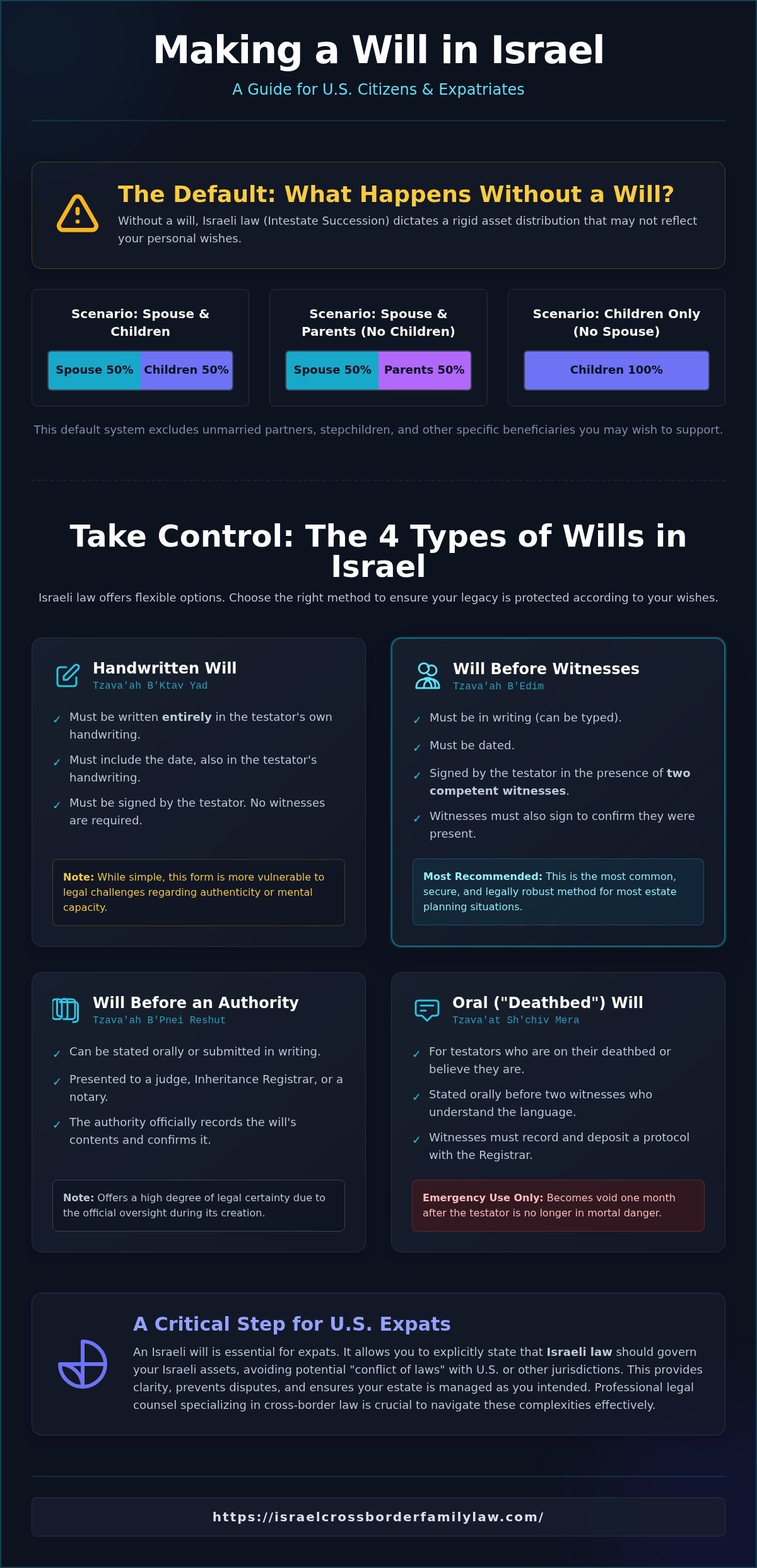
In the absence of a valid will, your estate is subject to the default rules of intestate succession as defined by Israeli law. This creates a rigid, predetermined hierarchy for distribution that may not align with your intentions. The primary order of inheritance is as follows:
- Your surviving spouse inherits 50% of the estate, with the remaining 50% divided equally among your children.
- If there are no children, the spouse inherits 50%, and your parents inherit the other 50%.
- If there is no spouse, your children inherit the entire estate equally.
This statutory framework does not account for the nuanced realities of modern relationships, potentially excluding unmarried partners, stepchildren, or specific friends and charitable organizations you wished to support. For blended families, this can lead to unintended consequences and significant legal complications.
Special Considerations for Foreign Nationals & Dual Citizens
Navigating multi-jurisdictional estates presents a unique set of challenges, chief among them the question of which country’s law applies to your Israeli assets. Israeli law generally allows for the application of the law of the deceased’s domicile at the time of death. However, this can create ambiguity and potential conflict of laws. A professionally drafted Israeli will provides a critical solution by allowing you to explicitly state that Israeli law should govern the distribution of your Israeli assets. This proactive step is essential for managing assets across multiple legal systems and is a core part of our dedicated services for expats and foreign nationals.
The Four Types of Wills Recognized Under Israeli Law
Israel’s Succession Law, 1965, provides a robust and flexible framework for estate planning, recognizing four distinct methods for creating a legally valid will. This multi-faceted approach allows individuals, including foreign nationals with assets in the country, to choose a format that best suits their unique personal and logistical circumstances. However, each type is governed by strict formal requirements, and failure to comply can render the document invalid. Navigating these complexities is a critical aspect of successfully making a will in Israel, and expatriates may find valuable preliminary guidance from community resources such as the Association of Americans and Canadians in Israel. Below, we detail the four recognized forms.
The Handwritten Will (Tzava’ah B’Ktav Yad)
This is the most straightforward type of will. For it to be valid, the document must be written entirely in the testator’s own handwriting, include the date it was written (also in the testator’s handwriting), and be signed by the testator. No witnesses are required. While its simplicity is appealing, this form is often more susceptible to challenges regarding its authenticity or the testator’s capacity at the time of writing, potentially leading to complex probate proceedings.
The Will Before Witnesses (Tzava’ah B’Edim)
Considered the most common and secure form, this will is the professionally recommended method for most situations. The will must be in writing (it can be typed) and bear a date. The critical step involves the testator signing the will, or declaring that the signature on it is their own, in the presence of two legally competent and disinterested witnesses. The witnesses must then, in the testator’s presence, confirm on the will itself that the testator made this declaration and signature.
The Will Before an Authority (Tzava’ah Bifnei Rashut)
This method provides a high degree of legal certainty and evidentiary weight. A testator may create this will by stating their final wishes orally before a judge, a notary, or the Registrar of Inheritance. The authority’s role is to accurately transcribe the testator’s instructions into a formal document, read it back to the testator, and have them declare it as their will. A will executed in this manner carries a strong presumption of validity and is exceptionally difficult to contest.
The Oral or ‘Deathbed’ Will (Tzava’ah She’Chiv Mera)
This is an extraordinary provision reserved for individuals who are on their deathbed or otherwise believe themselves to be facing imminent death. The testator must state their wishes orally before two witnesses who understand their language. These witnesses are then legally obligated to record the testator’s instructions in a memorandum (zichron devarim) as soon as possible and deposit it with the Registrar of Inheritance. This form of making a will in Israel is temporary; it becomes void one month after the circumstances that justified its creation have passed.
A Practical Guide to Drafting a Legally Sound Israeli Will
While a qualified Israeli lawyer must draft the final legal document, thorough preparation is a critical preliminary step for any foreigner. This strategic planning streamlines the complex legal process, minimizes potential legal fees, and is fundamental to ensuring your intentions are executed precisely and without ambiguity. A well-organized plan provides the essential foundation for successfully making a will in israel and mitigating the risk of future legal challenges by heirs.
Step 1: Inventory Your Israeli Assets & Liabilities
The cornerstone of your estate plan is a comprehensive and meticulous inventory of all assets and liabilities situated within Israel. Precision is paramount to ensure no asset is overlooked during the probate process, which could lead to significant complications. Your inventory should be detailed and include:
- Real Property: List all real estate holdings with their full, official addresses, such as an apartment in Tel Aviv or land holdings in the Galilee region.
- Financial Accounts: Detail all bank accounts (e.g., accounts with Bank Leumi or Hapoalim), investment portfolios, and pension funds held with Israeli financial institutions.
- Valuable Personal Property: Itemize significant personal effects of substantial value located in Israel, including artwork, Judaica collections, or jewelry.
- Liabilities: Document any outstanding debts tied to your Israeli assets, including mortgages, secured loans, or other financial obligations.
Step 2: Appoint an Executor (Menahel Izavon)
The executor, known in Hebrew as the Menahel Izavon, is the individual or entity entrusted with the fiduciary duty of administering your estate. This role is critical, involving settling debts, managing assets, and distributing the inheritance according to your will’s directives. You may appoint a trusted family member, your Israeli attorney, or a professional corporate trustee. The choice requires careful consideration of the individual’s integrity, financial acumen, and ability to navigate Israeli bureaucracy.
Step 3: Designate Beneficiaries and Specify Bequests
Ambiguity is the primary catalyst for estate litigation. To prevent disputes, you must clearly identify each beneficiary by their full legal name and state their relationship to you. Bequests must be specific and unequivocal; for example, “I bequeath my apartment located at 123 Rothschild Boulevard, Tel Aviv, to my daughter, Sarah Cohen.” It is also prudent business to establish contingency plans by naming alternate beneficiaries should a primary one predecease you, ensuring your assets are distributed exactly as you intend when making a will in israel.
Cross-Border Complexities: Common Pitfalls for US Citizens to Avoid
For US citizens with assets, family, or business interests in Israel, estate planning extends far beyond a single document. The interplay between two distinct legal systems creates a sophisticated, multi-jurisdictional challenge where a US-centric approach is fraught with risk. Failing to coordinate your US and Israeli estate plans can lead to conflicts, significant delays, and unintended consequences for your beneficiaries. Navigating this complex landscape requires experienced legal counsel capable of harmonizing the requirements of both nations to ensure your final wishes are honored seamlessly.
Relying on a US-Only Will for Israeli Assets
While an Israeli court may recognize a will validly executed in the United States, subjecting it to the probate process here can be a prolonged and costly affair. The procedure requires submitting the original will along with a sworn Hebrew translation, an expert legal opinion confirming its validity under US law, and an apostille certification. A far more efficient and secure strategy is drafting a separate, Israeli-compliant will specifically for your Israeli assets, which greatly simplifies the probate process and minimizes the potential for legal challenges or misinterpretations by the court.
Ignoring Different Legal Terminology and Concepts
A critical error is assuming that legal concepts translate directly between the US and Israel. For example, the “living trust,” a cornerstone of US estate planning, does not have an exact equivalent in Israeli law and can create significant confusion. Similarly, the roles and powers of an “executor” can differ substantially. Effective cross-border estate planning demands a legal advisor fluent in both legal frameworks, capable of structuring your will using precise Israeli terminology to ensure your intentions are legally unambiguous and enforceable.
Failing to Update Wills After Major Life Events
Significant life changes such as marriage, the birth of a child, or divorce necessitate an immediate review of your estate plan in both jurisdictions. This is especially critical in cases of marital dissolution. Unlike many US states where divorce automatically revokes provisions for a former spouse, Israeli law does not make this assumption. A failure to update your will post-divorce could result in an ex-spouse inheriting your Israeli assets, a common and devastating oversight in cases of divorce for international families.
Successfully making a will in Israel as a US citizen requires a holistic, cross-border strategy, not just a document. To protect your legacy and ensure a smooth transfer of assets, it is imperative to seek sophisticated legal guidance to navigate these multi-jurisdictional challenges effectively.
The Next Step: The Israeli Probate Process (Tzav Kiyum Tzava’ah)
Executing a legally sound will is the foundational step in securing your estate. However, the process of giving that will legal effect after the testator’s passing is an equally critical phase. In Israel, this is accomplished through the probate process, known in Hebrew as Tzav Kiyum Tzava’ah. While any legal procedure can seem daunting, particularly in a cross-border context, the Israeli probate system is a structured administrative process designed to validate the will and facilitate the lawful distribution of assets to the designated heirs. A meticulously drafted will is the key to navigating this stage efficiently and with minimal complications.
Filing for a Probate Order
A Probate Order is the official decree issued by the Inheritance Registrar that confirms the will’s validity. This order empowers the executor to act on the will’s instructions, such as transferring property and distributing funds. The application is typically submitted by a beneficiary or the executor named in the will. A comprehensive submission is essential for a smooth review and includes several key documents:
- The original executed will.
- An official death certificate of the testator.
- A completed application form for a probate order.
- Proof of payment for all applicable government fees.
- Notarized Hebrew translations of any documents not in Hebrew or Arabic.
The Role of the Inheritance Registrar
The application for a probate order is filed with the Inheritance Registrar (HaRasham Le’Inyanei Yerusha), an administrative body that functions under the Ministry of Justice. The Registrar’s primary role is to examine the application and the will to ensure they comply with the formal requirements of Israel’s Succession Law. Upon receiving a valid application, the Registrar will publish a notice of the filing, providing a specific period during which third parties may submit formal objections to the will’s probate.
Handling Objections and Contesting a Will
Objections to a will, while not common, can arise on several grounds, including claims of undue influence, lack of testamentary capacity, or procedural flaws in the will’s creation. This is precisely where professional legal drafting demonstrates its value. A will that is clear, unambiguous, and executed in strict accordance with Israeli law creates a formidable defense against potential challenges. The strategic foresight involved in properly making a will in israel is intended to minimize these risks, ensuring the testator’s true intentions are honored without dispute. Expert legal representation is crucial for both defending a will against challenges and navigating the complexities of the probate process.
For sophisticated guidance on all aspects of Israeli inheritance law, from drafting to probate, our experienced legal team is prepared to assist in protecting your cross-border estate.
Navigating Your Cross-Border Estate with Confidence
As we have explored, the process of making a will in israel is a critical undertaking for US citizens and expatriates, essential for overriding default succession laws and ensuring your assets are distributed according to your express wishes. Successfully navigating this landscape requires a sophisticated understanding of the four recognized will types and the subsequent probate process, all while strategically avoiding the complex cross-border pitfalls that can jeopardize a multi-jurisdictional estate. The intersection of Israeli and US inheritance law demands meticulous, forward-thinking planning.
Given these complexities, securing expert guidance is paramount. Our firm offers specialized expertise in US-Israel cross-border law, providing international families and foreign nationals with counsel built on a deep understanding of both legal systems and cultures. We are uniquely positioned to ensure your estate plan is both legally sound and culturally resonant. Secure your legacy. Request a confidential case review with our cross-border legal experts.
Take the definitive step today to ensure your wishes are honored and your legacy is preserved, no matter where your life has taken you.
Frequently Asked Questions
Do I need a separate will for my assets in Israel if I have one in the US?
While a US will can cover global assets, it is highly advisable to create a separate Israeli will for assets located within Israel. This strategic approach avoids complex multi-jurisdictional conflicts of law, significantly streamlines the probate process, and reduces potential delays and legal costs. A dedicated Israeli will ensures your estate is administered efficiently and in accordance with your wishes under the specific framework of Israeli succession law, providing clarity for both your heirs and the court.
Can I write my Israeli will in English?
Yes, under Israeli law, a will may be drafted in any language, including English, provided the testator fully understands its contents. For foreign nationals, executing a will in their native language is a common and accepted practice. However, it is crucial that the language is precise and unambiguous. Note that during the probate process, the Inheritance Registrar may require a notarized Hebrew translation of the will, which is a standard procedural step for non-Hebrew documents.
How much does it cost to make a will with a lawyer in Israel?
The legal fees for drafting a will in Israel vary based on the complexity of the estate and the law firm’s expertise. For a standard individual will, professional fees typically range from ₪3,000 to ₪8,000. More sophisticated wills involving international assets, trusts, or complex family structures may incur higher costs. It is essential to obtain a clear fee structure from your legal counsel before engaging their services to ensure full transparency and proper management of your legal budget.
What is a ‘mutual will’ in Israel, and is it recommended for couples?
A mutual will is a single testamentary document executed by two individuals, typically spouses, that dictates the disposition of their assets. Its key feature is that the surviving partner is legally bound by its terms and cannot alter the will after the first partner’s passing. While this provides certainty, the restriction on testamentary freedom can be problematic if circumstances change. Couples should seek expert legal counsel to navigate the complexities of making a will in Israel before deciding if this binding arrangement is suitable.
How is a foreign will recognized or probated in Israel?
For a foreign will to be legally recognized in Israel, it generally must first be probated in its jurisdiction of origin. Following this, an application, supported by the authenticated foreign probate order, must be submitted to the Israeli Inheritance Registrar or Family Court. The court then reviews the application to grant an order enforcing the foreign will for the assets located in Israel. This multi-step process can be significantly more complex and time-consuming than probating a locally drafted will.
Who can be a witness to a will in Israel?
To be valid, a formal will in Israel must be signed in the presence of two competent witnesses. A witness must be at least 18 years of age and legally competent (of sound mind). Crucially, neither the witness nor their spouse can be a beneficiary named in the will, as this would invalidate the provision benefiting them. Both witnesses must be present at the same time to observe the testator signing the will and then sign it themselves in the testator’s presence.

Article by
Gabriel Lior
A Personal Journey That Became a Mission
The advisory was founded by an American father Gabriel Lior, LLB, MBA , global entrepreneur, and cross-border advisor who spent more than a decade navigating the Israeli family court system firsthand and now lives in Singapore with his son.
As a divorced parent in a cross-border family, Gabriel faced nearly every legal challenge a foreign parent can encounter in Israel — including child custody disputes, child support proceedings, property matters in Israel and abroad, false accusations, and complex immigration and relocation proceedings.
Over the years, he learned the hard way how difficult it is for non-Israeli parents to understand the system, identify the right legal strategy, and choose the right legal representation — especially when language, culture, and jurisdictional differences are involved. He also witnessed how foreign parents and new immigrants are often disadvantaged or taken advantage of by service providers and institutions simply because they lack local knowledge or fluency.
From Client to Advisor
To truly understand — and survive — the system, Gabriel pursued formal legal education in Israel, completing two Israeli law degrees, alongside a BA and MBA earned in the United States. This was never about becoming a practicing attorney, but about gaining a deep, structural understanding of how the system works — and where it breaks down for foreign parents.
This rare combination of:
Firsthand client experience
Israeli legal and US business education
International business and negotiation training
Decades of commercial execution
created a unique perspective – one that understands both sides of the table.
After years of litigation, persistence, and at times self-representation, he ultimately succeeded in securing custody of his son and relocating abroad through a rare legal victory in the Israeli Supreme Court — becoming one of the first fathers in Israel to do so under these circumstances.
Disclaimer
Important Disclaimer:
The information provided on this website and in its content is for general informational and educational purposes only and does not constitute legal advice, legal opinion, or legal representation.
Gabriel Lior is not licensed to practice law in Israel (nor is he interested in doing so) and does not provide legal services, despite having completed 2 Law Degrees. The services offered are advisory in nature and are intended to provide general guidance, strategic insight, and information regarding cross-border family law considerations.
No attorney-client relationship is formed by accessing this website, reading its content, or communicating with us.
Any decisions made based on this information are at your own discretion and risk. For legal advice specific to your situation, you should consult a licensed attorney in the relevant jurisdiction.
Where appropriate, we may refer clients to independent, licensed attorneys or professionals. Such referrals do not constitute legal representation and no liability is assumed for services provided by third parties.