The most significant factor in your cross-border divorce costs Israel US isn’t necessarily the hourly rate of your attorney; it’s the strategic decision of where you file first. You likely feel overwhelmed by the prospect of managing legal fees across two continents while worrying about being trapped in a legal system you don’t fully understand. It’s natural to fear that dual-filing requirements, language barriers, and translation fees will drain your resources before you even reach a resolution.
This guide provides a clear breakdown of the fee structures in both systems, from mandatory Israeli settlement applications to the hidden costs of international document certification. We’ll explore how to avoid the “double-litigation” trap and maintain control over your financial future during this transition. This content is published on an independent advisory platform, not a law firm. It’s intended for informational and strategy purposes rather than legal representation or formal legal advice. Strategy and risk guidance are provided to help you make informed decisions before you commit to a specific legal path.
Key Takeaways
- Understand how the “Race to Court” determines the legal framework for your case and directly impacts your total cross-border divorce costs Israel US.
- Learn the fundamental differences between Israel’s “global fee” structure per litigation stage and the traditional US hourly billing model.
- Identify hidden expenses unique to international cases, such as certified document translations and the requirement for mirror orders to divide US-based retirement accounts.
- Discover how mediation and unbundled advisory services can serve as cost-effective alternatives to high-conflict litigation across two legal systems.
- Recognize the importance of mapping out a comprehensive strategy before engaging a litigator to avoid double-litigation and unpredictable legal fees.
Variables Affecting Cross-Border Divorce Costs Between Israel and the US
Calculating the total cross-border divorce costs Israel US requires looking at more than just attorney fees. The complexity of distributing assets across two continents introduces variables that don’t exist in domestic cases. When assets like real estate, pension funds, or business interests are split between the US and Israel, you face a significant conflict of divorce laws. This conflict determines which country’s rules apply to which asset, often requiring specialized expertise to navigate correctly.
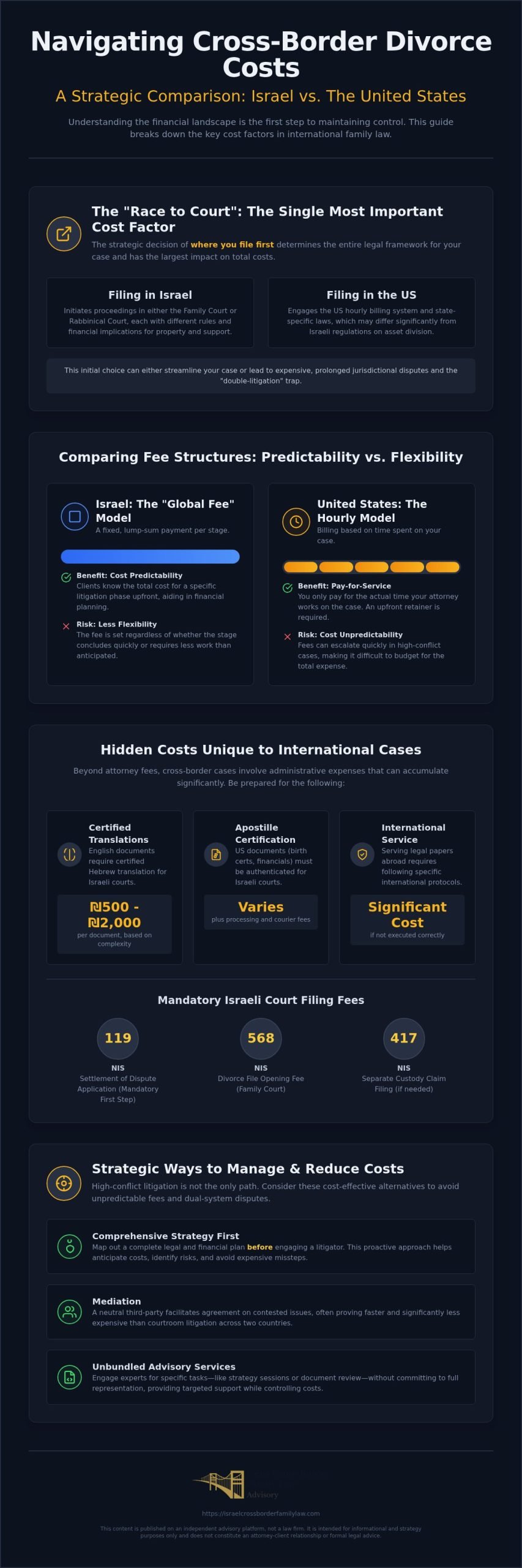
In Israel, the choice of venue adds another layer of financial unpredictability. You must decide whether to file in the secular Family Court or the religious Rabbinical Court. Since each system has different procedures regarding property and support, your initial choice can either streamline your case or lead to expensive jurisdictional disputes. As of January 2026, even starting this process requires a mandatory “Settlement of Dispute” application fee of 119 NIS, which is the required first step before any litigation can proceed.
To better understand the complexities of international jurisdiction, watch this helpful video:
Primary Drivers of Legal Expenses
The number of contested issues is the most direct predictor of your total expense. If you and your spouse disagree on child custody or international relocation, the required legal hours will increase. International relocation cases are particularly intensive. They often require expert testimony and detailed social worker reports to determine the child’s “center of life.”
Process service also carries unique costs. Serving legal papers to a spouse living in the US while you’re in Israel involves specific international protocols. If these steps aren’t followed perfectly, the Israeli court might not recognize the service. This forces you to repeat the process and pay additional fees. For high-net-worth individuals, the need for cross-border financial experts to value international holdings or perform a “balance of resources” analysis further adds to the professional fee structure.
Hidden Administrative and Translation Costs
Many people overlook the administrative burden involved in international litigation. Any US document, such as a birth certificate or a financial statement, must have an Apostille to be recognized by Israeli authorities. These certifications ensure the document is authentic but come with their own processing fees and courier costs. You’ll also face a standard divorce file opening fee in the Family Court of 568 NIS, with additional fees if specific claims for custody (417 NIS) are filed separately.
Translation is another unavoidable expense. Since Hebrew is the official language of the Israeli court system, English documents must be translated by a certified professional. Based on current 2026 data, certified document translation typically costs between ₪500 and ₪2,000, depending on the length and technical nature of the text. You should also account for travel expenses if witnesses living abroad need to appear in person. Mapping out these variables early through a strategic advisory session helps you anticipate these costs before they arise. This content is published on an independent advisory platform and does not constitute an attorney-client relationship.
Comparing Fee Structures: Israel’s Global Fees vs. US Hourly Billing
Understanding the fundamental difference between legal billing systems is essential for managing your expectations and your budget. In the United States, the dominant model for family law is hourly billing. You’ll typically provide a significant upfront retainer, and the attorney deducts their hourly rate from that fund. In contrast, Israeli practitioners often use a “Global Fee” structure. This is a lump sum payment that covers a specific stage of the litigation. Each model has distinct advantages and risks that directly impact your total cross-border divorce costs Israel US.
The US model provides flexibility because you only pay for the time actually spent on your file. However, it offers less predictability. High-conflict cases often lead to “evergreen retainers,” where you must replenish the account whenever it falls below a certain amount. For those living abroad, reviewing a practical guide to international divorce can help you understand how these domestic practices interact with international requirements. In Israel, the global fee model offers more certainty, but it may feel less flexible if your case resolves quickly.
The Israeli Global Fee Model
Israeli fee agreements are generally divided into “instances.” The first instance covers the proceedings in the Family Court through the final judgment. If either party appeals, a second global fee is usually required. It’s vital to check your agreement for exclusions. While the fee covers court appearances, it rarely includes international travel or extensive document translation. The Rabbinical Court may also require separate fees if you are handling the religious divorce (the “Get”).
Expert Witness and Third-Party Expenses
Third-party expenses are a major component of cross-border divorce costs Israel US. Israeli courts frequently appoint neutral experts whose fees are separate from your attorney’s costs. In custody disputes, you’ll likely share the cost of a court-appointed psychologist. If assets are split between nations, you’ll need appraisers for real estate in both countries. Actuarial experts are also necessary to evaluate US-based retirement accounts or Israeli “Monei Prisha” to ensure a fair balance of resources.
Before you commit to a specific attorney or billing model, it’s helpful to map out your potential exposure. You can reach out for a strategy session to discuss your options. This platform operates as an independent advisory service and is not a law firm; we focus on strategy and risk mitigation rather than direct legal representation.
The Cost of Jurisdiction: Why Where You File Matters
The most impactful variable in your cross-border divorce costs Israel US is often determined in the first few days of the separation. In Israel, this is known as the “Race to Court” or Merotz Samchuyot. Because Israel maintains a dual court system (secular Family Courts and religious Rabbinical Courts), the party who files first often dictates which legal framework will govern asset division and support. If you lose this race, you may find yourself litigating under a system that’s less favorable to your financial position, leading to increased legal hours as you attempt to rectify the situation.
Filing in the “wrong” country or court doesn’t just result in a tactical disadvantage; it creates a massive financial drain. You can easily spend tens of thousands of shekels on preliminary hearings just to determine if the court has the authority to hear your case. These jurisdictional battles can last for years before the actual merits of the divorce are even discussed. If a child is moved between the US and Israel without a clear agreement, you may also face the high cost of a Hague Convention claim. Defending or prosecuting these international child abduction cases typically requires a specialized skill set, with costs often ranging from ₪75,000 to over ₪225,000 depending on the complexity of the relocation dispute.
Strategic Jurisdiction Selection
Smart financial planning requires analyzing which legal system favors your specific assets and income structure. For example, Israeli courts have recently shifted toward a stronger presumption of shared ownership for pre-marital property in long-term marriages. If your assets are primarily located in the US, it’s often more cost-effective to seek a judgment there and then use an Israeli attorney to enforce it via “comity” or a mirror order. You can explore more about these jurisdictional strategies in our guide to international custody and relocation. Choosing the right path early prevents the need to start from scratch in a second country.
The Financial Toll of Dual-Proceedings
Dual-litigation, or litigating in both the US and Israel simultaneously, is the most expensive path possible. You’re effectively paying two separate legal teams to perform redundant work in two different time zones. To manage these costs, we often recommend a “Forum Non Conveniens” motion, which argues that one court is a more appropriate venue than the other. Successfully securing a “Stay of Proceedings” can pause litigation in one jurisdiction, allowing you to consolidate your legal spend and avoid conflicting judgments. Early advisory sessions are essential to identify these risks before you’re hit with double-billing from two different law firms. This platform provides strategy and risk-mitigation guidance as an independent advisory service and does not establish an attorney-client relationship.
Get clarity before you commit. Request a confidential consultation to map out your jurisdictional strategy.
Strategic Ways to Manage and Reduce International Divorce Costs
Managing cross-border divorce costs Israel US requires moving from a reactive stance to a proactive strategy. The most expensive divorces are those where parties rush into litigation without calculating the long-term financial impact of their jurisdictional choices. By adopting a “clarity before commitment” philosophy, you can identify which battles are worth the legal spend and which can be resolved through alternative channels. This approach prevents you from being trapped in expensive, redundant legal proceedings in two different countries.
Prioritizing Mediation and Settlement
Israeli law includes a mandatory first step designed to reduce conflict: the “Dispute Resolution” or Mahut sessions. These meetings allow you to explore settlement options before a single piece of evidence is presented in court. If you can reach an agreement here, you avoid the escalating costs of expert witnesses and multiple court hearings. Drafting a comprehensive Financial Agreement, or Heskem Mamon, is often the most cost-effective way to finalize your divorce. While the fee for court approval of a divorce agreement is 536 NIS, a moderately contested divorce can easily exceed ₪150,000 in legal fees. Choosing settlement early preserves your marital estate for your family rather than spending it on years of litigation.
Early Decision-Making as a Cost-Saving Tool
You can significantly reduce attorney billable hours by preparing your own documentation before your first meeting. Organizing bank statements, property deeds, and tax returns from both the US and Israel allows your legal team to focus on strategy rather than administrative data entry. It’s also vital to identify your non-negotiables early. Knowing exactly what you want regarding child support or asset division prevents the legal clock from ticking during emotional debates. You’ll also avoid the confusion of dual-filing costs by deciding on a primary jurisdiction from the outset.
Interim orders, such as temporary alimony or custody arrangements, carry immense weight. These early decisions often set the tone for the entire case and can be difficult to change later. Because of this, investing in an unbundled advisory session is a high-value move. A single one-hour strategic session can save thousands in future litigation. This platform provides strategy and risk-mitigation guidance as an independent advisory service. It’s not a law firm and doesn’t establish an attorney-client relationship.
You don’t have to navigate these financial complexities alone. You can schedule a strategic review to map out your cost-reduction plan.
The Israel Cross Border Advisory Approach to Family Law
Navigating the Israeli legal system as an Anglo requires a guide who understands both worlds. Israel Cross Border Law Firm provides the strategic clarity necessary to manage cross-border divorce costs Israel US by explaining complex procedures in plain English. We focus on bridging the gap between your expectations from the US legal system and the procedural reality of Israeli courts. By mapping out a comprehensive strategy before you engage a litigator, you gain control over your financial outcome and avoid the common pitfalls of international family law. This content is published on an independent advisory platform (not a law firm) and is designed for informational purposes. Legal services are only provided by licensed attorneys under a separate engagement.
Getting Clarity Before You Commit
A confidential case review allows you to assess jurisdictional risks before they become permanent financial burdens. We help you understand the weight of early decisions, such as where to file first, which determines the entire trajectory of your case. You can refer to our pricing page for full transparency regarding our advisory fee structures. This early investment in strategy ensures you don’t waste resources on redundant legal filings or unnecessary jurisdictional battles in two different time zones.
Resources for English Speakers in Israel
Education is the most effective tool for cost containment. You can access a wealth of educational content through our YouTube channel, which breaks down specific issues like the Hague Convention and international asset division. We also offer specialized guidance for expats and foreign nationals who may not be familiar with the “Center of Life” test or the authority of the Rabbinical Court. The most expensive mistake is acting without a cross-border plan; seeking clarity first is the only way to ensure your financial and legal security.
Securing Your Financial Future Across Borders
Navigating a divorce that spans two legal systems requires a specialized strategy tailored for international families. You’ve seen how the “Race to Court” and the fundamental differences between Israeli global fees and US hourly billing can dramatically shift your total cross-border divorce costs Israel US. By prioritizing mediation and understanding the weight of early interim orders, you can avoid the “double-litigation” trap that often drains marital estates. Our calm, advisory-first approach provides you with a deep understanding of the US-Israel legal bridge before you hire a litigator.
This platform serves as an independent advisory service and not a law firm. We provide informational guidance focused on strategy and risk mitigation; we don’t offer legal representation or establish attorney-client relationships. Taking the time to map out your “non-negotiables” and jurisdictional path now prevents expensive strategic errors later. You have the power to control your financial outcome through informed, deliberate decision-making. Get clarity before you commit. Request a confidential consultation today to begin your path forward with confidence.
Frequently Asked Questions
Is it cheaper to divorce in Israel or the US?
The total cost depends on your specific asset structure and the billing model of your chosen practitioners. Israel’s “global fee” model per stage of litigation can offer more predictability for straightforward cases compared to the US hourly billing system. However, high-conflict international cases involving relocation or complex business valuations often result in similar total expenses regardless of where you file. Early strategy is the most effective way to control these costs.
Does the Israeli court accept US-style prenuptial agreements?
Israeli courts do recognize foreign prenuptial agreements, but they must undergo a formal validation process to be enforceable in Israel. Under the Financial Relations Law, an agreement must be reviewed to ensure it was entered into freely and that it doesn’t violate Israeli public policy. If you’re an Anglo with a US agreement, you’ll likely need a certified translation and a validation hearing in the Family Court or Rabbinical Court.
How much are the court filing fees in Israel for a divorce?
Court fees are standardized and updated annually by the Israeli government. As of January 2026, the mandatory “Settlement of Dispute” application fee is 119 NIS. Opening a standard divorce file in the Family Court costs 568 NIS, while a specific claim for child custody requires a fee of 417 NIS. Approval of a mutual, uncontested divorce agreement costs 536 NIS. These fees are separate from your attorney’s professional fees.
Will I have to pay for a translator during Israeli court hearings?
You are responsible for providing and paying for a certified translator if you are not fluent in Hebrew. While many judges are proficient in English, the official court record and all formal transcripts must be in Hebrew. Certified translation for legal documents typically costs between ₪500 and ₪2,000. Budgeting for simultaneous translation during hearings is essential to ensure you fully understand the proceedings and that your testimony is recorded accurately.
Can I avoid cross-border costs by using mediation?
Mediation is the most effective tool to reduce cross-border divorce costs Israel US by avoiding redundant litigation in two countries. Reaching a settled “Financial Agreement” (Heskem Mamon) allows you to resolve issues like asset division and support without paying for years of jurisdictional battles. This approach also eliminates the need for expensive, court-appointed experts. Mapping out a settlement strategy early preserves your family’s resources for the future.
How do legal fees work if I have a lawyer in both the US and Israel?
You’ll typically manage two distinct billing structures simultaneously. Your US attorney will likely require an upfront retainer and bill hourly, while your Israeli attorney will often charge a global fee for the entire “instance” or stage of the case. Coordinating these two teams is vital to prevent redundant work. This platform provides strategy and risk guidance as an independent advisory service, helping you manage these dual-representation costs effectively.
What happens if my spouse files in the US after I file in Israel?
This situation triggers a jurisdictional conflict that often requires a “Stay of Proceedings” or a motion to dismiss based on the more appropriate venue. The “Race to Court” is a significant factor, but the court will also consider where the family’s “Center of Life” is located. These battles are expensive and technical, requiring specialized research into international treaties and comity principles to determine which country has the authority to hear the case.
Are child support enforcement costs higher in cross-border cases?

Article by
Gabriel Lior
A Personal Journey That Became a Mission
The advisory was founded by an American father Gabriel Lior, LLB, MBA , global entrepreneur, and cross-border advisor who spent more than a decade navigating the Israeli family court system firsthand and now lives in Singapore with his son.
As a divorced parent in a cross-border family, Gabriel faced nearly every legal challenge a foreign parent can encounter in Israel — including child custody disputes, child support proceedings, property matters in Israel and abroad, false accusations, and complex immigration and relocation proceedings.
Over the years, he learned the hard way how difficult it is for non-Israeli parents to understand the system, identify the right legal strategy, and choose the right legal representation — especially when language, culture, and jurisdictional differences are involved. He also witnessed how foreign parents and new immigrants are often disadvantaged or taken advantage of by service providers and institutions simply because they lack local knowledge or fluency.
From Client to Advisor
To truly understand — and survive — the system, Gabriel pursued formal legal education in Israel, completing two Israeli law degrees, alongside a BA and MBA earned in the United States. This was never about becoming a practicing attorney, but about gaining a deep, structural understanding of how the system works — and where it breaks down for foreign parents.
This rare combination of:
Firsthand client experience
Israeli legal and US business education
International business and negotiation training
Decades of commercial execution
created a unique perspective – one that understands both sides of the table.
After years of litigation, persistence, and at times self-representation, he ultimately succeeded in securing custody of his son and relocating abroad through a rare legal victory in the Israeli Supreme Court — becoming one of the first fathers in Israel to do so under these circumstances.
Disclaimer
Important Disclaimer:
The information provided on this website and in its content is for general informational and educational purposes only and does not constitute legal advice, legal opinion, or legal representation.
Gabriel Lior is not licensed to practice law in Israel (nor is he interested in doing so) and does not provide legal services, despite having completed 2 Law Degrees. The services offered are advisory in nature and are intended to provide general guidance, strategic insight, and information regarding cross-border family law considerations.
No attorney-client relationship is formed by accessing this website, reading its content, or communicating with us.
Any decisions made based on this information are at your own discretion and risk. For legal advice specific to your situation, you should consult a licensed attorney in the relevant jurisdiction.
Where appropriate, we may refer clients to independent, licensed attorneys or professionals. Such referrals do not constitute legal representation and no liability is assumed for services provided by third parties.