For international families, confronting matters of parentage across borders introduces a layer of profound complexity. The Israeli legal system, with its unique blend of civil and religious statutes, can appear intimidating, leaving you uncertain of your rights and obligations when managing a case from abroad. Understanding the specific procedures of paternity law in Israel is therefore not merely a procedural step; it is the critical foundation for establishing legal rights, securing a child’s welfare, and defining familial relationships for a lifetime. The stakes are incredibly high, touching upon everything from financial stability to national identity.
This comprehensive guide is engineered to provide clarity and confidence as you navigate this sophisticated legal landscape. We will meticulously outline the complete legal process, from filing a paternity lawsuit in the Israeli Family Court to the critical considerations of DNA testing and its consequences. You will gain a clear understanding of the legal impact on child support, custody arrangements, inheritance rights, and the potential pathways to Israeli citizenship for your child. Our objective is to equip you with the knowledge and strategic insight required to approach your case with certainty and achieve a successful outcome.
Key Takeaways
- Recognize that Israeli law treats paternity as a distinct legal status, where only the Family Affairs Court possesses the authority to order a legally binding genetic test.
- Discover the strategic importance of compiling sufficient preliminary evidence before filing a paternity lawsuit, as courts are cautious about ordering tests without a reasonable basis.
- For international families, navigating paternity law in Israel involves complex cross-border jurisdictional challenges that require specialized legal guidance when a party resides abroad.
- Understand that a court’s declaration of paternity is not merely a finding of fact; it establishes binding legal obligations and rights concerning child support, custody, and inheritance.
Foundations of Israeli Paternity Law: Why It’s Unique
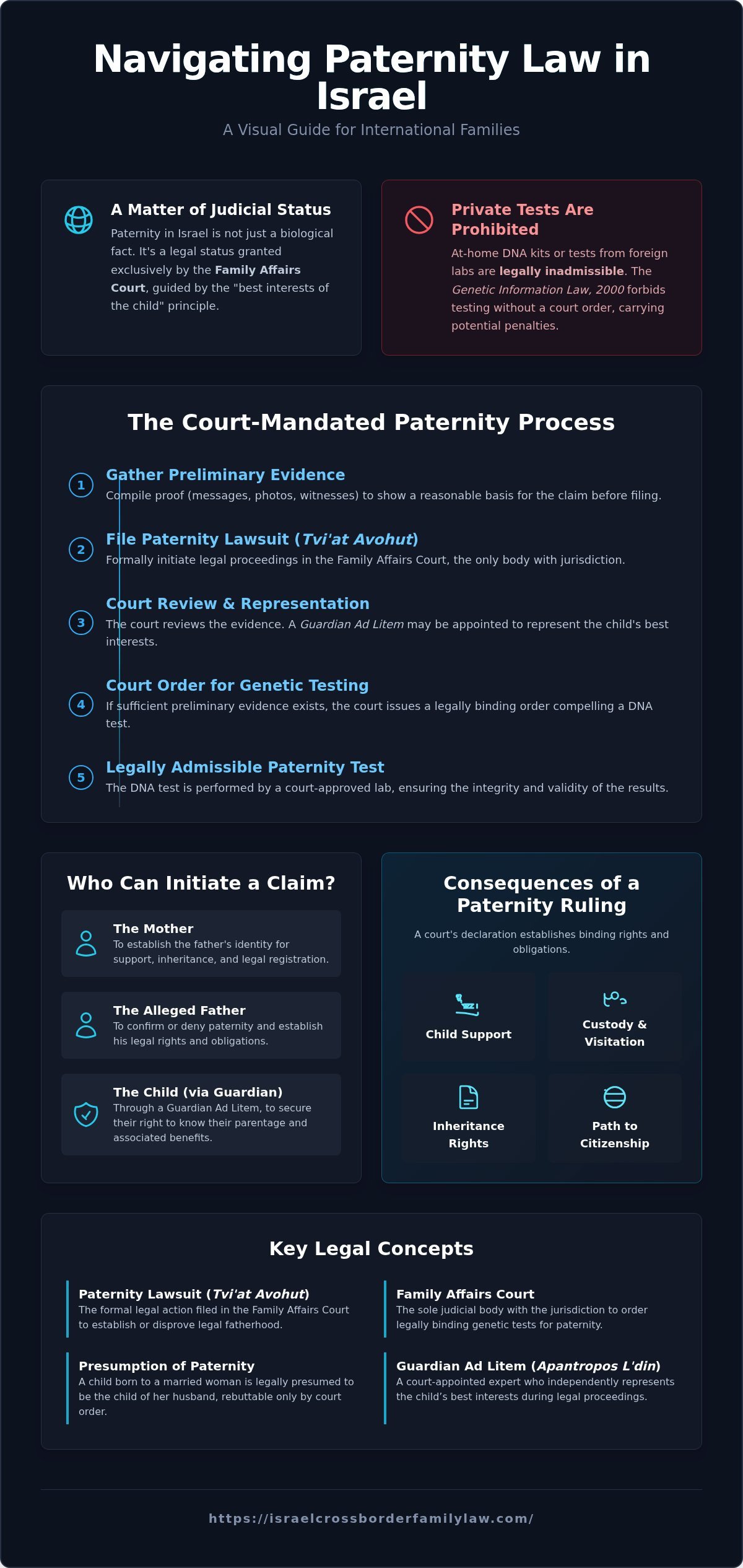
Navigating the complex framework of paternity law in Israel requires understanding a fundamental principle: legal fatherhood is a matter of judicial status, not merely a biological fact. Unlike in many Western jurisdictions where private DNA testing is common, Israeli law centralizes this authority exclusively within the Family Affairs Court. This sophisticated legal structure is designed to protect the child, with the court’s primary guiding principle being the “best interests of the child” (tovat ha’yeled). This doctrine weighs the potential psychological and social consequences of a paternity determination against the right to know one’s parentage. Consequently, establishing paternity has profound implications for a child’s personal status, inheritance rights, and even citizenship, a critical factor in cases involving paternity testing for immigration. This system reflects a unique intersection of civil legislation and the influence of religious law, which plays a significant role in matters of personal status for Jewish and other recognized religious communities.
To provide a clearer overview of this judicial process, the following video explains the key elements of a paternity decision in Israel:
The Prohibition on Private Paternity Tests
A critical component of Israeli paternity law is the strict prohibition on conducting genetic testing without a court order. The Genetic Information Law, 2000, explicitly forbids laboratories from performing, and individuals from commissioning, a paternity test outside the judicial framework. The results of at-home DNA kits or tests performed in foreign labs are legally inadmissible in an Israeli court. Attempting to bypass the Family Affairs Court can result in significant civil and even criminal penalties, as the law is designed to prevent the potential harm and social complications that could arise from an unregulated determination of parentage.
Key Legal Terms and Concepts
Understanding the specific terminology used in the Israeli legal system is essential for anyone involved in a paternity case. Key concepts include:
- Paternity Lawsuit (Tvi’at Avohut): This is the formal legal action filed in the Family Affairs Court to either establish or disprove legal fatherhood.
- Family Affairs Court (Beit Mishpat le’Inyanei Mishpacha): The sole judicial body in Israel with the jurisdiction to hear paternity cases and issue legally binding orders for genetic testing.
- Presumption of Paternity: Israeli law presumes that a child born to a married woman is the child of her husband. This presumption can only be rebutted through a court-ordered process.
- Guardian Ad Litem (Apantropos L’din): A court-appointed representative, typically a social worker or an attorney, tasked with independently assessing and representing the child’s best interests throughout the legal proceedings.
The Legal Process: How to File a Paternity Lawsuit in Israel
Navigating paternity law in Israel requires a structured and methodical approach through the judicial system. The primary objective of a paternity lawsuit is not to immediately declare fatherhood, but rather to obtain a declaratory judgment from the court that compels the parties to undergo a genetic tissue test. This court order is the critical first step toward establishing legal paternity. The process begins with the strategic gathering of preliminary evidence to build a compelling case, demonstrating a plausible biological connection before a formal claim is even filed. This sophisticated legal procedure is available to any party with a direct interest in the outcome.
Who Can File a Paternity Claim?
The right to initiate a paternity claim is extended to all principal parties involved, ensuring that the child’s best interests and the legal rights of the potential parents are addressed. A claim may be filed by:
- The Mother: Seeking to formally establish the father’s identity for legal registration, child support, inheritance rights, and to provide the child with a clear sense of parentage.
- The Presumed Father: Wishing to either confirm his biological relationship and secure parental rights or, conversely, to definitively disprove paternity and be released from legal obligations.
- The Child: Acting through a legal guardian or representative, the child has an inherent right to know their origins, which can have significant implications for their identity, health, and future inheritance.
Filing the Lawsuit with the Family Affairs Court
The formal legal process commences with the filing of a meticulously prepared statement of claim with the Family Affairs Court. This court holds the exclusive jurisdiction over such matters, as outlined by Israel’s Ministry of Justice. The claim must detail all relevant facts supporting the alleged paternity and be substantiated with all available preliminary evidence. This can include photographs, private correspondence, witness affidavits, and any documentation suggesting a relationship between the mother and the presumed father. Once filed, the lawsuit must be formally served to the respondent, providing them with the opportunity to file a statement of defense.
Initial Court Hearing and Deliberations
Following the submission of pleadings, the court will schedule an initial hearing. At this critical juncture, both parties present their arguments and evidence before a judge. The court’s role is to assess whether the claimant has presented sufficient prima facie (on its face) evidence to justify ordering a genetic test. The judge must deliberate on the potential consequences of such an order, carefully weighing the child’s welfare against all other factors. Given the complexity and profound implications of these proceedings, securing expert legal representation is vital to effectively navigate the nuances of paternity law in Israel and advocate for your position.
The Court-Ordered Paternity Test: Procedure and Challenges
In the framework of paternity law israel, a court order for genetic tissue testing is not granted automatically. The Israeli Family Court adopts a cautious and deliberate approach, primarily focused on safeguarding the best interests of the child (tovat ha’yeled). Before issuing such an order, the court must be satisfied that there is a reasonable preliminary basis for the paternity claim. This judicial oversight is designed to protect the child from the potential emotional and social harm that could arise from a paternity investigation, particularly when complex family dynamics are involved.
The ‘Mamzerut’ Risk: A Major Consideration for the Court
A significant hurdle in paternity proceedings is the religious concept of mamzerut. According to Jewish law (Halakha), a child born to a married woman from a man who is not her husband is considered a mamzer. This status carries severe, lifelong consequences, most notably a prohibition on marrying another Jew in a religious ceremony in Israel. Consequently, courts are extremely reluctant to order a paternity test if it could potentially brand a child with this stigma. The court must perform a delicate balancing act, weighing the child’s right to know their biological father against the devastating risk of being declared a mamzer.
The Genetic Tissue Testing Process
Once the court determines a test is necessary and safe for the child’s welfare, it issues a formal order specifying the accredited laboratory and the precise conditions for the test. The procedure itself is simple and non-invasive, typically involving a cheek swab from the child, mother, and putative father. To ensure legal integrity, the process follows a strict chain of custody, with court-appointed officials often overseeing the sample collection. This strict, court-managed protocol underscores some of the unique aspects of Israeli paternity law. The results are sent directly to the court, which then discloses them to the relevant parties.
What if a Party Refuses to Comply with the Court Order?
While the court cannot physically compel an individual to provide a genetic sample, a refusal to comply with a court order carries significant legal weight. Such a refusal is not without consequence. The court is empowered to interpret this non-compliance as evidence that corroborates the paternity claim. This legal principle allows a judge to draw an “adverse inference” against the refusing party, potentially leading to a declaration of paternity based on the refusal itself, combined with other circumstantial evidence presented in the case.
Legal Consequences of a Paternity Ruling
A court declaration of paternity is not merely a formality; it is a legally binding judgment that establishes a permanent parent-child relationship with profound and lasting consequences. These outcomes, which impact the child, mother, and father across financial, personal, and national spheres, are the primary impetus for pursuing a paternity claim. The ruling creates a new legal reality, and understanding its ramifications is essential when navigating paternity law Israel.
Child Support and Financial Obligations
Upon a declaration of paternity, the father becomes legally obligated to provide financial support for the child. This includes monthly child support payments, calculated based on the child’s essential needs and the father’s income, which continue until the child is at least 18 years old. Crucially, this financial obligation is retroactive, meaning the court can order the father to pay support dating back to the child’s birth. For international parents, navigating the complexities of cross-border child support enforcement is a critical component of this process.
Inheritance Rights, Custody, and Visitation
Establishing legal fatherhood fundamentally alters the personal and legal rights of both the father and the child. Key consequences include:
- Inheritance Rights: The child secures the legal right to inherit from the father’s estate and that of his extended family, according to Israeli succession law.
- Parental Rights: The father gains legal standing to petition the court for custody rights or to establish a formal visitation schedule (parenting time).
- Official Recognition: The father’s name can be officially added to the child’s birth certificate, legally documenting the relationship.
For parents residing in different countries, a paternity ruling is an essential prerequisite for resolving international custody disputes.
Citizenship and Registration
For children of an Israeli father, particularly those born abroad, a paternity judgment is a critical gateway to national status. The Israeli Ministry of Interior (Misrad HaPnim) requires a formal court declaration of paternity before it will recognize the child as an Israeli citizen. This step is indispensable for registering the child and securing an Israeli passport. Our firm provides specialized services for expats and foreign nationals facing these multi-jurisdictional challenges.
The multifaceted legal and financial ramifications of a paternity ruling underscore the importance of securing expert legal counsel. If you are facing a complex paternity matter with international dimensions, our firm provides the sophisticated guidance necessary to navigate this intricate legal landscape.
Navigating Paternity Cases as a Foreign National
Establishing legal fatherhood becomes a multi-jurisdictional challenge when one parent resides outside of Israel, such as in the United States or Europe. These cross-border cases introduce significant logistical and legal complexities that demand a sophisticated and strategic approach. Successfully managing the nuances of paternity law Israel in an international context requires not only a deep understanding of Israeli family court procedures but also robust expertise in international legal treaties and foreign domestic law.
From serving documents across continents to enforcing court orders in a foreign country, every step must be executed with precision. A misstep in procedure can lead to significant delays or even the dismissal of a case. For this reason, engaging legal counsel with proven experience in international family law is not just an advantage-it is a fundamental requirement for success.
Jurisdiction and Procedure When One Parent is Abroad
The Israeli Family Court can typically assert jurisdiction over a paternity case if the child or one of the parents is a resident of Israel. Once jurisdiction is established, one of the first procedural hurdles is the formal service of legal documents. Serving a party in the United States, for example, is governed by the Hague Service Convention, a treaty dictating a formal process to ensure legal validity. Likewise, arranging for court-ordered genetic (DNA) testing requires careful coordination between labs and legal authorities in both countries to ensure the results are admissible in court.
Enforcing Paternity Rulings Internationally
An order from an Israeli court establishing paternity is a powerful legal instrument that extends beyond Israel’s borders. This ruling can serve as the legal foundation for subsequent actions in a U.S. court, most commonly to establish and enforce child support obligations. This process, known as domestication or recognition of a foreign judgment, requires a legal team with comprehensive knowledge of both Israeli and the specific U.S. state-level family law codes. Successfully translating an Israeli order into an enforceable U.S. child support decree is critical for securing a child’s financial future. Facing a complex international case involving paternity law israel? Request a Confidential Case Review to assess your strategic options.
Secure Your Family’s Future: Strategic Guidance on Israeli Paternity Law
Navigating the intricate landscape of paternity law israel reveals a sophisticated legal framework where civil procedure and religious statutes uniquely intersect, creating significant challenges for international families. As this guide has detailed, the process-from filing a paternity lawsuit to the complexities of court-ordered genetic testing-demands meticulous legal navigation. The consequences of a paternity ruling are profound, establishing lifelong rights and obligations concerning child support, custody, and inheritance that transcend international borders.
For foreign nationals and expats confronting these multi-jurisdictional matters, strategic legal representation is paramount. Our distinguished team possesses decades of targeted experience in complex international family law, offering unparalleled guidance built upon a sophisticated understanding of both Israeli and US legal systems. We provide the strategic counsel necessary to protect your rights and secure a favorable outcome for your family’s future.
Schedule a Confidential Consultation with Our Cross-Border Legal Team to discuss your case and chart a clear path forward.
Frequently Asked Questions About Paternity Law in Israel
Can a private, at-home DNA test ever be used in an Israeli court?
No, the results of a private, at-home DNA test are not admissible as evidence in Israeli Family Courts to establish or disprove paternity. The Israeli legal system mandates that any genetic testing for the purpose of a paternity suit must be court-ordered. This ensures the integrity of the process, including a verifiable chain of custody for the samples and the use of an accredited laboratory, thereby preventing fraudulent or unreliable submissions in these complex legal matters.
What is the statute of limitations for filing a paternity claim in Israel?
Under Israeli law, a paternity claim is considered a right of the child. Therefore, the child has the right to file a claim until they reach the age of 19, which is one year after reaching the age of legal majority at 18. While a mother typically files the suit on behalf of her minor child, the statute of limitations is tied directly to the child’s ability to file independently upon becoming an adult, providing a substantial window for legal action.
Does establishing paternity automatically grant the father custody or visitation rights?
Establishing paternity is a critical prerequisite for a father to seek custody or visitation rights, but it does not automatically grant them. Legal fatherhood and parental responsibility (custody and visitation) are determined in separate legal proceedings. Once paternity is confirmed, the court will then assess custody and visitation arrangements based on the guiding principle of the child’s best interests, considering all relevant factors concerning the child’s welfare and parental capabilities.
What happens if the alleged father is deceased or cannot be located?
The sophisticated framework of paternity law in Israel provides mechanisms for these challenging scenarios. If the alleged father is deceased, the court may authorize genetic testing of his close relatives, such as parents or siblings, to establish a biological link. If an alleged father cannot be located, the court may permit service of the claim by substitution. Proving the case becomes more complex, relying on circumstantial evidence, but it is not an insurmountable barrier to establishing legal fatherhood.
How does Israeli paternity law apply to children born via surrogacy or sperm donation?
For children conceived through assisted reproductive technologies like sperm donation or legally sanctioned surrogacy, paternity is not determined by a biological claim post-birth. Instead, parental status is established through prior legal agreements and court orders as part of the fertility process. In the case of anonymous sperm donation, the donor has no legal parental rights or obligations. For surrogacy, a court order confirms the intended parents’ legal status, superseding biological connections.
Are the principles of paternity law different for unmarried couples versus married couples?
Yes, there is a fundamental distinction. For a child born to a married woman, Israeli law operates on the presumption that her husband is the father. For unmarried couples, no such legal presumption exists. The father must formally acknowledge paternity, typically by signing a declaration at the Ministry of Interior with the mother. If he refuses or if there is a dispute, the mother must initiate a paternity suit in the Family Court to legally establish his fatherhood.

Article by
Gabriel Lior
A Personal Journey That Became a Mission
The advisory was founded by an American father Gabriel Lior, LLB, MBA , global entrepreneur, and cross-border advisor who spent more than a decade navigating the Israeli family court system firsthand and now lives in Singapore with his son.
As a divorced parent in a cross-border family, Gabriel faced nearly every legal challenge a foreign parent can encounter in Israel — including child custody disputes, child support proceedings, property matters in Israel and abroad, false accusations, and complex immigration and relocation proceedings.
Over the years, he learned the hard way how difficult it is for non-Israeli parents to understand the system, identify the right legal strategy, and choose the right legal representation — especially when language, culture, and jurisdictional differences are involved. He also witnessed how foreign parents and new immigrants are often disadvantaged or taken advantage of by service providers and institutions simply because they lack local knowledge or fluency.
From Client to Advisor
To truly understand — and survive — the system, Gabriel pursued formal legal education in Israel, completing two Israeli law degrees, alongside a BA and MBA earned in the United States. This was never about becoming a practicing attorney, but about gaining a deep, structural understanding of how the system works — and where it breaks down for foreign parents.
This rare combination of:
Firsthand client experience
Israeli legal and US business education
International business and negotiation training
Decades of commercial execution
created a unique perspective – one that understands both sides of the table.
After years of litigation, persistence, and at times self-representation, he ultimately succeeded in securing custody of his son and relocating abroad through a rare legal victory in the Israeli Supreme Court — becoming one of the first fathers in Israel to do so under these circumstances.
Disclaimer
Important Disclaimer:
The information provided on this website and in its content is for general informational and educational purposes only and does not constitute legal advice, legal opinion, or legal representation.
Gabriel Lior is not licensed to practice law in Israel (nor is he interested in doing so) and does not provide legal services, despite having completed 2 Law Degrees. The services offered are advisory in nature and are intended to provide general guidance, strategic insight, and information regarding cross-border family law considerations.
No attorney-client relationship is formed by accessing this website, reading its content, or communicating with us.
Any decisions made based on this information are at your own discretion and risk. For legal advice specific to your situation, you should consult a licensed attorney in the relevant jurisdiction.
Where appropriate, we may refer clients to independent, licensed attorneys or professionals. Such referrals do not constitute legal representation and no liability is assumed for services provided by third parties.