This article is published on an independent advisory platform and is not a law firm. The information provided is for educational purposes only and does not constitute legal advice or an attorney-client relationship. Legal services are only provided by licensed attorneys under a separate engagement.
The 50/50 split you expect under U.S. law might look entirely different once an Israeli court applies its jurisdiction to your global assets. When your life is divided between the United States and Israel, “fairness” isn’t a fixed mathematical formula. It’s a strategic outcome determined by where you file and how you value cross-border holdings. Understanding what is a fair international divorce settlement requires looking beyond simple percentages to the specific legal frameworks of both nations. You’re likely feeling anxious about losing assets or wondering which country’s court will offer a more equitable result. It’s natural to feel protective of your financial future when multi-jurisdictional litigation costs can quickly climb, with contested U.S. cases often exceeding $23,300 as of early 2026.
This guide provides a clear framework to evaluate settlement offers and protect your financial interests. We’ll explore the risks of “forum shopping” between the secular Family Court and Rabbinical Court, the impact of the 1973 Spouses’ Property Relations Law, and how November 2025 legislative changes affect child support. You can also find detailed visual guides on these topics at the Israel Family Law YouTube channel. Get clarity before you commit. Request a confidential consultation.
Key Takeaways
- Contrast the U.S. standard of equitable distribution with the Israeli “Balance of Resources” to see how your asset split might change.
- Discover the critical factors that determine what is a fair international divorce settlement, including the legal characterization of marital versus separate property.
- Learn why the choice between Israel’s secular Family Court and the religious Rabbinical Court can fundamentally alter your financial outcome.
- Uncover hidden costs of international asset transfers and how the U.S.-Israel Tax Treaty affects your pensions and retirement savings.
- Build a coordinated strategy that looks at both legal systems simultaneously to ensure your global interests are fully protected.
This article is published on an independent advisory platform and is not a law firm. The information provided is for educational purposes only and does not constitute legal advice or an attorney-client relationship. Legal services are only provided by licensed attorneys under a separate engagement.
Defining ‘Fairness’ in an International Divorce Context
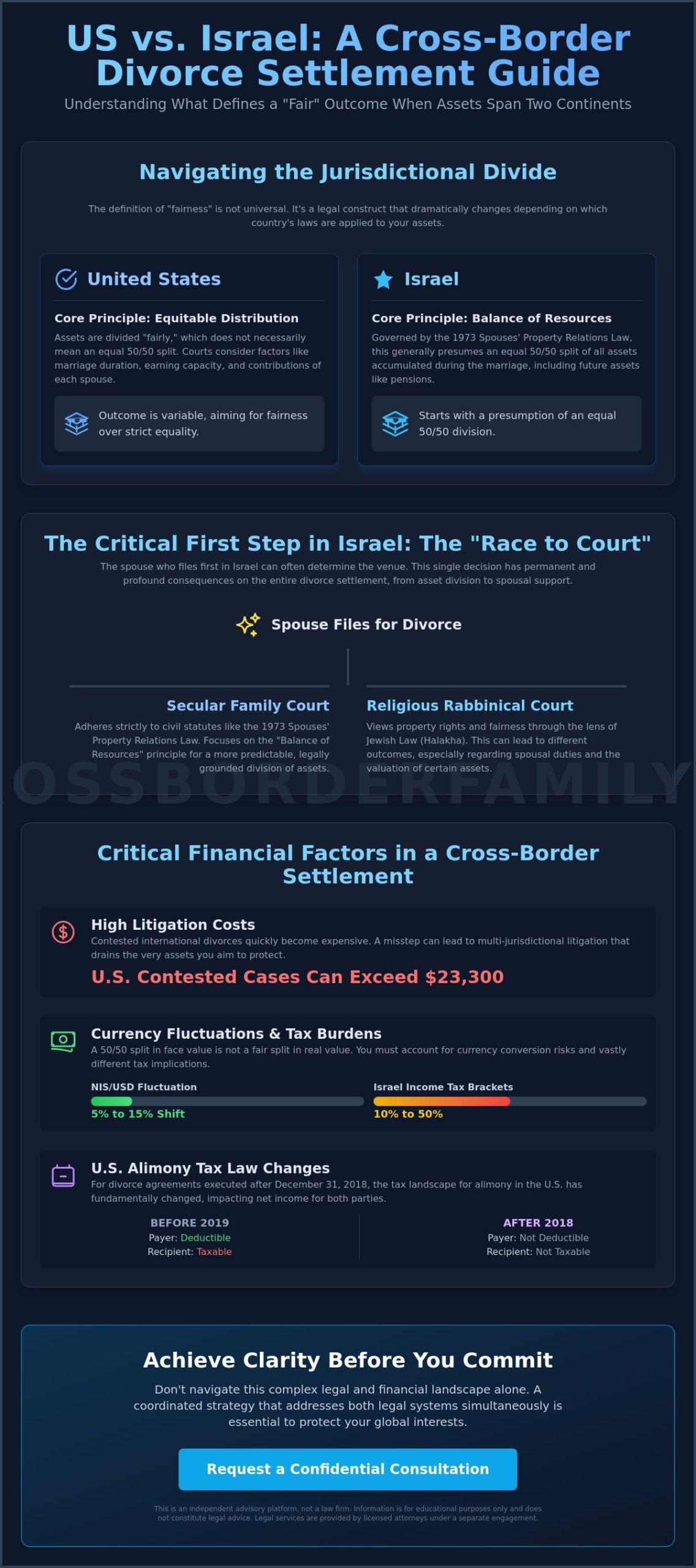
Fairness isn’t a universal truth. It’s a legal construct. In a US-Israel context, determining what is a fair international divorce settlement depends on which set of rules applies to your life. While many US states use “equitable distribution” to divide property fairly but not necessarily equally, Israel relies on the “Balance of Resources” under the 1973 Spouses’ Property Relations Law. These systems don’t just use different words. They prioritize different values and timelines for when assets are valued. What looks like a fair split in a New York court might be viewed as an imbalance in an Israeli court, especially when high-value tech stocks or pension funds are involved.
To better understand the complexities involved in these decisions, watch this helpful video:
A simple 50/50 split often fails the fairness test in cross-border scenarios. For example, a bank account in IL and a retirement fund in the US might have the same face value, but their actual worth differs after accounting for international tax and liquidity. US tax laws on alimony changed significantly after December 31, 2018; payments are no longer deductible for the payer or taxable for the recipient at the federal level. Such nuances mean that a mathematical split without strategic context can leave one spouse with significantly less buying power. This is where an independent advisory platform helps you find clarity before you make binding legal commitments.
The Difference Between Equality and Equity
Splitting a property in Tel Aviv and a 401k in New York is rarely straightforward. Currency fluctuations between the NIS and USD can shift the value of a settlement by 5% to 15% in a single quarter. Also, “non-tangible” assets like career potential or “reputation property” are treated differently. In Israel, courts may consider the “monetary value” of a spouse’s increased earning capacity, a concept that varies wildly across US state lines. Understanding these international divorce laws is vital for protecting your long-term stability. You must account for the 10% to 50% tax brackets in Israel when calculating the future value of local income compared to US federal brackets.
Why Jurisdiction Dictates the Definition of Fair
The “Race to Court” is a reality in the Israeli system. The first spouse to file often determines whether the case is heard in the secular Family Court or the religious Rabbinical Court. Each venue has a distinct approach to asset division and “fairness.” For instance, the Rabbinical Court might view certain property rights through the lens of Jewish law, while the Family Court adheres strictly to civil statutes. Because these early decisions have permanent consequences, you should focus on seeking clarity before making commitments. Decisions made in haste during a crisis often lead to multi-jurisdictional litigation that drains the very assets you are trying to protect.
This article is published on an independent advisory platform and is not a law firm. The information provided is for educational purposes only and does not constitute legal advice or an attorney-client relationship. Legal services are only provided by licensed attorneys under a separate engagement.
Key Factors That Influence a Fair International Settlement
Determining what is a fair international divorce settlement requires a granular analysis of where your assets are located and how each jurisdiction views them. Unlike domestic cases, a US-Israel divorce must account for the “center of life” principle, which Israeli courts use to determine which country’s laws should govern the marriage. If a family has lived in Israel for several years, even if they hold US citizenship, the court may apply Israeli law to assets held in America. This complexity increases when one spouse attempts to enforce a foreign court order across the border, as US decrees are not automatically recognized in Israel and must undergo a formal enforcement process.
Your future earning capacity also plays a central role in the final calculation. In Israel, the “needs” of the primary caregiver are often weighed against the available resources of the higher earner, a process that can be influenced by the choice of court. Strategic clarity is essential because early decisions regarding where you live and where you file will dictate the legal characterization of your entire estate. If you are feeling overwhelmed by these variables, you might consider a confidential case review to help organize your priorities.
Asset Characterization and Valuation
Marital property generally encompasses all assets and debts acquired by either spouse from the date of the marriage until the formal date of separation or the filing of a claim. While a US brokerage account provides clear monthly statements, valuing Israeli “monitored” assets such as pension funds, severance pay, and “Keren Hishtalmut” accounts requires bicultural expertise. The process of dividing assets in a divorce becomes significantly more complex when real estate in Tel Aviv or Jerusalem is involved, as these properties require professional appraisals from experts who understand both the local market and international reporting requirements.
Maintenance and Spousal Support Standards
There is a significant difference between American “Alimony” and the Israeli concept of “Mezonot” (maintenance). In the United States, spousal support is often based on the length of the marriage and the recipient’s ability to become self-sufficient. In Israel, particularly within the Rabbinical system, spousal maintenance is often tied to the “standard of living” enjoyed during the marriage but typically ends once the religious divorce (the Get) is finalized. Additionally, the November 2025 law change expanded the authority of Rabbinical Courts to rule on child support, which can fundamentally shift the financial balance of a divorce for international families. Understanding these nuances is the only way to move from confusion to a stable, risk-based strategy.
This article is published on an independent advisory platform and is not a law firm. The information provided is for educational purposes only and does not constitute legal advice or an attorney-client relationship. Legal services are only provided by licensed attorneys under a separate engagement.
Comparing Legal Systems: Israel vs. the United States
Understanding what is a fair international divorce settlement requires an honest look at the friction between two very different legal cultures. In the United States, divorce is governed by state law. If you live in California, you face a community property system where assets are generally split 50/50. If you are in New York, the court applies equitable distribution, which focuses on what is “fair” rather than what is equal. Israel, however, operates under a national civil law but utilizes a unique dual-court system that can produce vastly different outcomes based on which door you walk through first.
Israeli courts also apply a “Center of Life” test to determine if they have the authority to hear your case. This test looks at where you pay taxes, where your children attend school, and where you maintain your primary residence. It’s a common misconception that Israeli law guarantees an automatic 50/50 split. While the 1973 Spouses’ Property Relations Law creates a framework for balancing resources, the actual division can be influenced by the specific needs of the family and the location of the assets. As of January 12, 2026, filing a property claim in Israel carries a fee of 3,447 NIS, making it essential to understand your standing before initiating a case.
The Israeli ‘Race to Court’ Explained
The most striking difference for Americans is the “Race to Court.” In Israel, both the secular Family Court and the religious Rabbinical Court have the power to decide financial matters, but the court where the first valid claim is filed usually gains jurisdiction. Filing first in the Rabbinical Court can drastically change the division of assets or the calculation of maintenance. This leads to “forum shopping,” where spouses rush to file in the venue they believe will be more favorable. For those who need a visual breakdown of how this jurisdictional overlap works, the Israel Family Law YouTube channel provides helpful context on these bicultural challenges.
Enforceability and The Hague Convention
A settlement is only truly fair if it can be enforced in both countries. If your agreement includes provisions for international custody and relocation, it must comply with international treaties like the Hague Convention to prevent future legal deadlocks. You should also consult the U.S. State Department guidance on foreign divorces to understand how a decree issued in Israel might be viewed by U.S. authorities. Without this cross-border coordination, you risk a situation where one country recognizes your settlement while the other does not, leaving your assets and parental rights in a state of legal limbo. Get clarity before you commit. Request a confidential consultation.
This article is published on an independent advisory platform and is not a law firm. The information provided is for educational purposes only and does not constitute legal advice or an attorney-client relationship. Legal services are only provided by licensed attorneys under a separate engagement.
Strategic Risk Management for International Assets
Managing international assets requires moving past surface-level values to understand the net-after-tax reality of your estate. When evaluating what is a fair international divorce settlement, you must account for the hidden costs of moving capital between Israel and the United States. These costs include currency exchange spreads, international wire fees, and the complex reporting requirements of the US-Israel Tax Treaty. Failing to consider these factors can result in a settlement that looks equitable on paper but leaves one spouse with significantly less liquidity. Additionally, litigation in Israel often involves the risk of frozen assets through temporary restraining orders, which can paralyze your finances for months while the courts deliberate.
The US-Israel Tax Treaty provides a framework to avoid double taxation, but it doesn’t eliminate the inherent friction of cross-border transfers. For example, transferring a US-based pension to a spouse living in Israel can trigger unexpected withholding requirements if not structured correctly. You must calculate fairness on a net basis, accounting for the 2026 tax brackets in both countries. In Israel, the top marginal rate reaches 47% for income over ₪49,691 per month, plus a 3% high-income surtax on annual income exceeding ₪772,930. Comparing this to the US federal top rate of 37% for 2026 shows why a simple dollar-for-dollar swap is rarely appropriate.
Tax-Adjusted Valuations
A $1,000,000 apartment in Tel Aviv is fundamentally different from a $1,000,000 balance in a US 401k account. The Israeli property may be subject to capital gains tax (Mas Shevach) upon sale, while the 401k will face US federal income tax at ordinary rates when funds are withdrawn. You must evaluate every asset based on its value after all local and international taxes are paid. For families with complex portfolios, seeking a pricing and valuation advisory is a critical step in ensuring the final numbers reflect actual buying power in your chosen country of residence.
Early Decisions and Their Long-Term Impact
Early decisions often carry more weight than the final trial. Temporary orders issued by an Israeli court to maintain the “status quo” can inadvertently set the baseline for the final settlement. Many expats make the mistake of signing an Israeli Financial Agreement (Heskem Mamon) without a cross-border review, only to find it creates massive tax liabilities in the United States under IRC Section 1041 rules for non-resident aliens. It’s vital to prioritize strategy over emotion during the initial stages of a split. If you are unsure how your global holdings will be affected by these rules, consult with a professional who understands both systems before signing any documents.
This article is published on an independent advisory platform and is not a law firm. The information provided is for educational purposes only and does not constitute legal advice or an attorney-client relationship. Legal services are only provided by licensed attorneys under a separate engagement.
Achieving Clarity in Your Cross-Border Settlement
A successful outcome in a US-Israel divorce requires a unified strategy that views both legal systems as part of a single puzzle. Many families make the mistake of hiring separate legal teams in each country that do not communicate, leading to conflicting orders and tax inefficiencies. Determining what is a fair international divorce settlement is only possible when you evaluate your global balance sheet through a risk-based framework. This means weighing the potential financial gain in one jurisdiction against the high cost of multi-jurisdictional litigation and the risk of non-enforcement. Strategic clarity allows you to move away from the emotional confusion of the split and toward a decision-making process based on concrete data and established legal trends.
True fairness is not a default setting of the court system. It is a result of meticulous preparation and an understanding of how bicultural factors influence the division of assets. Whether you are dealing with a “Race to Court” in the Rabbinical system or complex IRS reporting requirements for Israeli business interests, your goal should be to reach a settlement that is stable, enforceable, and tax-efficient in both countries. Before making any binding commitments, it is vital to understand how the 2026 tax brackets and recent Israeli legislative changes regarding child support will impact your specific situation.
Steps to Take Before You File
The “Discovery” phase is the most critical period for any international family. You must gather comprehensive documentation for assets held in both the US and Israel, including property deeds, bank statements, and pension valuations. Identifying potential traps in a spouse’s settlement proposal requires a deep understanding of the Anglo expat experience in Israel. For example, a proposal might offer a larger share of Israeli liquid assets in exchange for keeping a US-based 401k, but without accounting for the future tax liability of that retirement account, the deal may be fundamentally lopsided. You should also verify the “date of separation” used in any proposal, as this date determines the valuation of marital property under the 1973 Spouses’ Property Relations Law.
Conclusion and Next Steps
Achieving what is a fair international divorce settlement is a process of preparation rather than luck. By coordinating your strategy across borders, you can protect your financial future and avoid the “legal limbo” that often traps international families. The complexity of these cases makes it essential to seek a confidential case review before filing any claims or signing financial agreements. This proactive approach ensures that your early decisions don’t inadvertently compromise your long-term goals.
Get clarity before you commit. Request a confidential consultation.
Disclaimer: This article is published on an independent advisory platform and is not a law firm. The information provided is for educational purposes only and does not constitute legal advice or an attorney-client relationship. Legal services are only provided by licensed attorneys under a separate engagement.
This article is published on an independent advisory platform and is not a law firm. The information provided is for educational purposes only and does not constitute legal advice or an attorney-client relationship. Legal services are only provided by licensed attorneys under a separate engagement.
Protecting Your Interests Across Borders
You’ve seen how the differences between the 1973 Spouses’ Property Relations Law and US state statutes can shift the financial landscape of your divorce. Understanding that a net-after-tax valuation is the only way to measure true equity is vital for your future. Determining what is a fair international divorce settlement requires moving beyond the initial shock toward a structured, risk-based strategy. This coordination between your legal standing in both the United States and Israel prevents conflicting orders and unintended tax liabilities that often catch international families off guard.
Our advisory platform prioritizes the unique Anglo expat experience in IL, offering a calm and authoritative space to evaluate your global holdings. We provide specialized expertise in cross-border matters, helping you navigate the complex bridge between the “start-up nation” and US markets. Preparation is your most effective tool for minimizing high litigation costs and securing a stable future for your family. Get clarity before you commit. Request a confidential consultation. You don’t have to manage these multi-jurisdictional challenges without a clear roadmap.
This article is published on an independent advisory platform and is not a law firm. The information provided is for educational purposes only and does not constitute legal advice or an attorney-client relationship. Legal services are only provided by licensed attorneys under a separate engagement.
Frequently Asked Questions
Is a 50/50 split mandatory in an international divorce involving Israel?
No, a 50/50 split is not strictly mandatory, although the 1973 Spouses’ Property Relations Law creates a strong presumption of equal resource balancing for assets acquired during the marriage. Israeli courts have the discretion to deviate from an equal split if specific circumstances, such as the future needs of children or significant imbalances in earning capacity, justify a different outcome. Understanding these nuances is essential to determining what is a fair international divorce settlement for your family.
Can a US court divide my property located in Israel?
A US court can issue an order regarding property in Israel if it has personal jurisdiction over both spouses, but enforcing that order in Israel requires a separate legal process. Israeli courts do not automatically recognize foreign property decrees and will assess whether the US court followed due process and had proper jurisdiction. Without formal recognition by an Israeli Family Court, your local real estate or bank accounts remain governed by Israeli law and procedure.
What happens if my spouse files for divorce in Israel before I file in the US?
Filing first in Israel initiates the “Race to Court,” which often locks in the jurisdiction and the specific legal standards applied to your financial affairs. If the case is filed in the Rabbinical Court, that venue may gain the authority to rule on all ancillary matters like property division and maintenance. This early move can significantly limit your ability to have the case heard in a US court, even if you are a US citizen or resident.
How do Israeli courts treat US-based retirement accounts like a 401k or IRA?
Israeli courts generally view US-based retirement accounts as marital assets subject to the “Balance of Resources” principle. However, they may struggle with the practicalities of dividing these accounts due to US tax regulations and the 2017 Tax Cuts and Jobs Act. Valuation must be calculated on a net-after-tax basis to reflect the actual liquidity available after accounting for US federal tax brackets, which reach up to 37% for single filers in the 2026 tax year.
Does a US prenuptial agreement hold up in an Israeli court?
A US prenuptial agreement is not automatically binding in Israel and must typically be approved by an Israeli court or a notary to be enforceable under local law. If the agreement was not validated according to the specific requirements of the Israeli Spouses’ Property Relations Law, a court might set it aside or ignore certain provisions. This creates a significant risk for families who assume their American contracts provide absolute protection for their separate property.
How long does it typically take to reach an international divorce settlement?
Reaching a settlement usually takes between 12 and 24 months, depending on the complexity of the global asset portfolio and the level of cooperation between spouses. Cases involving multi-jurisdictional valuations or contested custody often take longer due to the need for expert testimony and the formal translation of documents. Establishing a clear strategy early in the process can help streamline negotiations and reduce the time spent in active litigation.
What are the tax implications of transferring Israeli real estate in a divorce?
Transfers between spouses during a divorce are generally exempt from Israeli capital gains tax, known as Mas Shevach, but future sales will be taxed based on the original purchase price. For US citizens, these transfers may trigger US tax obligations if the recipient spouse is a non-resident alien. You must account for these potential liabilities to ensure the division of real estate is equitable on a long-term, net-value basis.
Can child support be enforced if one parent moves back to the US?
Yes, child support can be enforced across borders through international treaties and reciprocal agreements between Israel and many US states. The November 2025 law change in Israel expanded the Rabbinical Court’s authority over child support, which may affect how these orders are calculated and subsequently enforced abroad. Moving to the US does not terminate your financial obligations, as courts in both countries prioritize the child’s needs and habitual residence.
Get clarity before you commit. Request a confidential consultation.

Article by
Gabriel Lior
A Personal Journey That Became a Mission
The advisory was founded by an American father Gabriel Lior, LLB, MBA , global entrepreneur, and cross-border advisor who spent more than a decade navigating the Israeli family court system firsthand and now lives in Singapore with his son.
As a divorced parent in a cross-border family, Gabriel faced nearly every legal challenge a foreign parent can encounter in Israel — including child custody disputes, child support proceedings, property matters in Israel and abroad, false accusations, and complex immigration and relocation proceedings.
Over the years, he learned the hard way how difficult it is for non-Israeli parents to understand the system, identify the right legal strategy, and choose the right legal representation — especially when language, culture, and jurisdictional differences are involved. He also witnessed how foreign parents and new immigrants are often disadvantaged or taken advantage of by service providers and institutions simply because they lack local knowledge or fluency.
From Client to Advisor
To truly understand — and survive — the system, Gabriel pursued formal legal education in Israel, completing two Israeli law degrees, alongside a BA and MBA earned in the United States. This was never about becoming a practicing attorney, but about gaining a deep, structural understanding of how the system works — and where it breaks down for foreign parents.
This rare combination of:
Firsthand client experience
Israeli legal and US business education
International business and negotiation training
Decades of commercial execution
created a unique perspective – one that understands both sides of the table.
After years of litigation, persistence, and at times self-representation, he ultimately succeeded in securing custody of his son and relocating abroad through a rare legal victory in the Israeli Supreme Court — becoming one of the first fathers in Israel to do so under these circumstances.
Disclaimer
Important Disclaimer:
The information provided on this website and in its content is for general informational and educational purposes only and does not constitute legal advice, legal opinion, or legal representation.
Gabriel Lior is not licensed to practice law in Israel (nor is he interested in doing so) and does not provide legal services, despite having completed 2 Law Degrees. The services offered are advisory in nature and are intended to provide general guidance, strategic insight, and information regarding cross-border family law considerations.
No attorney-client relationship is formed by accessing this website, reading its content, or communicating with us.
Any decisions made based on this information are at your own discretion and risk. For legal advice specific to your situation, you should consult a licensed attorney in the relevant jurisdiction.
Where appropriate, we may refer clients to independent, licensed attorneys or professionals. Such referrals do not constitute legal representation and no liability is assumed for services provided by third parties.