When your loved ones live outside of Israel, ensuring their financial security after you are gone presents a unique set of challenges. You may worry about the complexities of international law, the potential for double taxation, or whether a foreign court will even recognize your final wishes. These concerns can create significant uncertainty, leaving you to question how to best protect your family’s future without placing an undue burden on them. The process of creating a trust for beneficiaries in another country can seem daunting, filled with legal and financial hurdles that span multiple jurisdictions.
This 2026 guide is designed to provide clarity and confidence as you navigate this sophisticated area of estate planning. We will walk you through the key considerations, from understanding the interaction between Israeli and foreign trust laws to anticipating potential tax implications for your heirs. Our goal is to demystify the process, helping you understand the strategic decisions required to build a secure and enforceable plan. By the end, you will have a clear framework for protecting your loved ones, ensuring your legacy is preserved exactly as you intend.
Key Takeaways
Understand why a standard will often fails to protect international beneficiaries and can lead to unintended legal and financial complications.
Identify the critical cross-border complexities, including conflicting tax regimes and legal systems, that can jeopardize your estate plan.
Gain a strategic framework for creating a trust for beneficiaries in another country, focusing on the key structural decisions you must make upfront.
Learn to recognize common but costly errors in international trust formation to ensure your legacy is secure and your wishes are honored.
Table of Contents
Why a Standard Will Often Fails for International Beneficiaries
Please note: The following information is intended as general guidance for strategic planning and does not constitute legal advice. When your loved ones live abroad, ensuring a smooth transfer of your assets requires a sophisticated understanding of multi-jurisdictional estate law. A standard Israeli will, while essential for domestic affairs, is often insufficient for this complex task because it is governed by the laws of a single location.
This jurisdictional limitation can create significant hurdles. To better understand the modern solution to this challenge, this video provides a helpful overview.
The Problem of Probate in Two Countries
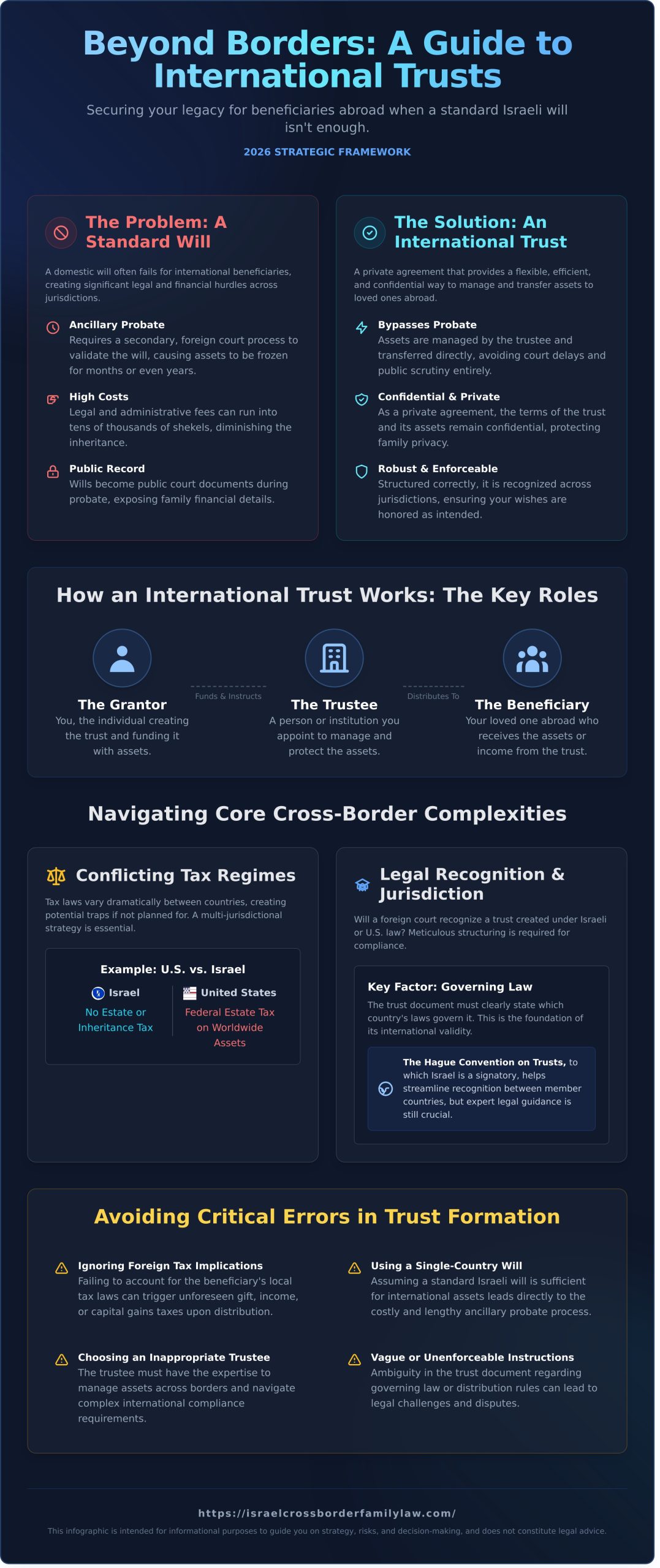
When a will must be executed in more than one country, it enters a secondary legal process known as ancillary probate. This involves having your Israeli will validated by a foreign court, a procedure that is notoriously time-consuming and costly, often running into tens of thousands of shekels in legal and administrative fees. This process can effectively freeze assets for months or even years, placing a significant burden on your beneficiaries. Attempting to use a domestic will for international assets is like trying to use one key to open two very different locks-it simply isn’t designed for the task.
What is a Cross-Border Trust in Simple Terms?
A trust provides a more flexible and private alternative. Unlike a will, which becomes a public court document, a trust is a private agreement for managing assets. The core advantage when creating a trust for beneficiaries in another country is its ability to bypass the probate process entirely. This structure, sometimes referred to as an offshore trust when established for international purposes, ensures a confidential and efficient transfer of wealth. Understanding the key roles is straightforward:
The Grantor: You, the individual creating the trust and funding it with assets.
The Trustee: A person or institution you appoint to manage the trust’s assets according to your instructions.
The Beneficiary: Your loved one in another country who will receive the assets or income from the trust.
This framework offers a robust and strategic solution for managing a global estate and protecting your international beneficiaries from legal complexities.
This article is provided by an independent advisory platform. It is intended for informational purposes to guide you on strategy, risks, and decision-making, and does not constitute legal advice or create an attorney-client relationship.
Navigating Core Complexities: Tax, Law, and Logistics
Establishing a trust for a beneficiary in a different country introduces a sophisticated layer of multi-jurisdictional challenges. It is a process that extends far beyond standard estate planning, requiring a deep understanding of how different national systems interact-and often conflict. Successfully creating a trust for beneficiaries in another country requires a proactive, multi-jurisdictional strategy, not just a legal document.
Conflicting Tax Regimes (The U.S. vs. Israel Example)
The most immediate challenge lies in navigating divergent tax laws. For instance, a U.S. citizen establishing a trust is subject to U.S. federal estate tax on their worldwide assets. In contrast, Israel does not impose any inheritance or estate tax. This disparity can create complex traps; a distribution from a U.S. trust could be considered a gift, potentially triggering U.S. gift tax, or create unforeseen capital gains or income tax liabilities for the Israeli beneficiary upon receipt. The U.S.-Israel tax treaty may offer relief, but its application is highly technical and specific to the asset types and trust structure.
Legal Recognition and Jurisdiction
A critical question is whether the beneficiary’s country will legally recognize a trust established elsewhere. For a trust created under Florida law for a beneficiary in Tel Aviv, its validity hinges on Israeli courts acknowledging the "governing law" designated in the trust document. While international agreements like the Hague Convention on Trusts (to which Israel is a signatory) streamline this process, ensuring compliance requires meticulous structuring. Understanding how foreign trusts work from a legal and administrative standpoint is fundamental to preventing future challenges to the trust’s legitimacy.
Practical Challenges for Your Beneficiary
Beyond the high-level legal and tax frameworks, your beneficiary will face significant logistical hurdles. These practical issues can cause delays, reduce the value of the inheritance, and create immense frustration if not planned for in advance. Key considerations include:
Financial Logistics: Navigating currency exchange from USD to ILS, managing international wire transfer fees, and satisfying stringent Israeli bank compliance and anti-money laundering (AML) verification.
Identity and Access: Proving their identity and legal right to the inheritance to a foreign trustee, which often requires internationally recognized documentation like an apostille.
Communication: Overcoming language barriers, time zone differences, and cultural nuances when communicating with the trustee to ensure clear and timely administration.
Addressing these three core areas is essential when creating a trust for beneficiaries in another country to ensure your assets are transferred smoothly and effectively, as you intended.
Structuring Your International Trust: Key Decisions to Make
Having identified the potential challenges, the next step is to make the foundational decisions that will shape your trust’s success. These choices are not merely legal technicalities; they are the strategic pillars of your plan. When creating a trust for beneficiaries in another country, getting this structure right from the outset is paramount. At Israel Cross Border Law Firm, our role is to guide you through these critical decisions, and you can understand our advisory approach to see how we help families gain clarity.
Revocable vs. Irrevocable Trusts: Control and Protection
A revocable trust offers maximum flexibility. You, as the grantor, retain the power to amend or even dissolve the trust during your lifetime. While this control is appealing, it often means the assets are still considered part of your estate for tax purposes, offering limited protection from creditors.
Conversely, an irrevocable trust cannot be easily changed once established. By transferring assets and relinquishing control, you can achieve significant benefits, including potential tax advantages and robust asset protection. This is often a strategic choice for long-term wealth preservation. The right path depends entirely on your objectives, balancing your need for control against your goals for asset protection.
Choosing the Right Trustee: The Most Critical Decision
Appointing a friend or family member as a trustee is a common impulse, but it can be a serious misstep in a cross-border context. They often lack the specialized knowledge to navigate the complex tax laws, investment regulations, and compliance requirements of multiple countries, creating significant risk for the trust and its beneficiaries.
The ideal trustee for an international trust possesses deep experience in multi-jurisdictional finance and law. They must understand the intricate reporting obligations in both Israel and the beneficiary’s home country. This is especially true when exploring various options for setting up offshore trusts, where professional oversight is non-negotiable. A professional trustee, whether an individual or a corporate entity, acts as a neutral administrator, ensuring your wishes are executed with precision and full legal compliance.
A Step-by-Step Framework for Establishing Your Trust
Navigating the complexities of international estate planning requires a structured approach. The process of creating a trust for beneficiaries in another country can feel overwhelming, but it follows a logical, multi-stage progression. This framework is designed to demystify the journey, providing a clear path forward. It is an overview to build your understanding, not a substitute for professional guidance tailored to your unique circumstances. See how our process provides clarity from the very beginning.
Step 1: The Clarity and Strategy Session
The foundation of any effective trust is a comprehensive strategy. This initial phase is dedicated to defining your precise objectives. We work with you to map out the critical elements of your plan, including:
Your Goals: Clearly identifying which family members you wish to protect and which specific assets (such as real estate in Israel, investment portfolios, or business interests) will be included.
Jurisdictional Analysis: Charting the location of the grantor (the person creating the trust), the assets, and the beneficiaries to understand which countries’ laws will apply.
Challenge Identification: Proactively pinpointing the primary legal and tax challenges inherent in your cross-border situation, such as potential inheritance taxes in the beneficiary’s country or Israeli reporting requirements.
Step 2: Design and Drafting
With a clear strategy in place, the next step is to construct the legal architecture of the trust. This is a meticulous process that involves drafting a trust document that is robust, clear, and legally compliant across all relevant jurisdictions. This stage requires close collaboration with legal counsel in both Israel and the beneficiary’s home country to ensure the language used is unambiguous and enforceable. Key decisions made here include selecting a suitable trustee and carefully defining their powers and responsibilities.
Step 3: Funding and Administration
A trust document on its own is an empty vessel; it must be "funded" to become effective. Funding is the legal process of retitling your assets into the name of the trust. For example, this could involve changing the deed of a property from your individual name to the trust’s name or updating the ownership of a bank account. Once funded, the trustee’s ongoing administrative duties begin, which include managing the assets, making distributions to beneficiaries as specified, and handling all necessary tax filings and reporting.
Avoiding Critical Errors: Your Path to Confidence
Navigating the complexities of cross-border estate planning is a significant undertaking. The core principle for success is clear: proactive strategy and informed choices are paramount to securing your legacy. While a simple will may seem sufficient for domestic matters, it often creates reactive and expensive problems when international assets or heirs are involved. A well-structured trust, by contrast, is a strategic instrument designed to execute your wishes seamlessly across jurisdictions.
Common Mistake 1: Assuming a Domestic Plan Works Internationally
Applying a standard Israeli estate plan to a global context is a frequent and costly error. This assumption can subject your assets to lengthy probate proceedings in multiple countries, trigger unforeseen tax liabilities, and ultimately lead to family disputes over the interpretation of your will. The process of creating a trust for beneficiaries in another country requires a purpose-built solution, one that acknowledges and navigates the distinct legal and financial systems involved. This is particularly true for the unique circumstances faced by expats and foreign nationals, whose ties to multiple countries demand sophisticated planning.
Common Mistake 2: Appointing an Unqualified Trustee
The trustee is the guardian of your legacy, responsible for managing and distributing assets according to your precise instructions. Appointing a friend or family member who lacks the requisite financial acumen or understanding of multi-jurisdictional compliance can lead to mismanagement, legal liability, and the ultimate failure of the trust’s objectives. This decision is as critical as the legal framework of the trust itself; selecting a qualified, professional trustee ensures your plan is executed with diligence and integrity.
By avoiding these common pitfalls, you can move forward with the confidence that your assets are protected and your family’s future is secure. The goal of creating a trust for beneficiaries in another country is not merely a legal task but a foundational act of care for those you value most. It requires guidance grounded in deep cross-border experience.
Get clarity before you commit. Request a confidential consultation to understand your options and build a strategy that works for your international family.
Securing Your Legacy Across Borders: A Strategic Approach
Ensuring your family’s future across international borders requires more than a standard will. As we have explored, the process demands a careful navigation of differing legal systems and complex, multi-jurisdictional tax obligations. A properly structured trust is the most effective instrument for protecting your assets and distributing them according to your precise wishes, avoiding costly delays and disputes for your loved ones.
Ultimately, success in creating a trust for beneficiaries in another country hinges on informed, strategic decision-making from the outset. Navigating these complexities, particularly for unique US-Israel matters, demands specialized guidance focused on strategy. Understanding your options fully is the critical first step toward achieving peace of mind.
Get clarity before you commit. Request a confidential, no-obligation consultation to ensure your path forward is both clear and secure.
Frequently Asked Questions
Can a trust created in the U.S. hold property located in Israel?
Yes, a U.S. trust can generally hold Israeli real estate, but this requires careful and strategic planning. The trust document must be drafted to be enforceable under Israeli law, and the transfer of property must be correctly registered with the Israel Land Authority. This is a complex, cross-border process that necessitates coordination between legal counsel in both jurisdictions to ensure the title is transferred properly and the trust’s objectives are upheld without creating unforeseen legal or tax complications.
How are distributions from a U.S. trust taxed for a beneficiary living in Israel?
The taxation of distributions is a sophisticated matter governed by both Israeli and U.S. tax codes, as well as the U.S.-Israel Tax Treaty. The tax liability for a beneficiary in Israel depends on their residency status, the type of trust, and whether the distribution is from income or principal. Professional tax advice is essential to navigate these multi-jurisdictional regulations, ensure full compliance, and implement strategies to mitigate the risk of double taxation for the beneficiary.
What is the difference between an executor of a will and a trustee of a trust?
An executor is a person or institution appointed in a will to manage and distribute a deceased person’s estate. Their role is temporary, court-supervised, and concludes once all assets are distributed and debts are paid. A trustee, conversely, manages assets held within a trust for the benefit of beneficiaries according to the terms you establish. This role is not automatically court-supervised and can last for many years or even generations, requiring ongoing asset management and distribution duties.
How much does it cost to set up an international trust?
The cost of establishing a cross-border trust varies significantly based on its complexity, the nature of the assets involved, and the jurisdictions of the grantor and beneficiaries. For a professionally drafted structure designed for international purposes, initial legal and advisory fees can range from ₪15,000 to ₪50,000 or more. Highly sophisticated trusts with complex assets or multi-jurisdictional tax planning will command higher fees due to the extensive expertise and coordination required for their proper establishment.
Can I be the trustee of my own revocable trust if my beneficiaries are abroad?
Yes, as the grantor, you can serve as the initial trustee of your own revocable trust. However, it is critical to appoint a capable successor trustee who can manage the cross-border complexities after you are no longer able to serve. The process of creating a trust for beneficiaries in another country must account for this transition. The successor trustee should have the expertise to handle international distributions, tax compliance, and communication with foreign beneficiaries effectively.
What happens if the laws change in the beneficiary’s country after I create the trust?
Changes in foreign laws, particularly regarding taxation, inheritance, or currency controls, can significantly impact a trust’s effectiveness and the benefits received by the beneficiary. A well-drafted international trust should include provisions that grant the trustee flexibility to adapt to such changes. Regular reviews of the trust with legal and financial advisors are crucial to ensure it remains compliant and continues to fulfill your original intentions within the evolving global legal landscape.

Article by
Gabriel Lior
A Personal Journey That Became a Mission
The advisory was founded by an American father Gabriel Lior, LLB, MBA , global entrepreneur, and cross-border advisor who spent more than a decade navigating the Israeli family court system firsthand and now lives in Singapore with his son.
As a divorced parent in a cross-border family, Gabriel faced nearly every legal challenge a foreign parent can encounter in Israel — including child custody disputes, child support proceedings, property matters in Israel and abroad, false accusations, and complex immigration and relocation proceedings.
Over the years, he learned the hard way how difficult it is for non-Israeli parents to understand the system, identify the right legal strategy, and choose the right legal representation — especially when language, culture, and jurisdictional differences are involved. He also witnessed how foreign parents and new immigrants are often disadvantaged or taken advantage of by service providers and institutions simply because they lack local knowledge or fluency.
From Client to Advisor
To truly understand — and survive — the system, Gabriel pursued formal legal education in Israel, completing two Israeli law degrees, alongside a BA and MBA earned in the United States. This was never about becoming a practicing attorney, but about gaining a deep, structural understanding of how the system works — and where it breaks down for foreign parents.
This rare combination of:
Firsthand client experience
Israeli legal and US business education
International business and negotiation training
Decades of commercial execution
created a unique perspective – one that understands both sides of the table.
After years of litigation, persistence, and at times self-representation, he ultimately succeeded in securing custody of his son and relocating abroad through a rare legal victory in the Israeli Supreme Court — becoming one of the first fathers in Israel to do so under these circumstances.
Disclaimer
Important Disclaimer:
The information provided on this website and in its content is for general informational and educational purposes only and does not constitute legal advice, legal opinion, or legal representation.
Gabriel Lior is not licensed to practice law in Israel (nor is he interested in doing so) and does not provide legal services, despite having completed 2 Law Degrees. The services offered are advisory in nature and are intended to provide general guidance, strategic insight, and information regarding cross-border family law considerations.
No attorney-client relationship is formed by accessing this website, reading its content, or communicating with us.
Any decisions made based on this information are at your own discretion and risk. For legal advice specific to your situation, you should consult a licensed attorney in the relevant jurisdiction.
Where appropriate, we may refer clients to independent, licensed attorneys or professionals. Such referrals do not constitute legal representation and no liability is assumed for services provided by third parties.