This article is published by Israel Cross Border Law Firm. The information provided is for strategy and decision-making guidance and does not constitute legal advice or an attorney-client relationship. For a personalized strategy, you can reach out via WhatsApp or our advisory call service.
What if the simple choice of which court building you enter first could impact your bank account by over ₪30,000 annually? For international families, the "race of jurisdiction" in Israel isn’t just a legal theory; it’s a financial reality that dictates how israeli child support is calculated and enforced. You probably feel the weight of this dual system, where Religious and Civil courts often reach different conclusions on what constitutes a fair payment. It’s common to worry about how your foreign income will be viewed or how to handle those unpredictable "extraordinary" expenses like private schooling or medical care. This 2026 guide provides the clarity you need to understand the current calculation methods and the strategic importance of early filing. We’ll explore the framework for potential payments and the specific tactics required for cross-border enforcement. To see these principles in action, you can watch our detailed case breakdowns on the Israel Cross Border Law Firm YouTube channel at https://www.youtube.com/@IsraelCrossBorderLawFirm. Get clarity before you commit. Request a confidential consultation.
Key Takeaways
Learn how the "Race of Jurisdiction" between Family and Rabbinical courts can fundamentally alter your case’s outcome based on where you file first.
Understand the distinction between "essential needs" and extraordinary expenses to accurately project the financial impact of israeli child support on your family’s future.
Navigate the complexities of international enforcement and the Hague Convention to ensure support orders are recognized and upheld across borders.
Discover why early strategic planning and mediation often provide more stability for international families than high-stakes litigation in the Israeli system.
Identify how your religious affiliation influences the legal basis for support obligations under Israel’s unique personal law system.
Table of Contents
This article is published on an independent advisory platform (not a law firm). This content is for informational and advisory purposes only and does not constitute legal representation or legal advice. Focus on strategy, risks, and decision-making guidance. For specific legal assistance, please contact a licensed attorney.
Understanding the Legal Framework of Child Support in IL
Understanding israeli child support requires looking at both civil and religious laws. It’s a legal mandate to ensure your child’s standard of living remains stable after a separation. The system relies heavily on "personal law," which means your religious identity determines the legal foundation of your case. Child support laws in Israel are unique because they blend religious statutes with modern civil rulings. This duality creates a framework where your background significantly influences how much you pay or receive.
To better understand how these costs factor into the broader picture of family law, watch this helpful video:
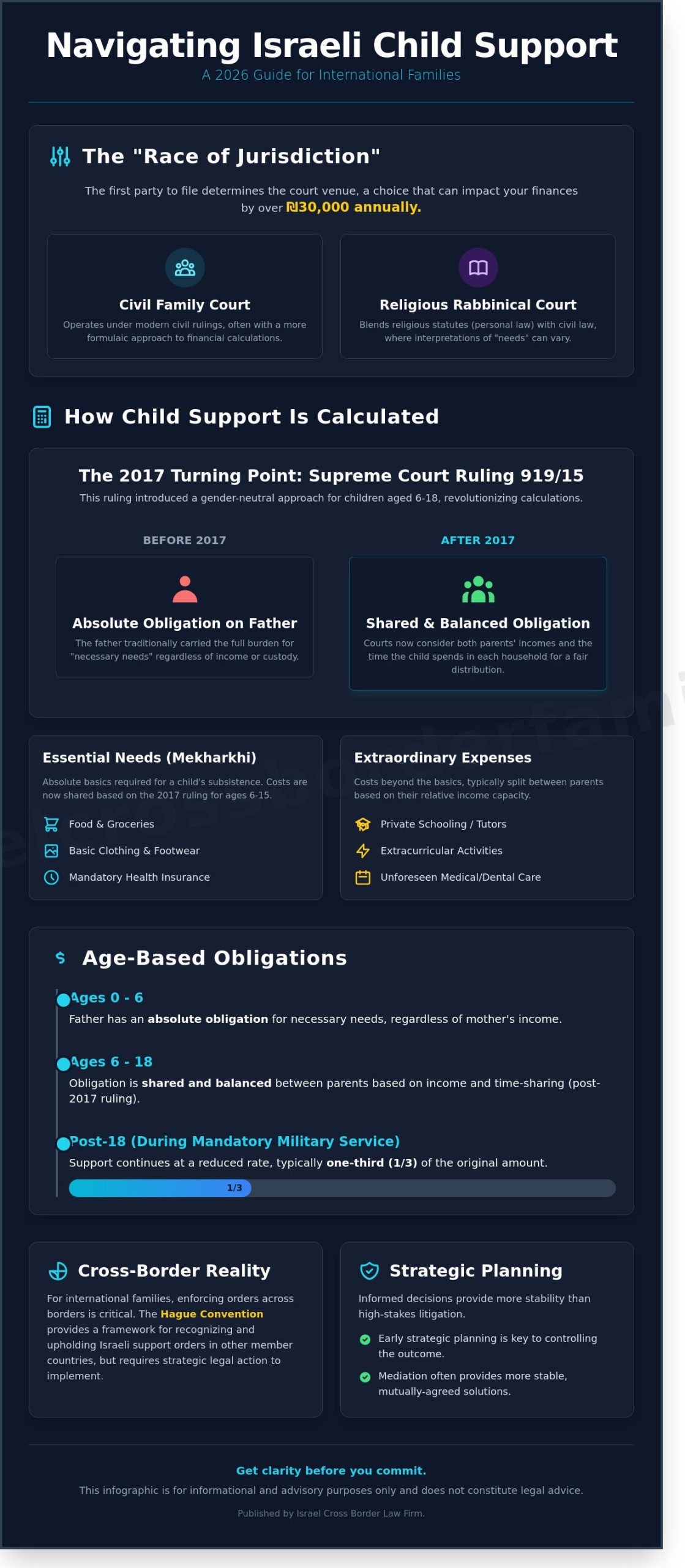
Jurisdiction is a critical early decision. Your case could be heard in the civil Family Court or a religious Rabbinical Court. This often leads to what’s known as the "race of jurisdiction," where the first party to file determines the venue. Each court has its own procedural nuances. While both courts must follow the same basic laws regarding the child’s welfare, the interpretation of "needs" can vary. It’s a strategic cross-border reality that requires careful planning before any paperwork is submitted.
The Legal Basis for Support Obligations
Under Israeli law, obligations differ based on the child’s age and the religious status of the parents. For children under six, the father traditionally carries an absolute obligation for "necessary needs" like food, clothing, and health. However, for children aged 6 to 18, the legal landscape changed significantly following the 2017 Supreme Court ruling 919/15. This ruling introduced a gender-neutral approach for children over six. When calculating israeli child support, the court now looks at the parents’ relative incomes and the actual time the child spends in each household. This shift is particularly relevant for expats and foreign nationals who may be used to different standards. The court now aims for a balance that reflects the modern reality of shared parenting.
Age Limits and Military Service
The obligation doesn’t necessarily end at 18. Full support is paid until high school graduation or age 18. After that, it typically continues at a reduced rate of one-third during mandatory IDF military service. This recognizes that while the state provides for the soldier’s basic needs, the parental home remains the soldier’s primary support system. Long-term orders are also linked to the Consumer Price Index to combat inflation. By the time the 2026 cost-of-living adjustments are applied to existing orders, the nominal ₪ amount will likely have shifted. This ensures the ₪ 2,500 set years ago still covers the same amount of groceries or school supplies today.
Get clarity before you commit. Request a confidential consultation.
How Child Support is Calculated: Essential vs. Extraordinary
Israeli courts divide financial obligations into two distinct categories: essential needs and extraordinary expenses. This distinction is the bedrock of any israeli child support arrangement. Essential needs, known as Mekharkhi, cover the absolute basics required for a child to subsist. This includes food, basic clothing, and mandatory health insurance. In the past, the father bore the sole responsibility for these costs. However, the landmark 2017 Supreme Court ruling (919/15) changed this for children aged six to fifteen. Now, courts weigh the relative income and the time each parent spends with the child to determine a fair distribution.
Beyond these basics, the court factors in housing and utilities, referred to as Medor. Medor represents the specific percentage of rent or mortgage payments, including utilities and municipal taxes, attributed to the child’s primary residence. Standard practice assigns 33% of these costs for one child, 40% for two children, and 50% for three or more. If you’re managing a case involving international child support enforcement, these percentages are critical because they often differ significantly from calculations used in the U.S. or U.K.
Income-based balancing isn’t just about the numbers on a payslip. The court examines disposable income, which is the amount left after a parent pays for their own basic living expenses. If one parent earns ₪25,000 and the other earns ₪10,000, the distribution of support won’t be equal. The court aims for a result that allows the child to enjoy a similar standard of living in both households. This calculation becomes complex when parents have assets like property or stock options, which are common in Israel’s tech-heavy economy. It’s vital to present a clear financial picture early in the process to avoid inflated assessments.
Defining Essential Needs in 2026
As of early 2026, Israeli family courts typically use a baseline of ₪1,600 to ₪2,250 per month for a child’s minimal essential needs. These figures don’t include housing or extraordinary costs. It’s a mistake to view these numbers as a cap. They’re a starting point for negotiations. If a child’s previous lifestyle involved higher spending, the court may adjust these figures upward to maintain consistency. Most families find that the actual cost of raising a child in Israel’s high-cost environment quickly exceeds these judicial minimums. Medor represents the specific percentage of rent or mortgage payments, including utilities and municipal taxes, attributed to the child.
The "Extraordinary" Expense Trap
Extraordinary expenses often become the primary source of conflict in post-divorce life. These include Chugim, which are after-school activities, and summer camps known as Kaytanot. Private medical treatments not covered by the basic basket of health services also fall into this category. While the court usually mandates a 50/50 split for these costs, the lack of a precise definition in the original agreement can lead to years of bickering. For example, does an expensive school trip or a high-end laptop for studies count as an extraordinary expense? Without clarity, you’re at risk of constant litigation. It’s often helpful to review your financial strategy before signing any long-term commitment.
To ensure a stable future, parents should define exactly which Chugim are covered and set a price ceiling for summer camps. This prevents one parent from enrolling the child in an elite, high-cost program and demanding half the payment from the other. Clear drafting is the only way to avoid the "trap" of unexpected bills that can strain even the most cooperative co-parenting relationship. This content is for informational and advisory purposes only and does not constitute legal representation or legal advice. Get clarity before you commit. Request a confidential consultation.
*This article is published on an independent advisory platform (not a law firm). This content does not constitute legal advice or an attorney-client relationship. We focus on strategy, risks, and decision-making guidance. For specific legal assistance, please request a referral to a licensed practitioner. *
The Race of Jurisdiction: Family Court vs. Rabbinical Court
In the Israeli legal landscape, the "Race of Jurisdiction" is a defining factor that dictates the trajectory of a divorce. This unique situation arises because two separate court systems, the Civil Family Court and the Rabbinical Court (Beit Din), possess concurrent authority to hear matters of israeli child support. The court that receives the first valid filing typically secures the right to adjudicate the case. This creates a strategic urgency for parents to decide which system aligns better with their financial reality and parental goals before their spouse takes action.
Choosing the wrong forum can lead to unexpected outcomes. For example, a parent might find themselves facing a stay-of-exit order if support payments are not managed correctly within the chosen system. These orders prevent a person from leaving IL until the debt is secured; sometimes for decades. Understanding the procedural nuances between these two courts is not just about legal theory. It’s about protecting your mobility and financial future.
The Rabbinical Court (Beit Din) Perspective
The Beit Din operates based on Halacha, or Jewish religious law. Historically, this system placed the absolute financial burden for a child’s "essential needs" on the father, regardless of the mother’s income. While modern rulings have introduced more balance, the Beit Din still emphasizes traditional roles. A critical tactic here is the "Binding of Issues." If a spouse files for divorce in the Rabbinical Court and explicitly attaches the matter of child support to the claim, that court gains jurisdiction. Many international families fear the Beit Din is biased against secular or foreign residents. However, the court’s primary focus remains on the father’s primary obligation to provide ₪1,600 to ₪2,250 per month for basic needs before considering extracurriculars.
The Civil Family Court Perspective
The Civil Family Court prioritizes the "Best Interests of the Child" through a secular, economic lens. Since a landmark Supreme Court ruling in July 2017 (File 919/15), the civil system has moved toward a more egalitarian formula. For children between the ages of 6 and 15, the court calculates israeli child support based on the relative income of both parents and the actual time each parent spends with the child. If parents have equal custody and similar salaries, the child support amount may be significantly lower than in the religious system. Expats often prefer this court because its decisions are based on transparent financial tables and modern lifestyle metrics rather than religious precedents.
Strategic planning is essential when navigating these dual tracks. If you’re a high-earning mother, the Rabbinical Court might offer a more traditional protection of your assets. If you’re a father seeking shared custody, the Civil Family Court’s 2017 formula often provides a fairer assessment of your daily expenses. Decisions made in the first 48 hours after a separation often dictate the financial terms for the next 15 years. You don’t want to leave these variables to chance.
Get clarity before you commit. Request a confidential consultation.
Enforcement and Modification: The Cross-Border Reality
Managing israeli child support obligations across international borders requires a sophisticated understanding of how two distinct legal systems interact. When a parent resides in Israel while owing support based on a foreign order, the legal distance doesn’t offer the protection many expect. Enforcement in Israel is primarily governed by the Foreign Judgments Enforcement Law of 1958. This statute provides the framework for Israeli courts to recognize and enforce foreign support orders, provided the judgment is final and doesn’t contradict Israeli public policy or sovereignty.
Israel is an active participant in the Hague Convention on the International Recovery of Child Support. This treaty streamlines international cooperation, allowing for the direct transmission of applications between central authorities. If a parent stops paying, Bituach Leumi (the National Insurance Institute) often intervenes. In many cases, Bituach Leumi pays the custodial parent a set monthly allowance and then steps into their shoes to collect the debt from the non-paying parent. They have broad powers to freeze bank accounts or issue "stay of exit" orders, preventing the debtor from leaving the country until the debt is settled or secured.
Enforcing US Support Orders in IL
Domesticating a US court order in Israel involves a specific legal process to ensure the order is "declared" enforceable by an Israeli Family Court. You must demonstrate that the US court had proper jurisdiction and that the defendant received adequate notice. Challenges frequently arise due to the lack of a federal treaty between the US and Israel, meaning reciprocity is often handled at the state level. For example, enforcing a New York order may involve different procedural hurdles than a California order. For a detailed breakdown of these technical requirements, refer to this guide on child support cross-border enforcement.
Modifying an Existing Support Agreement
In the Israeli system, child support orders are never truly "final" because they are always subject to the child’s changing needs. However, the court won’t grant a review without proof of a "material change in circumstances." This is a high bar. For instance, a temporary job loss or a minor decrease in salary is often insufficient to lower an obligation. The court expects parents to exhaust their earning potential before seeking relief. Relocation, whether it’s making Aliyah or leaving Israel, can be considered a material change due to the shift in the cost of living and local currency values. Despite financial shifts, Israeli courts prioritize the child’s continuity of care over parental financial fluctuations. If a father’s income drops from ₪15,000 to ₪12,000, the court may still insist on the original ₪2,500 monthly payment to ensure the child’s standard of living isn’t disrupted.
Navigating these rules requires early strategy to avoid aggressive collection actions by the state. You can explore strategic options for international families to better understand your position. Understanding the system is the first step toward a stable financial future for your family.
Get clarity before you commit. Request a confidential consultation.
This article is published on an independent advisory platform (not a law firm). Do NOT use language that implies attorney-client relationship, legal representation, or giving legal advice. Focus on strategy, risks, and decision-making guidance. Soft CTA to advisory call / WhatsApp.
Strategic Planning: Making Informed Decisions
Strategic planning in international cases isn’t just about legal tactics; it’s about protecting your financial future and your relationship with your children. In the Israeli legal system, the first move often dictates the trajectory of the next 24 to 36 months. Many expats make the mistake of reacting to a crisis rather than planning for a resolution. This reactive approach often leads to high-conflict litigation that can cost upwards of ₪70,000 in the first year alone. Clarity before commitment is the only way to ensure you don’t inadvertently waive your rights or lock yourself into a jurisdiction that doesn’t serve your family’s best interests.
Mediation is a mandatory first step in Israel under the 2016 Litigation Shifting Law. Families must attend "Mahut" sessions to explore settlement before a judge hears the case. While some view this as a delay, it’s actually a strategic opportunity. Litigation in Israel is notoriously direct and can feel aggressive to those used to Western court norms. By choosing mediation, you retain control over the outcome. A mediated agreement on israeli child support is generally more sustainable and easier to enforce than a court-imposed ruling, which often fails to account for the specific cost-of-living nuances faced by international families.
The advisory model bridges the gap between your expectations and the local reality. Most English speakers expect a system similar to the US or UK, but Israel’s dual system of Family Courts and Rabbinical Courts creates unique complexities. Professional guidance helps you maintain a calm, neutral stance. When you understand the cultural "tachles" (directness) of the system, you can ignore the noise of aggressive litigation and focus on child-centered results.
The Importance of Early Decision-Making
A single filing in Israel can lock you into a specific court system for years. This is particularly dangerous for expats who might sign "temporary" documents during a period of high stress. A temporary agreement to pay ₪4,000 per month can quickly become the permanent baseline that the court refuses to lower later. You should consult a cross-border expert before signing any document, even if it’s labeled as interim. To see how these filings impact your timeline, check out our video series on Israel Family Law YouTube for visual guides on these steps.
Next Steps for International Families
Success in cross-border cases requires a structured approach. Your first step should be a thorough review of your specific circumstances, including your residency status and income sources. You can begin this process by reviewing your specific case details through an Advisory Case Review. This ensures you aren’t guessing about your obligations or rights.
Understand the pricing and process of international family law advisory to avoid surprise costs.
Identify which court has jurisdiction over your assets and your children before any papers are served.
Maintain a child-focused approach by keeping dispute details away from the children and social media.
Prepare for a timeline that typically lasts 12 to 18 months for a full resolution.
Decisions made in the first 30 days of a dispute usually determine the outcome of the next three years. Taking the time to build a strategic foundation prevents the emotional and financial exhaustion that comes from being unprepared for the Israeli system. Get clarity before you commit. Request a confidential consultation.
Secure Your Strategy for the Year Ahead
Managing israeli child support in 2026 involves more than simple math; it’s a strategic maneuver between two distinct legal systems. You’ve learned that the "race to court" is real, where a filing difference of just 24 hours determines if your case stays in Family Court or moves to the Rabbinical system. Most families should budget for a baseline of ₪2,250 to ₪3,500 per child for essential needs, though extraordinary expenses like private education or specialized medical care can quickly double these figures. It’s essential to map out these costs before any formal litigation begins.
Our independent platform focuses on risk management for international families who don’t want to get caught in a cross-border trap. We use our specialized US-Israel expertise to provide a calm, advisory-first perspective on your unique situation. You can explore our video guides for more visual context at https://www.youtube.com/@IsraelFamilyLaw. Taking the right steps today ensures you aren’t surprised by enforcement actions or unexpected modifications later. You’ve got the tools to make an informed choice for your family’s future.
Get clarity before you commit. Request a confidential consultation.
This article is published on an independent advisory platform (not a law firm). The content below focuses on strategy, risks, and decision-making guidance. It does not constitute legal representation or legal advice. For specific legal services, you should consult with a licensed attorney. You can find more educational resources on these topics at https://www.youtube.com/@IsraelFamilyLaw.
Frequently Asked Questions
How much is child support in IL on average per child?
Standard child support for basic needs generally ranges from ₪1,600 to ₪2,250 per month per child. This figure covers food, clothing, and basic education but excludes housing costs and "extraordinary" expenses like medical or extracurricular activities. Since the 2017 Supreme Court ruling 919/15, judges calculate the final amount by weighing the relative income of both parents and the actual time the child spends in each home.
Until what age is child support paid in IL?
Parents must pay the full support amount until the child reaches 18 or finishes high school. After this milestone, the payment usually drops to one-third of the original amount while the child serves in the Israel Defense Forces or national service. This obligation typically concludes when the child turns 21 or completes their mandatory service, ensuring they’ve financial support during their transition to adulthood.
Can a US child support order be enforced in IL?
You can enforce a US child support order in Israel through the Foreign Judgments Enforcement Law of 1958. Israel is also a signatory to the Hague Convention on the International Recovery of Child Support, which simplifies the process. You’ll need to petition an Israeli family court to recognize the US judgment so the Enforcement and Collection Authority can legally collect the funds from the parent living in Israel.
What happens if a parent stops paying child support in IL?
If a parent defaults, the receiving parent can open a file with the Enforcement and Collection Authority, known as Hotza’a LaPoal. This agency has the power to freeze bank accounts, seize assets, or cancel a driver’s license to compel payment. They frequently issue "stay of exit" orders, which prevent the debtor from leaving the country for any reason until the debt is settled or secured with a bond.
Does the mother pay child support in IL if she earns more?
Israeli child support laws changed significantly on July 19, 2017, when the Supreme Court ruled that both parents are financially responsible for children aged 6 to 15. If the mother earns more than the father and they share equal custody, she may be required to pay support to him. The court focuses on the disposable income of each parent to ensure the child’s lifestyle remains consistent in both households.
How do IL courts handle private school tuition in support orders?
Courts classify private school tuition as an extraordinary educational expense rather than part of the basic monthly support. Parents typically split these costs 50/50 unless their income gap is substantial or one parent has a much higher earning capacity. If one parent insists on private schooling without the other’s consent, the court will decide based on the child’s previous educational history and the family’s established standard of living.
Is child support automatically deducted from a salary in IL?
Child support isn’t automatically deducted from a salary in Israel like it is in some US jurisdictions. Most parents set up a standing bank order to transfer the funds on a specific date each month. However, if a parent fails to pay, the Enforcement Office can issue an attachment order directly to the employer to garnish wages until the arrears are cleared.
What is the role of the Rabbinical court in child support?
The Rabbinical Court has concurrent jurisdiction with the Family Court and can rule on support if the issue is bundled into a divorce suit. They apply Jewish Law but must also respect Supreme Court precedents regarding gender equality in financial obligations. Choosing between the Rabbinical or Family Court is a strategic decision that significantly affects the outcome of your israeli child support case.
Get clarity before you commit. Request a confidential consultation.

Article by
Gabriel Lior
A Personal Journey That Became a Mission
The advisory was founded by an American father Gabriel Lior, LLB, MBA , global entrepreneur, and cross-border advisor who spent more than a decade navigating the Israeli family court system firsthand and now lives in Singapore with his son.
As a divorced parent in a cross-border family, Gabriel faced nearly every legal challenge a foreign parent can encounter in Israel — including child custody disputes, child support proceedings, property matters in Israel and abroad, false accusations, and complex immigration and relocation proceedings.
Over the years, he learned the hard way how difficult it is for non-Israeli parents to understand the system, identify the right legal strategy, and choose the right legal representation — especially when language, culture, and jurisdictional differences are involved. He also witnessed how foreign parents and new immigrants are often disadvantaged or taken advantage of by service providers and institutions simply because they lack local knowledge or fluency.
From Client to Advisor
To truly understand — and survive — the system, Gabriel pursued formal legal education in Israel, completing two Israeli law degrees, alongside a BA and MBA earned in the United States. This was never about becoming a practicing attorney, but about gaining a deep, structural understanding of how the system works — and where it breaks down for foreign parents.
This rare combination of:
Firsthand client experience
Israeli legal and US business education
International business and negotiation training
Decades of commercial execution
created a unique perspective – one that understands both sides of the table.
After years of litigation, persistence, and at times self-representation, he ultimately succeeded in securing custody of his son and relocating abroad through a rare legal victory in the Israeli Supreme Court — becoming one of the first fathers in Israel to do so under these circumstances.
Disclaimer
Important Disclaimer:
The information provided on this website and in its content is for general informational and educational purposes only and does not constitute legal advice, legal opinion, or legal representation.
Gabriel Lior is not licensed to practice law in Israel (nor is he interested in doing so) and does not provide legal services, despite having completed 2 Law Degrees. The services offered are advisory in nature and are intended to provide general guidance, strategic insight, and information regarding cross-border family law considerations.
No attorney-client relationship is formed by accessing this website, reading its content, or communicating with us.
Any decisions made based on this information are at your own discretion and risk. For legal advice specific to your situation, you should consult a licensed attorney in the relevant jurisdiction.
Where appropriate, we may refer clients to independent, licensed attorneys or professionals. Such referrals do not constitute legal representation and no liability is assumed for services provided by third parties.