This article is provided by Israel Cross Border Law Firm. It offers strategic insights and guidance for international families in Israel. Please note, this content does not constitute personalized legal representation or specific legal advice. For tailored assistance on strategy, risks, and decision-making, you can reach out via our advisory call or WhatsApp.
What if the simple act of filing a document in the wrong building could cost you ₪150,000 in unnecessary legal fees and years of jurisdictional battles? For international families in Israel, the choice between Rabbinical and Family Courts isn’t just a procedural detail; it’s a strategic move that dictates the outcome of your assets and custody arrangements. You’re right to feel concerned about the language barrier and the opaque nature of a system that feels foreign even to long-term residents. Finding a qualified עורך דין לענייני משפחה who understands the nuances of cross-border law is your first step toward regaining control. This guide offers a clear roadmap to help you identify a professional who speaks plain English and understands the 2016 mandatory mediation regulations. We’ll walk through how to protect your global interests, avoid common jurisdictional traps, and establish a strategic plan that acts as a bridge between the Israeli legal landscape and your international background.
Explore more on these topics through our dedicated video resources: https://www.youtube.com/@IsraelFamilyLaw
Get clarity before you commit. Request a confidential consultation.
Key Takeaways
- Understand the strategic implications of the dual-court system in IL and how the parallel authority between Civil and Rabbinical courts impacts your case.
- Identify why a bicultural עורך דין לענייני משפחה is critical for navigating international asset valuation and the complexities of the US-Israel Tax Treaty.
- Learn to navigate the mandatory mediation (Mahut) process with a focus on strategic clarity before committing to long-term legal obligations.
- Discover the practical differences between Israeli child support (Mezonot) and US guidelines, specifically regarding high-stakes relocation disputes.
- Evaluate the benefits of strategic advisory services to gain a comprehensive roadmap for cross-border family transitions before seeking formal representation.
This article is published on an independent advisory platform (not a law firm). Do NOT use language that implies attorney-client relationship, legal representation, or giving legal advice. Focus on strategy, risks, and decision-making guidance. Soft CTA to advisory call / WhatsApp.
Understanding Family Law in Israel: The Dual-Court System
Israel’s legal framework for domestic relations is unique and often surprises those from Western backgrounds. It operates through Israel’s dual-court system, where authority is split between civil Family Courts and religious Rabbinical Courts. This structure creates a complex strategic environment for anyone seeking an עורך דין לענייני משפחה to manage their case. The core challenge is that both systems often have parallel jurisdiction over the same issues, such as property division, alimony, and child custody.
To better understand how these two systems interact, watch this video:
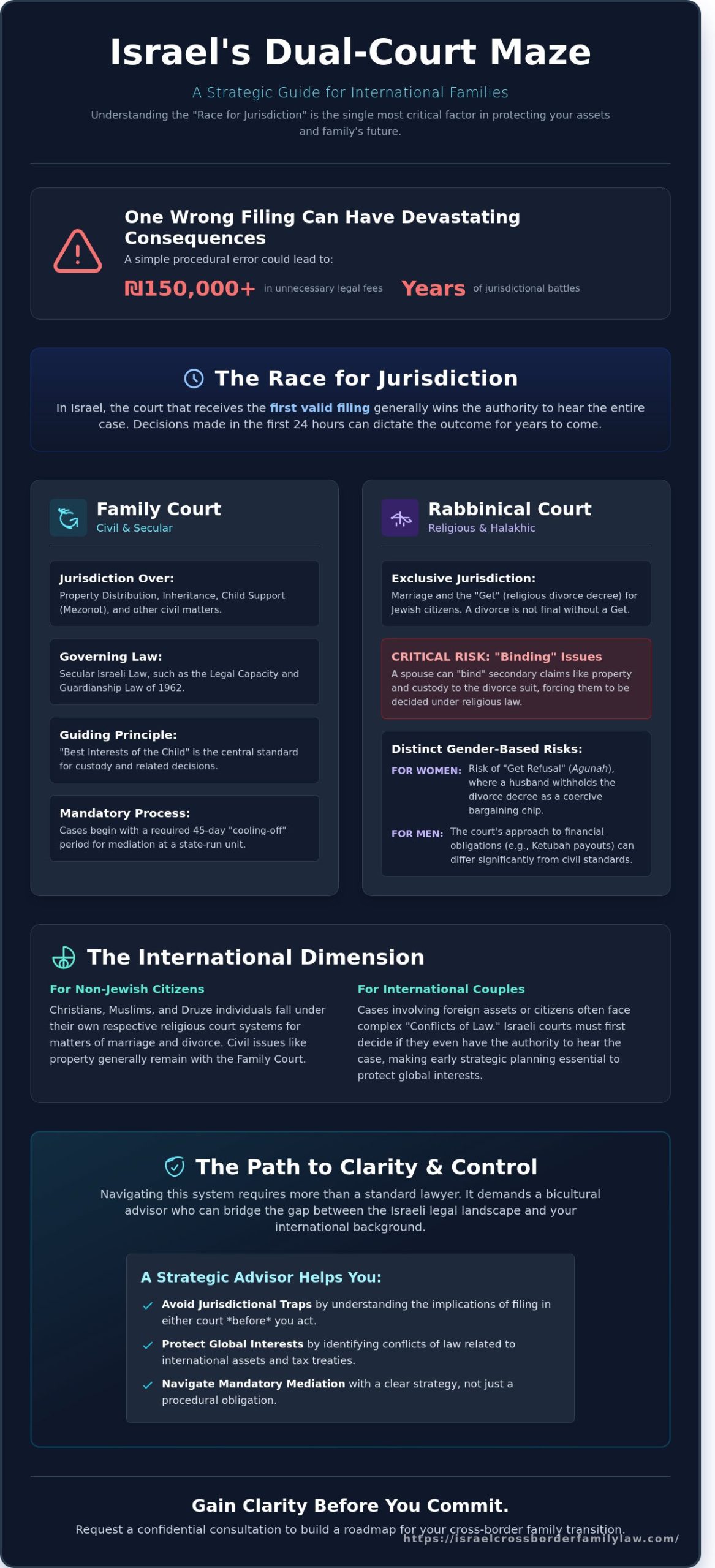
The “Race for Jurisdiction” is perhaps the most critical concept for international families and expats to grasp. In Israel, the court that receives the first valid filing generally gains the authority to hear the case. This means that where you file first determines the laws and procedural norms applied to your life. For example, a property dispute involving a ₪4,000,000 apartment in Tel Aviv might be handled differently in a religious court compared to a civil one. Decisions made in the first 24 hours of a legal conflict can echo for years.
The Role of the Family Court
The Family Court handles civil matters like property distribution, inheritance, and support based on secular Israeli law. It prioritizes the “Best Interests of the Child” standard, which is a central pillar of the Legal Capacity and Guardianship Law of 1962. Since the 2014 Family Dispute Resolution Law took effect, most cases must begin with a mandatory 45-day “cooling-off” period at a state-run Mediation and Legal Assistance Unit. This timeline is designed to reduce litigation, but it requires careful strategic planning to ensure your rights aren’t compromised during the wait.
The Rabbinical Court and the “Get”
For Jewish citizens and residents, the Rabbinical Court holds exclusive jurisdiction over the marriage and the “Get” (the religious divorce decree). A divorce isn’t final in Israel until this document is granted. A major risk involves “binding” secondary issues to the divorce suit. If a spouse files for divorce in the Rabbinical Court and includes property or custody claims, those issues are “bound” to the religious system. Men and women face distinct risks here; women may encounter “Get refusal” as a bargaining chip, while men might find the court’s approach to financial obligations differs significantly from civil standards. This is why consulting an עורך דין לענייני משפחה early is vital to avoid being forced into an unfavorable forum.
For non-Jewish citizens, the system is equally specific. Christians, Muslims, and Druze individuals fall under their own respective religious courts for marriage and divorce, while civil matters remain with the Family Court. International couples often face “conflicts of law,” where Israeli courts must decide if they even have the authority to hear a case involving foreign assets or citizens. Identifying these jurisdictional hurdles before filing is the only way to protect your global interests and financial stability.
Get clarity before you commit. Request a confidential consultation.
This article, provided by Israel Cross Border Law Firm, is published on an independent advisory platform. It offers strategic insights, highlights potential risks, and aims to guide your decision-making. Please note, this content is for informational and advisory purposes only and does not constitute legal representation or legal advice. For personalized assistance tailored to your specific situation, you can reach out via WhatsApp or book an advisory call with our experts.
What to Look for in a Cross-Border Family Lawyer
Selecting an עורך דין לענייני משפחה (family lawyer) in Israel requires more than checking for a local license. When your life spans two countries, the legal stakes involve overlapping tax codes, conflicting custody laws, and assets valued in different currencies. You need a professional who functions as a bridge between two distinct legal systems. Standard legal advice often fails to account for the long-term implications of a settlement that looks good in Tel Aviv but creates a tax nightmare in New York or the United States.
Bicultural and bilingual expertise is the foundation of a successful international case. It’s not just about “speaking English.” It’s about the ability to translate the nuances of the Israeli Rabbinical or Family Court systems into concepts that a Western client can actually use for decision-making. A lawyer who understands both the Israeli “Dugri” culture and Western expectations of professional transparency will save you from the confusion that often plagues expat litigation.
Technical Competence in International Law
Expats face unique pressures that domestic families don’t. Research from global mobility experts suggests that divorce rates in expat communities can be up to 20% higher than the 33% average seen in many Western countries due to the stress of relocation and jurisdictional isolation. Managing a divorce when you own a home in Ra’anana but hold a 401(k) or IRA in the United States requires specific knowledge of the US-Israel Tax Treaty. A standard עורך דין לענייני משפחה might not realize that an Israeli court order regarding a US-based pension isn’t automatically enforceable without a specific domestic relations order compatible with US federal law.
Understanding International Child Abduction laws is vital for families with dual citizenship. If one parent wants to relocate to the US with the children, the legal path is governed by the Hague Convention. Your advisor must explain how Israeli courts interpret “habitual residence” compared to US courts. These cases are time-sensitive; a delay of even a few weeks can permanently alter which country has jurisdiction over your children’s future.
Communication and Cultural Bridge
Language is often the first barrier. While many Israeli lawyers speak English, few can explain the difference between “joint physical custody” and the Israeli concept of “parental responsibility” without using dense jargon. You need “Plain English” summaries that respect your need for clarity. The cultural gap is just as wide. The Israeli approach to litigation often feels overly aggressive to Anglos. Conversely, a Western preference for polite negotiation might be seen as a weakness in the Israeli Family Court.
A sophisticated advisor balances these temperaments. They should focus on strategic resolution rather than high-conflict litigation that might drain a ₪60,000 retainer in three months without achieving a single goal. You can learn more about this process on the how it works page, which outlines the advisory transparency you should expect. Choosing the right temperament for your lawyer is a strategic decision. If your goal is a quiet settlement to protect your children, an aggressive “pitbull” lawyer might actually sabotage your interests. You can find more guidance on choosing a strategy that fits your specific family dynamic.
Get clarity before you commit. Request a confidential consultation.
The Strategic Approach: Divorce and Separation for Expats
Expats living in Israel face a unique set of challenges when a marriage ends. Your first move often dictates the entire trajectory of the case. In Israel, the “race of jurisdiction” means the court that first receives a filing, either the Family Court or the Rabbinical Court, usually retains authority over specific issues like property division or alimony. Before you sign any documents or make a life-altering decision, you need absolute clarity. Consulting with a qualified עורך דין לענייני משפחה (family law attorney) who understands international dynamics is vital to ensuring your rights are protected from the start.
The process begins with “Mahut” sessions. These are four mandatory dispute resolution meetings required by Israeli law since 2016. You can’t skip these sessions before filing a lawsuit. They’re designed to explore settlement options through mediation in a neutral environment. Preparation is key here. You should enter these meetings with a clear list of your assets and a firm understanding of your rights under both Israeli and international law. Many expats mistakenly view these as a formality, but they’re a strategic window to resolve the conflict before costs escalate.
Protecting International Assets
Property division for international families is rarely straightforward. Israeli courts generally follow the principle of “balancing of resources,” which aims for an equal split of assets acquired during the marriage. However, assets held abroad, such as a 401k in the US or real estate in Europe, introduce tax complexities and valuation disputes. For example, if you owned property before moving to Israel, it’s usually excluded from the split, but you must prove its separate status with documentation. If a house in London increased in value by ₪400,000 during the marriage, that specific gain might be subject to claims.
There’s a real risk when courts try to balance assets across different tax jurisdictions. An Israeli court might order a ₪250,000 offset from local bank accounts to account for a foreign pension. This often happens without considering the 20% or 30% tax hit you’ll take when eventually withdrawing that pension abroad. You need a financial strategy before any papers reach the court. Understanding how the Guide to Processing Family Law Cases with Israel details the interaction between civil and religious authorities can help you anticipate these hurdles and protect your global portfolio.
Mediation vs. Litigation
Reaching a settlement outside of court offers significant advantages for expats. It’s often faster and less expensive than a multi-year legal battle. More importantly, it allows you to maintain control over the outcome. In litigation, a judge who might not understand the nuances of a foreign trust or a cross-border career path will make the final decision. This can lead to rigid rulings that don’t account for your specific international lifestyle.
Mediation allows for creative solutions that Israeli law might not standardly provide. You can find more details on these strategies by visiting the divorce-separation-for-international-families page. For visual learners, the Israel Family Law YouTube channel provides several videos on mediation strategies and how to avoid common pitfalls. Choosing the right עורך דין לענייני משפחה to guide you through this process ensures your international interests remain protected while seeking a peaceful resolution.
Get clarity before you commit. Request a confidential consultation.
This article is published on an independent advisory platform (not a law firm). This content is for informational and advisory purposes only, not legal representation or legal advice. Focus on strategy, risks, and decision-making guidance. For direct assistance, reach out via WhatsApp for an advisory call.
Child Custody and Support: The Cross-Border Reality
Managing the financial and emotional needs of children across two different legal systems requires a strategic approach. Israeli child support, known as Mezonot, operates on principles that differ significantly from the standardized guidelines found in most US states. While US courts often use a strict mathematical formula based on gross income, Israeli courts traditionally followed religious law. However, a landmark 2017 Supreme Court ruling (919/15) shifted the landscape for children aged 6 to 15. In cases of joint physical custody where parents earn similar salaries, the obligation to pay child support is now shared more equitably. Consulting with an experienced עורך דין לענייני משפחה helps parents understand how these cross-border differences impact their monthly budget.
In Israel, basic child support for one child typically ranges from ₪1,650 to ₪2,250 per month. This figure doesn’t include “medur” (housing costs) or “extraordinaries” like private schooling or summer camps. When one parent lives in the US and the other in Israel, calculating these costs becomes a jurisdictional puzzle. You’ll need to account for currency fluctuations and the higher cost of living in Israeli urban centers. Enforcing these payments across borders is managed through the Department of International Affairs at the Ministry of Justice. They work under the 1956 UN Convention to ensure support reaches children, regardless of where the paying parent resides. For more details on this process, see our guide on child-support-cross-border-enforcement.
Relocation disputes are perhaps the most high-stakes aspect of international family law. If one parent wishes to move back to the US with the children, they must obtain either written consent from the other parent or a “relocation grant” from the Israeli Family Court. The court’s primary focus is the “best interests of the child” standard. This involves a deep dive into the child’s social, educational, and emotional ties to Israel. If you are facing a potential move, early strategy is vital to avoid being blocked at the border.
International Child Custody Laws
The concept of “habitual residence” is the cornerstone of international custody. If a child has lived in Israel for more than 12 months and is integrated into school and community life, Israel is likely their habitual residence. This determines which court has the right to make long-term decisions. The Hague Convention, which includes 103 member countries, protects against parental abduction by requiring the immediate return of a child taken across borders without consent. You can find specific guidance on these protections at international-custody-relocation.
Enforcement of Foreign Orders
An Israeli court doesn’t automatically follow a US custody agreement. To make a US order binding in Israel, you must go through a formal “recognition” process under the 1958 Foreign Judgments Law. The Israeli Family Court will check if the order contradicts local public policy or if the parties were given a fair chance to present their case. Comity is the legal principle where Israeli courts recognize the judicial acts of US states out of mutual respect and international courtesy. While comity is a strong factor, a local עורך דין לענייני משפחה will advise you that the court always retains the power to modify orders if a child’s circumstances change significantly after arriving in Israel.
Managing these issues requires a proactive plan rather than a reactive defense. Understanding the local system’s nuances ensures you don’t lose your rights when moving between jurisdictions. You should explore international strategy options before making any permanent residential changes.
Get clarity before you commit. Request a confidential consultation.
The Value of Informed Choice: Your Next Steps
Most people facing a family crisis in Israel instinctively rush to hire a law firm. While you’ll eventually need representation, a traditional firm isn’t always the right place to start for high-level strategy. Litigation-heavy firms are built to fight cases, not necessarily to design the most cost-effective exit plan. Choosing a עורך דין לענייני משפחה is a tactical decision, but that decision should only happen after you’ve developed a comprehensive strategic blueprint. Without this plan, you risk entering a system you don’t fully understand while spending thousands of shekels on reactive measures.
There’s a fundamental difference between legal advice and strategic advisory services. Legal advice tells you what the law says; strategic advisory tells you how the law, the local culture, and your specific financial situation intersect. If you’re an expat or have assets in multiple countries, the complexity doubles. You don’t just need someone to file papers. You need a professional team that operates like a well-oiled machine. This team should include:
- Strategic Advisory: To map out the jurisdiction risks and set the overall direction.
- Forensic Accounting: Especially if family assets exceed ₪2,000,000, ensuring nothing is hidden or undervalued.
- Litigation Counsel: A skilled עורך דין לענייני משפחה who executes the strategy in the Rabbinical or Family Courts.
One of the most expensive mistakes you can make is “emotional filing.” This happens when a spouse files for divorce out of anger or fear without calculating the long-term impact on child support (mezonot) or property division. In the Israeli “race for jurisdiction,” an unplanned filing can lock you into a court system that doesn’t favor your specific circumstances, potentially costing you ₪50,000 or more in unnecessary legal fees within the first 90 days.
Clarity Over Conflict
Litigation is a financial and emotional drain. In Israel, a contested divorce can drag on for 24 to 36 months, with legal costs often spiraling past ₪150,000. Much of this waste stems from unnecessary battles over small details. A single advisory call can often identify these pitfalls before they become permanent court records. By choosing a confidential-case-review, you gain an objective look at your situation. This helps you decide if a “war” is actually worth the investment or if a negotiated settlement is more viable.
Moving Forward with Confidence
Early intervention is the only way to maintain control over your future. When you understand the Israeli legal landscape, the fear of the unknown disappears. You’ll make decisions based on data and logic rather than panic. Expert guidance ensures that your cross-border interests are protected and that you don’t fall victim to local system nuances that catch many Anglos off guard. Success isn’t just about “winning” in court; it’s about emerging with your finances and sanity intact.
The content provided in this article is for informational and advisory purposes only. It does not constitute legal advice or an attorney-client relationship. Legal services are provided separately by licensed attorneys in their respective jurisdictions.
Get clarity before you commit. Request a confidential consultation.
Securing Your International Family’s Future
Navigating the Israeli legal landscape requires more than just a local advocate; it demands a strategist who understands the intersection of international treaties, the 1980 Hague Convention, and the nuances of the Rabbinical courts. In many cases, the first 30 days of a dispute dictate the long-term outcome, making the timing of your filing essential. Selecting an experienced עורך דין לענייני משפחה ensures you don’t lose jurisdictional advantages that could cost ₪50,000 or more in avoidable litigation fees. You need a professional who speaks your language and understands the bicultural hurdles unique to expats in Israel.
This platform provides specialized expertise for international families through plain English guidance and authoritative cross-border strategy. You can find further visual breakdowns of these complex topics on our YouTube channel. Remember, this information is for advisory purposes only and doesn’t constitute legal representation or legal advice. Making an informed choice now prevents complex multi-jurisdictional conflicts later. You’ve got the tools to move forward with confidence and protect your family’s interests in a foreign system.
Get clarity before you commit. Request a confidential consultation.
This article is published on an independent advisory platform (not a law firm). Do NOT use language that implies attorney-client relationship, legal representation, or giving legal advice. Focus on strategy, risks, and decision-making guidance. Soft CTA to advisory call / WhatsApp.
Frequently Asked Questions
Is a US prenuptial agreement enforceable in Israel?
An American prenuptial agreement is generally enforceable in Israel, provided it doesn’t contradict local public policy. Under the Spouses Property Relations Law of 1973, foreign agreements must often be validated by an Israeli Family Court to ensure both parties signed voluntarily and understood the terms. If you’re working with an עורך דין לענייני משפחה, they’ll likely recommend a “mirror agreement” to ensure the document holds weight in both jurisdictions.
How long does a typical divorce process take in IL for international couples?
A typical divorce for international couples in Israel lasts between 8 to 24 months. While a mutual consent divorce can be finalized in under 180 days, contested cases involving cross-border assets or child custody disputes often extend beyond 2 years. The timeline depends heavily on whether you resolve matters through mediation or litigation in the Family Court or Rabbinical Court.
Can I file for divorce in Israel if we were married in the US?
You can file for divorce in Israel even if your marriage took place in the United States. Israeli courts claim jurisdiction if at least one spouse is a resident or if the couple’s center of life is in the country. This applies to both civil marriages and religious ceremonies, though the specific court-Family or Rabbinical-will depend on your religious status and the timing of your filing. You can learn more about jurisdiction on our YouTube channel: https://www.youtube.com/@IsraelFamilyLaw.
What happens to my US-based 401k in an Israeli divorce?
Your US-based 401k is considered a marital asset subject to the “balancing of resources” principle under Israeli law. In a 2018 ruling, Israeli courts reaffirmed that pension funds and retirement accounts located abroad are divisible during divorce proceedings. An עורך דין לענייני משפחה will coordinate with US-based actuaries to determine the value of the 401k and how to offset it against Israeli assets like real estate.
Does the Rabbinical Court have authority over me if I am not religious?
The Rabbinical Court has exclusive authority over the act of divorce for all Jewish residents in Israel, regardless of their level of religious observance. While the Family Court can handle financial and custody matters, the Rabbinical Court gains authority over these issues if one spouse “attaches” them to a divorce claim first. This creates a strategic “race for jurisdiction” where the first person to file often dictates which legal system governs the case.
How is child support calculated in Israel compared to the US?
Child support in Israel is calculated based on the 2017 Supreme Court ruling (919/15), which accounts for the income of both parents and the actual time-sharing arrangement. Unlike many US states that use rigid percentage tables, Israeli courts focus on the specific needs of the child and the relative economic strength of each parent. For children over age 6 in joint custody, the financial burden is shared more equitably than in traditional US models.
What should I do if my spouse threatens to take the children out of IL?
If a spouse threatens to remove children from Israel without consent, you must immediately file for an emergency “Stay of Exit” order. This legal mechanism prevents the children from leaving the country through any port of entry for a renewable period of 12 months. Since Israel is a signatory to the 1980 Hague Convention on International Child Abduction, any unauthorized removal is treated as a serious legal violation requiring immediate international intervention.
How much does a family law lawyer in Israel typically cost?
The cost of a family law lawyer in Israel varies based on the complexity of the cross-border elements involved. Initial retainers for international divorce cases typically range from ₪25,000 to ₪65,000, with hourly rates for senior partners often falling between ₪800 and ₪1,800. These fees cover the drafting of motions, court appearances, and strategic planning, but third-party costs like expert valuations or translations are usually billed separately.
Get clarity before you commit. Request a confidential consultation.

Article by
Gabriel Lior
A Personal Journey That Became a Mission
The advisory was founded by an American father Gabriel Lior, LLB, MBA , global entrepreneur, and cross-border advisor who spent more than a decade navigating the Israeli family court system firsthand and now lives in Singapore with his son.
As a divorced parent in a cross-border family, Gabriel faced nearly every legal challenge a foreign parent can encounter in Israel — including child custody disputes, child support proceedings, property matters in Israel and abroad, false accusations, and complex immigration and relocation proceedings.
Over the years, he learned the hard way how difficult it is for non-Israeli parents to understand the system, identify the right legal strategy, and choose the right legal representation — especially when language, culture, and jurisdictional differences are involved. He also witnessed how foreign parents and new immigrants are often disadvantaged or taken advantage of by service providers and institutions simply because they lack local knowledge or fluency.
From Client to Advisor
To truly understand — and survive — the system, Gabriel pursued formal legal education in Israel, completing two Israeli law degrees, alongside a BA and MBA earned in the United States. This was never about becoming a practicing attorney, but about gaining a deep, structural understanding of how the system works — and where it breaks down for foreign parents.
This rare combination of:
Firsthand client experience
Israeli legal and US business education
International business and negotiation training
Decades of commercial execution
created a unique perspective – one that understands both sides of the table.
After years of litigation, persistence, and at times self-representation, he ultimately succeeded in securing custody of his son and relocating abroad through a rare legal victory in the Israeli Supreme Court — becoming one of the first fathers in Israel to do so under these circumstances.
Disclaimer
Important Disclaimer:
The information provided on this website and in its content is for general informational and educational purposes only and does not constitute legal advice, legal opinion, or legal representation.
Gabriel Lior is not licensed to practice law in Israel (nor is he interested in doing so) and does not provide legal services, despite having completed 2 Law Degrees. The services offered are advisory in nature and are intended to provide general guidance, strategic insight, and information regarding cross-border family law considerations.
No attorney-client relationship is formed by accessing this website, reading its content, or communicating with us.
Any decisions made based on this information are at your own discretion and risk. For legal advice specific to your situation, you should consult a licensed attorney in the relevant jurisdiction.
Where appropriate, we may refer clients to independent, licensed attorneys or professionals. Such referrals do not constitute legal representation and no liability is assumed for services provided by third parties.