This article is published on an independent advisory platform, not a law firm, and is for informational purposes only. It does not establish an attorney-client relationship. Legal services are only provided by licensed attorneys under a separate engagement.
What if a signed waiver or a verbal promise regarding contraception holds no legal weight once a child is born? In Israel, a biological father’s financial responsibility is nearly absolute, regardless of whether the pregnancy resulted from what is commonly termed sperm theft. You likely feel that a non-consensual pregnancy shouldn’t lead to a lifetime of financial obligation, especially if you’ve been the victim of deliberate deception. It’s an overwhelming realization for many expats and international families who expect the legal system to mirror the standards they’re used to in the U.S. or Europe.
This guide provides an educational overview of how Israeli courts prioritize the rights of the child over the circumstances of conception. You’ll learn about the reality of child support obligations in Israel and whether a claim for damages through a tort of deceit is a viable strategy for your specific situation. We’ll outline a strategic framework for cross-border protection to help you make informed decisions based on risk and reality. Get clarity before you commit. Request a confidential consultation.
Key Takeaways
- Understand how Israeli courts evaluate claims of sperm theft involving deception about contraception and why the lack of a statutory definition creates significant legal complexity.
- Learn why the “best interests of the child” serves as the paramount standard, often rendering child support obligations independent of a parent’s conduct or prior agreements.
- Examine the limited enforceability of “no-pregnancy” contracts and the challenges of pursuing a Tort of Deceit within the Israeli legal framework.
- Identify the unique jurisdictional risks for international families, including how Israeli support orders may be enforced across borders in countries like the US.
- Discover the importance of establishing a proactive legal strategy early on to navigate the inherent risks and cultural differences of the Israeli family court system.
This article is published on an independent advisory platform and does not constitute legal representation or an attorney-client relationship. Legal services are only provided by licensed attorneys under a separate engagement.
What is “Sperm Theft” Under Israeli Law?
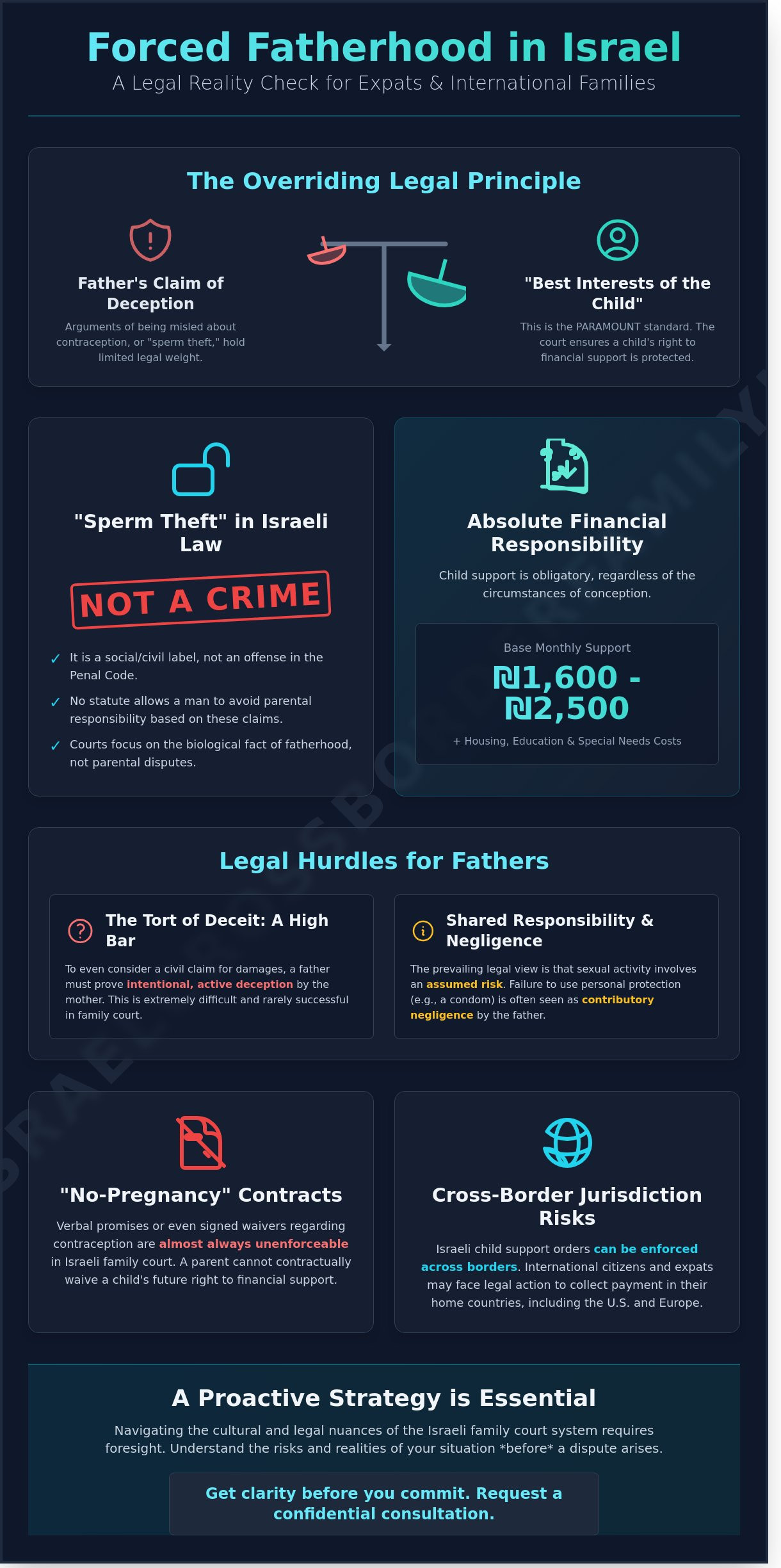
In the Israeli legal landscape, “sperm theft” describes a situation where a woman allegedly deceives a partner about her use of contraception or her fertility status to conceive a child without the man’s consent. Despite the provocative name, it isn’t a defined crime under the Israeli Penal Code. There’s no specific statute that allows a man to avoid parental responsibility based on these claims. Instead, the term serves as a social and civil label for a complex domestic dispute that sits at the intersection of tort law and family obligations.
To better understand this concept, watch this helpful video:
The distinction between legal “theft” and the consequences of unprotected sex is sharp. While a man might feel a profound sense of betrayal, Israeli judges view the act of intercourse as a voluntary assumption of risk. To explore the broader global context of this issue, one can look at What is Sperm Theft and how different jurisdictions handle these claims. In Israel, the subjective feeling of being wronged rarely overrides the biological reality of fatherhood. The court’s primary focus isn’t the conduct of the parents toward each other, but the rights of the resulting child.
The Legal Concept of Forced Fatherhood
The term remains a social descriptor rather than a criminal charge. When cases reach the bench, the Israeli Supreme Court must balance the father’s right to autonomy with the child’s fundamental right to exist and be supported. Israeli courts prioritize the child’s right to support over the father’s claim of being misled. This means that even if a man proves he was lied to, he’s still legally obligated to provide child support. Base support amounts often range from ₪1,600 to ₪2,500 per month, excluding housing and education costs, regardless of the circumstances of conception.
Deception vs. Negligence
Proving “misleading” behavior requires a high burden of proof that often remains unmet in family court. For a claim to even be considered as a potential civil tort, the man must demonstrate intentional, active deceit. However, the prevailing legal view is that any person engaging in sexual activity is responsible for its natural consequences. Courts generally rule that a man shouldn’t rely solely on a partner’s word regarding birth control if he wishes to avoid the possibility of fatherhood. The law views the protection against pregnancy as a shared responsibility, and failure to use a condom is often cited as a form of contributory negligence by the father.
Get clarity before you commit. Request a confidential consultation.
This article is published on an independent advisory platform, not a law firm. The information provided is for educational purposes only and does not constitute legal representation or an attorney-client relationship. Legal services are only provided by licensed attorneys under a separate engagement.
The Conflict Between Paternal Rights and Child Support Obligations
In Israel, the legal system prioritizes the “Best Interests of the Child” above almost all other considerations. When a man claims he is a victim of sperm theft, he often expects the court to relieve him of financial responsibility. However, Israeli law views the child as a separate legal entity with its own distinct rights. The conduct of the parents, even if proven to be deceptive or fraudulent, doesn’t negate the child’s basic right to sustenance and support.
The Israeli judiciary maintains a firm stance that a child shouldn’t suffer for the actions or misrepresentations of their parents. This creates a challenging landscape for international clients who may come from jurisdictions where “procreative fraud” is treated differently. In Israel, the focus remains squarely on the child’s welfare rather than the father’s grievances regarding the circumstances of conception.
The Child’s Independent Right to Support
Israeli courts operate on the principle that a child is not a party to the disputes or deceptions between the parents. Even if a father successfully proves he was misled about the use of contraception, his obligation to pay Mezonot (child support) remains mandatory. This is a fundamental pillar of the legal system. Support levels are calculated based on the child’s essential needs and the father’s financial capacity, rather than the “theft” claim. For those navigating divorce and separation for international families, it’s vital to recognize that these obligations are often non-negotiable.
- Minimum Support Standards: Courts typically set a baseline for support that covers food, clothing, and education.
- Housing Costs: The father is generally required to contribute to the child’s “roofing” expenses, which can range from 30% to 50% of the rent and utilities.
- Specific Figures: Minimum monthly support for a single child often starts between ₪1,650 and ₪1,950, excluding housing and extraordinary expenses like medical or extracurricular costs.
The Role of the Mother in Decision-Making
The Israeli legal framework grants the mother the sole right to decide whether to continue or terminate a pregnancy. A father’s objection to the birth doesn’t waive his support duties. Courts have consistently ruled that the right to bodily autonomy belongs to the woman, and once paternity is established via DNA testing, the financial responsibility is final. While the ethical debate around deception in reproductive health is complex, the legal outcome in Israel is predictable.
In landmark rulings such as Family Appeal 1059/02, the court emphasized that the father’s right to choose parenthood ends at the moment of conception. The state’s interest in ensuring the child is supported by its biological parents outweighs the father’s claim of being a victim of sperm theft. This creates an environment where strategy and early risk assessment are the only ways to manage the long-term impact of these claims.
Decisions made during the initial stages of a paternity claim can have lifelong financial consequences. Get clarity before you commit. Request a confidential consultation.
Contractual Validity and the Tort of Deceit
In Israel, the legal system prioritizes the welfare of the child over private agreements made between adults. If a man claims sperm theft based on a verbal or written promise that the woman was using contraception, he faces a steep uphill battle in court. While the Torts Ordinance [New Version] allows for claims based on deceit under Section 56, proving intentional misrepresentation in an intimate setting is exceptionally difficult. Israeli judges are often hesitant to invite the court into the bedroom to police the private conversations of consenting adults.
The threshold for winning a damages claim is high. A plaintiff must prove that the woman made a false representation with the intent to deceive him, and that he suffered actual damage as a result. Even if deceit is proven, the court must balance the father’s right to autonomy against the public interest of not “monetizing” the birth of a child. Most cases of this nature are dismissed unless there is clear, documented evidence of a pre-planned scheme to mislead the father.
Suing for Damages: A Separate Legal Track
A lawsuit for damages is entirely distinct from a child support claim. Winning a deceit case won’t stop your obligation to pay monthly support for the child. Courts may recognize emotional distress or specific financial losses, but awards are often modest, typically ranging from ₪35,000 to ₪100,000 in the rare instances they are granted. Men who pursue this track often face aggressive counter-suits for invasion of privacy or defamation, which can increase legal costs by tens of thousands of shekels.
Why Agreements Often Fail to Protect
Israeli judges frequently rule that “no-pregnancy” contracts are unenforceable because they violate public policy. You can’t legally “contract out” of a child’s right to financial support from their biological father. A financial indemnity agreement, where a mother promises to reimburse the father for child support, is also frequently struck down if it leaves the child with insufficient funds. It’s vital to seek a confidential case review before relying on any private waiver. These documents often provide a false sense of security that disappears the moment a paternity claim is filed in the Family Court.
Cross-Border Considerations for International Families and Expats
Jurisdictional challenges arise immediately when the father resides in the US and the mother is in Israel. Israeli courts generally claim jurisdiction over child support if the child is physically present in the country. This remains true even in cases where the father alleges sperm theft. The legal process doesn’t stop at the border; it creates a multi-jurisdictional web that affects financial obligations and freedom of movement.
Enforcement and the US-Israel Connection
Israel and the United States share a robust legal connection regarding the collection of maintenance. Since Israel joined the 2007 Hague Convention on the International Recovery of Child Support in 2018, the process for registering Israeli orders in US states has become more streamlined. US courts typically recognize these foreign orders under the Uniform Interstate Family Support Act (UIFSA). You can learn more about how these mechanisms work by reviewing child support cross-border enforcement protocols.
A critical risk for international fathers is the Israeli “Stay of Exit” order. If a support claim is filed while you’re visiting Israel, the court can prevent you from leaving the country until the debt is secured. This often requires depositing a significant financial bond, sometimes exceeding ₪100,000, or providing Israeli guarantors who earn at least ₪10,000 monthly. These orders can remain in place for decades, effectively barring a parent from international travel until the child reaches age 18 or 21.
Navigating Two Legal Systems
The procedural differences between the two systems are stark. US litigation relies heavily on broad “discovery” where parties exchange vast amounts of documentation. Israeli family courts operate with more judicial discretion and less formal discovery. For expats and foreign nationals, this means evidence that might be central in a US sperm theft defense may not be weighed the same way in an Israeli courtroom.
Citizenship status also hangs in the balance. While the child may be an Israeli citizen by birth, establishing US citizenship requires meeting specific Department of State requirements. Paternity must be established by “clear and convincing evidence,” which usually involves a court-ordered DNA test conducted under the Israeli Genetic Information Law (2000). Without this, the child may lack a Consular Report of Birth Abroad (CRBA), complicating future travel and residency. Strategies must be developed early to address these conflicting legal standards.
Get clarity before you commit. Request a confidential consultation.
Strategic Decision-Making in Complex Paternity Disputes
Facing a paternity claim under the cloud of sperm theft creates immediate pressure to react. You might feel a strong urge to defend your reputation or resolve the matter quickly through informal agreements. This is often a mistake. Early strategy saves money and stress; in Israel, once a legal precedent is set regarding paternity or support, it’s very difficult to reverse. Emotional reactions don’t win cases in the Israeli Family Court. Instead, a neutral, risk-based approach allows you to evaluate the situation without the fog of conflict.
Clarity Before Commitment
Don’t sign any documents without a cross-border review. A simple letter acknowledging “responsibility” or a seemingly harmless “agreement to help” can trigger a lifetime of financial obligations. You should keep communication with the other party minimal and professional. Emotional outbursts in text messages or emails often become evidence later. For a broader understanding of how these cases unfold, you can view educational content on the IsraelFamilyLaw YouTube channel. Seeking clarity on how the advisory process works is your first line of defense before making any legal moves.
- Avoid making verbal promises about financial support.
- Don’t agree to private DNA testing without legal oversight.
- Keep a detailed log of all interactions and dates.
Building a Risk-Based Strategy
A successful defense against a sperm theft claim requires weighing the cost of litigation against the likelihood of a damages award. While Israeli courts have occasionally awarded damages to men in these cases, the amounts are often modest. Previous rulings have seen awards ranging from ₪50,000 to ₪120,000, which may not cover the full cost of child support over 18 years. You must plan for the financial reality where child support often starts at a minimum of ₪2,500 to ₪3,000 per month, excluding housing and education costs.
International family law is complex because it involves two different legal cultures. Your strategy should focus on long-term parental responsibility and financial exposure. Developing a plan early helps you navigate the differences between your home country’s laws and the Israeli system. Get clarity before you commit. Request a confidential consultation.
Navigating Your Parental Rights with Strategic Foresight
Managing a paternity dispute in Israel requires a clear understanding of how local courts balance individual rights against the lifelong needs of a child. Israeli judiciary standards consistently prioritize the child’s right to financial support; this often overrides any private agreements made between parties. Claims involving sperm theft are legally complex because the tort of deceit rarely absolves a biological father from child support obligations. For expats and international families, these challenges are magnified by the jurisdictional differences between Israeli law and their home countries.
Early decisions in these cases carry permanent consequences. We provide strategic, risk-based guidance for those navigating the US-Israel legal bridge. We focus on helping you understand the specific Israeli regulations and market conditions that impact your case. By analyzing long-term financial and legal risks now, you can protect your interests and your family’s future. It’s vital to have a team on the ground that understands the bicultural nuances of these sensitive matters.
Get clarity before you commit. Request a confidential consultation.
Taking the first step toward legal clarity is the most effective way to ensure a stable path forward for everyone involved.
This article is published on an independent advisory platform and does not constitute legal representation or an attorney-client relationship. Legal services are only provided by licensed attorneys under a separate engagement.
Frequently Asked Questions about Sperm Theft and Paternity in Israel
Can I be forced to pay child support if I was lied to about birth control?
Yes, you’ll likely be required to pay. Israeli law prioritizes the child’s welfare over the circumstances of conception, viewing support as the child’s inherent right rather than the mother’s reward. Even if you provide evidence of deception, the court maintains that a child shouldn’t suffer financially due to their parents’ conduct. Standard support often starts around ₪1,600 per month plus expenses, regardless of how the pregnancy occurred.
Does Israel recognize sperm theft as a criminal offense?
No, Israel doesn’t recognize sperm theft as a specific criminal offense in its penal code. While the term is frequently used in civil disputes and family court, it’s treated as a tort or a breach of trust rather than a crime. You won’t see a mother facing jail time for these claims, but the situation can lead to complex litigation regarding parental rights and financial obligations.
Can a woman be forced to have an abortion if she deceived the father?
No court or individual in Israel can compel a woman to undergo an abortion. The right to bodily autonomy is absolute under Israeli law. Regardless of any prior agreements, written promises, or claims of fertility deception, the decision to carry a pregnancy to term rests solely with the woman. Deception doesn’t grant a man legal standing to dictate medical choices or terminate a pregnancy.
Will a signed agreement stating the woman takes full responsibility hold up in court?
These agreements are almost never enforceable regarding basic child support. Since a landmark 1982 Supreme Court ruling, Israeli courts have held that parents cannot contract away a child’s legal rights. While a contract might be valid between the two adults, it doesn’t bind the child. If the child’s needs aren’t met, the court will ignore the agreement and order the father to pay.
Can an Israeli child support order be enforced against me in the United States?
Yes, enforcement is highly effective through international treaties. Israel and the United States are both signatories to the 2007 Hague Convention on the International Recovery of Child Support. This allows Israeli orders to be registered and enforced by U.S. state authorities. Your U.S. wages can be garnished and your tax refunds intercepted to satisfy a debt established by an Israeli family court judge.
Is a DNA test mandatory if I deny paternity in a sperm theft case?
You can’t be physically forced, but refusal carries significant legal risks. Under the Genetic Information Law of 2000, if you refuse a court-ordered tissue classification test, the judge can invoke a “presumption of paternity.” This means the court will legally declare you the father based on your refusal alone. It’s a strategic mistake to decline a test if there’s any chance the claim is false.
Can I sue the mother for damages if I can prove she lied about her fertility?
You can file a tort claim for emotional distress or “wrongful life,” but success is rare. In a 2013 precedent, Israeli courts acknowledged the theoretical possibility of such claims, yet they’re hesitant to award damages. Judges worry that a large financial judgment against the mother would indirectly reduce the resources available for the child’s upbringing, which contradicts the “best interests” principle.
What happens if I leave Israel to avoid a paternity claim?
Leaving the country doesn’t stop the legal process. If a case is filed while you’re in Israel, the court can issue a stay-of-exit order, known as a Tzav Ikur Yetzia Min Haaretz, preventing you from leaving until you provide a financial guarantee. If you’re already abroad, the case can proceed in your absence, resulting in a default judgment that’s enforceable internationally through the Hague Convention.
For more information on navigating these complex family dynamics and the Israeli legal system, you can view educational resources on the Israel Family Law YouTube channel.
Get clarity before you commit. Request a confidential consultation.

Article by
Gabriel Lior
A Personal Journey That Became a Mission
The advisory was founded by an American father Gabriel Lior, LLB, MBA , global entrepreneur, and cross-border advisor who spent more than a decade navigating the Israeli family court system firsthand and now lives in Singapore with his son.
As a divorced parent in a cross-border family, Gabriel faced nearly every legal challenge a foreign parent can encounter in Israel — including child custody disputes, child support proceedings, property matters in Israel and abroad, false accusations, and complex immigration and relocation proceedings.
Over the years, he learned the hard way how difficult it is for non-Israeli parents to understand the system, identify the right legal strategy, and choose the right legal representation — especially when language, culture, and jurisdictional differences are involved. He also witnessed how foreign parents and new immigrants are often disadvantaged or taken advantage of by service providers and institutions simply because they lack local knowledge or fluency.
From Client to Advisor
To truly understand — and survive — the system, Gabriel pursued formal legal education in Israel, completing two Israeli law degrees, alongside a BA and MBA earned in the United States. This was never about becoming a practicing attorney, but about gaining a deep, structural understanding of how the system works — and where it breaks down for foreign parents.
This rare combination of:
Firsthand client experience
Israeli legal and US business education
International business and negotiation training
Decades of commercial execution
created a unique perspective – one that understands both sides of the table.
After years of litigation, persistence, and at times self-representation, he ultimately succeeded in securing custody of his son and relocating abroad through a rare legal victory in the Israeli Supreme Court — becoming one of the first fathers in Israel to do so under these circumstances.
Disclaimer
Important Disclaimer:
The information provided on this website and in its content is for general informational and educational purposes only and does not constitute legal advice, legal opinion, or legal representation.
Gabriel Lior is not licensed to practice law in Israel (nor is he interested in doing so) and does not provide legal services, despite having completed 2 Law Degrees. The services offered are advisory in nature and are intended to provide general guidance, strategic insight, and information regarding cross-border family law considerations.
No attorney-client relationship is formed by accessing this website, reading its content, or communicating with us.
Any decisions made based on this information are at your own discretion and risk. For legal advice specific to your situation, you should consult a licensed attorney in the relevant jurisdiction.
Where appropriate, we may refer clients to independent, licensed attorneys or professionals. Such referrals do not constitute legal representation and no liability is assumed for services provided by third parties.