This article is published on an independent advisory platform and does not constitute legal representation or legal advice. An attorney-client relationship is only formed through a separate engagement with a licensed attorney.
The most logical step in a us citizen divorce in israel might actually be the one that puts your US-based assets at the greatest risk. While many expats believe that waiting for a collaborative opening is the safest path, the Israeli legal system often rewards the party who initiates the “race to court” first. It’s a high-stakes environment where the choice between the Family Court and the Rabbinical Court, or Beit Din, can dictate your financial future for years. Data from 2024 indicates that jurisdictional priority frequently determines the outcome of asset division and support obligations.
It’s natural to feel overwhelmed by the overlapping jurisdictions and the potential for IRS tax penalties on foreign assets. This comprehensive 2026 advisory guide is designed to help you regain control by providing a clear strategy to protect your interests on both sides of the ocean. You’ll learn how to safeguard pre-marital property, avoid common international custody pitfalls, and structure settlements that respect international boundaries. For a deeper look at these dynamics, you can view our resources at https://www.youtube.com/@IsraelFamilyLaw. Get clarity before you commit. Request a confidential consultation.
Key Takeaways
- Understand how habitual residence and your US citizenship dictate the legal framework and jurisdictional boundaries of your cross-border case.
- Navigate the “Race for Jurisdiction” by learning the distinct roles and authorities of the Israeli Family Court versus the Rabbinical Court.
- Learn how a us citizen divorce in israel involves specific considerations for international child custody, guardianship, and the application of the Hague Convention.
- Manage financial risks by coordinating Israeli asset division principles with your ongoing US tax obligations and IRS filing requirements.
- Adopt a strategy-first approach to identify potential risks and secure clarity before committing to any formal legal filings or agreements.
Navigating the Intersection of US and Israeli Legal Systems
For an American living abroad, a us citizen divorce in israel is rarely a localized event. It’s a complex international matter where two distinct legal systems overlap. Your US citizenship doesn’t vanish when you enter an Israeli courtroom. Instead, it adds layers of responsibility regarding tax reporting, Social Security benefits, and the potential division of assets located in the United States. Failing to account for these cross-border factors early in the process can lead to unintended financial or jurisdictional consequences.
To better understand the complexities of this process, watch this helpful video:
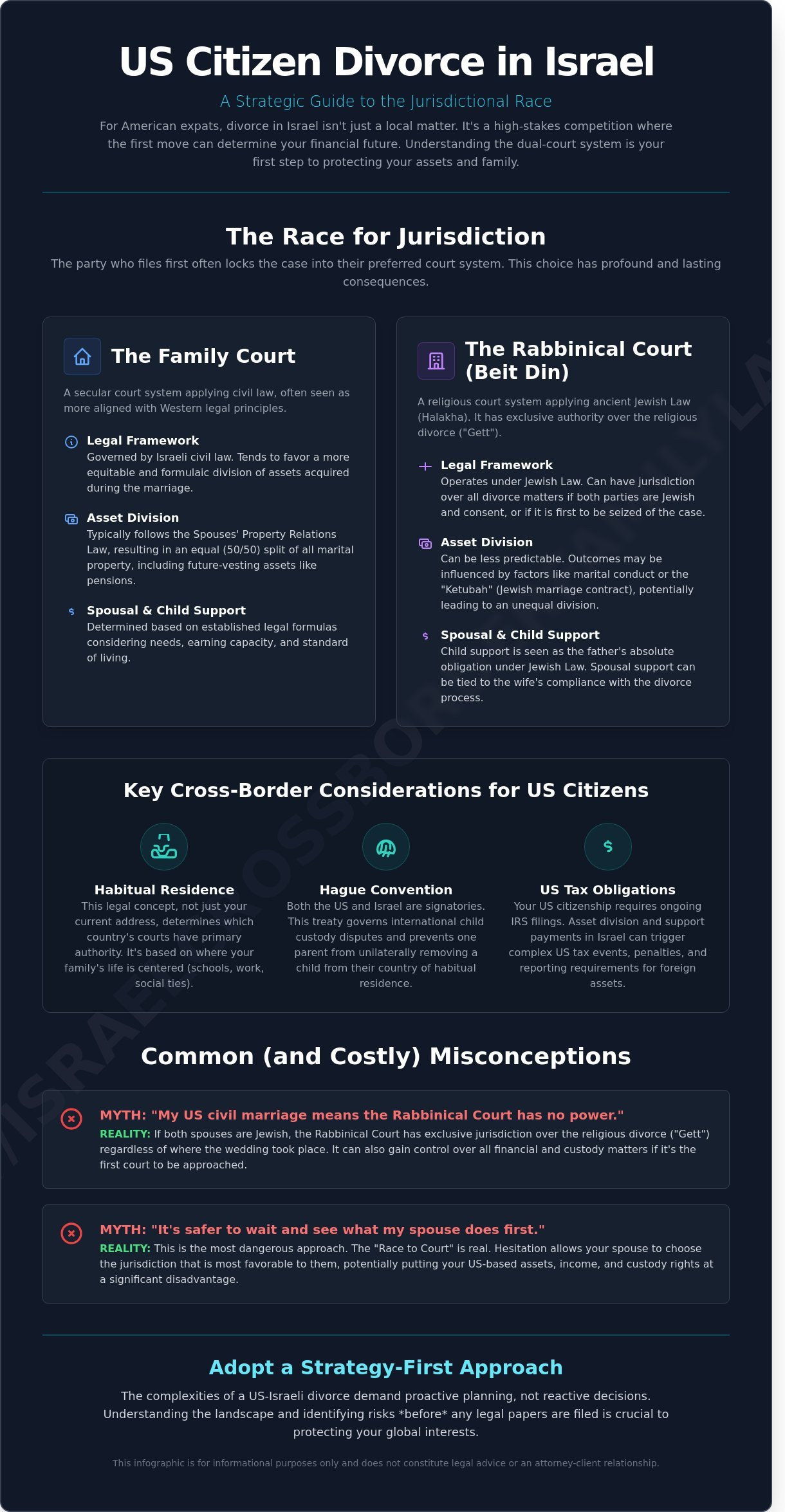
The concept of “habitual residence” is the primary factor that dictates which country has the authority to hear your case. This isn’t always as simple as where you’re currently standing. It involves an analysis of where the family’s life is centered, including school enrollment, employment, and social ties. When children are involved, the Hague Convention on International Child Abduction plays a critical role. Both Israel and the US are signatories to this 1980 treaty, which establishes protocols for returning children who have been removed from their country of habitual residence without the other parent’s consent.
It’s a common mistake to assume that a divorce decree issued in a US state court will be automatically recognized in Israel. For the Israeli Ministry of Interior or the local courts to honor a foreign judgment, a formal recognition process is required. This often involves proving that the foreign court had proper jurisdiction and that the ruling doesn’t conflict with Israeli public policy. Without these specific steps, you might find yourself “divorced” in America but still “married” under Israeli law.
The Advisory Platform Perspective
This article is published on an independent advisory platform and is intended for informational purposes only. It doesn’t constitute an attorney-client relationship. Because a us citizen divorce in israel involves high-stakes decisions, you should seek clarity on your specific circumstances before making any legal commitments. Understanding how it works from a strategic perspective is the first step toward protecting your global interests.
Common Misconceptions for Americans in IL
- The Civil Marriage Myth: Many Americans believe that because they had a civil wedding in the US, the Israeli Rabbinical Court has no jurisdiction over them. In reality, if both parties are Jewish, the Rabbinical Court often holds exclusive authority over the religious divorce (the “Gett”), regardless of where the wedding occurred.
- The “Wait and See” Risk: In international law, the person who files first often gains a significant strategic advantage. Waiting to see how things develop can be dangerous, as it may allow the other party to lock the case into a jurisdiction that’s less favorable for your specific needs.
- International Mobility: Early decisions regarding custody or residency can permanently impact your ability to move back to the US with your children. These choices are often difficult to reverse once a court has issued a ruling.
Get clarity before you commit. Request a confidential consultation.
The Dual Court System: Family Court vs. Rabbinical Court
Understanding the Israeli legal landscape is essential for any us citizen divorce in israel. The system operates under a unique dual-jurisdiction model where two distinct court systems have the authority to hear divorce cases. This creates what is known in IL law as the “Race for Jurisdiction” (Merotz Samchuyot). The court that receives a valid filing first typically gains the right to decide on related issues like property division and alimony. Because the Family Court and the Rabbinical Court apply different legal frameworks, the venue where your case is heard can fundamentally change your financial and personal outcome.
The Family Court (Beit Mishpacha)
The Family Court is a secular institution that operates under civil law. Its primary guiding principle is the “Best Interests of the Child” standard, which mirrors many U.S. legal concepts but carries specific local interpretations. For U.S. citizens, this court is often better equipped to handle international asset division. Judges frequently appoint neutral experts, such as forensic accountants or appraisers, to evaluate cross-border holdings, including 401(k) accounts, U.S. real estate, or stock options in Silicon Valley firms. The process is structured to ensure a fair distribution of marital property based on civil equity.
The Rabbinical Court and US Citizens
The Rabbinical Court (Beit Din) holds exclusive authority over the marriage bond itself. Many secular Americans are surprised to learn that they are subject to religious jurisdiction in IL, but the state grants these courts the sole power to issue the “Get” (the religious divorce decree). This document is essential; without it, you aren’t considered divorced under Israeli law. The U.S. Embassy in Israel’s official guidance explains how these religious certificates are documented for civil recognition. While the Rabbinical Court is often viewed as more traditional, there are strategic scenarios where it may be the preferred venue, particularly regarding specific interpretations of marriage contracts (the Ketubah) or certain types of spousal support.
Navigating the Dispute Settlement Process
Since the enactment of the Settlement of Disputes Law in July 2016, couples cannot simply rush to file a lawsuit. You must first submit a mandatory “Settlement of Dispute” (Yishuv Sichsach) application. This triggers a “cooling off” period, usually lasting 45 to 60 days, during which you meet with court-appointed social workers. It’s a critical phase for a us citizen divorce in israel because it prevents you from filing new motions in either IL or the U.S. during the stay of proceedings. Understanding how this pause affects your global strategy is vital for protecting your rights in divorce and separation for international families.
- The Family Court handles civil matters, child welfare, and complex international property.
- The Rabbinical Court manages the “Get” and can “attach” financial matters if filed first.
- The 2016 law requires a mandatory mediation period before litigation can begin.
Get clarity before you commit. Request a confidential consultation.
This article is published on an independent advisory platform and does not constitute a law firm or an attorney-client relationship. Legal services are only provided by licensed attorneys under a separate engagement.
Financial Complexity: US Tax Obligations and Asset Division in IL
Divorcing as a us citizen divorce in israel presents a unique clash of financial jurisdictions. Israel generally follows the “equal sharing” principle under the Spousal Property Relations Law of 1973, which mandates an even split of assets accumulated during the marriage. This often contrasts sharply with US state laws like Community Property in California or Equitable Distribution in New York. Navigating these differences requires a clear Israeli family law overview to understand how courts handle foreign-held wealth when the parties live abroad.
The US-Israel Tax Treaty of 1975 provides a framework to prevent double taxation, but it doesn’t solve every logistical hurdle. For instance, your IRS filing status is a critical divorce negotiation tool. Deciding whether to file “Married Filing Jointly” or “Married Filing Separately” during the 2026 tax year can significantly impact your net liquid assets. A strategic approach ensures that tax refunds or liabilities are factored into the final settlement rather than becoming an afterthought.
IRS Compliance During Divorce
Maintaining consistent US tax filings is mandatory for all citizens, regardless of their residency in IL. The IRS treats child support as tax-neutral, while the Israeli Tax Authority may have different views on alimony payments. You must also protect yourself from a spouse’s past tax liabilities. If your partner underreported income on joint US returns, you could be held liable. Requesting “Innocent Spouse Relief” is a necessary step if you suspect financial irregularities in your past joint filings.
Asset Balancing and Resource Balancing
Israeli courts typically view pre-marital assets and inheritances as separate property, yet “commingling” these funds into a joint Israeli bank account can change their legal status. Valuing a US-based business interest for an Israeli court is a complex task that requires specialized forensic accounting. Strategy involves “Resource Balancing,” where assets are allocated based on their tax-adjusted value in both currencies. It isn’t just about the current exchange rate; it’s about the long-term tax consequences of liquidating a 401(k) versus selling a home in Tel Aviv or Jerusalem. Every us citizen divorce in israel must account for the 10 percent early withdrawal penalty on US retirement accounts if they are used to facilitate a settlement.
Child Support in a Cross-Border Context
Calculating support is difficult when a parent earns in USD but the children reside in IL, where the cost of living is tied to the Shekel. You need a formula that accounts for currency volatility to ensure the support remains fair over time. For those dealing with non-payment, understanding Child Support Cross-Border Enforcement is vital. US-based parents can be reached through international enforcement mechanisms, ensuring that financial obligations are met regardless of the distance between the two legal systems.
Get clarity before you commit. Request a confidential consultation.
International Child Custody and the Hague Convention
Understanding child custody during a us citizen divorce in israel requires a shift in perspective. The Israeli legal system distinguishes between legal guardianship, known as Apotropusut, and physical residence. In almost every case, both parents retain equal legal guardianship. This means both must agree on major life decisions, such as medical treatments, religious upbringing, and the issuance of passports. Physical residence, or where the child actually sleeps, is a separate determination.
The landscape of physical custody has changed significantly over the last decade. The “Tender Years Doctrine,” which historically presumed that children under age six should remain with their mother, is being phased out. Since the 2011 Schnitt Committee recommendations, Israeli family courts have increasingly favored joint parental responsibility. For many US expats, this shift means that fathers are now much more likely to secure significant or equal parenting time than they were in previous years.
Relocation remains the most litigated issue for international families in IL. When one parent wants to move back to the US, the court must balance the “best interests of the child” against the right of the parent to move. Because the Israeli legal system views the child’s stability as paramount, obtaining permission to relocate is a complex, evidence-heavy process that often requires expert psychological evaluations.
The Hague Convention: What US Citizens Must Know
Moving a child out of Israel without a written court order or the other parent’s notarized consent is a grave legal error. Such actions are classified as “wrongful removal” or “wrongful retention” under the 1980 Hague Convention. If a parent takes a child to the US without proper authorization, the Israeli court can trigger an international legal process to demand the child’s immediate return. The stakes are incredibly high, and a violation can permanently damage a parent’s standing in future custody hearings. You can find detailed safety protocols in our guide to the Hague Convention & Child Abduction.
Relocation Strategy
Israeli courts evaluate relocation requests based on the parent’s primary motivation, the child’s social and educational needs, and the ability to maintain a meaningful connection with the parent staying in IL. A “relocation-proof” divorce agreement is the best way to avoid future litigation. These documents should specify exactly how travel costs are shared and which court retains jurisdiction. For a deeper look at these requirements, see our resource on International Custody & Relocation.
The Role of Technology in International Parenting
Modern technology has changed how Israeli judges view long-distance parenting. Virtual visitation through video calls and shared digital calendars is now a standard part of cross-border custody arrangements. These tools help children maintain their US-Israel connection despite the 6,000-mile distance. The @IsraelFamilyLaw YouTube channel offers several educational videos that explain how courts integrate technology into modern parenting plans. Our bicultural team on the ground helps parents draft schedules that account for time zone differences and international school holidays.
Get clarity before you commit. Request a confidential consultation.
Strategic Planning: Getting Clarity Before You Commit
A us citizen divorce in israel requires more than just filing paperwork. It demands a comprehensive roadmap designed before any legal action starts. Early decisions often dictate the trajectory of the entire case. In the Israeli legal system, the “race to jurisdiction” means the first spouse to file in either the Family Court or the Rabbinical Court can fundamentally change how assets and custody are handled. Without a strategy, you might find yourself litigating international assets under rules that don’t favor your specific financial structure.
Effective decision making relies on assessing risks accurately. You’ve got to decide which battles are worth the emotional and financial cost. For example, fighting over a US-based 401(k) in an Israeli court might lead to complex tax implications that a standard local attorney may overlook. In 2024, cross-border families face increasingly complex regulations regarding global asset disclosure. Choosing to focus on long-term stability in the US or IL requires a clear understanding of how both systems interact. It’s about looking at the big picture rather than winning a single point in court.
Bicultural and bilingual guidance is essential. It’s not just about translating Hebrew to English. It’s about translating legal cultures. An advisor who understands both the “Start-up Nation” business environment and US federal tax laws acts as a bridge. This ensures your interests stay protected in both jurisdictions simultaneously. You can find more detailed discussions on these dynamics on the Israel Family Law YouTube channel, where these cross-border complexities are explored in depth.
How the Advisory Works
The independent advisory model provides a neutral space to explore your options. This approach allows you to understand the landscape before engaging in formal litigation. To learn more about this process, you can review How it Works. This model is specifically designed For Expats & Foreign Nationals who need to navigate the friction between two different legal systems without the immediate pressure of a courtroom battle.
Next Steps for US Citizens
Start by gathering your documentation. You’ll need records from both the US and Israel, including tax returns, property deeds, and account statements. A confidential case review is the most effective way to identify potential pitfalls early. This preparation helps prevent reactive decisions that could haunt your financial future for years. Taking the time to build a strategy now saves significant resources later.
Get clarity before you commit. Request a confidential consultation.
Securing Your Future Through Strategic Planning
Navigating the intersection of two distinct legal systems requires a steady hand and a clear map. The decisions you make in the early stages of a us citizen divorce in israel often carry long-term consequences for your financial standing and your family’s stability. It’s vital to understand the jurisdictional “race” between the Israeli Family Court and the Rabbinical Court, as these venues apply different rules to alimony and property. You’re also managing US tax obligations and international protocols like the 1980 Hague Convention, which governs cross-border custody matters.
Our advisory focuses on risk-based strategic decision making specifically designed for the international community in IL. We provide the bicultural expertise needed to bridge the gap between US expectations and Israeli legal realities. This platform serves as an independent advisory resource. It helps you understand the complexities of multi-jurisdictional litigation before you commit to a specific path. By identifying potential conflicts in asset division and tax reporting early, you can move forward with a defined strategy rather than reacting to crises. Get clarity before you commit. Request a confidential consultation to evaluate your options. Taking the time to plan now helps ensure a more predictable transition for your future.
This article is published on an independent advisory platform and does not constitute a law firm or legal representation. The information provided is for educational purposes only and does not create an attorney-client relationship. Legal services are only provided by licensed attorneys under a separate, formal engagement. Get clarity before you commit. Request a confidential consultation.
Frequently Asked Questions
Can a US citizen be forced to divorce in an Israeli Rabbinical Court?
An Israeli Rabbinical Court holds exclusive jurisdiction over the marriage and divorce of Jewish residents in Israel, regardless of their foreign citizenship. If you’re a Jewish US citizen residing in Israel, your spouse may initiate proceedings in this religious court. This applies even if you married in a civil ceremony in the US, as the Rabbinical Court manages the “Get” or religious divorce decree for all Jewish residents under the 1953 Rabbinical Courts Jurisdiction Law.
Will the IRS recognize my Israeli divorce decree for tax purposes?
The IRS generally recognizes a foreign divorce decree if it’s valid in the country where it was issued and both parties received proper notice. For a us citizen divorce in israel, your filing status changes from “Married Filing Jointly” to “Single” or “Head of Household” once the final decree is issued. You must ensure the Israeli judgment is translated and authenticated to meet IRS documentation standards for the tax year ending December 31.
What happens to my US Social Security benefits if I divorce in Israel?
Your eligibility for US Social Security benefits remains subject to US federal law rather than Israeli court rulings. If your marriage lasted at least 120 months before the Israeli divorce was finalized, you may be entitled to benefits based on your ex spouse’s record once you reach retirement age. Israeli courts cannot divide these federal benefits, but they may consider them when calculating overall financial settlements or alimony during the asset division process.
Can I move back to the US with my children during the divorce process?
You cannot legally relocate children to the US without a written agreement or an Israeli court order while proceedings are active. Israel is a signatory to the 1980 Hague Convention on the Civil Aspects of International Child Abduction. Moving children without authorization can lead to an immediate return order within 6 weeks, which significantly impacts your custodial rights and legal standing in both jurisdictions.
For more information on international custody matters, you can view detailed explanations on this channel: https://www.youtube.com/@IsraelFamilyLaw
How is child support calculated in Israel compared to the US?
Israeli child support calculations differ from the percentage based models used in many US states. Following the 2017 Supreme Court ruling 919/15, support for children over age 6 is based on the relative income of both parents and the actual time spent with each child. This shift toward gender neutral support means that a parent with 50 percent custody may pay significantly less than they would under standard US guidelines.
Is a US prenuptial agreement enforceable in an Israeli court?
An Israeli court will often respect a US prenuptial agreement, but it requires formal validation under the Financial Relations Law of 1973 to be fully binding. If the agreement wasn’t previously ratified by a judge or notary, the Israeli court must review it to ensure it doesn’t violate local public policy. To avoid complications, a us citizen divorce in israel should involve a review of the foreign contract by a bicultural legal professional early in the process.
What is the “Race for Jurisdiction” and how does it affect me?
The “Race for Jurisdiction” refers to the tactical advantage gained by the spouse who files first in either the Family Court or the Rabbinical Court. Because these two systems have concurrent jurisdiction over matters like property division and alimony, the choice of venue can change the outcome of your case. Filing first allows a spouse to lock in the court that may offer a more favorable legal framework for their specific financial or custodial goals.
Do I need two lawyers, one in the US and one in Israel?
Maintaining legal counsel in both jurisdictions is standard practice for cases involving significant US based assets or pension plans. An Israeli lawyer manages the local litigation, while a US attorney ensures that Israeli orders are enforceable in your home state and that US tax obligations are met. This collaborative approach prevents conflicting rulings and ensures that your global interests remain protected throughout the multi jurisdictional process.

Article by
Gabriel Lior
A Personal Journey That Became a Mission
The advisory was founded by an American father Gabriel Lior, LLB, MBA , global entrepreneur, and cross-border advisor who spent more than a decade navigating the Israeli family court system firsthand and now lives in Singapore with his son.
As a divorced parent in a cross-border family, Gabriel faced nearly every legal challenge a foreign parent can encounter in Israel — including child custody disputes, child support proceedings, property matters in Israel and abroad, false accusations, and complex immigration and relocation proceedings.
Over the years, he learned the hard way how difficult it is for non-Israeli parents to understand the system, identify the right legal strategy, and choose the right legal representation — especially when language, culture, and jurisdictional differences are involved. He also witnessed how foreign parents and new immigrants are often disadvantaged or taken advantage of by service providers and institutions simply because they lack local knowledge or fluency.
From Client to Advisor
To truly understand — and survive — the system, Gabriel pursued formal legal education in Israel, completing two Israeli law degrees, alongside a BA and MBA earned in the United States. This was never about becoming a practicing attorney, but about gaining a deep, structural understanding of how the system works — and where it breaks down for foreign parents.
This rare combination of:
Firsthand client experience
Israeli legal and US business education
International business and negotiation training
Decades of commercial execution
created a unique perspective – one that understands both sides of the table.
After years of litigation, persistence, and at times self-representation, he ultimately succeeded in securing custody of his son and relocating abroad through a rare legal victory in the Israeli Supreme Court — becoming one of the first fathers in Israel to do so under these circumstances.
Disclaimer
Important Disclaimer:
The information provided on this website and in its content is for general informational and educational purposes only and does not constitute legal advice, legal opinion, or legal representation.
Gabriel Lior is not licensed to practice law in Israel (nor is he interested in doing so) and does not provide legal services, despite having completed 2 Law Degrees. The services offered are advisory in nature and are intended to provide general guidance, strategic insight, and information regarding cross-border family law considerations.
No attorney-client relationship is formed by accessing this website, reading its content, or communicating with us.
Any decisions made based on this information are at your own discretion and risk. For legal advice specific to your situation, you should consult a licensed attorney in the relevant jurisdiction.
Where appropriate, we may refer clients to independent, licensed attorneys or professionals. Such referrals do not constitute legal representation and no liability is assumed for services provided by third parties.