This article is published on an independent advisory platform and does not constitute legal representation or legal advice. What if your international wedding certificate is treated as nothing more than a souvenir in the eyes of the Israeli government? Many expats and Anglos arrive in Israel assuming that a legal marriage performed abroad is automatically valid here, only to face a wall of bureaucracy at the Ministry of Interior, known as Misrad HaPnim. The process of registering foreign marriage in israel is often the first major legal hurdle for international couples, and it carries significant implications for your residency and family rights.
It’s understandable to feel overwhelmed by the technical requirements or the distinction between religious and civil authorities. You want to ensure your family unit is secure and your spouse’s residency is protected. In this guide, you’ll learn the essential steps, risks, and strategic requirements for having your international marriage officially recognized. We’ll preview the 2026 documentation standards, including Apostille requirements and the multi-stage procedure for foreign spouses, so you can move forward with clarity and confidence.
Key Takeaways
- Understand that while Israel does not perform civil ceremonies, the Population and Immigration Authority is legally required to recognize valid international unions.
- Learn the strategic steps for registering foreign marriage in israel to secure residency rights and work permits through the multi-stage StuPro process.
- Discover why the “Cyprus Route” remains a primary choice for expats and how to navigate the overlapping jurisdictions of civil and religious courts.
- Identify the specific documentation requirements, including Apostille legalization for marriage and birth certificates, to avoid bureaucratic delays.
- Gain clarity on how early registration decisions impact your family’s future legal standing and potential jurisdictional issues in the Israeli court system.
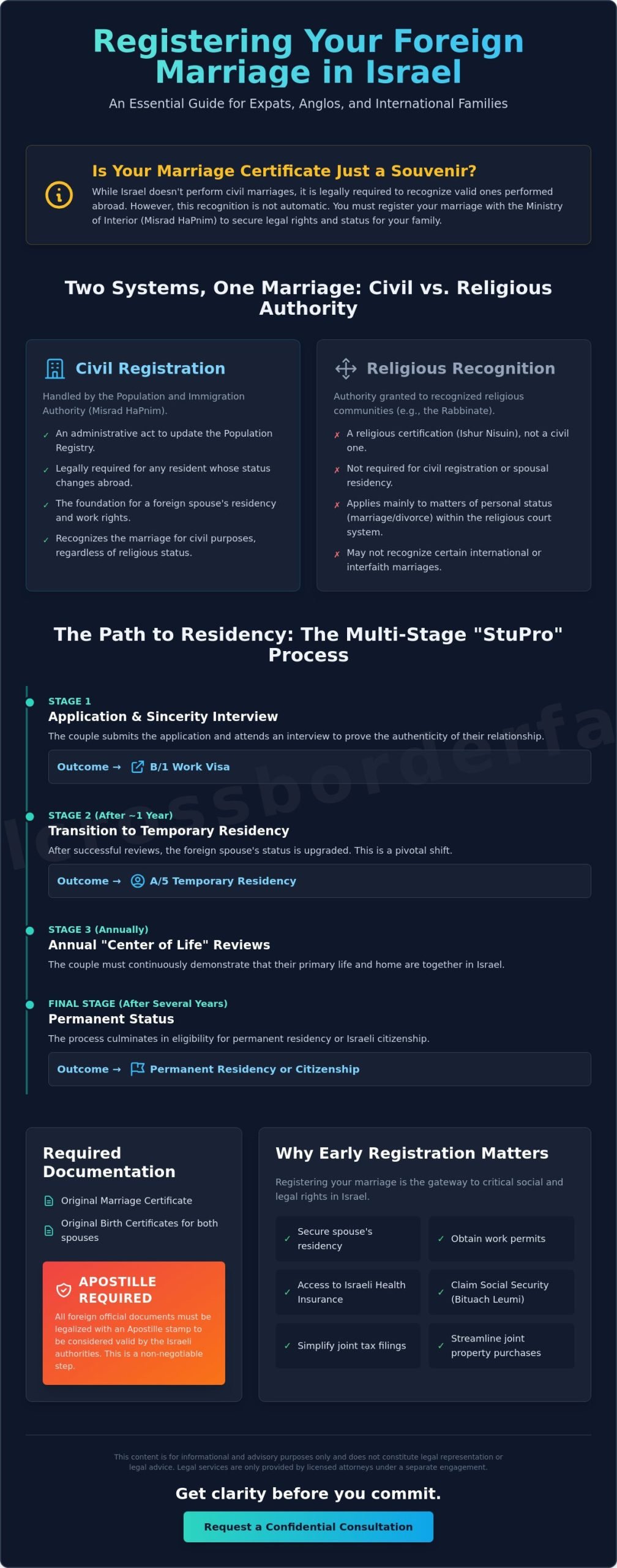
This article is published on an independent advisory platform and does not constitute legal representation or legal advice. Israel operates under a unique legal framework where civil marriage is not performed within its borders. Instead, authority over marriage and divorce is granted to recognized religious communities. However, the state is legally bound to recognize civil marriages performed abroad. This creates a critical distinction for expats: while you cannot get a civil wedding in Tel Aviv, the government must acknowledge your wedding from New York, London, or Cyprus. For a deeper context, Understanding Marriage in Israel provides a baseline for how these historical laws shape modern life.
The central body responsible for this process is the Population and Immigration Authority, commonly known as Misrad HaPnim. When you are registering foreign marriage in israel, you aren’t seeking religious validation; you are updating the civil Population Registry. As of June 2026, the standard fee for this registration is NIS 107. This update is a legal requirement for any resident whose personal status changes abroad. It ensures your Teudat Zehut (Israeli ID) accurately reflects your life, which is vital for all future interactions with the state.
To better understand how these registration steps facilitate life for international couples, watch this helpful video:
It’s essential to distinguish between Ishur Nisuin and civil registration. Ishur Nisuin is a religious certification of marriage validity according to Jewish law, often required by the Rabbinate for those wishing to marry or divorce within their system. Registration, however, is a secular administrative act. You can be registered as “married” in the civil registry even if the Rabbinical Court hasn’t formally approved the marriage for religious purposes. This separation allows couples who don’t meet religious criteria to still enjoy the civil benefits of marriage.
Why Registration Matters for Expats
For many Anglos, registration is the gateway to essential social rights. Without an updated status, you may face hurdles when applying for joint health insurance or claiming Bituach Leumi (Social Security) benefits. It also serves as the legal foundation for securing residency rights for a foreign spouse, particularly for those navigating life as expats and foreign nationals in Israel. Beyond residency, a registered status simplifies joint tax filings and the purchase of real estate as a couple, ensuring that both partners’ rights are reflected in official state records.
The Distinction Between IL and Foreign Jurisdictions
In the context of this guide, “IL” refers to Israel, where the “Dual System” allows religious and civil laws to coexist. An American or British marriage certificate isn’t just a piece of paper; it’s a foreign legal instrument that the Israeli civil system must translate into local rights. While the Ministry of Interior handles the administrative side, the Rabbinical Court may still claim jurisdiction over the personal status of Jewish residents. This complexity is why early registration is a strategic decision. It shifts your family from a foreign legal framework into the intricate Israeli landscape, where the timing of your registration can impact future legal standing.
This article is published on an independent advisory platform and does not constitute legal representation or legal advice. While the act of registering foreign marriage in israel takes only a few business days at a district office, securing long-term legal status for a foreign spouse is a significantly longer commitment. This path, known as the “Graduated Procedure” or StuPro, typically spans several years. It’s a structured process where the state gradually grants rights as the couple demonstrates the sincerity of their life together in Israel.
The journey follows a specific hierarchical path. It begins with the initial application and a “sincerity” interview. If successful, the foreign spouse receives a B/1 work visa. After approximately one year of successful reviews, the spouse transitions to A/5 temporary residency status. This is a pivotal shift, as it grants access to Israeli health insurance and social security benefits. The process continues with annual reviews of your “center of life” until the spouse is eligible for permanent residency or citizenship. Utilizing a Practical Guide to Approval can assist in managing the extensive list of required documents for each stage.
Navigating the Misrad HaPnim Interview
The “honesty interview” is often the most stressful part of the procedure. Clerks at Misrad HaPnim interview spouses separately to ensure their accounts of the relationship match. You should expect questions about how you met, your wedding details, and even mundane daily habits like who does the grocery shopping. Consistency in your answers and your cross-border documentation is vital. Discrepancies, even minor ones, can lead to additional scrutiny or delays in your application. If you have concerns about your specific situation, it’s wise to seek a strategy session before your scheduled appointment.
Living in the Interim: Rights and Restrictions
Life during the B/1 phase requires careful planning. During this time, the foreign spouse can legally work, but they remain a “visitor with a work permit” rather than a resident. This means private health insurance is necessary until the A/5 status is secured. Travel also becomes more complex. You must obtain an Inter-Visa, which is a formal re-entry permit, before leaving the country. If you leave Israel without this permit while your application is pending, the Ministry may view the file as abandoned. Maintaining a clear “center of life” in Israel, evidenced by utility bills, rent receipts, and employment records, is the only way to keep the process moving toward a final resolution.
This article is published on an independent advisory platform (not a law firm) and must not imply an attorney-client relationship. Expats often assume that registering foreign marriage in israel through civil channels completely bypasses religious authorities. This is a common misconception. In IL, the civil registry (Misrad HaPnim) and the religious courts operate in parallel. While the Ministry records your status for tax and residency purposes, the Rabbinical Court may still claim jurisdiction over matters of divorce or inheritance if both spouses are Jewish. This “Dual System” means your foreign civil marriage is recognized by the state, but its dissolution or legal impact on your estate might still be subject to religious law.
The “Cyprus Route” remains a staple for couples seeking a quick civil ceremony abroad. However, as of 2026, “Utah Online Marriages” have become a significant trend for those who prefer to avoid international travel. These ceremonies are performed via video link under the legal jurisdiction of Utah, USA. While initially met with bureaucratic resistance, current Ministry policy recognizes these marriages as valid for registration, provided they meet specific digital verification and Apostille standards. This allows couples to secure a civil status without leaving their home in Israel.
The Role of the Rabbinical Courts for Jewish Couples
For Jewish couples, registering with the Ministry is only one side of the coin. If you eventually need to prove your status for a religious ceremony or a “get” (religious divorce), you may need an Ishur Nisuin (Marriage Approval) from the Rabbinate. The current fee to register a marriage with the Rabbinate is 709 NIS, though a 40% discount is available for new immigrants (Olim Chadashim) within their first two years of Aliyah. Opening a file to legalize a halachic marriage in the Beit Din Rabbani costs 326 NIS. Understanding these layers is critical, as religious registration can significantly influence divorce and separation for international families. Decisions made during the registration phase can dictate which court system holds authority over your family’s future.
Options for Non-Jewish or Mixed-Religion Couples
Couples of different religious backgrounds or those who aren’t recognized as Jewish by the Rabbinate face different hurdles. The Ministry processes these marriages civilly, but the lack of a religious “umbrella” can lead some to consider “Common Law” status, known as Yeduim B’tzibur. While this provides some rights similar to marriage, it carries strategic risks. Common law status is often harder to prove to third parties like banks or insurance companies. It also lacks the clear-cut legal protections that formal registration provides in the event of a partner’s death or a relationship breakdown. Choosing formal registration over common law status usually offers a more robust legal foundation for cross-border families. Get clarity before you commit; we invite you to an advisory call or WhatsApp to discuss your specific circumstances.
This article is published on an independent advisory platform and does not constitute legal representation or legal advice. Success in registering foreign marriage in israel depends entirely on the technical integrity of your paperwork. While the Ministry of Interior requires specific records to verify your identity and marital history, the manner in which these documents are presented often determines the speed of your application. Bureaucratic delays are rarely caused by the facts of a marriage; they are almost always caused by technical errors in the documentation provided.
To ensure a smooth process at Misrad HaPnim, you must prepare a comprehensive file. This folder should include the following original documents:
- The original marriage certificate with an Apostille from the issuing country.
- Original birth certificates for both spouses, also bearing an Apostille.
- A “Certificate of No Impediment” or official proof of single or divorced status from your home country.
- A clean criminal record check, such as an FBI or State-level report for US citizens, for the foreign spouse.
- Professional Hebrew translations of all foreign-language documents, certified by an Israeli notary.
What is an Apostille and Why Do You Need It?
An Apostille is a specialized certificate that authenticates a document for use in another country under the Hague Convention. It’s the only way the Israeli government can verify that a foreign marriage certificate is legitimate. In the US, you typically obtain this from the Secretary of State in the state where the document was issued. In the UK, it’s handled by the Foreign, Commonwealth & Development Office. A common mistake is presenting an Apostille on a document that is considered “outdated.” Many Ministry offices in IL require certificates to have been issued within the last six months to ensure the records are current. Presenting a ten-year-old birth certificate, even with an old Apostille, may lead to an immediate rejection.
Notarization and Translation Requirements
The Ministry of Interior maintains strict standards for translations. They frequently reject documents translated outside of Israel, even if they were notarized by a foreign official. In the Israeli system, an Israeli Notary acts as an officer of the court. Their signature guarantees that the Hebrew translation is an exact and faithful representation of the original English or foreign text. This local certification provides the Ministry with the security they require to update the Population Registry. Organizing your folder with a “Bureaucracy-Ready” checklist is the best way to prevent multiple trips to the district office. If you’re unsure if your specific documents meet these 2026 standards, request a confidential document review to avoid unnecessary delays and ensure your strategy is sound before your appointment.
This article is published on an independent advisory platform and does not constitute legal representation or legal advice. Beyond the immediate goal of registering foreign marriage in israel, families must consider the long-term legal consequences of this transition. Registration is a strategic pivot that moves your family unit from a foreign legal framework into the dual jurisdiction of the Israeli system. This shift affects everything from how your assets are handled to your standing in potential future disputes. It’s not merely a bureaucratic checkbox; it is a decision that dictates which laws will govern your family’s most private matters.
One of the most critical concepts for international couples to understand is the “Race of Jurisdiction.” In IL, the court that first receives a filing for divorce or property division often gains the authority to decide the entire case. By registering your marriage, you are formally establishing your family’s presence in the Israeli legal records. This can trigger the jurisdiction of religious courts even if you were married in a civil ceremony abroad. Additionally, for families with children, registration solidifies your status as residents. This has significant implications under the Hague Convention on the Civil Aspects of International Child Abduction, as it helps define the “habitual residence” of the children in any future relocation dispute.
Financial planning also requires a fresh look once your status is updated. Registration should be the catalyst for a comprehensive review of your cross-border will and estate plan. Israeli inheritance laws may differ significantly from those in your home country, particularly regarding the rights of a surviving spouse. Ensuring your assets are protected across multiple jurisdictions requires a proactive approach that accounts for your new registered status in IL.
The Importance of Strategy Before Commitment
Making decisions at the Ministry of Interior without a clear plan can limit your future legal options. Many couples choose “automatic” registration without considering the benefits of a prenuptial or postnuptial agreement. In the Israeli system, these agreements can provide essential protection against the default rules of property division. For those seeking tailored guidance on these complexities, our resources for expats and foreign nationals offer a deeper look at how to structure your family’s legal foundation correctly from the start.
Next Steps: Getting Professional Clarity
While a DIY approach to registration is possible for some, many international families find value in seeking strategic clarity before submitting their documents. A strategic advisor looks beyond the immediate paperwork to identify potential risks in your specific family structure. For visual guidance on how family law functions in a cross-border context, you can explore the educational videos on our YouTube channel: Israel Family Law.
It’s important to remember that the Ministry of Interior acts as a gatekeeper for the state, not as an advisor for your family. Their role is to verify your documents, not to explain how registration affects your inheritance or jurisdictional rights. Get clarity before you commit. We invite you to reach out for an advisory call or WhatsApp to discuss your family’s strategic needs.
This article is published on an independent advisory platform and does not constitute legal representation or legal advice.
Establishing a Robust Foundation for Your International Life
Successfully registering foreign marriage in israel is a vital milestone for securing your family’s residency and civil rights. This transition involves more than just a routine administrative update; it requires a precise understanding of 2026 documentation standards and the overlapping authority of religious and civil courts. By addressing these complexities early, you prevent bureaucratic delays and protect your long-term interests in matters of inheritance and jurisdictional standing.
Our practitioners are licensed in multiple jurisdictions and specialize in the unique complexities of US-Israel cross-border family law. We provide authoritative guidance tailored specifically for Anglos and expats navigating these multi-jurisdictional challenges. Don’t leave your family’s legal status to chance. Get clarity before you commit. Request a confidential case review.
Moving forward with a clear strategy allows you to focus on building your life in Israel with the confidence that your family unit is legally recognized and protected.
This article is published on an independent advisory platform and does not constitute legal representation or legal advice.
Frequently Asked Questions
Can I register my foreign marriage in Israel if we married online?
Yes, the Israeli Ministry of Interior currently recognizes valid online marriages, such as those performed through the jurisdiction of Utah, USA. These ceremonies are treated as valid foreign civil marriages, provided you submit the original marriage certificate with a proper Apostille and meet the Ministry’s digital verification standards for 2026.
How long does the registration process take at the Ministry of Interior?
The registration of a foreign marriage typically takes 3 to 5 business days from the date of your scheduled appointment at the Population and Immigration Authority. This timeline applies to district offices in major cities like Tel Aviv and Jerusalem, assuming all your Apostilled documents and Hebrew translations are in order at the time of submission.
Do we need to be in Israel to start the marriage registration process?
Generally, you must be physically present in Israel to complete the registration at a Misrad HaPnim office. While you can gather your documentation and obtain Apostilles while abroad, the formal update to your Population Registry status and the associated interviews usually require both spouses to attend an appointment within IL.
What happens if the Ministry of Interior refuses our marriage registration?
Refusals are often based on technical documentation errors or doubts regarding the “sincerity” of the marriage. If your application is rejected, you have the right to file an internal administrative appeal or seek a judicial review in the Israeli courts. It’s vital to understand the specific reason for the refusal before resubmitting any documents.
Does registering my marriage automatically give my spouse Israeli citizenship?
No, registration is an administrative update of your personal status and does not grant citizenship or residency. It is simply the first step that allows a couple to apply for the “Graduated Procedure” (StuPro). This multi-stage process takes several years of annual reviews before the foreign spouse can obtain permanent status.
Is a US prenuptial agreement still valid once we register our marriage in Israel?
A foreign prenuptial agreement isn’t automatically enforceable in Israel and often requires formal validation by an Israeli family court to be recognized. Without this local approval, you risk having your assets governed by Israeli default laws, which is why strategy is essential before registering foreign marriage in israel.
What is the cost of registering a foreign marriage in Israel?
The official fee for registering a foreign marriage with the Population and Immigration Authority is NIS 107 as of June 2026. This fee is updated annually. You should also budget for the costs of professional notary fees and Hebrew translations, which are required for all documents not issued in Hebrew or Arabic.
Do I need a lawyer to register my marriage at Misrad HaPnim?
A lawyer is not required for the technical act of registration, but many expats use an advisor to navigate the cross-border complexities. Professional guidance ensures that registering foreign marriage in israel is done strategically, protecting your jurisdictional rights and ensuring your documentation meets the strict requirements of the Ministry of Interior.
Get clarity before you commit. Request a confidential consultation.

Article by
Gabriel Lior
A Personal Journey That Became a Mission
The advisory was founded by an American father Gabriel Lior, LLB, MBA , global entrepreneur, and cross-border advisor who spent more than a decade navigating the Israeli family court system firsthand and now lives in Singapore with his son.
As a divorced parent in a cross-border family, Gabriel faced nearly every legal challenge a foreign parent can encounter in Israel — including child custody disputes, child support proceedings, property matters in Israel and abroad, false accusations, and complex immigration and relocation proceedings.
Over the years, he learned the hard way how difficult it is for non-Israeli parents to understand the system, identify the right legal strategy, and choose the right legal representation — especially when language, culture, and jurisdictional differences are involved. He also witnessed how foreign parents and new immigrants are often disadvantaged or taken advantage of by service providers and institutions simply because they lack local knowledge or fluency.
From Client to Advisor
To truly understand — and survive — the system, Gabriel pursued formal legal education in Israel, completing two Israeli law degrees, alongside a BA and MBA earned in the United States. This was never about becoming a practicing attorney, but about gaining a deep, structural understanding of how the system works — and where it breaks down for foreign parents.
This rare combination of:
Firsthand client experience
Israeli legal and US business education
International business and negotiation training
Decades of commercial execution
created a unique perspective – one that understands both sides of the table.
After years of litigation, persistence, and at times self-representation, he ultimately succeeded in securing custody of his son and relocating abroad through a rare legal victory in the Israeli Supreme Court — becoming one of the first fathers in Israel to do so under these circumstances.
Disclaimer
Important Disclaimer:
The information provided on this website and in its content is for general informational and educational purposes only and does not constitute legal advice, legal opinion, or legal representation.
Gabriel Lior is not licensed to practice law in Israel (nor is he interested in doing so) and does not provide legal services, despite having completed 2 Law Degrees. The services offered are advisory in nature and are intended to provide general guidance, strategic insight, and information regarding cross-border family law considerations.
No attorney-client relationship is formed by accessing this website, reading its content, or communicating with us.
Any decisions made based on this information are at your own discretion and risk. For legal advice specific to your situation, you should consult a licensed attorney in the relevant jurisdiction.
Where appropriate, we may refer clients to independent, licensed attorneys or professionals. Such referrals do not constitute legal representation and no liability is assumed for services provided by third parties.