This article is published on an independent advisory platform and does not constitute legal representation or an attorney-client relationship. Legal services are only provided by licensed attorneys under a separate engagement.
The court you choose first in Israel could be the single most important decision of your legal journey, even if it feels counterintuitive. When searching for “jewish family lawyers near me,” many international families expect a straightforward civil process, only to find themselves caught between the Rabbinical and Civil court systems. It’s natural to feel anxious about how your global assets will be divided or how the Get process might impact your future. You’re not alone in seeking a clear path through this complexity.
In this guide, you’ll learn how to navigate the unique intersection of religious law and international family dynamics with professional confidence. We’ll cover the strategic clarity needed to decide where to file, how to protect assets across borders, and how to reach a resolution that respects both Jewish tradition and international law. By understanding the 2026 legal landscape in Israel, you can move from confusion to a focused strategy for your family’s future. Get clarity before you commit. Request a confidential consultation.
Key Takeaways
- Navigate the complexities of Israel’s dual-court system by understanding how the timing of your filing determines whether a Rabbinical or Civil court handles your matter.
- Identify the specific criteria for selecting “jewish family lawyers near me” who possess the bicultural and bilingual expertise necessary to represent international families effectively.
- Learn how Israeli courts evaluate cross-border assets, including US-based businesses and retirement accounts, to protect your financial interests.
- Demystify the “Gett” process and the strategic implications of managing a Jewish divorce when your family maintains ties to both Israel and the United States.
- Move from a state of anxiety to strategic clarity by adopting a risk-based approach and securing early intervention for your international family law concerns.
This article is published on an independent advisory platform and does not constitute an attorney-client relationship. Legal services are only provided by licensed attorneys under a separate engagement.
Jewish Family Law in Israel: The Dual-Court System Explained
Israel’s legal framework for domestic relations is unique and requires a sophisticated understanding of how religious and civil authorities interact. For Jews in Israel, personal status matters such as marriage and divorce fall under a parallel system where Rabbinical and Civil courts share power. This framework, often referred to as Jewish Family Law in Israel, is rooted in historical mandates that grant religious communities autonomy over their own members. If you’re searching for “jewish family lawyers near me,” it’s likely because you’ve realized that your religious identity directly dictates which court holds the keys to your legal status.
The system is complex because the Rabbinical Court (Beit Din) and the Civil Family Court often have overlapping authority. A “Dayan,” or Rabbinical judge, applies Halakha (Jewish law), while a Family Court judge applies civil statutes. International families often find this overlap confusing; decisions made in the first few days of a dispute can lock a case into one system or the other. This is commonly called the “race for jurisdiction,” where the location of the first filing determines which court handles specific aspects of the separation.
To better understand how these laws apply when one spouse is outside the country, watch this helpful video:
The Jurisdiction of Rabbinical Courts
The Rabbinical Court holds exclusive authority over the actual act of marriage and the granting of the “Gett” (the religious divorce document) for Jewish residents. Without this decree, a Jewish person in Israel cannot legally remarry. Beyond the divorce itself, these courts can acquire jurisdiction over financial assets and child custody through a process called “binding.” In these instances, religious law determines spousal support and property division, which may differ significantly from Western legal expectations or the laws of your home country. For those seeking divorce and separation for international families, understanding the Beit Din’s role is a critical first step.
The Role of the Israeli Family Court
The Israeli Family Court serves as a civil alternative for matters of custody, child support, and asset distribution. Many expats prefer this system because it aligns more closely with Western legal principles and international norms. This court is the primary venue for handling international custody and relocation cases, including those involving the Hague Convention. When searching for “jewish family lawyers near me,” it’s vital to find a team with a presence on the ground that understands how to bridge the gap between these two distinct legal worlds. Get clarity before you commit. Request a confidential consultation.
This article is published on an independent advisory platform and does not constitute legal representation or an attorney-client relationship. Legal services are only provided by licensed attorneys under a separate engagement.
The Race for Jurisdiction: Strategy for International Jewish Families
In the Israeli legal landscape, the timing of a filing is not just a procedural detail; it’s a decisive strategic move. This phenomenon, often called the “race for jurisdiction,” occurs because Israel’s dual court system allows both Rabbinical and Family Courts to handle divorce-related issues. The court where the first valid claim is filed typically gains the authority to hear all connected matters, including property division and alimony. For expats searching for jewish family lawyers near me, understanding this race is the first step in protecting international interests.
Strategic implications are profound. If a spouse files in the Rabbinical court and “binds” the property division to the divorce suit, that religious panel may apply different principles than a civil judge. While the Family Court follows the Spousal Property Relations Law of 1973, which generally mandates a 50/50 split of assets, Rabbinical courts might interpret “equitable” distribution through the lens of Jewish law. Anglos who wait too long to seek local counsel often find themselves forced into a forum they didn’t choose, facing a system that operates in a language and cultural framework they don’t fully grasp.
Rabbinical vs. Civil: A Comparison for Expats
Timelines vary significantly between the two systems. Rabbinical courts may move faster regarding the actual “Get” (religious divorce decree), but they often lack the specialized infrastructure to handle complex international property disputes. A major point of divergence is “Wife’s Alimony” (Mezonot Isha). In the Rabbinical system, a wife’s right to support is tied to her conduct under Halakha; if she is deemed “rebellious,” she may lose this entitlement entirely. Binding jurisdiction is the legal process where one court claims authority over all related family matters.
Risk Management in the Filing Process
International families face the specific risk of “jurisdictional kidnapping.” This happens when one spouse quietly files in Israel while the other spouse is still living abroad or visiting family in the US or UK. If the Israeli court accepts the filing first, the spouse living abroad may be forced to litigate their entire life’s savings in a foreign court. Protection requires an early, proactive strategy to ensure the case stays in a forum that recognizes international financial structures.
Treatment of foreign assets like US 401ks, IRAs, or UK property also differs. Family Courts are generally more accustomed to valuing and dividing these assets according to civil actuarial standards. To avoid being disadvantaged by the “race,” families should seek a clear roadmap for divorce and separation as soon as a breakdown in the relationship becomes apparent. When looking for jewish family lawyers near me, prioritize those who understand the interplay between Israeli law and your home country’s financial regulations.
Get clarity before you commit. Request a confidential consultation.
Cross-Border Challenges: US Assets and Jewish Divorce
Israeli courts frequently exercise jurisdiction over global assets when one or both parties reside in the country. Under the 1973 Property Relations Law, the default rule is an equal distribution of assets acquired during the marriage. This includes US-based real estate, 401(k) retirement accounts, and interests in private LLCs. Families often search for jewish family lawyers near me to understand how a judge in Jerusalem might value a tech startup in Silicon Valley or a brownstone in Brooklyn. It’s a complex process because Israeli courts may require expert valuations of foreign entities to ensure an equitable “balancing of resources.”
The ‘Gett’, or Jewish divorce document, remains a critical hurdle for international families. Unlike US civil courts that lack the power to mandate a religious divorce due to constitutional limitations, Israeli Rabbinical Courts utilize aggressive legal tools. If a party refuses to grant a ‘Gett’, the court can issue sanctions that have immediate consequences. These tools include:
- Freezing Israeli bank accounts and seizing local assets.
- Revoking professional licenses or Israeli driver’s licenses.
- Issuing “Stay of Exit” orders to prevent the refuser from leaving Israel until the document is delivered.
- In extreme cases, imprisonment to compel compliance with a divorce decree.
Enforcing Foreign Decrees in Israel
Recognition of a US divorce decree isn’t automatic in the Holy Land. The Israeli Rabbinical system requires a formal process to confirm the divorce is valid under Halakha. This is vital because a US civil divorce won’t allow a Jewish individual to remarry within Israel. Additionally, enforcing US child support in Israel involves the 1958 New York Convention or the Hague Convention on the International Recovery of Child Support. These frameworks ensure that payments scheduled in ₪ or dollars are honored across borders, though the administrative process can take several months to finalize through the Israeli Enforcement and Collection Authority.
Protecting International Assets
Sophisticated asset protection requires an international strategy that bridges two legal systems. Many families utilize prenuptial agreements that explicitly state which jurisdiction’s laws apply to specific assets. Without these, an Israeli court might apply local laws to US property you thought was separate. For visual guides on these strategies, the YouTube channel ‘IsraelFamilyLaw’ provides detailed breakdowns of how courts view global portfolios. It’s essential to consult with jewish family lawyers near me who understand the interplay between US tax implications and Israeli family law. Taking early action helps prevent an unfavorable ruling that could impact your global financial standing.
Get clarity before you commit. Request a confidential consultation.
Choosing the Right Jewish Family Lawyer for Cross-Border Needs
Selecting a legal representative for a multi-jurisdictional case requires looking beyond basic credentials. When you search for jewish family lawyers near me, you’re searching for a bridge between two distinct legal cultures. Bicultural proficiency is vital because Israeli courtrooms and US legal traditions operate on different social assumptions. A lawyer who understands the nuance of an Anglo client’s expectations while effectively navigating the Israeli system prevents costly misunderstandings. This dual perspective ensures that your strategy aligns with both local requirements and your long-term global interests.
Bilingual proficiency is equally critical. It’s not just about speaking Hebrew and English; it’s about translating legal concepts that don’t have direct equivalents. For example, the way Israeli courts view “communal property” differs significantly from US “equitable distribution” models. Without a representative who masters these nuances, essential details can be lost in translation during testimony or document filing. You need an advocate who can explain the intricacies of divorce for international families in plain English while arguing effectively in Hebrew before a judge.
A “team on the ground” in both Tel Aviv and the US provides a significant advantage. This structure allows for real-time coordination when serving legal papers across time zones or securing assets in multiple jurisdictions. It ensures that your jewish family lawyers near me aren’t just remote advisors but active participants in both legal systems. This physical presence is often the difference between a stalled case and a swift resolution.
Questions to Ask Your Potential Representative
Before committing to representation, you should verify their specific expertise in international matters. Ask how many cross-border cases involving US-Israel assets they’ve handled in the last 12 months. Inquire about their specific strategy for navigating the Rabbinical court for an Anglo client who might be unfamiliar with its unique procedures. Finally, confirm they have documented experience with international custody and relocation, as these cases involve strict Hague Convention protocols.
The Value of an Advisory Approach
Strategic planning is essential in complex cases. You should seek a clear breakdown of risks and potential costs before filing any motions. Understanding how it works when you engage a cross-border advisor helps you set realistic expectations for the timeline and outcome. Transparent pricing is also a hallmark of a professional firm. International cases can involve complex fee structures, so knowing the ₪ (ILS) costs upfront prevents financial friction. An advisory approach prioritizes risk-based decision-making over aggressive litigation, which often leads to more stable results for the family.
Get clarity before you commit. Request a confidential consultation.
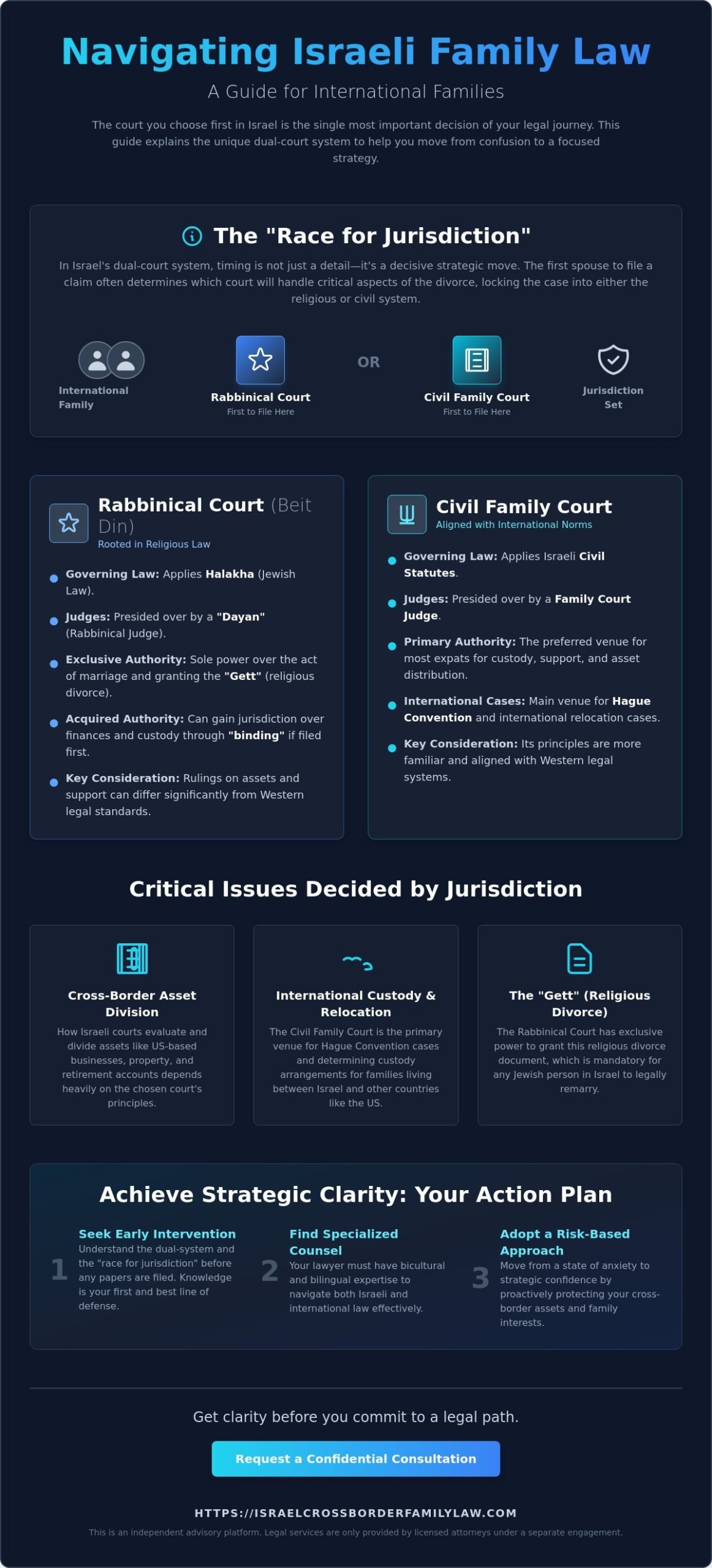
Strategic Clarity: Navigating Your Family Law Matter with Confidence
Decisive action at the start of a family law dispute often determines the trajectory of the next several years. In Israel, the “race to the court” remains a defining characteristic of the legal system, where the first party to file in either the Family Court or the Rabbinical Court can significantly influence the procedural landscape. This makes early intervention a necessity rather than a choice. When families begin searching for jewish family lawyers near me, they’re often operating from a place of high anxiety. Strategy replaces that anxiety with a structured plan based on risk assessment and jurisdictional logic.
The Israel Cross Border Law advisory serves as a vital bridge for those caught between different legal cultures. Many international families find the Israeli system’s intersection of civil and religious law confusing. By providing a neutral, strategic perspective, the advisory helps clients understand how their specific international assets and custody arrangements will be viewed by an Israeli judge or Dayan. This clarity allows you to move from reactive emotional responses to proactive, data-driven decisions.
For expats and foreign nationals, the goal is to create a professional home where their unique status is understood. Whether you’re dealing with a prenuptial agreement drafted in London or child support obligations tied to an American salary, the strategy must account for both local IL regulations and international enforcement standards.
Setting Realistic Expectations
Patience is a requirement in cross-border litigation. A standard international divorce or custody matter involving assets in multiple countries can take between 14 to 30 months to reach a final resolution. Complex cases involving the valuation of foreign businesses or the tracing of offshore funds often extend toward the longer end of that spectrum. You’ll need to prepare for a marathon rather than a sprint.
Sustainable agreements are the true mark of success in family law. While the desire to “win” is natural, high-conflict litigation can quickly consume ₪250,000 to ₪600,000 in legal fees and expert costs. A successful outcome is one that protects your parental rights and financial stability without destroying the family’s long-term resources. Neutral advisory helps you identify which battles are worth the financial and emotional investment.
Your Path Forward
Organization is your strongest asset during the initial stages of a legal matter. You should begin gathering documentation for all international assets immediately. This includes bank statements from foreign accounts, property deeds, and records of any inheritances received during the marriage. Having these documents ready can save weeks of delays once the legal process officially begins.
The value of a confidential case review cannot be overstated. It provides a safe environment to assess your legal standing and identify potential pitfalls before they become public record. Understanding the strengths and weaknesses of your position allows you to negotiate from a place of knowledge rather than fear.
Get clarity before you commit. Request a confidential consultation.
Strategic Clarity for Your International Family Law Matter
Navigating the intersection of Israeli and international law requires more than just local representation; it demands a strategic roadmap. Choosing the right path within the dual-court system often determines how your assets and parental rights are protected for years to come. When families search for jewish family lawyers near me, they aren’t just looking for a nearby office. They’re seeking a bicultural team that understands the nuances of both the Rabbinical courts and civil Family courts.
Our advisory team brings decades of experience to the table, specializing in the specific needs of international families with US-based interests. We provide the bicultural perspective necessary to bridge the gap between different legal cultures and expectations. By prioritizing strategic clarity before filing any documents, you avoid the common pitfalls of the “race for jurisdiction” that can complicate cross-border divorce proceedings. Protecting your family’s interests starts with understanding your options under Israeli law. It’s about making informed choices that reflect your long-term goals rather than reacting to immediate pressure.
Get clarity before you commit. Request a confidential consultation.
With the right guidance, you can navigate these complex systems and move forward with confidence.
This article is published on an independent advisory platform and does not constitute a law firm or an attorney-client relationship. Legal services are only provided by licensed attorneys under a separate engagement.
Frequently Asked Questions
Is a Jewish divorce (Gett) required if I already have a civil divorce from the US?
Yes, a Jewish divorce decree, known as a Gett, is mandatory for Jewish individuals who wish to be recognized as single or remarry within Israel. Even if your US civil divorce is finalized, the Israeli Chief Rabbinate holds exclusive jurisdiction over the marital status of Jewish residents. Failing to obtain a Gett can lead to significant legal complications, including being labeled an Agunah or having future children classified as Mamzerim under religious law.
Can an Israeli Rabbinical court take control of my US-based assets?
Israeli Rabbinical courts can assert jurisdiction over foreign assets if the divorce case is legally “tethered” to their court first. While an Israeli court cannot directly seize a house in New York, it can issue personal orders against a party present in Israel to compel the transfer of those assets. Under the 1973 Financial Relations Law, the court may use sanctions or offsets from Israeli-based property to ensure a global distribution of the marital estate.
What happens if my spouse refuses to give me a ‘Get’ in Israel?
If a spouse refuses to grant a Gett, the Rabbinical court can apply various legal sanctions under the 1995 Rabbinical Courts Law to compel compliance. These measures include the revocation of a driver’s license, the closure of bank accounts, or the issuance of a stay-of-exit order to prevent them from leaving the country. Consulting with jewish family lawyers near me is vital in these cases to implement a strategy that utilizes both civil and religious pressure.
How does the ‘Race for Jurisdiction’ affect child custody for international families?
The “Race for Jurisdiction” occurs when one spouse files in the Rabbinical court while the other files in the Civil Family Court, with the first valid filing determining which system hears the case. This choice is critical because the two systems apply different legal nuances to custody and child support. For international families, the outcome of this race can dictate whether the case follows the “best interests of the child” standard or religious precedents that might differ from US expectations.
Are US prenuptial agreements enforceable in the Israeli Rabbinical courts?
US prenuptial agreements aren’t automatically enforceable in Israel and must typically be validated by an Israeli court to be fully recognized. If the agreement wasn’t drafted to meet the specific requirements of the 1973 Financial Relations Law, a spouse might challenge its validity during the divorce process. It’s common for Rabbinical courts to scrutinize foreign contracts to ensure they don’t contradict Israeli public policy or religious requirements regarding the Gett.
Do I need to be physically present in Israel for my family law case?
You aren’t always required to be physically present in Israel, as courts frequently allow testimony via video link for parties residing abroad. However, certain procedures, such as the formal delivery of the Gett or specific cross-examination hearings, usually necessitate your physical attendance. Your legal team can often coordinate with the court to minimize travel, but you should expect at least one or two mandatory appearances for critical milestones in the litigation.
How much does a cross-border family law consultation typically cost?
A comprehensive consultation for cross-border family law matters in Israel generally costs between ₪1,200 and ₪2,500 plus VAT. This fee covers a detailed review of your jurisdictional standing and the complex interaction between Israeli and foreign legal systems. Because international cases involve high stakes and multi-jurisdictional strategy, these sessions provide the necessary clarity before you commit to a specific legal path or file any formal motions.
Can I enforce a US child support order if my ex-spouse moved to Israel?
You can enforce a US child support order in Israel by utilizing the 1958 Convention on the Recovery Abroad of Maintenance. The Israeli Ministry of Justice and the Enforcement and Collection Authority work together to process foreign judgments against residents living in Israel. This international cooperation ensures that child support obligations remain enforceable across borders, allowing for the garnishment of wages or the seizure of Israeli assets to satisfy the debt.
Get clarity before you commit. Request a confidential consultation.
For more information on navigating the Israeli legal system, you can view educational resources here: https://www.youtube.com/@IsraelFamilyLaw

Article by
Gabriel Lior
A Personal Journey That Became a Mission
The advisory was founded by an American father Gabriel Lior, LLB, MBA , global entrepreneur, and cross-border advisor who spent more than a decade navigating the Israeli family court system firsthand and now lives in Singapore with his son.
As a divorced parent in a cross-border family, Gabriel faced nearly every legal challenge a foreign parent can encounter in Israel — including child custody disputes, child support proceedings, property matters in Israel and abroad, false accusations, and complex immigration and relocation proceedings.
Over the years, he learned the hard way how difficult it is for non-Israeli parents to understand the system, identify the right legal strategy, and choose the right legal representation — especially when language, culture, and jurisdictional differences are involved. He also witnessed how foreign parents and new immigrants are often disadvantaged or taken advantage of by service providers and institutions simply because they lack local knowledge or fluency.
From Client to Advisor
To truly understand — and survive — the system, Gabriel pursued formal legal education in Israel, completing two Israeli law degrees, alongside a BA and MBA earned in the United States. This was never about becoming a practicing attorney, but about gaining a deep, structural understanding of how the system works — and where it breaks down for foreign parents.
This rare combination of:
Firsthand client experience
Israeli legal and US business education
International business and negotiation training
Decades of commercial execution
created a unique perspective – one that understands both sides of the table.
After years of litigation, persistence, and at times self-representation, he ultimately succeeded in securing custody of his son and relocating abroad through a rare legal victory in the Israeli Supreme Court — becoming one of the first fathers in Israel to do so under these circumstances.
Disclaimer
Important Disclaimer:
The information provided on this website and in its content is for general informational and educational purposes only and does not constitute legal advice, legal opinion, or legal representation.
Gabriel Lior is not licensed to practice law in Israel (nor is he interested in doing so) and does not provide legal services, despite having completed 2 Law Degrees. The services offered are advisory in nature and are intended to provide general guidance, strategic insight, and information regarding cross-border family law considerations.
No attorney-client relationship is formed by accessing this website, reading its content, or communicating with us.
Any decisions made based on this information are at your own discretion and risk. For legal advice specific to your situation, you should consult a licensed attorney in the relevant jurisdiction.
Where appropriate, we may refer clients to independent, licensed attorneys or professionals. Such referrals do not constitute legal representation and no liability is assumed for services provided by third parties.