The prospect of a divorce in Israel is fraught with complexity, particularly when a significant US-based family inheritance is involved. The fear that these assets, intended as a family legacy, could be divided as marital property is a significant source of anxiety for many. For individuals facing this multi-jurisdictional challenge, understanding the critical steps for protecting a US inheritance in an Israeli divorce is not merely a financial objective-it is a fundamental component of securing your future. This complex legal intersection, where US estate law meets Israeli family law, often leaves individuals feeling vulnerable and uncertain about their rights and the enforceability of US-based legal instruments like wills and trusts. This comprehensive guide provides the clarity and strategic direction you require. We will navigate the sophisticated legal framework governing foreign assets in Israeli divorce proceedings, offering a detailed analysis of how to legally separate and shield your inheritance from division. By outlining decisive, actionable measures, we aim to provide you with the confidence and knowledge necessary to safeguard your family legacy and to identify legal counsel with the requisite cross-border expertise to represent your interests effectively.
The Core Conflict: US Inheritance vs. Israeli Marital Property Law
Navigating a multi-jurisdictional divorce between the United States and Israel presents a unique and complex set of legal challenges, particularly concerning the division of assets. At the heart of this complexity lies a fundamental conflict between how each country’s legal system treats property acquired during a marriage. For individuals who have received a significant inheritance from a US source, understanding this divergence is the first critical step in the process of protecting a us inheritance in an israeli divorce. The default assumptions in one country do not automatically apply in the other, creating a high-stakes environment where proactive legal strategy is paramount. To better understand the core principles involved in safeguarding such assets, the following video provides a valuable overview:
Understanding Israel’s Spouses’ Property Relations Law
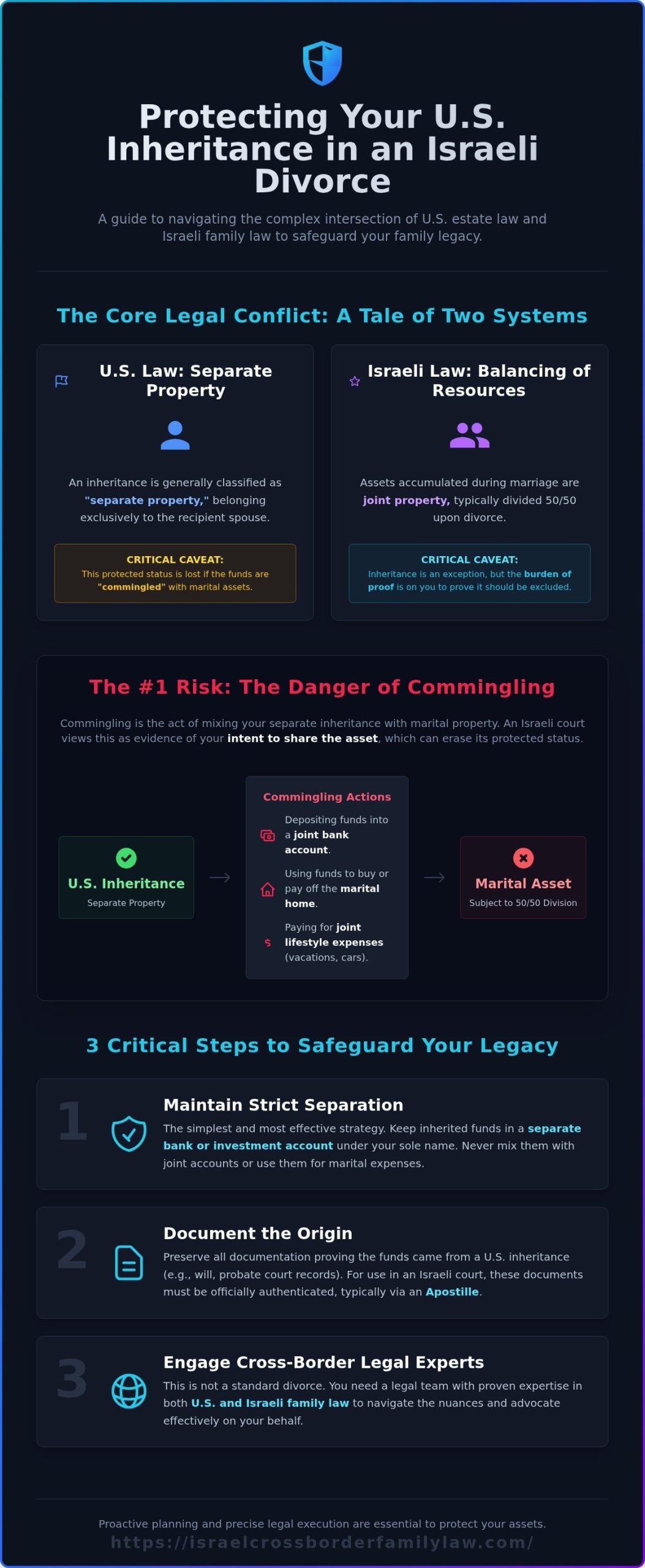
For couples married after January 1, 1974, Israeli family courts operate under the Spouses’ Property Relations Law. This legislation establishes a default regime known as the “Balancing of Resources” (Izun Mashabim). The core tenet of this system is the presumption of community property: all assets and rights accumulated by either spouse during the marriage are considered joint property. Upon divorce, this pool of marital assets is typically divided equally (50/50). While the Israeli Marital Property Law does provide exceptions for assets like inheritances, the burden of proof falls squarely on the recipient to prove the asset should be excluded from the marital estate.
The ‘Separate Property’ Doctrine in the US Context
In stark contrast, most US states operate under common law principles where an inheritance is generally classified as “separate property.” This means it belongs exclusively to the spouse who received it and is not subject to division in a divorce. However, this protected status can be inadvertently lost through an action known as “commingling”-for instance, by depositing inherited funds into a joint bank account or using them to purchase a marital home. Critically, an Israeli court is not bound by an asset’s classification under US law. The determination will be made based on Israeli legal precedent, making the act of protecting a us inheritance in an israeli divorce a matter of diligent planning and precise legal execution within the Israeli framework.
Is Your US Inheritance a Marital Asset in Israel? Key Factors
A central concern in any cross-border divorce is whether an inheritance from abroad will be divided by an Israeli court. Under Israel’s Spouses’ Property Relations Law (1973), assets received via inheritance or gift are generally considered separate property, excluded from the marital asset pool subject to division. However, this statutory protection is not absolute. The ultimate determination rests not on the origin of the funds, but on the actions and intent demonstrated by the couple throughout the marriage. This is a common and complex challenge for expats and foreign nationals navigating the Israeli legal system.
The Timing of the Inheritance: Before vs. During Marriage
Assets inherited prior to the marriage are afforded the strongest initial protection as separate property. Nevertheless, even these can be re-categorized as marital assets if they are consistently used for the family’s joint benefit. For example, using pre-marital inherited funds as a down payment on the marital home can be interpreted by the court as an intent to share the asset. An inheritance received during the marriage is subject to even greater scrutiny, making the strategy for protecting a us inheritance in an israeli divorce all the more critical.
The Danger of Commingling: How Separate Property is Lost
The most significant risk to your inheritance is “commingling”-the act of mixing separate property with marital property to the point where its separate identity is lost. The court examines financial behavior for evidence of intent to make the inheritance a shared asset. Key examples of commingling include:
- Depositing Funds into a Joint Account: Placing inherited money into a bank account shared with your spouse is a clear signal of intent to share.
- Purchasing a Marital Home: Using inheritance funds to buy or significantly pay down the mortgage on a family home, especially if titled in both names, often converts the funds into a marital asset.
- Funding Joint Lifestyle Expenses: Consistently using the inheritance to pay for shared costs like vacations, renovations, or investments demonstrates that the funds were treated as a family resource.
To preserve its separate character, an inheritance must be maintained in a separate bank or investment account, under the sole name of the inheriting spouse.
Gifts vs. Inheritance: Does the Distinction Matter?
Legally, an inheritance is transferred via a will or intestacy laws after death, while a gift is a voluntary transfer during the donor’s lifetime. In the context of Israeli divorce law, both are treated similarly-they begin as separate property belonging to the recipient spouse. Consequently, both are equally vulnerable to the same risks of commingling. Proving the origin of these funds is paramount, and it often requires official documentation from the U.S. The process of Authenticating U.S. Documents for Use Abroad, such as probate court records via an apostille, is a critical step in establishing the separate nature of these assets.
Proactive Strategies: How to Shield Your Inheritance Before Divorce
In the complex arena of multi-jurisdictional family law, preventative measures are unequivocally the most effective. The optimal time to establish a robust framework for asset protection is before a marriage commences or, at the very least, immediately upon receiving an inheritance. Engaging in strategic planning early on can prevent future disputes and provide crucial clarity. The cornerstone of successfully protecting a us inheritance in an israeli divorce lies in creating a clear, legal separation between inherited assets and the communal marital estate through the use of sophisticated legal instruments and disciplined financial management.
Drafting an Enforceable US-Israel Prenuptial Agreement
A meticulously drafted prenuptial agreement (heskem mamon) serves as a primary line of defense. This legally binding contract can explicitly define a US-based inheritance, and any assets derived from it, as the separate, non-marital property of the recipient spouse. For the agreement to be effective, it must be validated in both jurisdictions-the relevant US state and Israel. This dual validation is critical to prevent challenges to its enforceability. Furthermore, Israeli law mandates that both parties receive independent legal counsel to ensure the agreement is entered into freely and with full understanding, a principle that aligns with best practices in the United States. For those already married, a postnuptial agreement can serve a similar protective function.
Best Practices for Managing Inherited Funds
Beyond legal agreements, the practical handling of inherited assets is paramount to preserving their separate character. Commingling funds-mixing inheritance money with marital assets-is a critical error that can inadvertently convert separate property into joint property in the eyes of the court. To avoid this, we advise our clients to adhere to the following stringent protocols:
- Establish a Separate Account: Immediately open a new bank or investment account in the sole name of the inheriting spouse. All inherited cash, securities, and proceeds from the sale of inherited property should be deposited exclusively into this account.
- Avoid Joint Deposits: Under no circumstances should inherited funds be transferred into a joint bank account or used to purchase assets titled in both spouses’ names.
- Maintain Meticulous Records: Keep comprehensive documentation, including wills, trust documents, bank statements, and transaction histories, that clearly traces the origin and handling of the inherited assets. This paper trail is invaluable evidence.
Using US-Based Trusts for Enhanced Asset Protection
For a more formidable layer of security, establishing a US-based trust can be a highly effective strategy. Placing the inheritance into a properly structured irrevocable trust can legally separate the assets from the individual’s personal ownership. Consequently, these assets may be considered outside the scope of the marital estate divisible in an Israeli divorce. However, navigating the interaction between US trust law and Israeli family court interpretations requires deep expertise. Israeli courts will scrutinize foreign trust structures to prevent their misuse in avoiding spousal obligations. Therefore, consulting with counsel specializing in complex cross-border trust and estate law is essential to ensure the trust is structured for maximum resilience in both legal systems.
Defensive Measures: Protecting Your Inheritance During a Divorce
Even if you are already facing or in the midst of divorce proceedings, strategic action can still be taken to safeguard your inheritance. The common misconception is that once inherited funds are commingled with marital assets, they are irrevocably lost to the shared marital estate. However, Israeli law provides avenues to reclaim these assets, provided a clear and demonstrable link to their inherited origin can be established. Successfully protecting a US inheritance in an Israeli divorce at this stage shifts from pre-planning to a meticulous process of evidence-gathering and legal argument. Navigating these complex international divorce cases demands sophisticated legal representation with a deep understanding of both US and Israeli legal frameworks.
The Forensic Process of Tracing Separate Property
To prove that assets originated from an inheritance, your legal team, often alongside forensic accountants, must “trace” the flow of funds. This involves a detailed examination of financial records to follow the money from its initial receipt in the US to its current form. The process requires extensive documentation, including historical bank statements, property deeds, and investment portfolio records. Tracing funds over a long marriage can be a complex and costly endeavor, potentially requiring an investment of tens of thousands of shekels, but it is a critical step in substantiating your claim.
Gathering and Presenting Evidence from the United States
The burden of proof rests on the party claiming the asset as separate property. This requires presenting authenticated evidence from the United States to the Israeli Family Court. Essential documents include:
- The US will, trust documents, or other testamentary instruments.
- Official probate court records from the relevant US jurisdiction.
- Bank and brokerage statements showing the initial deposit of inherited funds.
In many cases, this evidence must be supplemented by sworn affidavits or testimony from US-based parties, such as the executor of the estate. These documents must then be properly authenticated, often via an Apostille, to be admissible in an Israeli court.
Jurisdictional Challenges: Which Court Holds the Power?
A significant complication in protecting a US inheritance in an Israeli divorce is the question of jurisdiction. If the inherited assets, such as real estate or a brokerage account, remain in the United States, a conflict may arise over whether an Israeli or a US court has the authority to adjudicate their division. This can lead to parallel legal proceedings and the risk of conflicting rulings, creating a multi-jurisdictional legal battle. Determining the proper forum and enforcing court orders across borders is a highly specialized area of international family law. Navigating these intricate cross-border challenges requires counsel with specific experience in both jurisdictions. If you are facing this situation, contact our firm to discuss a comprehensive legal strategy.
Why You Need a Cross-Border Family Law Specialist
Navigating the division of marital assets in an Israeli divorce is a complex process. When those assets include a significant inheritance originating from the United States, the legal challenges become exponentially more sophisticated. Successfully protecting a US inheritance in an Israeli divorce requires more than standard family law counsel; it demands a multi-jurisdictional legal strategy executed by professionals fluent in the legal systems of both nations.
The Limitations of a Local-Only Lawyer
Relying on legal counsel qualified in only one country creates critical vulnerabilities. An Israeli family lawyer, while preeminent in local statutes, may lack the specific understanding of US common law trusts, probate procedures, and the intricate tax implications that define American estate planning. Similarly, a US-based attorney cannot represent your interests in an Israeli Family Court. This fragmented approach often leads to misinterpretations of foreign legal documents, a catastrophic error that could result in an inheritance worth millions of shekels being incorrectly classified as a divisible marital asset.
The Strategic Advantage of a Dual-Jurisdiction Firm
A cross-border family law firm eliminates these dangerous gaps by offering a single, cohesive legal strategy. Our team possesses a deep, institutional knowledge of how US and Israeli laws interact, conflict, and can be synergized to protect your assets. This integrated expertise is the cornerstone of effectively protecting a US inheritance in an Israeli divorce. We specialize in:
- Coordinating legal and financial evidence from US fiduciaries for presentation in Israeli courts.
- Anticipating and neutralizing conflicts of law before they can jeopardize your case.
- Translating the function and intent of complex US financial structures, such as revocable living trusts or LLCs, into concepts that are clear and compelling to an Israeli judge.
The financial risk of inadequate representation is immense. Entrusting your case to a team with proven cross-border experience is not a luxury, but a strategic imperative. Learn more about our advisory team’s unique qualifications in these complex international matters or contact our firm to secure a comprehensive legal defense for your inheritance.
Secure Your Legacy with Strategic Cross-Border Counsel
Navigating the intersection of US inheritance and Israeli family law presents significant challenges. As this guide has detailed, your inheritance is not automatically shielded from division; its classification as a marital asset depends on a range of factors, including how it was managed during the marriage. The complexities of Israeli marital property law mean that protecting a us inheritance in an israeli divorce is not a passive exercise but a strategic imperative, requiring both proactive planning and decisive action. Our firm is uniquely positioned to guide international families through these multi-jurisdictional complexities. With decades of experience and specialized expertise in both US and Israeli family law, we deliver sophisticated, strategic asset protection tailored to your unique circumstances. Do not leave your financial future to chance. To ensure your inheritance is properly safeguarded, we invite you to Schedule a Confidential Case Review to Protect Your Assets. Take the decisive step toward securing your legacy today.
Frequently Asked Questions
What happens if I used my US inheritance to buy our family home in Israel?
Utilizing inherited funds to purchase a marital asset, such as a family home in Israel, significantly complicates its legal status. This action is frequently interpreted by Israeli courts as demonstrating an intention to share the asset, a legal principle known as “commingling.” The funds may undergo “transmutation,” effectively converting them from separate, non-marital property into a joint marital asset. Consequently, the home, including the value of the inheritance invested, is typically subject to equitable division between the spouses upon divorce.
Does a US will or trust automatically protect my assets in an Israeli divorce?
While a US will or trust is a critical estate planning instrument, it does not automatically shield assets from division in an Israeli divorce. The distribution of property is governed by Israeli family law, specifically the Spouses’ Property Relations Law. An Israeli court will consider the US document as evidence of your intent to keep the inheritance separate, but it is not determinative. The court’s primary focus will be on the conduct of the parties during the marriage and how the assets were actually managed.
How can I prove that funds in a joint account originally came from a US inheritance years ago?
Proving the provenance of funds requires meticulous documentation and often a forensic accounting approach. Essential evidence includes the original US probate or trust distribution documents, historical bank statements from the US showing the transfer, and corresponding deposit records into the Israeli account. Establishing an unambiguous paper trail that traces the funds from their source directly to the specific account is paramount. Without this clear, contemporaneous evidence, courts are likely to presume that funds held in a joint account are marital property.
Can my spouse claim the appreciation or growth of my inherited assets during our marriage?
Yes, the appreciation of inherited assets can be subject to a claim. Israeli courts differentiate between “passive” growth (e.g., general market fluctuations) and “active” appreciation resulting from marital efforts, such as one or both spouses managing an investment portfolio or using joint funds for the upkeep of an inherited property. Any growth attributable to the joint efforts or resources of the couple is generally considered marital property and is divisible, requiring sophisticated financial analysis to segregate the sources of appreciation.
What is the process for dividing US-based real estate in an Israeli divorce?
The division of US-based real estate within an Israeli divorce is a complex, multi-jurisdictional matter. An Israeli family court possesses the authority to rule on the division of the asset’s value and can order the parties to sell the property. However, enforcing this order requires cooperation with the US legal system. This often necessitates a parallel proceeding or the registration and domestication of the Israeli judgment in the relevant US state to effectuate the sale or transfer of title, a procedure demanding sophisticated cross-border legal counsel.
Is it too late to protect my inheritance if my spouse has already filed for divorce in Israel?
While proactive planning is optimal, it is not necessarily too late to take defensive action. The strategy for protecting a US inheritance in an Israeli divorce shifts from prevention to litigation and negotiation once proceedings have commenced. It becomes critical to immediately engage experienced counsel to gather all necessary documentation, meticulously trace the origin and flow of assets, and construct a robust legal argument to prove the separate nature of your inherited property before the court makes its final determinations.

Article by
Gabriel Lior
A Personal Journey That Became a Mission The advisory was founded by an American father Gabriel Lior, LLB, MBA , global entrepreneur, and cross-border advisor who spent more than a decade navigating the Israeli family court system firsthand and now lives in Singapore with his son.
As a divorced parent in a cross-border family, Gabriel faced nearly every legal challenge a foreign parent can encounter in Israel — including child custody disputes, child support proceedings, property matters in Israel and abroad, false accusations, and complex immigration and relocation proceedings. Over the years, he learned the hard way how difficult it is for non-Israeli parents to understand the system, identify the right legal strategy, and choose the right legal representation — especially when language, culture, and jurisdictional differences are involved. He also witnessed how foreign parents and new immigrants are often disadvantaged or taken advantage of by service providers and institutions simply because they lack local knowledge or fluency. From Client to Advisor To truly understand — and survive — the system, Gabriel pursued formal legal education in Israel, completing two Israeli law degrees, alongside a BA and MBA earned in the United States. This was never about becoming a practicing attorney, but about gaining a deep, structural understanding of how the system works — and where it breaks down for foreign parents. This rare combination of: Firsthand client experience Israeli legal and US business education International business and negotiation training Decades of commercial execution created a unique perspective – one that understands both sides of the table. After years of litigation, persistence, and at times self-representation, he ultimately succeeded in securing custody of his son and relocating abroad through a rare legal victory in the Israeli Supreme Court — becoming one of the first fathers in Israel to do so under these circumstances.
Disclaimer
Important Disclaimer: The information provided on this website and in its content is for general informational and educational purposes only and does not constitute legal advice, legal opinion, or legal representation. Gabriel Lior is not licensed to practice law in Israel (nor is he interested in doing so) and does not provide legal services, despite having completed 2 Law Degrees. The services offered are advisory in nature and are intended to provide general guidance, strategic insight, and information regarding cross-border family law considerations. No attorney-client relationship is formed by accessing this website, reading its content, or communicating with us. Any decisions made based on this information are at your own discretion and risk. For legal advice specific to your situation, you should consult a licensed attorney in the relevant jurisdiction. Where appropriate, we may refer clients to independent, licensed attorneys or professionals. Such referrals do not constitute legal representation and no liability is assumed for services provided by third parties.