This article is published on an independent advisory platform, not a law firm, and does not imply an attorney-client relationship.
What if the most prestigious law firm in Tel Aviv is actually the wrong choice for your international custody dispute? Many expats and international families assume that a high local ranking guarantees success, but cross-border cases require a specialized skill set. When you begin a Top 10 Israeli Family Lawyers review in 2026, you’ll find that domestic expertise isn’t enough to manage the friction between Israeli law and your home country’s regulations. It’s common to feel anxious about how the dual system of civil and rabbinical courts might impact your property in the UK or the US.
You’ll learn exactly how to evaluate top-tier firms through a global lens to ensure your representation understands both cultures and legal frameworks. We’ll provide a clear framework for finding bicultural, bilingual attorneys who can prevent early strategic mistakes that often jeopardize international assets. This guide walks you through the essential criteria for selecting a legal partner who acts as a bridge between jurisdictions. Get clarity before you commit. Request a confidential consultation.
Key Takeaways
- Learn to distinguish between standard corporate prestige rankings and the specific advocacy skills required for complex international family law matters.
- Discover why bicultural proficiency and a deep understanding of the “Race to Jurisdiction” are essential criteria for your Top 10 Israeli Family Lawyers review.
- Compare the benefits of boutique family law specialists against large Tel Aviv firms to determine which legal structure best supports your cross-border objectives.
- Identify common red flags in online feedback and understand why a formal case review is more valuable than a standard free consultation.
- Gain strategic clarity on your unique legal profile to avoid making high-stakes commitments before you fully understand the Israeli legal landscape.
This article is published on an independent advisory platform and does not constitute a law firm relationship or legal advice. Legal services are only provided by licensed attorneys under a separate engagement.
Understanding the Landscape of Israeli Family Law Ratings
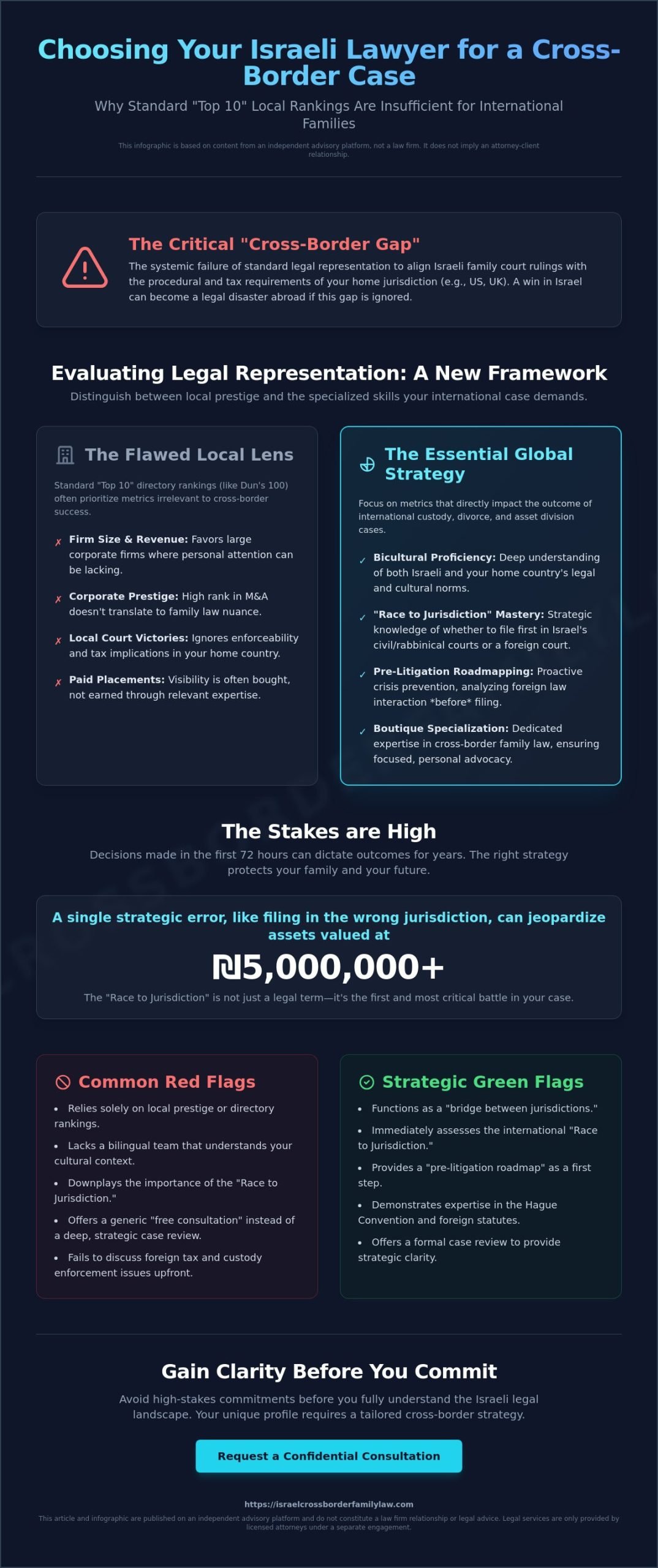
Most searches for legal help begin with a Top 10 Israeli Family Lawyers review. These lists are usually generated by established business directories like Dun’s 100 or BDI Code. While these rankings offer a snapshot of market presence, they often prioritize firm size and annual revenue over the specific needs of individual clients. The Israeli judicial system operates through a unique dual track of civil and religious courts. A firm that ranks highly in corporate prestige might not have the granular experience required to manage the sensitive intersection of civil law and rabbinical court jurisdiction.
To better understand this concept, watch this helpful video:
The Limitations of Directory-Based Reviews
Directory algorithms often favor large firms with dozens of associates. This structure works for mergers and acquisitions but can be a disadvantage in family law where personal attention is vital. Many “star ratings” fail to account for the complexity of US-Israel asset division or the specific needs of expats. You should distinguish between paid placements, where firms pay for enhanced visibility, and earned professional recognition. A high-ranking local firm might lack a dedicated “team on the ground” capable of communicating in your native language or understanding your cultural background.
Why Your Case Requires More Than a Local Specialist
A “top” local lawyer might secure a favorable ruling in an Israeli court while inadvertently creating a disaster abroad. International cases involve a delicate balance of Israeli law and foreign treaties like the Hague Convention. If your lawyer doesn’t understand US tax implications or foreign custody enforcement, a win in Israel could lead to legal gridlock elsewhere. Handling a divorce or separation for international families requires a bicultural approach that bridges two different legal worlds. It’s about strategy and risk-based decision-making rather than just filing paperwork in a local district court.
The Cross-Border Gap is the systemic failure of standard legal representation to align Israeli family court rulings with the specific procedural and tax requirements of a client’s home jurisdiction.
Get clarity before you commit. Request a confidential consultation.
Essential Criteria for Reviewing Cross-Border Legal Representation
Selecting the right counsel requires a filter that goes beyond local popularity. When conducting a Top 10 Israeli Family Lawyers review, you must prioritize specific cross-border metrics. The most critical factor is an attorney’s ability to manage the “Race to Jurisdiction.” In Israel, this typically refers to the tension between civil Family Courts and religious Rabbinical Courts. However, in international cases, the race is between IL and a foreign nation. Filing first in the correct jurisdiction can protect assets valued at ₪5,000,000 or more; a delay of even 24 hours might trap a case in a legal system that’s less favorable to your specific needs.
Strategic risk assessment must happen before any legal action is taken. A high-quality review should identify firms that offer a “pre-litigation roadmap.” This involves analyzing how Israeli law interacts with foreign statutes before papers are served. It’s about preventing a crisis rather than simply reacting to one. Decisions made in the first 72 hours of a dispute often dictate the outcome for the next several years.
Bicultural Competency and Language
You’ll find many lawyers who claim to be fluent in English. For a cross-border case, this is a baseline, not a specialty. There’s a significant gap between speaking English and understanding Anglo legal expectations. Attorneys who have practiced or studied in both the US and IL bring a unique advantage. They understand that a client from New York or London expects structured updates and detailed billing. In the Israeli family court system, cultural nuance affects everything from how a judge perceives a witness to how a settlement is negotiated. A bicultural lawyer acts as a bridge, ensuring your goals don’t get lost in translation.
Technical Expertise in Multi-Jurisdictional Matters
Your search should focus on a firm’s track record with international treaties. The 1980 Hague Convention on Child Abduction is a highly specialized area of law. Since 2023, there’s been a notable rise in relocation disputes involving families moving between Tel Aviv and major global hubs. You need a lawyer who understands dual-country asset protection and how to draft prenuptial agreements that hold up in both jurisdictions. For more tailored information, see this Guidance for Expats and Foreign Nationals.
Reviewing a lawyer’s experience with international child support enforcement is also vital. The process for collecting ₪4,500 in monthly support across borders is technically demanding. It requires knowledge of both Israeli enforcement mechanisms and international reciprocity agreements. If you’re comparing options in a Top 10 Israeli Family Lawyers review, ask about their specific experience with the Ministry of Justice regarding international recovery. Get clarity before you commit. Request a confidential consultation.
Comparing Local Israeli Firms vs. International Advisory Practices
Choosing the right representation requires looking beyond a Top 10 Israeli Family Lawyers review to understand how a firm’s internal structure dictates your experience. In the Tel Aviv legal market, the “Big Law” approach often involves multi-practice firms that handle everything from high-tech M&A to real estate. While these entities possess massive administrative power, international clients often find that their personal matters are treated with a corporate detachment. Early strategic decisions often outweigh the choice of a specific lawyer. If you don’t establish a clear roadmap before signing a retainer, you may find yourself locked into a litigation path that serves the firm’s billing structure more than your family’s long-term stability.
Boutique Firms vs. Large Multi-Practice Firms
Boutique family law firms in Israel specialize exclusively in personal status and matrimonial law. These practitioners often provide more direct access to lead partners. This is vital when your case involves the intersection of Israeli Rabbinical Courts and civil family courts. However, a small boutique might lack the internal tax or corporate departments needed if your divorce involves complex share options in a “Start-up Nation” unicorn.
Large firms offer prestige and deep benches of specialists, but they come with a hierarchy. You might be impressed by a senior partner during the initial consultation only to have your daily communication handled by a junior associate with three years of experience. This delegation can lead to cultural misunderstandings or missed nuances in cross-border documents. It’s essential to select a firm that matches the specific complexity of your family assets rather than just their name on a building in Rothschild Boulevard.
The Role of Independent Advisory
The Israeli legal system can be aggressive. Many litigants fall into a “litigation trap” where the race to file first in a specific jurisdiction consumes their entire budget in Israeli Shekels (₪) before a single productive negotiation occurs. An independent advisory phase allows you to step back and analyze the jurisdictional risks before any court filings are made.
Using an advisor helps you vet potential attorneys from a Top 10 Israeli Family Lawyers review with an objective lens. An advisor doesn’t have a financial interest in prolonged court battles. Instead, they focus on how the advisory works to align your legal strategy with your financial and parental goals. You can learn more about how the advisory works to protect your interests before you commit to a heavy litigation retainer. This objective layer ensures that the lawyer you eventually hire is a tool for your strategy, not the person defining it for you.
Get clarity before you commit. Request a confidential consultation.
This article is published on an independent advisory platform, not a law firm. The information provided is for educational purposes only and does not constitute an attorney-client relationship or legal advice. Legal services are only provided by licensed attorneys under a separate engagement.
How to Evaluate Reviews and Conduct a Case Review
Online reviews for international family law practitioners function differently than feedback for retail services. A standard Top 10 Israeli Family Lawyers review often aggregates data from high-volume domestic cases. For expats and international families, these broad rankings can mask a lack of cross-border proficiency. You must look for specific indicators of expertise, such as mentions of the 1980 Hague Convention or complex jurisdictional disputes. Vague praise like “great service” is less valuable than descriptions of specific legal outcomes in multi-jurisdictional matters.
In high-stakes family law, an absence of public reviews isn’t necessarily a negative sign. Many elite firms handling private wealth and sensitive custody matters operate under strict non-disclosure agreements. These practitioners prioritize client discretion over public marketing. When vetting a professional, focus on their demonstrated ability to bridge the gap between the Israeli legal system and foreign jurisdictions rather than their total number of five-star ratings.
Vetting a Lawyer Beyond the Rating
Vetting requires moving past the aggregate star rating to verify technical competency. You need to confirm if the practitioner understands the friction between the Israeli Rabbinical courts and foreign civil systems. A “team on the ground” presence in IL is essential, but it must be paired with bicultural literacy. Ask potential counsel for specific examples of cases they have handled involving US-IL cross-border issues. If they cannot explain the implications of the US-Israel tax treaty on asset division, they may not be equipped for your case.
Checklist: 5 questions every expat must ask a potential Israeli lawyer:
- How many cases have you managed that involved my specific foreign jurisdiction?
- Can you explain the “race to court” dynamics between the Israeli Family Court and the Rabbinical Court for my situation?
- What is your experience coordinating strategy with foreign legal counsel or tax advisors?
- How do you handle service of process for a spouse currently residing outside of IL?
- What are the specific risks of an Israeli “Stay of Exit” order (Tzav Ikur Yetzia Min HaAretz) in my case?
The Confidential Case Review Process
A free fifteen-minute consultation is often a introductory sales conversation. For international families, a paid, deep-dive review is significantly more valuable than any “Top 10” list. This process focuses on strategy and risk-based decision-making. It allows the professional to analyze your specific facts against IL statutes and international treaties without the pressure of a sales pitch.
A professional Confidential Case Review identifies potential pitfalls in asset division and custody before you file a single document. This initial investment helps you avoid costly procedural errors that can take years to correct in the Israeli court system. Avoid practitioners who offer empty guarantees; instead, look for those who provide a clear-eyed assessment of the legal complexities and risks involved in your cross-border matter.
Get clarity before you commit. Request a confidential case review.
This article is published on an independent advisory platform, not a law firm. The information provided is for educational purposes and does not constitute an attorney-client relationship. Legal services are only provided by licensed attorneys under a separate engagement.
Gaining Clarity Before You Commit to an Israeli Family Lawyer
Finding the right professional isn’t about picking a name from a generic list. Your specific international profile determines which advocate is actually the best fit for your needs. When you conduct a Top 10 Israeli Family Lawyers review, you should look for more than just a high ranking in a directory. For an expat or a family with assets in both London and Tel Aviv, local fame matters less than cross-border fluency. You need a professional who understands how an Israeli court ruling will impact your status or assets abroad.
Commitment without a roadmap is a common mistake. Many clients sign a retainer before they understand the multi-jurisdictional impact of their choices. This often leads to unnecessary litigation costs that can exceed ₪150,000 in the first year alone. You need to understand the strategic landscape before you bind yourself to a specific firm’s approach. The Israel Cross Border Family Law platform serves as your starting point to bridge these gaps. We help you identify specific risks so you can approach a lawyer with a clear objective. Strategy comes first; representation follows.
The Importance of Early Strategic Decisions
In Israel, the first person to file often dictates the entire legal journey. This “race to jurisdiction” means your first filing in IL can permanently move your case from a civil family court to a religious rabbinical court. These two systems operate under different sets of rules and can produce vastly different outcomes for child support or alimony. Planning prevents the emotional exhaustion that comes from high-conflict litigation. You can learn more about these dynamics by watching Strategic Family Law Insights on YouTube.
Next Steps for International Families
International families face unique risks that local residents don’t. You might have to navigate the 1980 Hague Convention or manage property divisions across two continents. It’s vital to know how your options in the US or European legal systems compare to those in Israel before you lock in a strategy. Don’t let the pressure of the moment force a permanent legal error. You deserve to understand the full strategic landscape before you commit your resources to a specific firm.
Get clarity before you commit. Request a confidential consultation.
Securing Your Strategy for a Cross-Border Future
Selecting the right legal partner for a multi-jurisdictional matter requires more than just skimming a list of names. By 2026, the complexity of international family law has evolved, making it vital to look beyond surface-level ratings. Your Top 10 Israeli Family Lawyers review should focus on a firm’s specific history with cross-border strategy and their ability to manage the friction between different legal systems. Early decisions often dictate the long-term trajectory of your case, so it’s important to prioritize clarity over speed.
Our independent advisory platform specializes in US-Israel strategy tailored for the international and expat community. We provide expertise in jurisdictional conflicts to help you navigate the differences between legal cultures. We don’t offer legal representation, but we empower you to evaluate potential firms with precision. Taking the time to verify a lawyer’s bicultural expertise can prevent costly mistakes in the Israeli Family Court system.
Get clarity before you commit. Request a confidential consultation.
You’ve the power to make an informed choice that protects your family’s interests across borders.
This article is published on an independent advisory platform, not a law firm. The content is for informational and advisory purposes only and does not establish an attorney-client relationship. Legal services are provided only by licensed attorneys under a separate engagement.
Frequently Asked Questions
Is this article published by a law firm?
No, this content is published by an independent advisory platform focused on cross-border strategy for international families. We aren’t a law firm and don’t provide direct legal representation. Our goal is to provide an objective Top 10 Israeli Family Lawyers review to help expats and Anglos navigate complex systems. You should always engage a licensed attorney for specific legal actions in court.
How do I know if an Israeli family lawyer understands US laws?
Look for bicultural attorneys who hold active licenses in both Israel and a US state, such as New York or California. Approximately 15% of high-end family firms in Israel employ dual-qualified lawyers who understand the intersection of different legal systems. You can verify their credentials through the Israel Bar Association and the relevant US state bar website. Ask for specific examples of cases involving US-Israeli tax treaties or the Hague Convention on child abduction.
Can I use a US-based lawyer for my divorce in Israel?
You can’t use a US-based lawyer to represent you in an Israeli courtroom. Only members of the Israel Bar Association have the legal right to appear before Israeli Family or Rabbinical courts. However, a US lawyer is often essential to handle the American side of asset division or custody orders. It’s best to have a collaborative team where your Israeli counsel works with your US attorney to ensure a seamless global strategy.
What is the “Race to Jurisdiction” in Israeli family law?
The “race” refers to the unique parallel court system in Israel where both the Civil Family Court and the Rabbinical Court have jurisdiction over divorce. The court where the first valid petition is filed generally gains the authority to decide on related matters like property and support. Since the 2016 Law for the Settlement of Family Disputes, a mandatory stay of proceedings is required, making the timing of your initial filing critical for your overall strategy.
Are “Top 10” lists for lawyers in Israel reliable for foreigners?
These lists are helpful benchmarks but they require careful scrutiny. Many rankings prioritize local Hebrew-speaking prestige rather than international capabilities or English proficiency. When reading a Top 10 Israeli Family Lawyers review, check if the firm has a dedicated “team on the ground” for English speakers. Ensure the ranking criteria include experience with multi-jurisdictional assets and international relocation cases rather than just domestic disputes.
What happens if I hire a lawyer who doesn’t speak English fluently?
Hiring a lawyer without native-level English fluency often leads to strategic errors in complex cross-border cases. You might struggle to understand the nuances of the Israeli legal system, or your lawyer might misinterpret your long-term goals. Clear communication is vital when discussing sophisticated financial structures or child custody arrangements. It’s hard to build trust when there’s a language barrier, and you might feel sidelined in your own case.
How much does a top family lawyer in Israel typically cost?
Fees vary based on the complexity of the case and the firm’s reputation. The Israel Bar Association sets a minimum recommended tariff, where a basic divorce claim might start around ₪12,000. However, top-tier international firms usually charge hourly rates ranging from ₪800 to ₪1,500 plus 17% VAT. Complex litigation involving international assets can result in total costs exceeding ₪100,000. Always request a written fee agreement to understand the billing structure before you commit.
Should I consult an advisor before hiring a lawyer in IL?
Consulting an independent advisor is a strategic step for expats and international families dealing with the Israeli system. An advisor helps you clarify your objectives and evaluate potential risks before you enter the formal legal system. This early guidance can prevent costly mistakes in the “race to jurisdiction” and help you select the right legal team. Get clarity before you commit. Request a confidential consultation. For more insights, visit our YouTube channel at https://www.youtube.com/@IsraelFamilyLaw.

Article by
Gabriel Lior
A Personal Journey That Became a Mission
The advisory was founded by an American father Gabriel Lior, LLB, MBA , global entrepreneur, and cross-border advisor who spent more than a decade navigating the Israeli family court system firsthand and now lives in Singapore with his son.
As a divorced parent in a cross-border family, Gabriel faced nearly every legal challenge a foreign parent can encounter in Israel — including child custody disputes, child support proceedings, property matters in Israel and abroad, false accusations, and complex immigration and relocation proceedings.
Over the years, he learned the hard way how difficult it is for non-Israeli parents to understand the system, identify the right legal strategy, and choose the right legal representation — especially when language, culture, and jurisdictional differences are involved. He also witnessed how foreign parents and new immigrants are often disadvantaged or taken advantage of by service providers and institutions simply because they lack local knowledge or fluency.
From Client to Advisor
To truly understand — and survive — the system, Gabriel pursued formal legal education in Israel, completing two Israeli law degrees, alongside a BA and MBA earned in the United States. This was never about becoming a practicing attorney, but about gaining a deep, structural understanding of how the system works — and where it breaks down for foreign parents.
This rare combination of:
Firsthand client experience
Israeli legal and US business education
International business and negotiation training
Decades of commercial execution
created a unique perspective – one that understands both sides of the table.
After years of litigation, persistence, and at times self-representation, he ultimately succeeded in securing custody of his son and relocating abroad through a rare legal victory in the Israeli Supreme Court — becoming one of the first fathers in Israel to do so under these circumstances.
Disclaimer
Important Disclaimer:
The information provided on this website and in its content is for general informational and educational purposes only and does not constitute legal advice, legal opinion, or legal representation.
Gabriel Lior is not licensed to practice law in Israel (nor is he interested in doing so) and does not provide legal services, despite having completed 2 Law Degrees. The services offered are advisory in nature and are intended to provide general guidance, strategic insight, and information regarding cross-border family law considerations.
No attorney-client relationship is formed by accessing this website, reading its content, or communicating with us.
Any decisions made based on this information are at your own discretion and risk. For legal advice specific to your situation, you should consult a licensed attorney in the relevant jurisdiction.
Where appropriate, we may refer clients to independent, licensed attorneys or professionals. Such referrals do not constitute legal representation and no liability is assumed for services provided by third parties.