Engaging legal counsel represents a significant step in addressing complex commercial or personal challenges. The initial consultation is a foundational meeting, yet many individuals approach it with considerable apprehension, concerned about the efficient use of time and the significant financial investment, often measured in thousands of shekels. A lack of preparation can lead to an unproductive session and unclear strategic outcomes. Therefore, strategically preparing for your initial consultation with a lawyer is not merely advisable; it is essential for achieving your objectives and ensuring your interests are robustly represented from the outset.
This comprehensive guide provides a structured framework, offering a step-by-step checklist designed to empower you for this critical engagement. By following our guidance, you will enter your first legal meeting feeling organized and confident in your position. You will be equipped with the necessary documentation and targeted questions to secure clear advice, effectively evaluate if the lawyer is the right fit for your sophisticated needs, and gain a transparent understanding of the potential costs and next steps for your case.
Key Takeaways
- Understand that the initial consultation is a two-way assessment; you are not only receiving advice but also evaluating if the attorney is the right strategic partner for your matter.
- Effective preparation involves more than just gathering documents; it requires organizing all relevant materials into logical categories to facilitate a more efficient and substantive analysis.
- A core component of preparing for your initial consultation with a lawyer is developing a concise narrative of your situation and a list of critical questions to guide the meeting.
- The decision to retain counsel should not be made under pressure. Use the information gained to deliberately evaluate the proposed legal strategy and its alignment with your objectives.
Step 1: Foundational Work Before You Book the Consultation
Engaging with legal counsel begins with a critical first step: the initial consultation. This meeting should not be viewed as a mere formality but as a sophisticated, two-way interview designed to establish a foundation for potential representation. Your primary objective is to obtain a professional assessment of your legal position and to evaluate the attorney’s expertise, strategic approach, and suitability for your specific case. Concurrently, the attorney’s goal is to understand the fundamental facts of your matter, assess its legal viability, and determine if their firm possesses the requisite skills to achieve your objectives. Thoroughly preparing for your initial consultation with a lawyer is the most effective way to maximize the value of this crucial first meeting.
To better understand the key documents and information to bring, this overview can be particularly helpful:
Define Your Primary Goal
Before scheduling any appointments, it is imperative to articulate your desired outcome with precision. Ask yourself: what is the single most important resolution you seek to achieve through legal action? We advise prospective clients to distill this complex objective into one clear, concise sentence. For example, “My primary goal is to establish a clear and enforceable international co-parenting agreement that prioritizes my children’s stability and educational continuity.” This level of focus empowers your prospective counsel to provide targeted, relevant advice immediately, cutting through ambiguity and centering the entire discussion on what matters most.
Conduct Initial Research
Selecting the right legal representation is a strategic decision that demands diligent research. Your efforts should be focused on identifying attorneys and firms that possess specialized, demonstrable expertise in your specific area of need, whether it involves complex multi-jurisdictional commercial disputes or sensitive international family law. For family matters involving parties in both Israel and another country, confirming the firm has significant cross-border experience is non-negotiable. A thorough review of the firm’s website, detailed attorney biographies, and client testimonials is essential. This provides critical insight into their professional history and the sanctity of their client relationships, which are legally protected by doctrines such as the attorney-client privilege. Understanding their methodology is equally important; for instance, you can review how the process works on their website to gain a clear picture of their client engagement model from start to finish.
The quality of a firm’s online presence, which is crucial for this research, is often the result of strategic digital marketing. Many professional service firms, including in the legal sector, partner with experts like mintz to build a credible and informative digital footprint that helps clients find the right match.
Step 2: Gather and Organize Your Essential Documents
A fundamental component of preparing for your initial consultation with a lawyer is the systematic collation of relevant documentation. Arriving with an unorganized collection of papers consumes valuable time and can obscure the critical facts of your case. A structured, methodical approach demonstrates foresight and allows your counsel to immediately focus on the substantive legal issues. Reputable sources on how to prepare for a consultation consistently emphasize this step as foundational to a productive meeting.
We advise clients to group all documents into logical categories-such as financial, legal, and correspondence-and to create a master list or index. This organizational framework facilitates an efficient review. If feasible, provide both the original documents and a complete set of copies for your lawyer’s records, which streamlines their case-building process from the outset.
Core Legal and Personal Information
This category forms the legal backbone of your matter. Assembling these foundational documents is a non-negotiable part of preparing for your initial consultation with a lawyer. Ensure you have gathered:
- Any existing court documents, orders, or official filings related to your case.
- Relevant contracts, business agreements, or prenuptial/postnuptial agreements.
- Identification documents such as passports, Teudat Zehut, birth certificates, and marriage certificates.
- All significant correspondence (letters, emails, text messages) with the opposing party or their representatives.
Critical Financial Records
A transparent and comprehensive financial picture is indispensable, particularly in family law, estate, or commercial disputes. These records provide the quantitative data necessary for a robust legal analysis.
- Recent pay stubs (tlush maskoret) and income tax returns for the last 2-3 years.
- Bank statements and summaries for investment or pension accounts.
- A detailed list of major assets (e.g., property deeds, vehicle registrations) and debts (e.g., mortgage statements, loan agreements).
For complex international support cases, it is also beneficial to review guides on cross-border enforcement to understand the multi-jurisdictional financial disclosures that may be required.
A Written Timeline of Events
A chronological summary of key events provides immediate context and is a significant time-saving tool for your legal team. This document should be a concise, factual narrative-a simple bulleted list is often most effective. Include key dates such as marriage, separation, births of children, or the signing of a critical contract. By outlining the sequence of events, you empower your lawyer to quickly identify patterns, causal links, and junctures relevant to your legal position.
Step 3: Prepare Your Narrative and Key Questions
A successful initial consultation hinges on clear communication and strategic inquiry. By structuring your narrative and preparing a list of pertinent questions, you demonstrate to potential counsel that you are organized, serious, and prepared to engage with the complexities of your legal matter. This level of preparation is a critical component of preparing for your initial consultation with a lawyer, as it ensures the meeting remains productive and focused, particularly when discussing emotionally charged subjects. It allows the attorney to move directly to substantive analysis, maximizing the value of your time together.
Craft a Brief Summary of Your Situation
Your first objective is to articulate the core of your legal issue concisely. Practice summarizing your situation in two to three minutes, focusing on a clear, chronological sequence of events. Begin by stating the central problem, followed by your desired resolution or outcome. While the context is important, strive to present the key facts objectively and avoid excessive emotional detail. This disciplined approach enables the lawyer to immediately grasp the fundamental legal questions at play and begin formulating a preliminary assessment.
Questions to Ask the Lawyer About Your Case
Once you have presented your situation, the focus should shift to understanding the lawyer’s initial analysis and proposed strategy. Having a prepared list of questions ensures you cover all critical angles for your complex matter. Consider asking the following:
- Based on the information I have provided, what are my primary legal options?
- What do you perceive as the potential strengths and weaknesses of my case?
- What is your initial strategic recommendation for moving forward?
- Should I choose to retain your services, what are the immediate next steps?
Questions to Ask About Their Practice and Fees
Equally important are questions concerning the lawyer’s specific experience and the financial parameters of the engagement. Understanding the costs associated with legal representation is a fundamental step; many jurisdictions provide resources for those concerned about finding affordable legal help to better understand their options. To clarify the terms of a potential engagement in Israel, be prepared to ask:
- Have you previously handled sophisticated cases similar to mine?
- If I retain your firm, who will be my primary point of contact for day-to-day communications?
- Could you explain your fee structure? (e.g., hourly rate, flat fee, retainer model)
- What is the estimated total cost for a matter of this nature? For example, is a typical retainer in the range of ₪15,000 or ₪50,000?
Step 4: During the Consultation – Making the Most of Your Time
The diligence you applied when preparing for your initial consultation with a lawyer culminates in this critical meeting. Whether you are meeting in person at their offices or connecting via video conference, arriving a few minutes early demonstrates professionalism and respect for the attorney’s time. This session is not a passive lecture but a structured, productive dialogue. Your objective is to actively engage, provide complete information, and evaluate whether the firm is the correct strategic partner for your complex legal needs. Remember that from the moment you begin discussing your case, the principles of attorney-client privilege are in effect, creating a confidential environment for open discussion.
Be an Active and Honest Participant
Your role is to guide the initial conversation by presenting the summary and timeline you prepared. This provides immediate context and allows the lawyer to ask targeted, substantive questions. It is imperative to answer these questions with complete honesty and transparency. Withholding or altering facts, even if they seem unfavorable, will invariably undermine your legal strategy and credibility down the line. While you should take detailed notes on the legal advice provided, do not hesitate to ask for clarification on sophisticated legal concepts. A capable attorney will be able to explain complex matters clearly.
Discussing Fees and Retainers Clearly
A legal engagement is a significant professional relationship, and a clear understanding of the financial structure is fundamental. Do not be reluctant to address the matter of fees; it is a standard and necessary part of the process. Inquire directly about their billing practices, such as hourly rates versus fixed fees. It is crucial to understand what the initial retainer covers-for example, whether a ₪15,000 retainer is applied to the first 30 hours of work or specific initial filings-and when it is due. Many established firms provide a transparent overview of their approach to costs and pricing to set clear expectations from the outset.
Pay Attention to Communication Style
Beyond legal expertise, you are assessing a potential long-term partner. Pay close attention to the attorney’s communication style and professional demeanor.
- Does the lawyer articulate complex cross-border legal frameworks in a way that you can understand?
- Do you feel that your concerns are being heard and that your perspective is respected?
- Is their personality and approach a good fit for the collaborative relationship you envision?
This professional relationship may last for many months or even years, particularly in international family law cases. A foundation of comfort and clear communication is essential for navigating the challenges ahead.
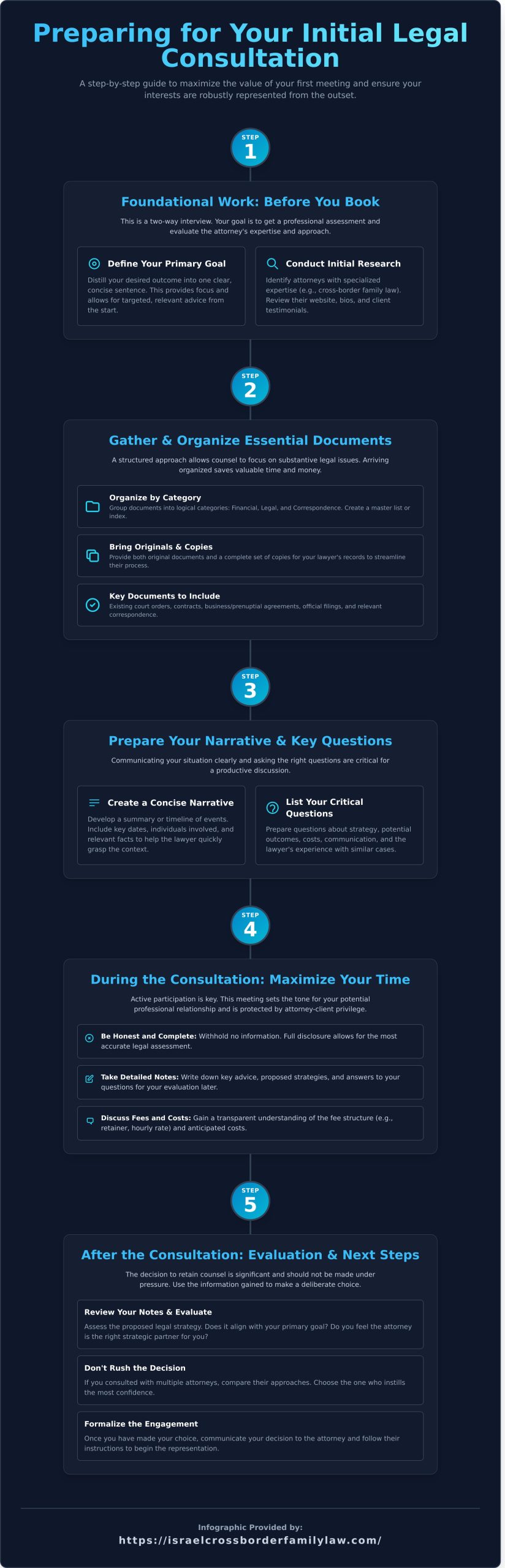
Step 5: After the Consultation – Evaluation and Next Steps
The conclusion of your meeting does not mark the end of your engagement, but rather the beginning of your decision-making process. The extensive effort involved in preparing for your initial consultation with a lawyer culminates in this critical evaluation phase. A reputable legal professional will not pressure you into an immediate commitment; instead, they will provide the space and information necessary for you to consider your options. This is a significant decision regarding a complex legal matter, and taking the time to make an informed choice is paramount.
Review Your Notes and Impressions
Immediately following the consultation, while the details remain fresh, dedicate time to review and expand upon your notes. Assess the substance of the conversation. Did the lawyer provide a clear, actionable strategy tailored to your situation, or were the answers vague and non-committal? Evaluate your confidence in their demonstrated expertise and relevant experience. If you have met with other attorneys, this is the time for a direct comparison of their proposed approaches, communication styles, and overall professional demeanour.
Understand the Engagement Letter or Retainer Agreement
Should you decide to proceed, the firm will provide a formal engagement letter (הסכם שכר טרחה). This is a legally binding document that merits your full attention before you sign or transfer any funds. It will meticulously outline the scope of legal services to be rendered, the complete fee structure-for example, a flat fee or an hourly rate with an initial retainer (פקדון) of several thousand shekels (₪)-and the responsibilities of both the client and the firm. Do not hesitate to request clarification on any clauses or terms you do not fully comprehend.
Making Your Final Decision
Your final determination should be a synthesis of factual analysis and professional intuition. Weigh the critical factors: the lawyer’s specific expertise in your area of need, a communication style that fosters confidence, and a transparent and reasonable cost structure. Once you have made your choice, promptly inform the lawyer and return the signed agreement to formally retain their services. As a matter of professional courtesy, it is also important to inform any other lawyers you consulted that you have secured representation elsewhere. Making the right choice is fundamental to successfully navigating your legal journey.
If you are facing the challenges of a cross-border legal matter and require counsel with proven international expertise, we invite you to contact our firm for a comprehensive consultation.
Transforming Preparation into a Powerful Legal Strategy
The comprehensive steps outlined in this guide-from conducting foundational work and meticulously organizing your essential documents to preparing a coherent narrative and targeted questions-are designed to transform your meeting from a simple introduction into a highly productive strategic session. Ultimately, successfully preparing for your initial consultation with a lawyer is the foundational act that empowers you to advocate for your position with clarity and confidence, ensuring your time and investment are maximized from the very beginning.
When your legal matter involves the complexities of international jurisdictions, this level of preparation is paramount. If you are facing a complex US-Israel cross-border family law issue, we invite you to take the next step. Our firm offers decades of experience navigating these intricate multi-jurisdictional challenges, grounded in a client-focused approach designed to achieve clarity and tangible results. With specialized expertise in this unique legal field, we are positioned to provide the sophisticated guidance you require. Schedule a Confidential Case Review to Discuss Your Cross-Border Matter and let us help you build a clear path toward resolution.
Frequently Asked Questions About Preparing for Your Legal Consultation
Is my initial consultation with a lawyer confidential?
Yes. Under Israeli law, communications during your initial consultation are protected by attorney-client privilege (חיסיון עורך דין-לקוח). This legal safeguard ensures that all information you share remains strictly confidential, irrespective of whether you ultimately retain the firm’s services. This protection is fundamental, allowing for a candid and comprehensive discussion of your matter, which is essential for our attorneys to provide an accurate preliminary assessment of your complex legal position and guide you effectively.
What is the difference between a free and a paid legal consultation?
A complimentary consultation typically serves as a brief, introductory screening to ascertain if your legal matter aligns with the firm’s specialized practice areas. In contrast, a paid consultation constitutes a substantive, in-depth session where our attorneys will analyze the specifics of your case, review documents, and provide concrete legal advice and a preliminary strategic outline. For sophisticated legal challenges, a paid session is an investment in obtaining a detailed, actionable evaluation from experienced counsel.
How much does an initial consultation typically cost?
In Israel, the fee for a comprehensive initial consultation reflects the expertise and seniority of the advising attorney. While some brief introductory calls may be complimentary, a detailed, hour-long strategic session typically ranges from ₪400 to ₪1,200. This investment provides you with tailored legal advice and a clear understanding of your options. We advise confirming the precise fee structure when scheduling your appointment to ensure complete transparency before the meeting commences.
What should I do if I forget to bring an important document to the meeting?
You should immediately inform the attorney during the consultation. While thorough documentation is a key part of preparing for your initial consultation with a lawyer, seasoned counsel can often conduct a valuable preliminary analysis based on the facts you provide. The forgotten document can be securely transmitted to the attorney following the meeting. This ensures our legal team possesses a complete file to conduct a comprehensive and accurate assessment of your matter.
Should I bring a friend or family member with me to the consultation?
We strongly advise attending the consultation alone. In the Israeli legal system, the presence of a third party who is not essential to the legal matter can potentially waive the attorney-client privilege. This would mean your conversation is no longer legally protected as confidential. If you feel you require support, it is imperative to discuss this with the attorney in advance to understand the significant legal ramifications and determine the most prudent course of action.
How do I know if I have a strong case?
Determining the strength of a legal case is a primary objective of the initial consultation. An attorney evaluates its merits by analyzing the facts presented, scrutinizing relevant documentation, and applying the appropriate Israeli statutes and legal precedents. The viability of a case depends on numerous factors, including the quality of evidence and potential counter-arguments. You will receive a candid, professional opinion on your position and the potential strategic pathways available for your consideration.

Article by
Gabriel Lior
A Personal Journey That Became a Mission
The advisory was founded by an American father Gabriel Lior, LLB, MBA , global entrepreneur, and cross-border advisor who spent more than a decade navigating the Israeli family court system firsthand and now lives in Singapore with his son.
As a divorced parent in a cross-border family, Gabriel faced nearly every legal challenge a foreign parent can encounter in Israel — including child custody disputes, child support proceedings, property matters in Israel and abroad, false accusations, and complex immigration and relocation proceedings.
Over the years, he learned the hard way how difficult it is for non-Israeli parents to understand the system, identify the right legal strategy, and choose the right legal representation — especially when language, culture, and jurisdictional differences are involved. He also witnessed how foreign parents and new immigrants are often disadvantaged or taken advantage of by service providers and institutions simply because they lack local knowledge or fluency.
From Client to Advisor
To truly understand — and survive — the system, Gabriel pursued formal legal education in Israel, completing two Israeli law degrees, alongside a BA and MBA earned in the United States. This was never about becoming a practicing attorney, but about gaining a deep, structural understanding of how the system works — and where it breaks down for foreign parents.
This rare combination of:
Firsthand client experience
Israeli legal and US business education
International business and negotiation training
Decades of commercial execution
created a unique perspective – one that understands both sides of the table.
After years of litigation, persistence, and at times self-representation, he ultimately succeeded in securing custody of his son and relocating abroad through a rare legal victory in the Israeli Supreme Court — becoming one of the first fathers in Israel to do so under these circumstances.
Disclaimer
Important Disclaimer:
The information provided on this website and in its content is for general informational and educational purposes only and does not constitute legal advice, legal opinion, or legal representation.
Gabriel Lior is not licensed to practice law in Israel (nor is he interested in doing so) and does not provide legal services, despite having completed 2 Law Degrees. The services offered are advisory in nature and are intended to provide general guidance, strategic insight, and information regarding cross-border family law considerations.
No attorney-client relationship is formed by accessing this website, reading its content, or communicating with us.
Any decisions made based on this information are at your own discretion and risk. For legal advice specific to your situation, you should consult a licensed attorney in the relevant jurisdiction.
Where appropriate, we may refer clients to independent, licensed attorneys or professionals. Such referrals do not constitute legal representation and no liability is assumed for services provided by third parties.