This article is published on an independent advisory platform and does not constitute an attorney-client relationship. Legal services are provided only by licensed attorneys under a separate engagement.
What if the legal document designed to protect your future in New York or California leaves you “chained” to a marriage under the authority of the Israeli Rabbinical courts? For international couples, the intersection of US civil law and the Israeli religious system creates a unique set of risks that a standard agreement often fails to address. You likely recognize that managing a life across two continents is inherently complex, but the added layer of religious jurisdiction can feel particularly daunting. A properly structured jewish prenup acts as a vital bridge, ensuring your rights are protected within both the Beth Din and civil courtrooms.
This guide provides the authoritative clarity you need to safeguard your future. You’ll learn how a strategic, cross-border approach can prevent the tragedy of get-refusal and provide a legally sound framework for assets spanning different legal cultures. We’ll walk through the specific mechanisms required to harmonize these multi-jurisdictional systems, offering both partners the peace of mind that comes from a proactive and informed strategy. Get clarity before you commit. Request a confidential consultation.
Key Takeaways
- Understand how a jewish prenup serves as a specialized halakhic contract designed to protect both parties from the risks of get-refusal and provide clarity in religious divorce.
- Explore the financial mechanisms, such as increased spousal support, used by Rabbinical Courts to encourage compliance with religious requirements without compromising civil rights.
- Navigate the complexities of the “Race to Court” by learning how jurisdiction impacts the enforceability of prenuptial agreements between the US and Israeli legal systems.
- Learn why standard “off-the-shelf” templates are often insufficient for cross-border couples and which strategic clauses are essential for international validity.
- Discover the value of early consultation to ensure clarity and avoid the pressure of last-minute decisions before entering a multi-jurisdictional marriage.
This article is published on an independent advisory platform and does not constitute an attorney-client relationship. All information provided is for educational purposes only; legal services are provided only by licensed attorneys under a separate engagement.
What is a Jewish Prenup and Why is it Necessary?
A Jewish prenuptial agreement, or Halakhic prenup, is a contract signed before marriage to ensure the religious divorce process remains fair. While a civil court can end a legal marriage, Jewish law requires a specific act to dissolve a religious union. This act involves the husband giving, and the wife accepting, a bill of divorce known as a “get.” It’s a process based on mutual consent. If one party refuses to cooperate, the marriage cannot end religiously. A jewish prenup creates a binding commitment to prevent this situation from occurring.
To better understand this concept, watch this helpful video:
The Problem of Get-Refusal
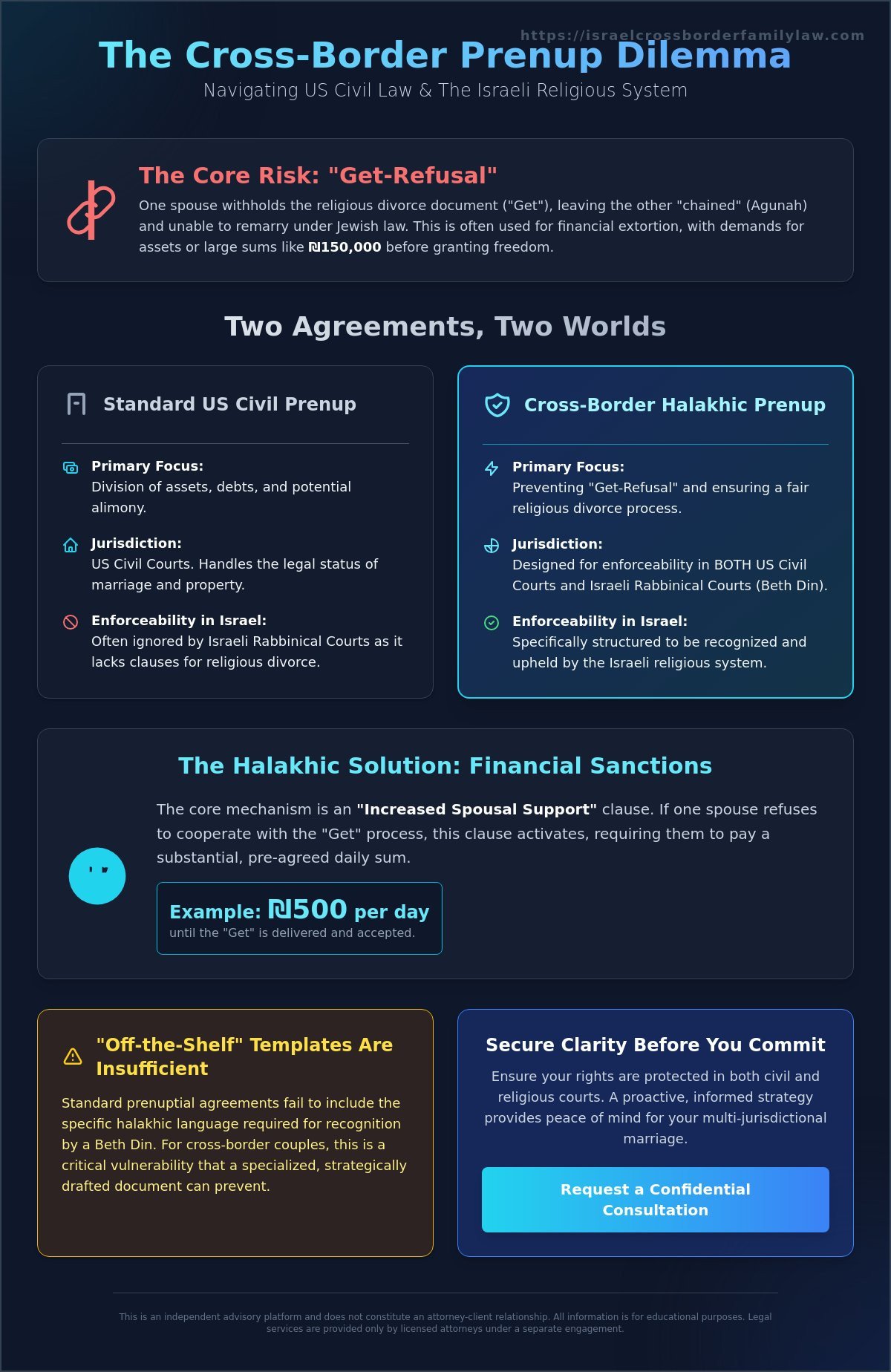
Get-refusal occurs when one spouse withholds the religious divorce document to gain leverage. This creates a state of being “chained,” known in Hebrew as being an Agunah. A chained person cannot remarry under Jewish law. Any children born to a woman in this position from a new relationship would face significant legal and religious hurdles in Israel. Refusal is often a tactic for financial extortion. One party might demand ₪150,000 or specific property concessions before agreeing to the get. Because civil courts in the US or Israel cannot always interfere in religious rituals, the jewish prenup serves as a vital tool to penalize such behavior through enforceable financial obligations.
Halakhic vs. Civil Prenuptial Agreements
Many couples mistakenly believe a standard US prenuptial agreement is sufficient. Civil agreements focus on the division of assets, debts, and potential alimony. However, the Israeli Rabbinical Court, which has exclusive jurisdiction over Jewish marriage and divorce in Israel, may ignore a US civil contract if it doesn’t align with religious law. The differences are significant:
- Jurisdiction: Civil courts handle property; Rabbinical courts handle the status of the marriage.
- Enforcement: A civil prenup might not include the specific language needed to compel a religious divorce.
- Financial Support: Halakhic agreements often use an “increased maintenance” clause, requiring the refusing spouse to pay a high daily sum, such as ₪500 per day, until the get is given.
For international families, having a single integrated agreement or two separate, coordinated documents is essential. This ensures that your financial protections and your religious freedom are both secure. Get clarity before you commit. Request a confidential consultation to discuss divorce and separation strategy for international families.
This article is published on an independent advisory platform (not a law firm) and does not imply an attorney-client relationship. Legal services are only provided by licensed attorneys under a separate engagement.
How a Halakhic Prenuptial Agreement Works in Practice
A Jewish prenup operates differently than a standard civil agreement. While a civil contract typically focuses on the division of assets or alimony, the halakhic version is designed to ensure that neither party can use the “Get” (the Jewish writ of divorce) as a bargaining chip. It establishes a clear, pre-negotiated framework for ending the marriage religiously if the relationship reaches an irreparable state.
The Financial Sanction Mechanism
The core of the agreement is a financial commitment known as “increased spousal support.” If a couple separates and one party refuses to participate in the divorce process, the agreement triggers a daily financial obligation. In Israel, this amount is often set at approximately ₪500 per day, adjusted for inflation. This isn’t framed as a “penalty” because Jewish law generally prohibits a divorce obtained through physical or financial coercion. Instead, it’s structured as a voluntary commitment to provide a higher level of support during the period of separation.
The Halakhic Prenuptial Agreement creates a powerful incentive for both parties to appear before the court. Because the obligation is framed as support, it’s more likely to be respected by both rabbinical and civil authorities. Data from organizations like Tzohar suggests that these agreements effectively resolve over 95 percent of potential get-refusal cases before they become protracted legal battles. This financial structure provides a predictable path forward for couples navigating the complexities of divorce for international families.
The Role of the Beth Din (Rabbinical Court)
In Israel, the Rabbinical Court (Beth Din) holds exclusive jurisdiction over marriage and divorce for Jewish citizens and residents. For cross-border couples, this adds a layer of complexity. The Beth Din must verify the agreement’s validity at the time of the wedding or shortly thereafter. This ensures the document meets the specific requirements of the Israeli Chief Rabbinate while remaining enforceable in foreign jurisdictions like New York or London.
The process of activating the agreement involves several steps:
- The parties must have lived apart for a specified period, usually six months.
- One spouse must formally request a divorce through the Beth Din.
- If the other spouse refuses to appear or provide the Get, the financial support obligation begins to accrue automatically.
Frameworks such as the Tzohar “Agreement for Mutual Respect” or the Center for Women’s Justice (CWJ) agreements are widely recognized in Israel. These documents are drafted by experts who understand the nuances of both the “start-up nation” legal environment and ancient religious statutes. They act as a bridge between two distinct systems, ensuring that a jewish prenup remains halakhically valid without violating civil contract laws. Get clarity before you commit. Request a confidential consultation to understand how these frameworks apply to your specific situation.
The Cross-Border Challenge: US Law vs. Israeli Religious Law
When a marriage involves both US and Israeli jurisdictions, the legal landscape becomes significantly more complex. The most immediate concern is the “Race to Court.” In Israel, jurisdiction is often determined by whoever files first. A spouse might file in the Israeli Rabbinical Court to secure a forum that follows religious law, while the other might prefer the Israeli Family Court or a US civil court. This race can dictate the entire outcome of a divorce, making a proactive strategy essential.
The 1973 Spouses (Property Relations) Law in Israel serves as the default framework for couples who don’t have a valid agreement. This law mandates a “resource balancing” approach, which generally results in an equal split of assets acquired during the marriage. For US expats, this might conflict with expectations set by US state laws. A well-structured jewish prenup must account for these differences to ensure that your intentions are respected in both countries.
US courts approach these agreements through the lens of the First Amendment. Judges generally avoid “religious entanglement” and will only enforce a religious contract if it can be interpreted using neutral principles of law. If a jewish prenup is drafted with purely religious terminology without secular backups, a US court might find it unenforceable. This creates a high stakes environment where the wording of the document determines its global validity.
Enforcing a US Prenup in Israel
A prenup signed in New York or California isn’t automatically valid in Israel. Israeli law requires that foreign agreements undergo a process of “validation” or approval by an Israeli court to be enforceable, especially regarding property located within Israel. Israeli courts frequently reject US-drafted documents if they don’t meet specific local standards. Common reasons for rejection include a lack of independent legal counsel for both parties or clauses that violate Israeli public policy. Understanding these risks is vital for divorce and separation for international families who want to protect their assets across borders.
Jurisdictional Conflicts and Strategy
The risk of conflicting rulings is a primary concern for cross-border couples. You might find yourself in a situation where a US civil court issues a ruling on property that an Israeli Rabbinical court refuses to recognize. This “legal limbo” can lead to years of litigation and massive legal fees. Forum selection is a contractual tool that allows couples to stipulate in advance which specific court system will have the authority to resolve their disputes, providing much-needed predictability. By choosing a preferred forum in your agreement, you reduce the incentive for a “race to court” and ensure that one legal system takes the lead.
Get clarity before you commit. Request a confidential consultation.
Strategic Drafting for International Couples
Drafting a jewish prenup for a cross-border life requires more than just translating a standard document. It demands a strategy that bridges two distinct legal systems. For couples with ties to both the US and Israel, the “Choice of Law” and “Choice of Forum” clauses are the most critical decisions. These clauses determine which country’s laws apply and which court has the authority to hear a case. Without this clarity, a spouse might find their Israeli assets, such as a ₪4,200,000 apartment in Tel Aviv, subject to unexpected US equitable distribution rules during a dispute.
The drafting process must also account for specific Israeli legal concepts like “Ma’aseh Yadeha.” This traditional concept refers to a husband’s right to his wife’s earnings in exchange for support. Modern international couples usually prefer to waive this right to ensure financial independence. A document that fails to address these nuances may be viewed as incomplete by an Israeli Rabbinical Court, leading to delays or complications in the divorce process.
Key Clauses for Asset Protection
A robust agreement must clearly define separate property versus joint property across both jurisdictions. Under Israel’s Spouses (Property Relations) Law of 1973, assets owned before marriage generally remain separate, but commingling funds in a joint account can blur these lines quickly. Drafting should explicitly address how to handle future inheritances and business growth in both countries. For those navigating these waters, understanding family law for expats and foreign nationals is essential to ensure the document remains enforceable in both a US state court and an Israeli family court.
Addressing Religious Obligations
The jewish prenup serves as a vital tool to handle the intersection of civil law and Halacha. It should include an explicit requirement for both parties to cooperate in the “Get” (religious divorce) process. This helps prevent the tragic situation of a “chained” spouse. To make these provisions enforceable in the US, the language must be carefully crafted to avoid violating the “Establishment Clause.” Instead of asking a secular judge to rule on religious doctrine, the document should name a specific Beth Din (rabbinical court) to resolve religious matters. This provides a clear, legally recognized roadmap for the parties while respecting the boundaries of the US Constitution.
Every international agreement requires a bilingual and bicultural review. A document that works in New York might be unenforceable in Israel if it doesn’t meet the specific formal requirements of the Israeli Family Court. Professional review ensures that the terminology used is accurate in both Hebrew and English, preventing costly misunderstandings later. Get clarity before you commit. Request a confidential consultation.
This article is published on an independent advisory platform and does not constitute a law firm or an attorney-client relationship. Legal services are only provided by licensed attorneys under a separate engagement.
Securing Clarity: Steps to Take Before You Marry
Seeking Strategy Over Simple Paperwork
The discussion phase is where the real value lies. It’s not just about a document; it’s about aligning expectations before the wedding. Couples often overlook how assets acquired during the marriage will be treated under balancing of resources rules in Israel. Decisions made in haste can lead to unintended consequences ten years down the line. You can find more on these strategic nuances by reviewing the cross-border family law strategy videos on the @IsraelFamilyLaw YouTube channel. Understanding the risks of early, uninformed decisions is the first step toward a stable future.
Next Steps for Your Agreement
Effective cross-border agreements require coordination between your US and Israeli legal teams. You don’t want a situation where your US jewish prenup contradicts your Israeli agreement. Both parties must seek independent legal advice to ensure the document is enforceable and that no one feels coerced. This transparency is a requirement for the agreement to be validated by an Israeli court. For those living abroad, you should understand how the advisory process works to ensure your strategy covers all bases.
Before you finalize your plans, use this checklist to ensure your assets and residency are protected:
- Identify and document all assets held in both the US and Israel.
- Determine which jurisdiction’s laws will govern the division of property.
- Verify if the agreement needs validation by an Israeli Family Court, a Notary, or a Rabbinical Court.
- Confirm the document addresses potential future relocation between countries.
- Ensure both parties have had at least 30 days to review the final draft before signing.
Get clarity before you commit. Request a confidential consultation.
Securing Your Future Across Borders
This article is published on an independent advisory platform and does not constitute legal representation or legal advice. Legal services are only provided by licensed attorneys under a separate engagement.
Navigating a marriage across two countries requires more than a standard agreement. It’s complex. Because the Israeli Rabbinical Court maintains exclusive jurisdiction over Jewish marriage and divorce in Israel, a standard US document often falls short. A properly drafted jewish prenup acts as a critical bridge between these two legal systems. It provides a strategic framework to prevent get refusal and resolves the jurisdictional tensions that naturally occur between US and Israeli law.
We provide specialized expertise in US-Israel cross-border family law, focusing specifically on the unique needs of international families and expats. Our advisory approach centers on a risk-based strategy designed to identify potential conflicts before they escalate. It’s essential to understand that early decisions impact your long-term security in both countries. By seeking clarity now, you ensure your transition between legal cultures is handled with precision. For more detailed insights, you can also explore our guides on the Israel Family Law YouTube channel.
Get clarity before you commit. Request a confidential case review.
Taking proactive steps today builds a foundation of certainty for your life together in Israel and beyond.
This article is published on an independent advisory platform and does not constitute a law firm or an attorney-client relationship. Legal services are only provided by licensed attorneys under a separate engagement.
Frequently Asked Questions
Is a Jewish prenup legally binding in a US civil court?
A Jewish prenup is generally enforceable in US civil courts when it’s structured as a valid contract or an agreement to arbitrate. Most US jurisdictions, including New York where many cross-border couples have ties, treat these documents as binding civil obligations rather than purely religious matters. The specific wording must comply with state-specific contract laws to ensure a judge can grant a stay or enforce financial penalties for non-compliance.
Can I sign a Jewish prenup after I am already married?
You can sign a Jewish prenup after the wedding ceremony, though it’s then technically referred to as a postnuptial agreement. This is a common practice for couples who realize the importance of halakhic protection after their nuptials. In Israel, a postnuptial agreement must be approved by a Family Court or a Rabbinical Court to be legally valid under the 1973 Spouses (Property Relations) Law. This ensures the document is enforceable in future proceedings.
What happens if my spouse refuses to give a get despite the agreement?
If a spouse refuses to give or receive a get, the agreement typically triggers a pre-agreed financial obligation known as increased maintenance. This requires the refusing party to pay a daily or monthly sum, such as ₪500 per day, until the religious divorce is finalized. These clauses aim to remove the incentive for get-refusal by making the delay financially burdensome. Strategic planning helps ensure these payments don’t conflict with Israeli child support laws.
Does a Jewish prenup cover child custody and support?
A Jewish prenup typically doesn’t cover child custody or support because courts retain ultimate jurisdiction over the best interests of the child. In both Israel and the US, judges won’t be bound by private agreements regarding children’s welfare or future living arrangements. While you can express your intentions, the court will make an independent determination based on the circumstances at the time of the divorce. For more insights on child-related issues, visit https://www.youtube.com/@IsraelFamilyLaw.
Do I need a separate lawyer in both Israel and the US for my prenup?
Engaging bicultural and bilingual attorneys in both Israel and the US is essential for cross-border couples. A document that’s valid in New York might not meet the strict procedural requirements of the Israeli Family Court. Having a team on the ground in both locations ensures the agreement is portable and provides a seamless professional home for your legal needs, protecting your assets across both jurisdictions and preventing future multi-jurisdictional conflicts.
What is the difference between an Israeli “Financial Agreement” and a Jewish prenup?
An Israeli Financial Agreement, or Heskem Mamon, primarily manages the division of assets, while a jewish prenup specifically addresses the religious divorce process. While a Heskem Mamon follows the 1973 Spouses (Property Relations) Law to prevent future litigation over property, the jewish prenup focuses on preventing agunah status. For international families, it’s often best to integrate both into a single, comprehensive cross-border document that satisfies both civil and religious requirements.
How much does it cost to draft a cross-border prenuptial agreement?
The cost to draft a cross-border prenuptial agreement varies based on the complexity of your global assets and the jurisdictions involved. While basic templates exist, custom drafting for international families often involves significant professional time to ensure compliance with both Israeli and US law. You should budget for the specialized expertise required to navigate two different legal systems. Get clarity before you commit. Request a confidential consultation.
Can a secular Israeli court enforce a halakhic prenup?
A secular Israeli Family Court can enforce the financial components of a jewish prenup if it’s been properly validated according to Israeli law. While the secular court won’t force a spouse to give a get, it can enforce the increased maintenance payments as a contractual obligation. This provides a critical layer of protection for English-speaking Israelis who want to ensure their religious rights are backed by the civil legal system’s enforcement powers and professional oversight.

Article by
Gabriel Lior
A Personal Journey That Became a Mission
The advisory was founded by an American father Gabriel Lior, LLB, MBA , global entrepreneur, and cross-border advisor who spent more than a decade navigating the Israeli family court system firsthand and now lives in Singapore with his son.
As a divorced parent in a cross-border family, Gabriel faced nearly every legal challenge a foreign parent can encounter in Israel — including child custody disputes, child support proceedings, property matters in Israel and abroad, false accusations, and complex immigration and relocation proceedings.
Over the years, he learned the hard way how difficult it is for non-Israeli parents to understand the system, identify the right legal strategy, and choose the right legal representation — especially when language, culture, and jurisdictional differences are involved. He also witnessed how foreign parents and new immigrants are often disadvantaged or taken advantage of by service providers and institutions simply because they lack local knowledge or fluency.
From Client to Advisor
To truly understand — and survive — the system, Gabriel pursued formal legal education in Israel, completing two Israeli law degrees, alongside a BA and MBA earned in the United States. This was never about becoming a practicing attorney, but about gaining a deep, structural understanding of how the system works — and where it breaks down for foreign parents.
This rare combination of:
Firsthand client experience
Israeli legal and US business education
International business and negotiation training
Decades of commercial execution
created a unique perspective – one that understands both sides of the table.
After years of litigation, persistence, and at times self-representation, he ultimately succeeded in securing custody of his son and relocating abroad through a rare legal victory in the Israeli Supreme Court — becoming one of the first fathers in Israel to do so under these circumstances.
Disclaimer
Important Disclaimer:
The information provided on this website and in its content is for general informational and educational purposes only and does not constitute legal advice, legal opinion, or legal representation.
Gabriel Lior is not licensed to practice law in Israel (nor is he interested in doing so) and does not provide legal services, despite having completed 2 Law Degrees. The services offered are advisory in nature and are intended to provide general guidance, strategic insight, and information regarding cross-border family law considerations.
No attorney-client relationship is formed by accessing this website, reading its content, or communicating with us.
Any decisions made based on this information are at your own discretion and risk. For legal advice specific to your situation, you should consult a licensed attorney in the relevant jurisdiction.
Where appropriate, we may refer clients to independent, licensed attorneys or professionals. Such referrals do not constitute legal representation and no liability is assumed for services provided by third parties.