What if your U.S. citizenship matters less than where you live, which issues need to be decided, and whether orders already exist in the United States? If you’re asking, “what are my rights as an American divorcing in Tel Aviv,” the answer depends on more than your passport. Different parts of a divorce may involve different Israeli forums, and cross-border questions can affect how decisions fit together.
This guide explains the facts to clarify before choosing a course of action. It covers forum, children, support, property, and existing U.S. orders, while recognizing that the answer depends on each family’s circumstances and current law. Israel Cross Border Law Firm focuses on family law, including divorce and child custody. This article offers general information, not legal advice or a case-specific assessment.
What Are My Rights as an American Divorcing in Tel Aviv?
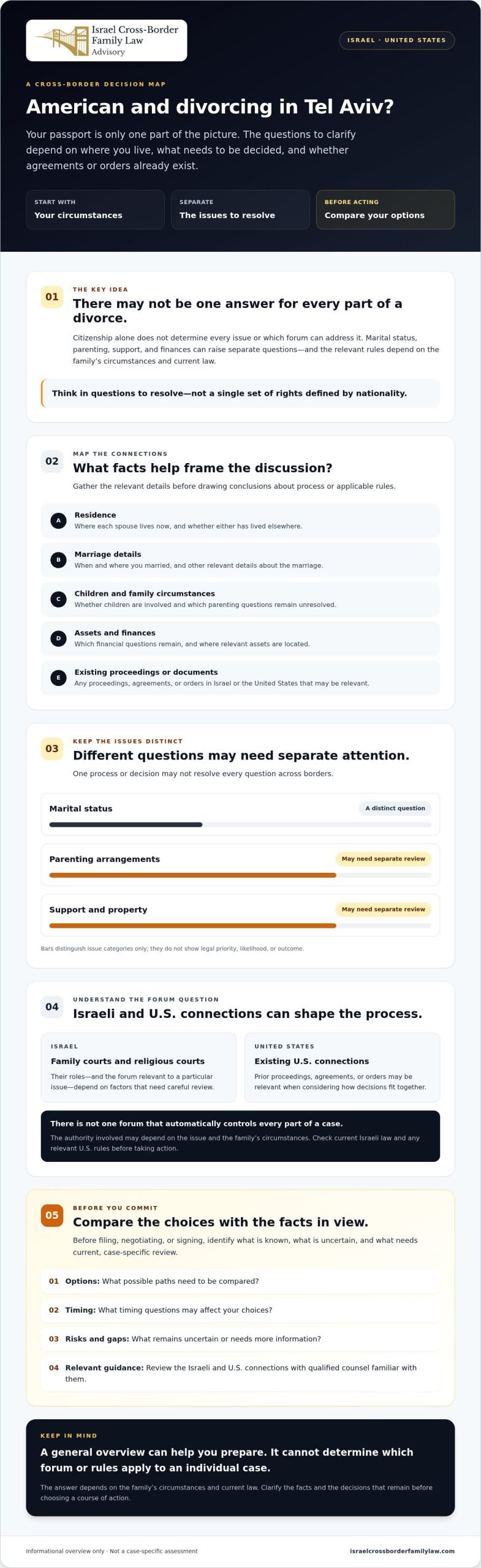
Start by listing the decisions you need to make rather than looking for one answer based on nationality. Identify where each spouse lives, whether children are involved, what agreements or orders already exist, and which financial or parenting questions remain unresolved. Those details help frame a useful discussion with counsel familiar with the Israeli and U.S. connections in your case.
Key Takeaways
- When asking “what are my rights as an American divorcing in Tel Aviv,” identify the specific questions that need answers rather than assuming citizenship determines one set of rights.
- Map your connections to Israel and the United States, including where you live and whether existing orders or agreements may be relevant.
- Separate questions about children, support, and property. Each may depend on different facts and require its own current legal review.
- Before filing, negotiating, or signing, compare possible options, timing, risks, and information gaps with appropriate professional guidance.
- General information can help you prepare, but it cannot determine which forum or rules apply to an individual case.
What Does “American Divorcing in Tel Aviv” Mean for Your Rights?
A divorce connected to Israel and the United States can raise questions about which rules matter, where different issues may be addressed, and whether a decision in one country could affect matters in the other. If you’re asking, “what are my rights as an American divorcing in Tel Aviv,” treat “rights” as a set of issue-specific questions, not a single package determined by nationality.
Your residence, family circumstances, marriage details, prior proceedings, and the issues you need resolved may all be relevant. Their legal effect depends on your situation and current law. A general overview can help you identify what to ask, but it cannot establish jurisdiction or determine which law applies in an individual case.
Does U.S. citizenship determine your divorce rights in Tel Aviv?
Citizenship alone should not be treated as deciding every issue or determining which forum can address it. Before drawing conclusions, clarify where each spouse lives, where and how you married, whether you have children, where relevant assets are located, and whether either country already has proceedings, agreements, or orders involving your family.
These facts help frame the questions, but they do not establish the legal answer. Ask qualified counsel familiar with the relevant Israeli and U.S. connections to verify how current rules on jurisdiction and applicable law relate to your circumstances before you commit to a course of action.
Which parts of a cross-border divorce may need separate attention?
Marital status, finances, parenting arrangements, and support are connected, but one process or decision may not resolve every question across borders. For example, a decision on marital status may leave separate questions about parenting arrangements or financial matters to be considered. The implications depend on the circumstances and require jurisdiction-specific review.
International matrimonial law principles offer a broad introduction to legal questions that can arise across national borders. This is general background, not a substitute for checking current Israeli and U.S. rules. For related context, see this guide for expats and foreign nationals.
Israel Cross Border Law Firm handles family law matters, including divorce and child custody. Whether a particular service or legal approach fits your circumstances depends on a review of the facts and applicable law.
Get clarity before you commit. Request a confidential consultation.
How Israeli and U.S. Connections Can Shape a Tel Aviv Divorce
A divorce connected to Israel and the United States may raise different questions about where proceedings can take place and how decisions might be treated in the other country. There is not one forum that automatically controls every part of a case. The authority involved may depend on the issue and the family’s circumstances, so current Israeli law and any relevant U.S. rules should be checked before taking action.
Israel has family courts and religious courts, but their roles and the forum relevant to a particular issue depend on factors that need careful legal review. For an overview of the subject, see this guide to Israeli family law regulations. It is a starting point, not a conclusion about which authority would address your circumstances.
Local circumstances matter too. Families may be based in Tel Aviv, Jerusalem, Herzliya, Ra’anana, Netanya, Haifa, Modi’in, Beit Shemesh, Kfar Saba, Hod Hasharon, Ramat Gan, Givatayim, Petah Tikva, Ashdod, Be’er Sheva, Eilat, Caesarea, or Zichron Ya’akov. Wherever you live, the relevant questions turn on your facts and the rules that apply, not on the city name alone.
What should you clarify about the forum and process?
Before asking “what are my rights as an American divorcing in Tel Aviv,” assemble the facts that may help qualified counsel assess the process. A compact checklist can make an initial discussion more focused:
- Residence: Where each spouse lives now, and whether either has lived elsewhere.
- Marriage: When and where you married, and any details about the marriage that may be relevant.
- Religion: Whether religious status may affect the process or forum. Do not assume it determines every issue.
- Children: Where the children live and whether parenting arrangements are already in place.
- Prior steps: Any filings, agreements, or court orders in Israel or the United States.
These details are prompts for review, not a formula for predicting which court or authority will hear a particular matter. The roles of Israeli family courts and religious courts, and how they apply to your situation, require current verification by qualified counsel.
How should you think about U.S. proceedings or documents?
Gather copies of any U.S. court orders, filings, signed agreements, or related proceedings. Note which issue each document addresses, where it was issued, and whether it is final or still under discussion. This makes it easier to identify questions that should be reviewed on both sides of the border.
Recognition and enforcement are separate questions. Recognition concerns whether a decision may be accepted as having effect in another country. Enforcement concerns whether steps can be taken there to carry it out. Neither should be assumed. A U.S. order or agreement may need jurisdiction-specific review before anyone can determine its effect in Israel, and an Israeli decision may raise separate questions in the United States.
The place where a divorce process occurs therefore does not, by itself, resolve every cross-border issue. Israel Cross Border Law Firm’s family law practice can address divorce and related family law questions. The issues in a case with U.S. connections may require careful review of both jurisdictions and the documents involved.
Which Rights Questions Matter Most: Children, Support, and Property?
Children, financial support, and property are distinct topics. The facts that matter for one may not answer another, particularly when family members, records, assets, or existing decisions connect Israel with the United States. If you’re considering what are my rights as an American divorcing in Tel Aviv, use the questions below to organize what needs review, not to assume a particular entitlement or result.
| Issue | Cross-border facts to gather | What needs verification |
|---|---|---|
| Children and parenting | Where the children live, existing arrangements, prior orders, and any proposed relocation. | Which authority may address parenting, relocation, or an existing order, and whether a decision may be recognized or enforced elsewhere. |
| Support | Any current child or spousal support arrangements, relevant orders, and records relating to income and payments. | Which rules and processes apply to the specific support question, including any cross-border enforcement issue. |
| Property and finances | Where assets and debts are located, ownership records, agreements, and available financial documents. | How the relevant jurisdictions may treat the property and what financial information may be needed for assessment. |
How may children and parenting arrangements raise cross-border questions?
Share the children’s residence, current care arrangements, and any prior court orders with qualified counsel. Keep separate the questions of custody, parenting time, relocation, and international enforcement. For example, a discussion about a child’s schedule is not necessarily the same as a request to move the child to another country, and neither fact alone predicts how a decision would be made.
For background on cross-border parenting and relocation, see the guide to international custody and relocation. Any proposed move or existing order should be reviewed in light of the specific facts and applicable rules. Israel Cross Border Law Firm offers child custody and child abduction legal services, which may be relevant to families facing cross-border parenting questions.
What should you clarify about support and marital property?
For support, identify whether the question concerns child support, spousal support, an existing order, or payments that may need to be addressed across borders. If a child-support order may need to be enforced in another country, that is a distinct issue requiring jurisdiction-specific review; the available cross-border child-support enforcement resource can help frame questions to ask.
For property, gather account statements, ownership records, agreements, and information about where assets and debts are held. Registration in one person’s name may be relevant information, but do not assume it determines the outcome. The location and history of property, the documents available, and the rules that apply all need assessment.
Keep the records organized by issue. For example, place parenting orders and schedules together, separate support orders and payment records, and collect property documents by account or asset. This helps counsel see what is already documented and where information is missing. It does not replace a legal assessment of how the documents may be treated.
What Should You Compare Before Choosing a Divorce Strategy?
A useful strategy comparison does not start with a prediction about which court or process is best. It starts with the issues that need attention, the facts still missing, and the possible consequences of each step that must be verified. An early filing, negotiation, or signed agreement may have implications beyond Israel, so consider how it could interact with existing proceedings or documents in the United States before committing.
No single path is right for every family. This guide can help you organize the questions, but it cannot determine the best course for an individual case or replace current guidance from appropriately qualified professionals.
Which questions help you compare possible paths?
For each option you are considering, make a short comparison. Ask which issues need attention first, what the step may affect, and what should be checked in both countries. Then identify which professional is qualified to address each question. Depending on the issue, you may need input from professionals familiar with Israeli law, U.S. law, or both.
- Purpose: Which issue would this step address, and which would remain unresolved?
- Consequences to verify: Could it affect an existing proceeding, order, agreement, or later decision in either country?
- Information needed: Which records or facts are missing before you can assess the option?
- Coordination: Does the issue require input from professionals in more than one jurisdiction?
Before signing an agreement, filing a claim, or making plans to relocate children, clarify what each step is intended to resolve, whether it could have cross-border effects, and what remains uncertain. If you’re asking what are my rights as an American divorcing in Tel Aviv, these questions help turn a broad concern into specific points for review. They do not predict a result.
How can you prepare before making a commitment?
Gather relevant records in one place. These may include court papers, marriage or financial agreements, and financial documents. Create a timeline noting where each spouse and the children have lived, when proceedings began, and when agreements or orders were made. Mark any gaps or conflicting information rather than trying to resolve them yourself.
Before making a decision, consider whether you understand the purpose and possible effect of the proposed step, what facts still need confirmation, and which professional should review it. The confidential case review information may help you understand the review process. A case-specific assessment should address the issues and jurisdictions relevant to your circumstances.
Israel Cross Border Law Firm’s family law services include divorce and child custody. If your questions also involve U.S. proceedings or documents, prepare those details for discussion so the cross-border aspects can be identified alongside the family law issues.
Get clarity before you commit. Request a confidential consultation.
How to Get Clear, Case-Specific Guidance Before Your Next Step
Before you file, sign an agreement, or make plans that could affect your children, take a measured first step: organize the facts, identify urgent concerns, and get the right questions in front of the appropriate professionals. If you’re still asking, “what are my rights as an American divorcing in Tel Aviv,” a focused review of your circumstances can help clarify what needs to be checked without assuming one answer fits every case.
What information should you have ready for an initial review?
A concise summary is often more useful than a large, unorganized collection of papers. Prepare:
- A timeline of the relationship, where each spouse has lived, and where the children have lived.
- A list of any current or past proceedings, orders, and signed agreements in Israel or the United States.
- Relevant financial records and documents about assets or support questions.
- Your main questions about forum, children, support, property, and whether decisions or documents may have an effect across borders.
Keep originals secure. Before sending sensitive documents, confirm what information is needed, how to share it, and how it will be handled. If an urgent concern exists, such as an imminent filing deadline or a proposed change to a child’s living arrangements, flag it early so the appropriate professional can assess its significance.
What can an advisory conversation clarify?
A focused discussion can help organize the issues, identify information gaps, and prepare a practical list of points for further review. It may help you distinguish questions about Israeli proceedings from questions about U.S. orders or agreements, and identify where cross-border coordination may need attention. It cannot guarantee an outcome or replace a case-specific legal assessment.
Israel Cross Border Law Firm focuses on family law, including divorce, child custody, child abduction matters, and wills and estates. If your divorce involves connections to the United States, make those connections clear at the outset so the relevant documents, family circumstances, and questions can be considered together.
Get clarity before you commit. Request a confidential consultation.
Take Your Next Step With Clarity
The question “what are my rights as an American divorcing in Tel Aviv” does not have one answer based on citizenship alone. Residence, family circumstances, existing proceedings, and the specific issues at stake all help shape what needs to be reviewed. Children, support, property, and marital status may raise separate questions, especially when decisions or documents connect Israel and the United States.
Before filing, signing an agreement, or making plans for your children, organize the relevant facts and identify what remains uncertain. Current, case-specific guidance can help you understand which questions to raise and which professionals may need to address them. Israel Cross Border Law Firm provides family law services, including divorce and child custody, for people navigating these issues in Israel.
Get clarity before you commit. Request a confidential consultation.
A careful next step can begin with better questions and a clearer view of your options.
Frequently Asked Questions
Does being an American give me different divorce rights in Tel Aviv?
U.S. citizenship alone does not determine which rules, forum, or outcomes apply. If you’re asking “what are my rights as an American divorcing in Tel Aviv,” consider nationality alongside where each spouse lives, details of the marriage, children’s circumstances, existing agreements, and any proceedings in either country. The effect of these facts depends on current law and your situation. Treat citizenship as one fact to discuss, not a complete answer.
Can I file for divorce in Tel Aviv if I am a U.S. citizen?
Whether a particular forum can hear a matter depends on current rules and jurisdiction-specific facts. Residence, the parties’ circumstances, the marriage, and any existing proceedings may need review before filing. This article cannot determine eligibility or identify the correct forum for an individual case. Whether you’re connected to Tel Aviv, Jerusalem, Herzliya, Ra’anana, Netanya, Haifa, Modi’in, Beit Shemesh, Kfar Saba, Hod Hasharon, Ramat Gan, Givatayim, Petah Tikva, Ashdod, Be’er Sheva, Eilat, Caesarea, Zichron Ya’akov, or another Israeli city, ask qualified counsel to assess your facts and any timing concerns.
What happens if divorce proceedings have already started in the United States?
Existing U.S. proceedings may make timing and coordination important, but their effect in Israel cannot be assumed. Collect filing documents, orders, agreements, and relevant dates, then have their status reviewed by professionals familiar with the jurisdictions involved. Avoid assuming that a process in one country resolves every issue in the other, or taking a step that may conflict with an existing proceeding before its implications are checked.
How are child custody and parenting arrangements handled when one parent is American?
A parent’s American nationality alone does not determine parenting arrangements. Relevant facts may include where the child lives, existing agreements or orders, prior proceedings, and any proposed relocation. Custody, parenting time, relocation, and international enforcement can raise distinct questions, and the applicable rules require current, case-specific review. Do not move a child or rely on an assumed international rule without first seeking qualified guidance on the circumstances and possible cross-border implications.
Can an Israeli divorce decision affect my U.S. financial or support matters?
Possibly, but recognition and enforcement are separate questions from obtaining a decision in Israel. The analysis may depend on the type of decision, the jurisdictions involved, and the facts of the case. Do not assume an Israeli decision automatically applies or can be enforced in the United States. Before relying on an order or proposed agreement, ask qualified professionals to review its intended effect in each relevant jurisdiction.
What documents should I gather before discussing divorce in Tel Aviv?
Prepare a concise timeline covering where each spouse and the children have lived, marriage details, and proceedings in either country. Gather available agreements, court documents, and relevant financial records. You do not need a perfect file before raising an urgent concern. Ask how sensitive documents should be shared, and avoid sending personal records until you know what information is needed and the appropriate way to provide it.
Do I need an Israeli lawyer if I am an American divorcing in Tel Aviv?
Whether and when to retain an Israeli lawyer depends on the issues and steps involved in your circumstances. General information cannot determine which representation is appropriate for your case. If you seek counsel, confirm that the professional is qualified to address the relevant jurisdiction and legal issues. Israel Cross Border Law Firm offers family law services, including divorce and child custody, and you can contact the firm to discuss whether its services fit your needs.
Get clarity before you commit. Request a confidential consultation.
What resources exist for Americans rebuilding their personal lives in Israel after divorce?

Article by
Gabriel Lior
A Personal Journey That Became a Mission
The advisory was founded by an American father Gabriel Lior, LLB, MBA , global entrepreneur, and cross-border advisor who spent more than a decade navigating the Israeli family court system firsthand and now lives in Singapore with his son.
As a divorced parent in a cross-border family, Gabriel faced nearly every legal challenge a foreign parent can encounter in Israel — including child custody disputes, child support proceedings, property matters in Israel and abroad, false accusations, and complex immigration and relocation proceedings.
Over the years, he learned the hard way how difficult it is for non-Israeli parents to understand the system, identify the right legal strategy, and choose the right legal representation — especially when language, culture, and jurisdictional differences are involved. He also witnessed how foreign parents and new immigrants are often disadvantaged or taken advantage of by service providers and institutions simply because they lack local knowledge or fluency.
From Client to Advisor
To truly understand — and survive — the system, Gabriel pursued formal legal education in Israel, completing two Israeli law degrees, alongside a BA and MBA earned in the United States. This was never about becoming a practicing attorney, but about gaining a deep, structural understanding of how the system works — and where it breaks down for foreign parents.
This rare combination of:
Firsthand client experience
Israeli legal and US business education
International business and negotiation training
Decades of commercial execution
created a unique perspective – one that understands both sides of the table.
After years of litigation, persistence, and at times self-representation, he ultimately succeeded in securing custody of his son and relocating abroad through a rare legal victory in the Israeli Supreme Court — becoming one of the first fathers in Israel to do so under these circumstances.
Disclaimer
Important Disclaimer:
The information provided on this website and in its content is for general informational and educational purposes only and does not constitute legal advice, legal opinion, or legal representation.
Gabriel Lior is not licensed to practice law in Israel (nor is he interested in doing so) and does not provide legal services, despite having completed 2 Law Degrees. The services offered are advisory in nature and are intended to provide general guidance, strategic insight, and information regarding cross-border family law considerations.
No attorney-client relationship is formed by accessing this website, reading its content, or communicating with us.
Any decisions made based on this information are at your own discretion and risk. For legal advice specific to your situation, you should consult a licensed attorney in the relevant jurisdiction.
Where appropriate, we may refer clients to independent, licensed attorneys or professionals. Such referrals do not constitute legal representation and no liability is assumed for services provided by third parties.