This article is published on an independent advisory platform and does not constitute legal representation or an attorney-client relationship. Legal services are only provided by licensed attorneys under a separate engagement.
Many US citizens assume that a comprehensive trust or a valid American will allows their heirs to bypass court proceedings, but the probate process in israel is virtually unavoidable for transferring assets like real estate or bank accounts. It’s natural to feel overwhelmed by the prospect of managing an estate across borders, especially when faced with bureaucratic delays in a foreign language and the technicalities of the Succession Law, 1965. You might be concerned about whether your US documents hold weight or how to manage hidden costs like the Foreign Legal Opinion, which typically ranges from ₪5,000 to ₪15,000.
This guide provides a clear roadmap for these complex multi-jurisdictional requirements, detailing how to validate international documents and manage mandatory statutory fees. You’ll learn the specific steps to secure an inheritance order, the timeline for estates based abroad, which typically spans four to six months, and how to avoid common pitfalls that lead to family disputes. For additional visual guidance, you can view our resources at https://www.youtube.com/@IsraelFamilyLaw. Get clarity before you commit. Request a confidential consultation.
Key Takeaways
- Understand the legal distinction between a Probate Order and a Succession Order to ensure you initiate the correct procedure for your family’s estate.
- Navigate the probate process in israel by identifying the essential documentation and notification requirements for international heirs and beneficiaries.
- Learn how US-based wills are validated in IL and why a Foreign Legal Opinion is required to explain foreign laws to the Registrar.
- Set realistic expectations for cross-border timelines, which typically span six to twelve months due to multi-jurisdictional complexities and administrative procedures.
- Identify key strategic decision points early to avoid common bureaucratic pitfalls and minimize the risk of family disputes.
What is the Probate Process in Israel?
This article is published on an independent advisory platform and does not constitute legal representation or an attorney-client relationship. Legal services are only provided by licensed attorneys under a separate engagement. The probate process in israel is the essential legal mechanism used to authenticate a person’s final wishes or determine legal heirs when no will exists. Unlike many US jurisdictions where living trusts can effectively bypass court oversight, assets located in IL almost always require a formal order to change ownership. This framework is governed by the Israeli legal system, specifically the Succession Law of 1965, which sets the standards for how estates are managed and distributed.
To better understand this concept, watch this helpful video:
The primary goal of the probate process in israel is to legally transfer titles for assets such as apartments, bank accounts, or investment portfolios to the rightful beneficiaries. For international families and expats or foreign nationals, this standard procedure involves additional layers of complexity. You aren’t just dealing with local law; you’re navigating the intersection of two different legal cultures. A US-based will might be perfectly valid, but it won’t be recognized by an Israeli bank or the Land Registry until it has been processed and validated through the local system.
Probate Order vs. Succession Order
There are two main types of orders you might need to secure. A ‘Kiyum Tzavah’ (Probate Order) is used when the deceased left a valid will. This document confirms the will’s authenticity and provides the legal basis for asset distribution. If the deceased died without a will, the family must apply for a ‘Yerusha’ (Succession Order). This order identifies the legal heirs based on the statutory hierarchy established in 1965. Both orders serve the same ultimate function: they give you the legal authority to manage and distribute the estate’s assets.
The Role of the Registrar for Matters of Succession
The Registrar for Matters of Succession (Rasham HaYerusha) handles most applications in an administrative capacity. This office isn’t a ‘court’ in the way Americans typically imagine; it functions more like a government registry. Most filings are now handled through a digital system, which is convenient for families living abroad. However, if a case involves complex multi-jurisdictional disputes or if someone files a formal objection, the Registrar will transfer the file to the Family Court for litigation. Understanding this distinction is vital for setting a realistic strategy for your family’s needs. Get clarity before you commit. Request a confidential consultation.
This article is published on an independent advisory platform and does not constitute legal representation or an attorney-client relationship. Legal services are only provided by licensed attorneys under a separate engagement.
The Procedure: Filing with the Registrar for Matters of Succession
The probate process in israel follows a specific administrative path designed to ensure transparency and protect the rights of potential heirs. Once you’ve determined whether you need a Probate Order or a Succession Order, the actual filing involves several sequential steps. It’s a structured system, but the cross-border nature of your family’s situation adds logistical layers that require careful attention from the start.
The first step involves gathering original documentation. You’ll need the original will and a formal death certificate. For families based in the US, these documents must be properly authenticated for use in IL. Following this, you must notify all potential heirs. The law is strict here; you’ve got to prove that everyone with a legal interest in the estate knows about the application. This is typically done via registered mail with a return receipt to provide the Registrar with physical evidence of the notification.
Financial obligations are the third step. As of May 2026, the mandatory filing fee for the Registrar is ₪566. You’re also required to pay a ₪215 fee for a public notice in a daily newspaper. This leads to the fourth step: the digital submission. The Registrar’s office operates a sophisticated online portal where the petition and all scanned documents are uploaded. Finally, there’s a statutory waiting period. After the newspaper publication, the public has a window, usually 14 days, to file objections before the Registrar issues the final order.
Required Documentation for Foreign Residents
US-issued death certificates aren’t automatically accepted in IL. They must carry an Apostille, which is a specialized form of international certification obtained in the state where the document was issued. Additionally, any document not in Hebrew requires a translation by a certified Israeli notary. Notarized translation fees for a standard will can range from ₪250 to ₪400 per page. You can learn more about how it works regarding document coordination and the logistics of handling foreign paperwork.
The Notification Requirement
The Registrar requires physical proof that all heirs were notified. This protects the probate process in israel from future litigation or claims of “lost” relatives. If a beneficiary doesn’t want their portion, they must file a formal ‘Renunciation of Share’. This is often a strategic choice to simplify the distribution of assets like real estate or to manage specific tax implications. Managing these notifications effectively prevents unnecessary delays. Get clarity before you commit. Request a confidential consultation.
This article is published on an independent advisory platform and does not constitute legal representation or an attorney-client relationship. Legal services are only provided by licensed attorneys under a separate engagement.
Managing Foreign Wills and the Foreign Legal Opinion (FLO)
When an estate involves a deceased person who was not a resident of IL, the probate process in israel requires a bridge between two different legal systems. A US-based will is generally considered valid in the eyes of the Israeli Registrar if it meets the legal requirements of the jurisdiction where it was signed. However, the Registrar’s office is not equipped to interpret the specific statutes of individual states like New York, Florida, or California. To bridge this gap, the family must provide a Foreign Legal Opinion (FLO).
The FLO is a formal expert report that explains the relevant succession laws of the deceased’s home state to the Israeli authorities. It is a mandatory requirement for any application involving a foreign will or a foreign resident. This document must be authored by an attorney who is actively licensed in that specific US jurisdiction. Without this expert clarification, the Registrar cannot confirm that the will was executed correctly or determine how the laws of that state interact with Israeli property requirements.
Is Your US Will Valid in Israel?
Israel follows the principle of Lex Loci Celebrationis, which means the law of the place of signing governs the will’s formal validity. If your will was signed in accordance with Texas law, Israel will typically respect it. A common hurdle for many expats and foreign nationals is that US wills often fail to specifically identify Israeli assets, such as a specific apartment in Jerusalem or a bank account in Tel Aviv. While a general “residuary clause” may cover these assets, it can lead to administrative delays. In the future, many families choose to simplify this by creating dual-country wills that separate their Israeli and American interests.
Understanding the Foreign Legal Opinion (FLO)
The FLO must address specific legal questions, most notably the concept of ‘Domicile.’ This determines which country’s laws govern the distribution of movable assets like cash and stocks. While real estate in IL is always governed by Israeli law, the distribution of a bank account might depend on whether the deceased was legally domiciled in the US at the time of death. This expert report is often the most time-consuming part of the process for international families. According to verified data from May 2026, the cost for this specialized opinion typically ranges from ₪5,000 to ₪15,000. To see how these cross-border dynamics play out in real scenarios, you can view the educational content on the @IsraelFamilyLaw YouTube channel. Get clarity before you commit. Request a confidential consultation.
This article is published on an independent advisory platform and does not constitute legal representation or an attorney-client relationship. Legal services are only provided by licensed attorneys under a separate engagement.
Timeline and Practical Risks for International Families
Setting realistic expectations for the probate process in israel is vital for families managing an estate from abroad. While local, uncontested cases might conclude in two to three months, cross-border situations typically require a minimum of four to six months. In many instances involving US-based wills and complex asset structures, a 12-month timeline is common. This duration accounts for the logistical challenges of coordinating documents between jurisdictions and the administrative requirements of the Israeli Registrar.
One factor often overlooked by international families is the Israeli holiday calendar. Government offices, including the Registrar for Matters of Succession and the Guardian General, frequently close or operate with minimal staff during major holidays such as Passover and the High Holiday season in September and October. These periods can add weeks to the processing time. Additionally, if the assets involve a former spouse or unresolved matrimonial claims, you should review how divorce and separation for international families impacts estate distribution.
There’s also a risk of formal objections. If a family member contests the will, the Registrar will transfer the file to the Family Court, which shifts the process into a litigation phase. Failing to claim assets quickly can lead to the ‘abandoned property’ designation. If the Administrator General takes control of unclaimed assets, the legal path to recover them becomes significantly more complex and expensive.
Factors That Delay the Probate Order
Delays often stem from technical errors rather than legal disputes. Missing an Apostille on a US death certificate or providing an imprecise Hebrew translation of a legal document can cause the Registrar to reject an application. Another common bottleneck is the Guardian General’s office. They must review every probate application to ensure no state interests or minors’ rights are compromised. During peak seasons, their backlog can stall even the most straightforward probate process in israel for several months.
Financial Considerations and Taxes
As of May 2026, Israel maintains its policy of having no inheritance or estate tax. This has been the standard since 1981. However, US citizens must remain aware of their domestic obligations. This includes filing Form 3520 with the IRS to report the receipt of foreign gifts or bequests if they exceed specific thresholds. Beyond taxes, families must account for professional fees, such as the Foreign Legal Opinion (FLO) and mandatory statutory filing costs. To ensure you’re prepared for these multi-jurisdictional requirements, schedule a review of your specific estate situation. Get clarity before you commit. Request a confidential consultation.
This article is published on an independent advisory platform and does not constitute legal representation or an attorney-client relationship. Legal services are only provided by licensed attorneys under a separate engagement.
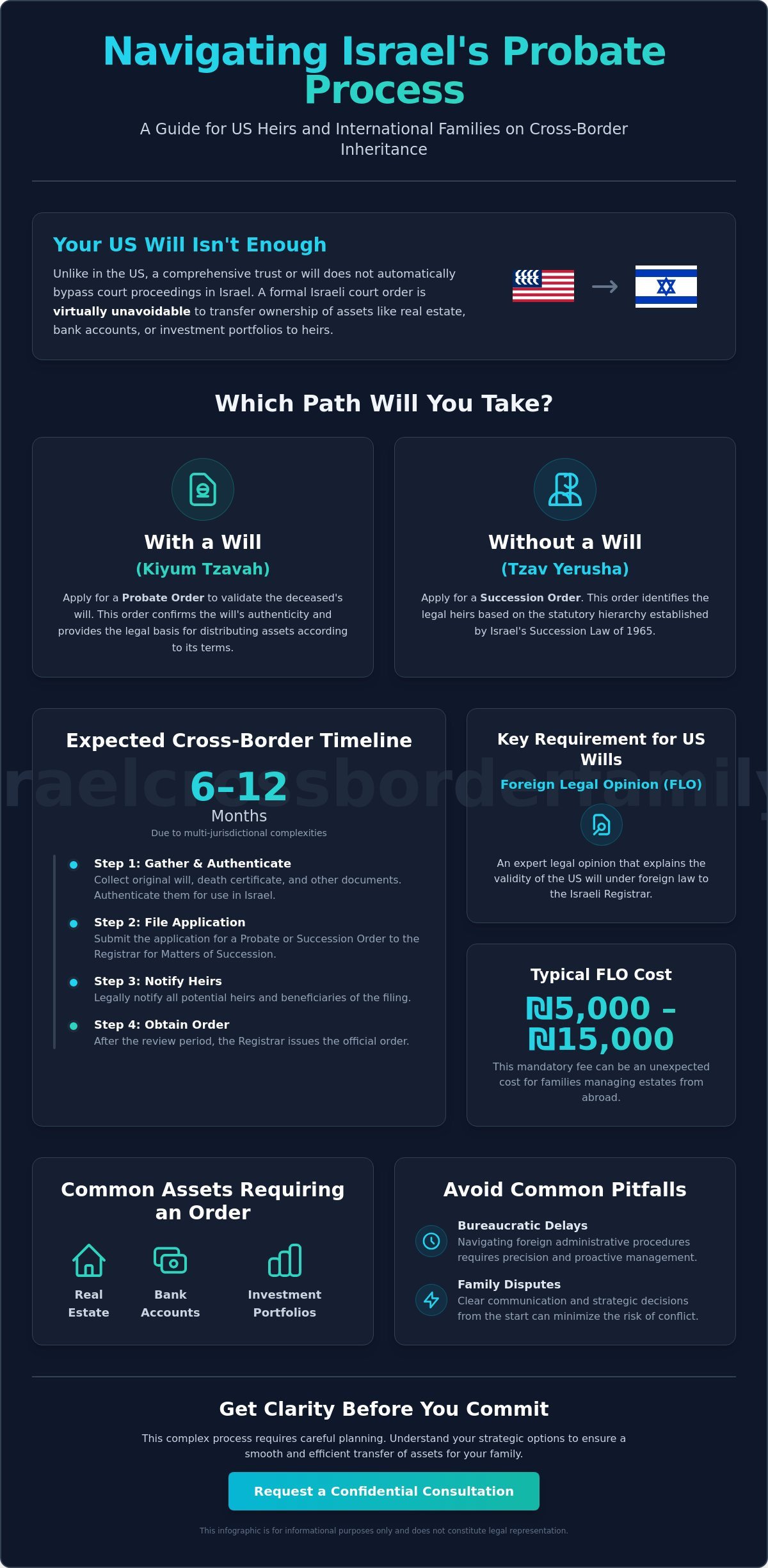
Strategic Decisions: Getting Clarity Before You Commit
The probate process in israel is often seen as a purely administrative task, but for international families, it is a strategic challenge. Most families feel pressured to sign a full representation agreement with a law firm immediately after a loss. However, jumping into a long-term legal commitment without a clear roadmap can lead to unexpected complications. It’s vital to distinguish between the search for assets and the actual legal probate. While a lawyer handles the court filings, the family must often lead the effort to identify bank accounts and property titles. Taking an advisory step first allows you to assess the risks before committing to a full litigation or distribution strategy.
Why Strategy Matters More Than Filings
A single misstep in the early stages of an application can lock an estate in the Family Court for years. For instance, choosing the wrong “domicile” in your initial petition might trigger complex tax issues or invite objections from distant relatives. A cross-border perspective is essential because it considers how Israeli probate orders will interact with your US tax filings and estate plans. You can learn more about the advisory approach, which focuses on identifying these high-level risks before any documents are filed with the Registrar. This method ensures that your decisions are based on a comprehensive understanding of both legal systems rather than just local procedural rules.
Next Steps for Heirs and Executors
If you are responsible for an estate with assets in IL, your immediate focus should be on document readiness and asset identification. Start by auditing your existing paperwork. Ensure you have the original will and that you can secure an Apostille for the death certificate from the correct US state. You should also compile a detailed list of all Israeli assets, including real estate holdings and dormant bank accounts that may not have been accessed for years.
Consulting with a professional who understands the specific “Anglo” expat experience can provide the reassurance you need during a difficult time. This helps you avoid the common mistake of assuming US legal concepts, like “rights of survivorship,” apply in the Israeli context. Get clarity before you commit. Request a confidential case review to evaluate your family’s specific situation and develop a risk-based strategy for the probate process in israel.
This article is published on an independent advisory platform and does not constitute legal representation or an attorney-client relationship. Legal services are only provided by licensed attorneys under a separate engagement.
Securing Your Family’s Legacy in Israel
Success in the probate process in israel requires more than just submitting paperwork; it demands a neutral, risk-based strategy that accounts for the specific challenges of the Anglo and expat community. You now understand that while a US will is often valid, the mandatory Foreign Legal Opinion and the logistical hurdles of the Apostille process define your timeline. By identifying Israeli assets early and anticipating the administrative backlogs of the Registrar, you can avoid the common procedural traps that lead to years of litigation. Our expertise in US-Israel cross-border family law is designed to bridge the gap between these two distinct legal cultures.
Focusing on strategy first allows you to make informed choices before you commit to long-term legal representation. This approach ensures you remain in control of the estate’s direction while protecting the interests of all beneficiaries. Get clarity before you commit. Request a confidential consultation to discuss your specific family situation. We are here to help you navigate this complex landscape with confidence and steady guidance.
This article is published on an independent advisory platform and does not constitute legal representation or an attorney-client relationship. Legal services are only provided by licensed attorneys under a separate engagement.
Frequently Asked Questions
Is a US will valid for assets located in Israel?
A US will is generally valid in IL if it complies with the legal standards of the state where it was signed. This principle, known as Lex Loci Celebrationis, ensures that Israeli authorities respect foreign testamentary documents. To be accepted by the Registrar, you must provide a Foreign Legal Opinion that confirms the will’s validity under the laws of that specific US jurisdiction.
How long does the probate process take in Israel for foreign residents?
The probate process in israel typically takes between four and six months for foreign residents, though complex cases can extend to 12 months. This is longer than the two to three month timeline for local estates. The extra time accounts for the authentication of foreign documents and the mandatory review by the Guardian General’s office.
What is a Foreign Legal Opinion (FLO) and why is it required?
A Foreign Legal Opinion is a formal expert report written by an attorney licensed in the deceased’s home state. It is required because the Israeli Registrar doesn’t have the authority to interpret foreign statutes independently. As of May 2026, the cost for this expert report generally ranges from ₪5,000 to ₪15,000 depending on the complexity of the state’s succession laws.
Does Israel have an inheritance tax for US beneficiaries?
Israel does not impose an inheritance or estate tax, as this tax was abolished in 1981. This applies to all beneficiaries regardless of their residency or citizenship. However, US beneficiaries should be aware of their domestic reporting obligations, such as filing IRS Form 3520 if they receive a foreign bequest that exceeds the current reporting threshold.
Can I complete the Israeli probate process remotely from the United States?
You can complete the probate process in israel entirely from abroad through the Registrar’s digital filing system. There is no requirement for heirs or executors to be physically present in the country to secure a Probate or Succession Order. Most families coordinate the process through a local representative who manages the digital portal and physical document submissions.
What happens if my loved one died in Israel without a will?
If someone dies without a will, their estate is distributed according to the statutory hierarchy defined in the Succession Law, 1965. In this scenario, the family must apply for a Succession Order (Yerusha) rather than a Probate Order. This legal document identifies the rightful heirs, such as a surviving spouse and children, based on the fixed percentages established by Israeli law.
Do I need an Israeli lawyer if I already have an executor in the US?
A US executor has no legal standing to manage assets like Israeli bank accounts or real estate without a local court order. While your US executor manages the American estate, you need a professional licensed in IL to navigate the Registrar’s specific requirements. This ensures that the local Probate Order is issued correctly so assets can be legally transferred to the beneficiaries.
What is an Apostille and how do I get one for my documents?
An Apostille is a specialized certificate issued by a government authority that authenticates a document for use in another country. For the Israeli probate process, you must obtain an Apostille for the US death certificate and sometimes the original will. You get this from the Secretary of State in the US jurisdiction where the document was originally issued or notarized.

Article by
Gabriel Lior
A Personal Journey That Became a Mission
The advisory was founded by an American father Gabriel Lior, LLB, MBA , global entrepreneur, and cross-border advisor who spent more than a decade navigating the Israeli family court system firsthand and now lives in Singapore with his son.
As a divorced parent in a cross-border family, Gabriel faced nearly every legal challenge a foreign parent can encounter in Israel — including child custody disputes, child support proceedings, property matters in Israel and abroad, false accusations, and complex immigration and relocation proceedings.
Over the years, he learned the hard way how difficult it is for non-Israeli parents to understand the system, identify the right legal strategy, and choose the right legal representation — especially when language, culture, and jurisdictional differences are involved. He also witnessed how foreign parents and new immigrants are often disadvantaged or taken advantage of by service providers and institutions simply because they lack local knowledge or fluency.
From Client to Advisor
To truly understand — and survive — the system, Gabriel pursued formal legal education in Israel, completing two Israeli law degrees, alongside a BA and MBA earned in the United States. This was never about becoming a practicing attorney, but about gaining a deep, structural understanding of how the system works — and where it breaks down for foreign parents.
This rare combination of:
Firsthand client experience
Israeli legal and US business education
International business and negotiation training
Decades of commercial execution
created a unique perspective – one that understands both sides of the table.
After years of litigation, persistence, and at times self-representation, he ultimately succeeded in securing custody of his son and relocating abroad through a rare legal victory in the Israeli Supreme Court — becoming one of the first fathers in Israel to do so under these circumstances.
Disclaimer
Important Disclaimer:
The information provided on this website and in its content is for general informational and educational purposes only and does not constitute legal advice, legal opinion, or legal representation.
Gabriel Lior is not licensed to practice law in Israel (nor is he interested in doing so) and does not provide legal services, despite having completed 2 Law Degrees. The services offered are advisory in nature and are intended to provide general guidance, strategic insight, and information regarding cross-border family law considerations.
No attorney-client relationship is formed by accessing this website, reading its content, or communicating with us.
Any decisions made based on this information are at your own discretion and risk. For legal advice specific to your situation, you should consult a licensed attorney in the relevant jurisdiction.
Where appropriate, we may refer clients to independent, licensed attorneys or professionals. Such referrals do not constitute legal representation and no liability is assumed for services provided by third parties.