
This article is published on an independent advisory platform and does not constitute legal representation or an attorney-client relationship. Legal services are only provided by licensed attorneys under a separate engagement.
The most logical legal move in your home country could be your biggest liability when dealing with the Israeli legal system. Many expats arriving in Israel assume that international law or foreign precedents will automatically shield their interests; however, the reality of the race for jurisdiction in Israel often catches families off guard. If you are searching for a family lawyer Jerusalem, you need more than just a translator. You need a strategist who understands how the dual court system of Rabbinical and Family Courts interacts with your international assets and obligations.
It’s natural to feel a sense of unease when your family’s future depends on a legal framework that feels culturally and linguistically foreign. You likely believe that your rights should remain consistent across borders, yet jurisdictional gaps can put your global property or parental rights at risk. This guide provides a clear, strategy-first roadmap designed specifically for the international community. We will explore how to navigate the complexities of cross-border divorce, estate planning, and asset protection. Get clarity before you commit. Request a confidential consultation.
Key Takeaways
- Understand the implications of Israel’s dual court system and how the “race for jurisdiction” between religious and civil courts impacts international divorce proceedings.
- Navigate the complexities of cross-border asset management and child custody, including the enforcement of foreign judgments and the Hague Convention in Jerusalem.
- Learn why partnering with a family lawyer Jerusalem who specializes in international cases is critical for developing a strategy before any legal filings are made.
- Discover how an advisory “team on the ground” provides a necessary bridge between the US and Israeli legal systems for expat families.
- Gain the clarity needed to make informed, risk-based decisions that protect your family’s future across multiple jurisdictions.
Navigating Family Law in Jerusalem: What International Families Need to Know
This article is published on an independent advisory platform, not a law firm, and does not imply an attorney-client relationship. All information provided is for educational purposes to help you understand the Israeli legal landscape. Legal services are only provided by licensed attorneys under a separate, formal engagement.
Jerusalem is more than just a historical center; it’s a complex legal hub where ancient tradition meets modern civil law. For the international community, a family lawyer Jerusalem acts as a vital bridge between these worlds. These professionals don’t just file paperwork; they translate the cultural and procedural nuances of the Israeli system for families who may be more familiar with the legal structures of the United States, Canada, or the United Kingdom. Because Jerusalem hosts a high concentration of foreign diplomats, NGO workers, and academic researchers, the local legal community is accustomed to handling “cross-border” cases that involve assets or citizenships spanning multiple continents.
To better understand how rights and visitation work within this jurisdiction, watch this helpful video:
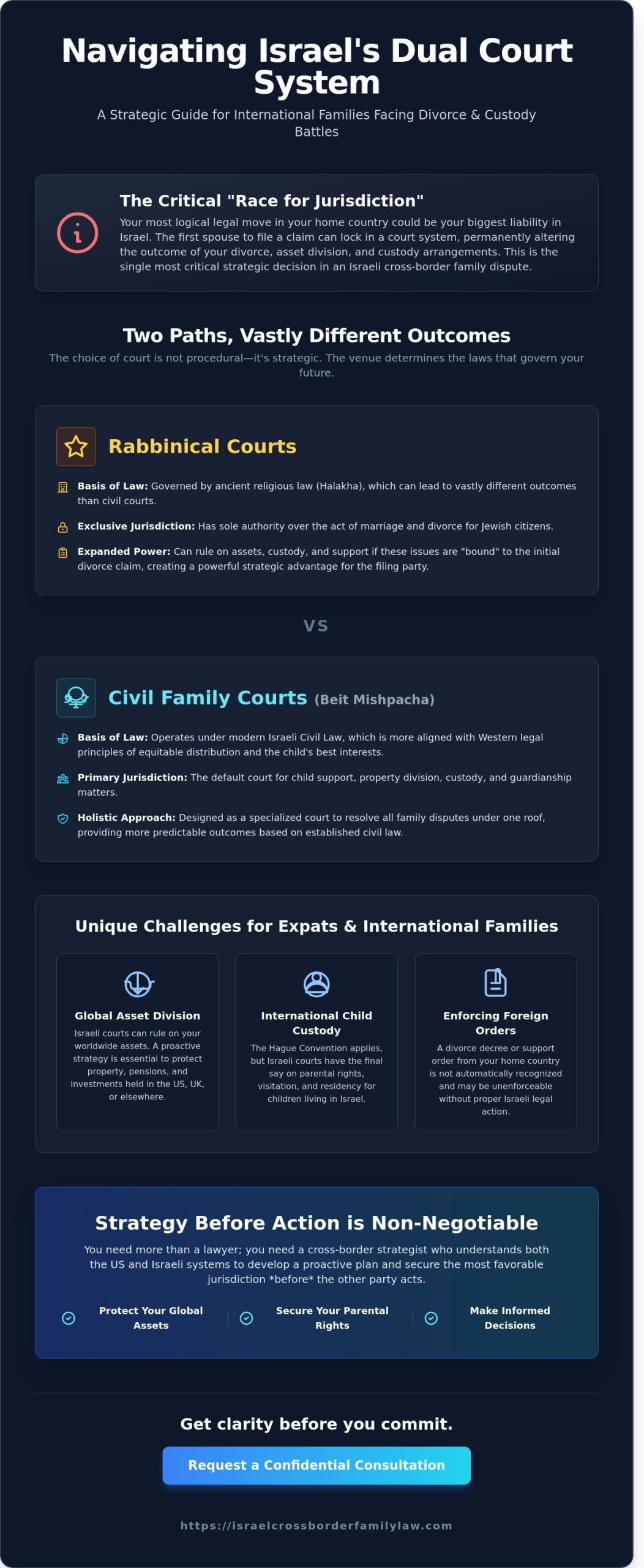
The city’s legal framework is defined by a dual-track system. You’ll likely interact with either the Jerusalem Family Court or the Jerusalem District Rabbinical Court. Understanding The Dual Court System: Rabbinical Courts vs. Civil Family Courts is essential because the choice of venue can significantly influence the strategy and outcome of a case. While the civil Family Court handles matters like child support and property division, religious courts often have exclusive jurisdiction over the act of marriage and divorce itself. This overlap creates a unique jurisdictional environment that requires a family lawyer Jerusalem with deep local expertise to navigate effectively.
The Unique Challenges for Expats in Jerusalem
Expats often find that the Jerusalem legal community operates with a different rhythm than what they expect from Western systems. Procedural rules are strict, but the culture within the courtroom can feel more informal yet intensely bureaucratic. This makes bilingual and bicultural representation essential for expats and foreign nationals. You shouldn’t assume that your home country’s laws will follow you. If you’re a resident of Israel, IL law typically applies to your family matters regardless of your original citizenship. Decisions made in the early stages of a case can have long-term impacts on your residency status and international mobility.
Plain English: Key Terms You Will Encounter
- Personal Status: This term refers to the legal category, often based on religious affiliation, that determines which laws govern your marriage, divorce, and inheritance in Israel.
- Ministry of Justice: This is the government body that oversees the legal system, including the appointment of judges and the regulation of the legal profession.
- Beit Mishpacha: This is the Hebrew term for the Family Court, a specialized civil court designed to resolve family disputes including custody, assets, and guardianship in a holistic manner.
Get clarity before you commit. Request a confidential consultation.
This article is published on an independent advisory platform and does not constitute an attorney-client relationship. Legal services are only provided by licensed attorneys under a separate engagement.
The Dual Court System: Rabbinical Courts vs. Civil Family Courts
Israel’s legal landscape for matrimonial matters is unique, characterized by a parallel authority between religious and civil institutions. When you begin the process of hiring a family lawyer Jerusalem based, understanding this structure is the first step toward a strategic resolution. The Israel’s dual court system grants jurisdiction over personal status issues, such as marriage and divorce, to religious courts. While Rabbinical courts handle the divorce itself, civil Family Courts maintain concurrent authority over related matters like property division and child custody.
This overlap creates a phenomenon known as the “Race for Jurisdiction,” or Mirotz Samchuyot. The court where a case is first filed generally gains the authority to hear the “attached” issues. If a spouse files for divorce in the Jerusalem Rabbinical Court and includes property division in the claim, that court may block the civil court from hearing the property dispute. This makes the timing of your initial filing a critical strategic component.
Many expats hold the misconception that Rabbinical courts are inherently disadvantageous for women or foreign nationals. The reality is more nuanced. While these courts operate under Halakhic law, they sometimes offer more streamlined procedures for specific religious requirements. They may also view certain types of assets or spousal behavior differently than a civil judge. An experienced family lawyer Jerusalem helps clients evaluate which venue aligns better with their specific financial and personal objectives.
How Jurisdiction is Established
Jurisdiction is often secured by the party who files a comprehensive claim first. This “first to file” rule locks in the venue for matters like spousal support and asset distribution. For international families with assets in both Israel and the United States, this creates significant complexity. You must determine if a Jerusalem court will respect a prenuptial agreement drafted in New York or California. Decisions made in the first 48 hours can dictate the legal trajectory for years. For a detailed breakdown of these steps, consult the divorce and separation guide.
Religious vs. Civil: A Comparison
- Property Division: Civil Family Courts follow the Spousal Resources Balancing Law, which generally dictates an equal split of assets acquired during the marriage. Rabbinical courts follow Halakhic principles, which may treat separate property or “ketubah” obligations with different weight.
- Child Custody: Both systems prioritize the “best interests of the child,” though their interpretations can vary based on the family’s religious lifestyle and domestic history.
- The Get: The religious divorce decree remains under the exclusive jurisdiction of the Rabbinical court. Even if financial issues are settled in a civil court, the final religious release must be granted by the Rabbinate.
Get clarity before you commit. Request a confidential consultation.
Cross-Border Legal Issues: Assets, Custody, and the Hague Convention
Managing a divorce when your life is split between Israel and the US creates layers of complexity that a standard domestic case lacks. When assets like a ₪4,000,000 home in Jerusalem sit alongside a 401(k) or brokerage account in New York, the legal strategy must be multi-jurisdictional. Jerusalem courts generally respect foreign judgments, but enforcement isn’t automatic. Under the 1958 Law on the Enforcement of Foreign Judgments, a family lawyer Jerusalem residents hire must prove the original court held proper jurisdiction and the ruling doesn’t contradict Israeli public policy.
International Child Custody and Relocation
Jerusalem judges evaluate the “best interests of the child” through a lens that accounts for the child’s cultural and social ties to both countries. Moving a child from Israel to the US without a formal court order or written consent can trigger the Hague Convention on the Civil Aspects of International Child Abduction. This 1980 treaty, which Israel ratified in 1991, aims to return children to their country of “habitual residence” for custody determinations. Relying on international custody and relocation services helps parents avoid the severe legal consequences of unilateral moves, which often result in court-ordered returns within weeks.
Enforcing Child Support Across Borders
US child support orders can be enforced in Jerusalem through the Israeli Central Authority. Israel is a signatory to international enforcement treaties, including the 2007 Hague Child Support Convention which it joined in 2018. This treaty provides the mechanism for cross-border child support enforcement, allowing parents to collect payments even when the obligor moves between countries. The process typically involves administrative cooperation between the Israeli Ministry of Justice and US state agencies to ensure ₪ payments are calculated and delivered accurately.
Protecting Assets and Inheritance
Estate planning for US-Israel families differs significantly from domestic Israeli law. Israel has no estate tax, while the US federal estate tax can reach 40% for high-value estates. When business interests or complex investments are involved, cross-border family law expertise prevents double taxation or the loss of corporate control. A family lawyer Jerusalem expats trust will coordinate with US tax professionals to protect these interests. For a deeper look at managing global wealth, refer to our video regarding international assets on our YouTube channel.
Get clarity before you commit. Request a confidential consultation.
This article is published on an independent advisory platform (not a law firm) and does not imply an attorney-client relationship. Legal services are only provided by licensed attorneys under a separate engagement.
Strategy Before Action: Selecting the Right Family Lawyer in Jerusalem
Selecting a family lawyer Jerusalem is a decision that requires a strategic pause. Many international families feel pressured to act quickly when a crisis hits. However, filing a petition without a clear understanding of the long-term consequences can lead to years of unnecessary litigation. You need a guide who prioritizes strategy before action. This means seeking clarity on how Israeli law interacts with your home country’s statutes before you sign a single retainer or submit a filing to the Jerusalem Family Court.
Assessing a professional requires looking beyond their local reputation. A lawyer might understand domestic Israeli law perfectly but lack experience with the tax implications of a US-based 401(k) or the enforcement of a British pension share. You need an advisor who views your case through a global lens. They must be comfortable with multi-jurisdictional complexities and have a team on the ground that understands the nuances of the “Start-up Nation” economy alongside international financial structures.
Decision-making should always be risk-based. Every legal move carries a cost in Israeli Shekels, time, and emotional capital. A sophisticated advisor helps you weigh the risk of a specific filing against the probable outcome. They don’t just tell you what’s possible; they explain what’s practical. Communication is the final pillar. It’s not just about literal translation. Your lawyer must speak your cultural language. If they don’t understand the specific expectations and values of an Anglo or expat family, critical nuances will be lost during negotiations.
Questions to Ask During a Consultation
- How many US-Israel cases have you handled specifically in the Jerusalem Family Court or the Rabbinical Court?
- How do you handle the “Race for Jurisdiction” to ensure the case stays in the most favorable venue for international clients?
- What is your pricing structure for complex multi-jurisdictional matters involving assets in multiple countries?
The Impact of Early Decisions
The first document you sign can dictate the next three years of your life. An impulsive filing can trigger a jurisdictional battle that exhausts your savings before the actual merits of the case are even discussed. You should avoid aggressive litigation that drains assets and harms family dynamics. In the Jerusalem context, mediation is often a superior path. It allows for a structured, private resolution that the public court system cannot always provide. Choosing a family lawyer Jerusalem who values mediation over reflexive litigation can preserve both your wealth and your children’s well-being.
Get clarity before you commit. Request a confidential consultation to discuss your specific cross-border situation.
This article is published on an independent advisory platform, not a law firm. The content provided is for informational and advisory purposes only and does not constitute legal advice or an attorney-client relationship. Legal representation is only provided by licensed attorneys through a separate, formal engagement.
How Israel Cross Border Family Law Provides Clarity
Jerusalem presents a unique legal environment where secular civil law and religious jurisdictions frequently overlap. For the Anglo community, this intersection can create significant confusion during divorce or custody proceedings. We act as a strategic bridge between the US and IL legal systems, offering the guidance necessary to manage these complexities. Our platform serves as an advisory hub, ensuring you understand the implications of every decision before you hire a family lawyer Jerusalem.
Our “Team on the Ground” approach ensures that we aren’t providing remote theories, but practical strategies based on the current realities of the Jerusalem District Court and the Jerusalem Rabbinical Court. We focus on bicultural and bilingual expertise. This is essential because legal terminology in Israel often carries cultural weight that a simple translation cannot capture. Our professionals understand both the Western expectations of the expat community and the procedural nuances required when working with a family lawyer Jerusalem.
Our Strategic Process
The path to resolution begins with a clear understanding of how it works from your initial inquiry through to the final decree. We believe that an independent advisory is the most effective way to maintain objectivity. By prioritizing strategy over immediate litigation, we help families avoid the high costs of reactive legal battles. In Jerusalem, where roughly 35% of the population adheres to Haredi or strictly religious lifestyles, understanding how cultural specifics influence the local courts is vital for a successful outcome.
Our commitment to the international community in Jerusalem is rooted in providing a seamless professional home. We help clients navigate the “Start-up Nation” legal pace while respecting the sensitivities of cross-border family dynamics. This strategic oversight allows for risk-based decision-making rather than emotional reactions.
Next Steps for Your Family
Your family deserves a professional home where legal matters are handled with sophistication and care. We encourage you to educate yourself on these multi-jurisdictional challenges by visiting our YouTube channel. Seeing the differences between the systems explained clearly can reduce the anxiety often associated with international family law.
Early decisions in cross-border cases often dictate the final outcome. Whether you’re dealing with property division or international relocation, starting with a confidential case review allows you to assess risks before they escalate. It’s about making an informed choice for your future in Israel or abroad.
Get clarity before you commit. Request a confidential consultation.
Strategic Planning for Your International Family
Navigating the intersection of Israeli law and international status requires more than just local knowledge. It demands a strategic approach that accounts for the unique jurisdictional race between Jerusalem’s Civil Family Courts and the Rabbinical courts. For families with ties to both Israel and the United States, decisions made in the initial stages often dictate the legal trajectory for years. Success in these complex cases depends on a deep understanding of the Hague Convention and the nuances of cross-border asset division. Professional guidance helps ensure your rights are protected across multiple jurisdictions simultaneously.
Partnering with a bicultural and bilingual family lawyer Jerusalem ensures your case isn’t lost in translation or cultural misunderstanding. Our platform provides specialized expertise for US-Israel disputes, offering a steady hand for the Jerusalem expat community. You don’t have to navigate these multi-jurisdictional challenges alone. Taking the time to understand the risks and rewards of each legal path is the most effective way to protect your financial interests and your children’s well-being. Making an informed choice now prevents costly legal complications later.
Get clarity before you commit. Request a confidential consultation.
This article is published on an independent advisory platform and is not a law firm. The information provided is for educational purposes only and does not constitute an attorney-client relationship. Legal services are only provided by licensed attorneys under a separate engagement.
Frequently Asked Questions
Do I need a separate lawyer for my US assets and my Israeli assets?
You don’t strictly need two separate legal teams, but your family lawyer in Jerusalem must possess a sophisticated understanding of cross-border property laws. Managing assets like a US-based 401(k) alongside Israeli real estate requires knowledge of the 1999 Israel-US Income Tax Treaty and local civil codes. A bilingual attorney can often coordinate the division of global assets more effectively than two disconnected firms working in different time zones.
Can I get divorced in the Jerusalem Family Court if I am not Jewish?
Yes, the Jerusalem Family Court has full jurisdiction over civil divorce for couples who are not Jewish or belong to different religious groups. Under the Matters of Dissolution of Marriage Law of 1969, the Family Court handles these cases to ensure a civil path to divorce exists outside the religious tribunal system. This provides a vital legal framework for expats and international families who don’t fall under the authority of the Rabbinical courts.
How long does a typical cross-border divorce take in Jerusalem?
A typical cross-border divorce in Jerusalem takes between 12 and 24 months to reach a final resolution if the parties don’t reach a settlement. Procedural requirements, such as international service of process under the Hague Convention and the valuation of foreign business interests, often lengthen the timeline. For more information on navigating these timelines, you can view guidance on the Israel Family Law YouTube channel.
Is a US prenuptial agreement valid in the Israeli court system?
A US prenuptial agreement isn’t automatically enforceable in Israel and must be reviewed under the Spouses (Property Relations) Law of 1973. The court will examine if the agreement was signed voluntarily and whether its terms align with Israeli public policy. To avoid future disputes, many international couples work with a family lawyer in Jerusalem to have their foreign agreements formally validated by an Israeli judge shortly after relocation.
What happens if my spouse files in the Rabbinical court before I file in the Family court?
If your spouse files first in the Rabbinical court, that tribunal may claim exclusive jurisdiction over property division and alimony through a process known as “jurisdiction grabbing.” This “race to the court” is a unique feature of the Israeli system where the first filing often determines which legal principles apply to the divorce. Because Rabbinical and Family courts use different standards, the timing of your initial filing is a critical strategic decision.
Can I relocate to the US with my children after a divorce in Jerusalem?
You cannot relocate to the US with your children without either written consent from the other parent or a relocation order from the court. Israeli courts apply the “best interests of the child” standard and frequently appoint social workers or psychologists to evaluate the potential impact of the move. Unauthorized relocation can trigger immediate return proceedings under the Hague Convention on the Civil Aspects of International Child Abduction, which Israel has enforced since 1991.
Are legal fees in Jerusalem higher for international cases?
Legal fees for international cases are generally higher than domestic matters because they require specialized knowledge of multi-jurisdictional statutes and international treaties. While the Israel Bar Association provides a scale for minimum fees, complex cases involve additional costs for certified translations, expert opinions on foreign law, and international communication. Professional firms typically structure these fees based on the complexity of the global estate and the level of conflict involved.
How does the Jerusalem Rabbinical court handle child support for non-citizens?
The Jerusalem Rabbinical court applies Jewish law to child support, which traditionally required the father to bear the primary financial burden. However, following a landmark 2017 Supreme Court ruling (HCJ 919/15), child support for children over age six is now calculated based on the relative income of both parents and the time the child spends with each. This shift applies to citizens and non-citizens alike, creating a more equitable financial landscape for international families.
Get clarity before you commit. Request a confidential consultation.

Article by
Gabriel Lior
A Personal Journey That Became a Mission
The advisory was founded by an American father Gabriel Lior, LLB, MBA , global entrepreneur, and cross-border advisor who spent more than a decade navigating the Israeli family court system firsthand and now lives in Singapore with his son.
As a divorced parent in a cross-border family, Gabriel faced nearly every legal challenge a foreign parent can encounter in Israel — including child custody disputes, child support proceedings, property matters in Israel and abroad, false accusations, and complex immigration and relocation proceedings.
Over the years, he learned the hard way how difficult it is for non-Israeli parents to understand the system, identify the right legal strategy, and choose the right legal representation — especially when language, culture, and jurisdictional differences are involved. He also witnessed how foreign parents and new immigrants are often disadvantaged or taken advantage of by service providers and institutions simply because they lack local knowledge or fluency.
From Client to Advisor
To truly understand — and survive — the system, Gabriel pursued formal legal education in Israel, completing two Israeli law degrees, alongside a BA and MBA earned in the United States. This was never about becoming a practicing attorney, but about gaining a deep, structural understanding of how the system works — and where it breaks down for foreign parents.
This rare combination of:
Firsthand client experience
Israeli legal and US business education
International business and negotiation training
Decades of commercial execution
created a unique perspective – one that understands both sides of the table.
After years of litigation, persistence, and at times self-representation, he ultimately succeeded in securing custody of his son and relocating abroad through a rare legal victory in the Israeli Supreme Court — becoming one of the first fathers in Israel to do so under these circumstances.
Disclaimer
Important Disclaimer:
The information provided on this website and in its content is for general informational and educational purposes only and does not constitute legal advice, legal opinion, or legal representation.
Gabriel Lior is not licensed to practice law in Israel (nor is he interested in doing so) and does not provide legal services, despite having completed 2 Law Degrees. The services offered are advisory in nature and are intended to provide general guidance, strategic insight, and information regarding cross-border family law considerations.
No attorney-client relationship is formed by accessing this website, reading its content, or communicating with us.
Any decisions made based on this information are at your own discretion and risk. For legal advice specific to your situation, you should consult a licensed attorney in the relevant jurisdiction.
Where appropriate, we may refer clients to independent, licensed attorneys or professionals. Such referrals do not constitute legal representation and no liability is assumed for services provided by third parties.
Related Insights & Resources

Defining Your Goals for the Legal Process in Israel
This article is published on an independent advisory platform and does not constitute an attorney-client...Read More →
Relocation Success Stories: Navigating Child Custody Moves
Relocation success is not measured by the move itself, but by the legal stability and...Read More →
Cross-Border Prenuptial Agreements in Israel: A Strategic Guide for International Couples
This article is published on an independent advisory platform and does not constitute legal representation...Read More →