This article is published on an independent advisory platform and does not constitute legal representation or an attorney-client relationship. Legal services are only provided by licensed attorneys under a separate engagement.
Registering your marriage in Israel is not just a bureaucratic formality; it is a strategic legal decision that binds your family to two distinct legal systems simultaneously. For many, the process of marriage registration in israel for americans feels like a walk through a legal minefield, where a single document error can lead to years of jurisdictional confusion. You likely feel overwhelmed by the prospect of facing Misrad HaPnim or worried about how an Israeli religious court might one day impact your rights in the United States. These concerns are valid, as the choice you make today determines which laws govern your assets and personal status for decades to come.
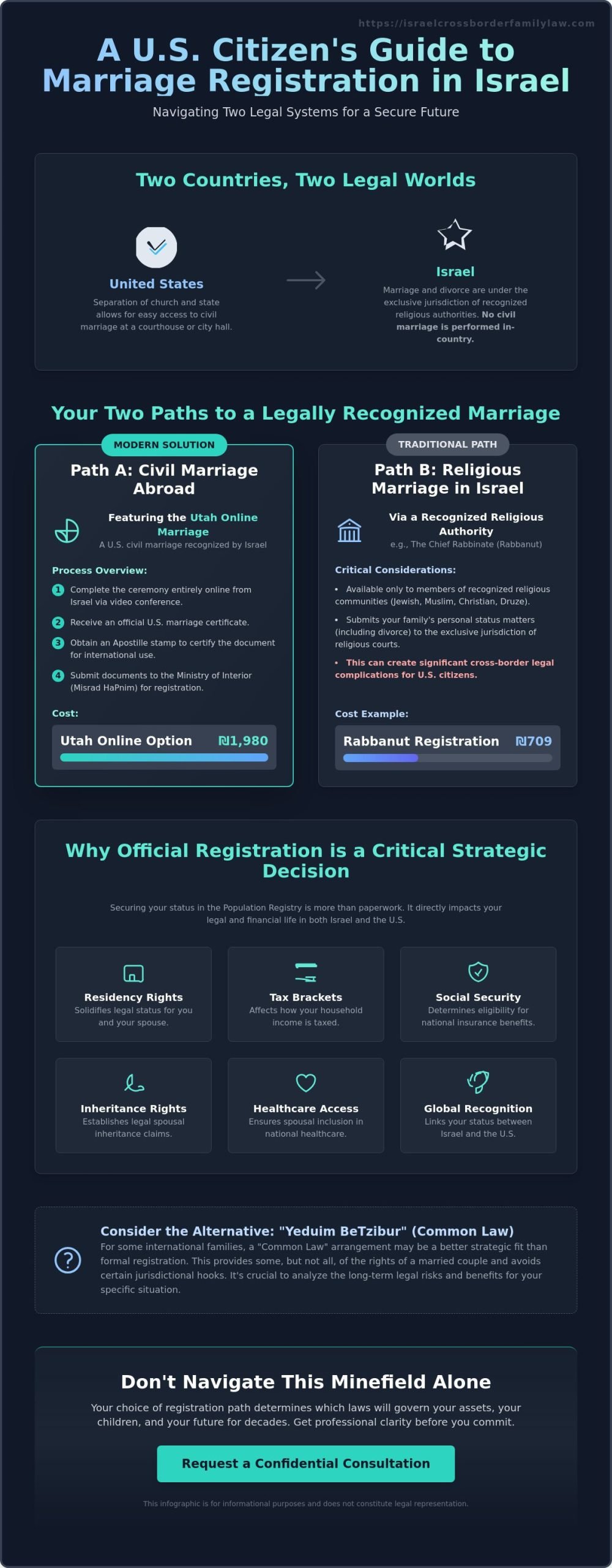
We understand that you want to secure your family’s future without sacrificing the legal protections you enjoy as a U.S. citizen. This guide provides a clear roadmap to help you achieve a legally recognized status in Israel while protecting your interests abroad. You will learn about the ₪1,980 Utah online marriage alternative, the ₪709 Rabbanut registration process, and how to ensure your documentation satisfies both Israeli and American authorities. Get clarity before you commit. Request a confidential consultation.
Key Takeaways
- Distinguish between the Israeli religious court system and civil registration to prevent your marital status from creating unforeseen jurisdictional complications.
- Learn the specific steps for marriage registration in israel for americans, including the increasingly popular Utah online marriage route and other civil options.
- Master the documentation requirements for the Ministry of Interior to ensure your foreign marriage certificate is accepted without bureaucratic delays or repeated appointments.
- Analyze the long-term legal risks of registration and how it influences which court system governs your family’s future financial or personal disputes.
- Determine if formal registration or a “Common Law” (Yeduim BeTzibur) arrangement is the better strategic fit for your family’s international legal needs.
This article is published on an independent advisory platform and does not constitute legal representation or an attorney-client relationship. Legal services are only provided by licensed attorneys under a separate engagement.
Understanding the Israeli Marriage Framework for American Citizens
American citizens arriving in Israel often expect a separation of church and state that simply doesn’t exist here. In the United States, couples can visit a courthouse or a city hall for a secular wedding. In Israel, the Israeli Marriage Framework dictates that all domestic ceremonies are governed by recognized religious authorities. Understanding the nuances of marriage registration in israel for americans is the first step toward legal security. There is no state-sanctioned civil marriage performed within the country’s borders. This creates a vital distinction between the “ceremony” and the “registration.” While a ceremony might be a religious event or a civil act performed abroad, the registration is a secular administrative step handled by the Ministry of Interior (Misrad HaPnim).
To better understand how these systems interact, particularly regarding digital alternatives, watch this helpful video:
The Role of Religious Courts in International Marriages
Israel’s system is rooted in the “millet” structure, where your “personal status” is determined by your religious confession. Under the Rabbinical Courts Jurisdiction Law of 1953, the Rabbinical courts hold exclusive jurisdiction over the marriages and divorces of Jewish residents. Similar rules apply to Muslims, Christians, and Druze through their respective religious tribunals. This confession-based system is why Americans often face surprises; if you don’t fit into a recognized religious category or wish to marry outside of one, you cannot marry within Israel. This legal reality drove 3,247 couples in Tel Aviv alone to register their status in 2025, many of whom utilized civil ceremonies performed outside the country to bypass religious restrictions.
Why Registration Matters for Cross-Border Families
Securing your status in the Population Registry is more than just a paperwork exercise. It directly impacts your residency rights, tax brackets, and eligibility for social security benefits within Israel. For those seeking legal guidance for expats and foreign nationals, registration ensures that your marital status is recognized by both the Israeli government and the U.S. State Department. While Israeli law technically requires citizens and residents to report changes in personal status within 30 days, many international families delay this step, unaware that it affects inheritance rights and healthcare access. Proper marriage registration in israel for americans provides a clear legal link between your life in the “start-up nation” and your legal standing in the United States. Get clarity before you commit. Request a confidential consultation.
This article is published on an independent advisory platform and does not constitute legal representation or an attorney-client relationship. Legal services are only provided by licensed attorneys under a separate engagement.
Civil Marriage Abroad and the Utah Online Option
While the state of Israel does not perform domestic civil ceremonies, it maintains a long standing legal obligation to recognize valid civil marriages conducted outside its borders. This recognition is a cornerstone of personal status law, allowing couples to secure their rights without adhering to religious requirements. The landscape for marriage registration in israel for americans shifted dramatically following the Israeli Supreme Court ruling on March 7, 2023. This decision compelled the Ministry of Interior to register marriages conducted through online platforms, specifically those under the jurisdiction of Utah County, Utah. This “Utah Revolution” has provided a sophisticated, cost-effective alternative for international families who wish to avoid the complexities of the religious court system.
Many American expats choose this route because it allows them to marry under a legal system they understand while remaining physically present in Israel. It bridges the gap between their U.S. citizenship and their life in the “start-up nation.” By choosing a civil path, couples often feel they are maintaining greater control over their legal destiny, particularly regarding how their union will be viewed by both Israeli and American authorities. Before making a final decision on which jurisdiction should govern your union, you may want to review how strategic planning impacts your long-term costs.
The Mechanics of the Utah Marriage for Americans
The Utah online marriage process is remarkably efficient for those familiar with U.S. administrative procedures. The ceremony is conducted via video conference with a certified officiant in Utah, making it a legally valid U.S. marriage. For the marriage to be recognized in Israel, the couple must obtain a marriage certificate with an Apostille stamp from the State of Utah. This stamp is the essential evidentiary link that proves the document’s authenticity to Israeli officials. For a visual guide on these requirements, the Israel Family Law YouTube channel offers detailed breakdowns of the documentation flow. Agency services for this process typically cost around ₪1,980, which is often significantly less than the travel expenses required for a traditional foreign wedding.
Traditional Foreign Civil Marriages (Cyprus, USA, etc.)
For couples who prefer a physical ceremony, traditional options like Cyprus or returning to the United States remain popular. Cyprus is a frequent choice due to its proximity, but Americans often find it simpler to marry during a visit home to the U.S. Regardless of the location, the primary challenge remains the same: ensuring the foreign document meets Israeli evidentiary standards. A marriage certificate must be the original version, and if it is not in English or Hebrew, it requires a notarized translation. Failing to register a foreign wedding promptly can lead to complications in residency status or tax benefits. If you are unsure how your foreign ceremony affects your status, you can request a confidential case review to gain clarity on your specific situation.
This article is published on an independent advisory platform and does not constitute legal representation or an attorney-client relationship. Legal services are only provided by licensed attorneys under a separate engagement.
The Registration Process at the Ministry of Interior
Once you’ve obtained your marriage certificate, the administrative phase of your journey begins. Successfully completing the marriage registration in israel for americans requires a meticulous approach to documentation to satisfy the Population and Immigration Authority. This process isn’t just about handing over a paper; it’s the formal update of your legal identity in the state’s registry. While the service itself is free of charge, the preparation involved is significant. You must first schedule an appointment through the official government portal or the MyVisit application. Showing up without a confirmed slot often results in being turned away by security.
The second step involves the Apostille stamp. For an American marriage certificate to be recognized, it must bear this specific state-level certification. An Apostille from the Secretary of State where you married proves to Israeli officials that your document is authentic. You’ll also need to prove you were single before the wedding. Since the United States doesn’t have a national “single status” database, Americans usually sign a legal affidavit at the U.S. Embassy or before a local Israeli notary. Finally, while Misrad HaPnim frequently accepts English documents, some clerks may require a notarized Hebrew translation for more complex certificates or supporting affidavits. Once approved, you’ll receive an updated “Sefah” (the paper slip inside your ID) reflecting your new marital status.
Document Checklist for American Citizens
Your document package must be complete before you arrive at the office. You’ll need your valid U.S. passport and proof of your current Israeli visa status, whether you’re here on an A/2 student visa or a B/1 work permit. It’s critical to bring the original official marriage certificate, not the decorative souvenir license often given at the end of a ceremony. If your documents originate from a state that requires additional authentication, you may need a consular certification. Having a “team on the ground” to review these files can prevent the frustration of multiple return trips to the government office.
Common Bureaucratic Pitfalls and How to Avoid Them
Discrepancies in name spelling are the most common cause for registration rejection. If your U.S. passport uses a middle name that doesn’t appear on your Israeli records, the clerk may demand additional proof of identity. You should also be aware of the 30-day reporting rule. Israeli law requires residents to report changes in personal status within one month, and while fines for delays are rare for expats, long gaps can complicate future residency renewals. To ensure your paperwork is flawless, you can check our pricing page for professional document review services. Get clarity before you commit. Request a confidential consultation.
This article is published on an independent advisory platform and does not constitute legal representation or an attorney-client relationship. Legal services are only provided by licensed attorneys under a separate engagement.
Cross-Border Legal Implications: Beyond the Wedding
Completing the process of marriage registration in israel for americans is a significant administrative milestone, but it also functions as a jurisdictional trigger. Many couples view registration as a simple update to their population status, yet in the eyes of the Israeli legal system, it formalizes the state’s authority over your family life. Once registered, your marriage is no longer just a private contract governed by U.S. state law; it becomes subject to the dual-track system of Israeli Family Courts and Religious Courts. This transition can have profound consequences if the relationship ever faces a dispute, as the legal framework in Israel differs fundamentally from the American “no-fault” or equitable distribution models.
One of the most critical concepts for international couples to understand is the “Race to Court.” In Israel, the court that first receives a filing for divorce or property division typically gains the authority to decide the case. For a U.S. citizen, this means that even if you have significant assets in New York or California, an Israeli court could potentially issue rulings affecting your global estate if you are a registered resident. This makes early strategic planning and the use of cross-border prenuptial agreements essential. These documents ensure that your original intentions regarding asset division and forum selection are respected by both legal systems. To protect your future interests, you should schedule a strategy session to align your international legal protections.
Jurisdictional Risks for International Couples
When you register your marriage, you inadvertently grant the Israeli Rabbinical Court potential authority over your personal status. Even if you married in a civil ceremony in Utah or Cyprus, the Rabbinical court holds exclusive jurisdiction over the divorce of Jewish residents in Israel. This can lead to complex situations where a U.S. citizen is required to navigate religious laws that do not exist in the American system. Clarifying your forum selection in writing before a crisis occurs is the only way to mitigate these risks. For more detailed information on how these systems interact during a split, read our guide on divorce and separation for international families.
Estate Planning and the Registered Marriage
Marriage registration in israel for americans also fundamentally alters your estate profile. Under Israeli law, a registered spouse has specific inheritance rights that might conflict with a will drafted solely under U.S. law. If you own property in Israel, such as a residence or business interests, you must adopt a “dual-jurisdiction” approach to your estate planning. This is particularly relevant for those involved in the tech sector or cross-border commerce, where marriage can impact corporate holdings. If your union involves significant business assets, you may find our guide on navigating US-Israel M&A helpful for understanding how personal status affects commercial ventures. Get clarity before you commit. Request a confidential consultation.
This article is published on an independent advisory platform and does not constitute legal representation or an attorney-client relationship. Legal services are only provided by licensed attorneys under a separate engagement.
Strategic Planning for International Families in Israel
For many international families, the instinct is to complete the marriage registration in israel for americans as quickly as possible to resolve residency or tax issues. However, treating this process as a mere administrative hurdle ignores the long-term legal consequences. Strategic planning requires you to look beyond the immediate update to your ID slip and consider how your status affects your global legal footprint. Every decision made at the start of your life in Israel carries a jurisdictional weight that can last for decades. You should view registration not as an inevitability, but as a calculated choice within a broader family strategy.
In Israel, couples who live together but choose not to register their marriage may be recognized as “Common Law” spouses, known as Yeduim BeTzibur. This status provides many of the same social benefits as a registered marriage, including residency rights and social security, without necessarily triggering the full jurisdiction of the religious courts in the same way a formal registration does. For some American expats, maintaining this status remains a viable strategic alternative. It allows them to enjoy life in the “start-up nation” while keeping their legal affairs primarily under the familiar framework of U.S. law. Choosing the right path requires a deep understanding of the Israeli marketplace and the specific needs of your family.
Strategy vs. Bureaucracy
Filling out forms at the Population and Immigration Authority should be the final act of a well-considered plan, not the first step. You must identify potential conflicts between U.S. state laws and Israeli statutes before you submit your certificate. A proactive approach allows you to address issues like forum selection and asset protection before they become a source of litigation. Early decisions have the greatest impact on long-term protection, especially when navigating the inherent complexity of cross-border situations. If you are unsure how these systems overlap in your specific case, you should request a confidential case review to assess your risks.
Final Advisory Checklist
Before you approach any government office for marriage registration in israel for americans, ensure you have addressed the following strategic points:
- Verify that all U.S. documents, including marriage certificates and single-status affidavits, carry a valid Apostille from the correct Secretary of State.
- Evaluate the ₪1,980 Utah online option if you require a legally valid U.S. marriage certificate without the need for international travel.
- Consult with a professional regarding the impact of Israeli registration on your U.S. tax status and future estate planning.
- Ensure that any cross-border prenuptial agreements are properly mirrored in both jurisdictions to prevent the “race to court” scenario.
Get clarity before you commit. Request a confidential consultation.
Securing Your Family’s Legal Future in Israel
Navigating the transition from a wedding ceremony to a legally recognized status requires more than just administrative persistence. It demands a strategic understanding of how marriage registration in israel for americans impacts your global assets and personal rights. By now, you recognize that the choice between a religious ceremony or a civil alternative like the Utah online process dictates which court system governs your future. You also understand that meticulous documentation, including Apostilles and verified affidavits, is the only way to satisfy the Ministry of Interior’s rigorous standards without facing unnecessary bureaucratic delays.
Success in this multi-jurisdictional landscape depends on identifying potential conflicts before they arise. Our advisory platform provides an authoritative perspective for international families, drawing on a deep understanding of both legal systems to guide you through these complexities. We help you move beyond simple bureaucracy toward a strategy that safeguards your rights in both Israel and the United States. Get clarity before you commit. Request a confidential consultation to align your personal status with your long-term legal and financial goals. You can build a secure future in Israel with the right preparation.
This article is published on an independent advisory platform and does not constitute legal representation or an attorney-client relationship. Legal services are only provided by licensed attorneys under a separate engagement.
Frequently Asked Questions
Is a US marriage legally recognized in Israel?
Yes, the state of Israel legally recognizes civil marriages performed in the United States, provided they were validly conducted under the laws of the specific state. This recognition is based on long-standing Supreme Court precedents that require the Ministry of Interior to register foreign civil certificates. Couples must present an original certificate with an Apostille to ensure the administrative update is processed without dispute in the Population Registry.
Can Americans get married in a civil ceremony inside Israel?
No, there’s no domestic civil marriage framework within the state of Israel as of 2026. All marriages performed inside the country fall under the exclusive jurisdiction of recognized religious authorities, such as the Rabbinate for Jewish couples. Americans who prefer a secular union must marry outside the country or utilize an online civil platform before pursuing marriage registration in israel for americans to secure their legal status.
What is a “Utah marriage” and is it valid for Americans in Israel?
A “Utah marriage” is a civil ceremony conducted via video conference by an officiant in Utah County, Utah. It’s fully valid for Americans in Israel following a landmark Supreme Court ruling on March 7, 2023. This ruling compelled the Ministry of Interior to register these online ceremonies as valid foreign marriages. It’s a popular choice because it costs approximately ₪1,980 and avoids the high expenses of international travel.
How long do I have to register my marriage after moving to Israel?
You’re legally required to report any change in your personal status to the Population and Immigration Authority within 30 days of the change or your arrival in Israel. While the Ministry of Interior rarely imposes immediate fines on expats for minor delays, failing to register can complicate residency renewals and social security eligibility. Prompt registration ensures your legal identity remains consistent across both the U.S. and Israeli systems.
Do I need an Apostille for my US marriage certificate to be valid in IL?
Yes, an Apostille is an absolute requirement for the Israeli Ministry of Interior to accept a U.S. marriage certificate. This certification, issued by the Secretary of State in the state where you married, verifies the signature of the local official on your document. Without this specific authentication, Israeli clerks won’t recognize the certificate as a valid legal instrument for updating your marital status or processing marriage registration in israel for americans.
Does registering my marriage in Israel affect my US citizenship or taxes?
Registering your marriage in Israel doesn’t affect your U.S. citizenship, but it can influence your international tax profile. The IRS requires U.S. citizens to report global income and may require specific filing statuses like Married Filing Separately. You should consult with a cross-border tax specialist to understand how your Israeli registered status interacts with Foreign Earned Income Exclusions and the bilateral tax treaties that exist between both nations.
What happens if we choose not to register our marriage in the Ministry of Interior?
If you don’t register, the state of Israel will continue to view your status as Single in the official Population Registry. This can lead to significant complications regarding spousal visa applications, joint tax benefits, and inheritance rights under Israeli law. While you might maintain the status of Common Law partners, known as Yeduim BeTzibur, you lose the administrative clarity that formal registration provides for international families living in Israel.
Can I register my marriage if my spouse is not Jewish?
Yes, you can register a marriage between a Jewish and non-Jewish spouse if the ceremony was performed civilly outside of Israel. Because the domestic religious courts don’t perform interfaith ceremonies, many couples marry in the U.S. or via Utah and then register the union at Misrad HaPnim. The Ministry is obligated to register any valid foreign marriage regardless of the religious background of the spouses involved in the union.

Article by
Gabriel Lior
A Personal Journey That Became a Mission
The advisory was founded by an American father Gabriel Lior, LLB, MBA , global entrepreneur, and cross-border advisor who spent more than a decade navigating the Israeli family court system firsthand and now lives in Singapore with his son.
As a divorced parent in a cross-border family, Gabriel faced nearly every legal challenge a foreign parent can encounter in Israel — including child custody disputes, child support proceedings, property matters in Israel and abroad, false accusations, and complex immigration and relocation proceedings.
Over the years, he learned the hard way how difficult it is for non-Israeli parents to understand the system, identify the right legal strategy, and choose the right legal representation — especially when language, culture, and jurisdictional differences are involved. He also witnessed how foreign parents and new immigrants are often disadvantaged or taken advantage of by service providers and institutions simply because they lack local knowledge or fluency.
From Client to Advisor
To truly understand — and survive — the system, Gabriel pursued formal legal education in Israel, completing two Israeli law degrees, alongside a BA and MBA earned in the United States. This was never about becoming a practicing attorney, but about gaining a deep, structural understanding of how the system works — and where it breaks down for foreign parents.
This rare combination of:
Firsthand client experience
Israeli legal and US business education
International business and negotiation training
Decades of commercial execution
created a unique perspective – one that understands both sides of the table.
After years of litigation, persistence, and at times self-representation, he ultimately succeeded in securing custody of his son and relocating abroad through a rare legal victory in the Israeli Supreme Court — becoming one of the first fathers in Israel to do so under these circumstances.
Disclaimer
Important Disclaimer:
The information provided on this website and in its content is for general informational and educational purposes only and does not constitute legal advice, legal opinion, or legal representation.
Gabriel Lior is not licensed to practice law in Israel (nor is he interested in doing so) and does not provide legal services, despite having completed 2 Law Degrees. The services offered are advisory in nature and are intended to provide general guidance, strategic insight, and information regarding cross-border family law considerations.
No attorney-client relationship is formed by accessing this website, reading its content, or communicating with us.
Any decisions made based on this information are at your own discretion and risk. For legal advice specific to your situation, you should consult a licensed attorney in the relevant jurisdiction.
Where appropriate, we may refer clients to independent, licensed attorneys or professionals. Such referrals do not constitute legal representation and no liability is assumed for services provided by third parties.