This article is published on an independent advisory platform and does not constitute legal representation or an attorney-client relationship. Legal services are only provided by licensed attorneys under a separate engagement.
What if the perceived bias in Israel’s dual court system isn’t an insurmountable barrier, but a variable you can manage through strategic timing? Many expats and international families feel overwhelmed by the “race for jurisdiction” between civil Family Courts and Rabbinical Courts. You might worry that getting a fair outcome in a biased system is impossible due to language barriers or unfamiliar religious frameworks. It’s a common concern, especially when the legal landscape feels opaque and unpredictable.
You can achieve clarity and protect your interests by understanding how early procedural moves dictate the long-term trajectory of your case. This guide will show you how to protect your assets and parental rights using a risk-based strategy. We will examine the jurisdictional rules updated on November 18, 2025, the impact of the March 24, 2026 religious arbitration law, and how to choose the forum that best serves your family’s needs. For more visual guidance, visit https://www.youtube.com/@IsraelFamilyLaw. Get clarity before you commit. Request a confidential consultation.
Key Takeaways
- Distinguish between inherent systemic bias and the challenges of navigating an unfamiliar legal culture as an international citizen.
- Learn how the ‘race for jurisdiction’ between civil and religious courts influences your strategy for getting a fair outcome in a biased system.
- Identify the five critical steps for expats to take within the first 48 hours to protect their interests and avoid jurisdictional traps.
- Understand the complexities of enforcing foreign orders in IL and why early procedural moves are more effective than reactive litigation.
This article is published on an independent advisory platform and does not constitute legal representation or an attorney-client relationship. Legal services are only provided by licensed attorneys under a separate engagement.
Understanding ‘Bias’ in the Israeli Legal System: Perception vs. Reality
Systemic bias in family law isn’t always about intentional prejudice. For international citizens, it often manifests as a profound disconnect between Western legal expectations and the unique structures found in IL. When you enter a system where religious and civil laws intertwine, the feeling of being an outsider is immediate. Many expats believe that getting a fair outcome in a biased system is a lost cause. However, this perception often stems from a lack of strategic insight into how the system actually functions. You aren’t necessarily fighting against the law itself, but rather against a framework designed for a different cultural context.
Distinguishing between inherent bias and procedural unfamiliarity is crucial for your success. Inherent bias might relate to how specific courts prioritize certain values, such as the Rabbinical court’s focus on religious tradition. Procedural unfamiliarity is simply not knowing the “rules of the game.” For expats and foreign nationals, these two forces often blend together. This makes the legal process feel rigged from the start. Identifying which issues are systemic and which are merely procedural allows you to build a more effective defense.
To better understand the invisible forces that can shape legal proceedings and the concept of implicit bias, watch this helpful video:
The Dual Court System: A Source of Confusion
The Judiciary of Israel operates a dual-court system that is unique among modern democracies. Civil Family Courts and Religious Courts share concurrent jurisdiction over many family matters. This creates a “race for jurisdiction” where the first person to file can choose the forum. The March 24, 2026 law expanded the authority of Rabbinical courts to arbitrate civil disputes with mutual consent. This makes the choice of court more critical than ever. One spouse might find the Family Court more equitable. The other may see the Rabbinical Court as their best chance at a favorable result. This structural competition naturally leads to a perception of bias depending on which side of the filing you are on.
Cultural and Linguistic Barriers
For English speakers, the “Anglo” experience in IL courts is often defined by a sense of isolation. Proceedings are conducted in Hebrew. While translators are provided, the nuance of your testimony can be lost in the process. Cultural differences also play a significant role. A judge or Dayan might misinterpret a Western parenting style or a specific financial arrangement because it doesn’t align with local norms. Getting a fair outcome in a biased system requires more than just a lawyer. It requires a strategy that bridges these linguistic and cultural gaps. You must ensure that your narrative is not just translated, but correctly contextualized for the court to understand your perspective.
This article is published on an independent advisory platform and does not constitute legal representation or an attorney-client relationship. Legal services are only provided by licensed attorneys under a separate engagement.
The Race for Jurisdiction: Strategic Choice of Forum
In IL, the “Race for Jurisdiction” isn’t just a legal concept; it’s the single most influential factor in your case. The spouse who files first determines which court will handle ancillary matters like property division and child custody. This decision often dictates whether you are getting a fair outcome in a biased system. If you wait for your spouse to act, you may find yourself forced into a forum that doesn’t align with your legal expectations or cultural values. Being proactive is the only way to ensure the venue matches your strategic needs.
Strategic choice of forum allows you to mitigate the risks of systemic bias. For example, if you have significant assets abroad, the Civil Family Court may offer protections that the Rabbinical Court does not. Conversely, if you are seeking a specific religious resolution, the Beit Din might be the necessary path. Understanding Recent Trends in Marriage and Divorce helps clarify why these systems remain so distinct and competitive in the modern era. Identifying the right forum early on is essential for protecting your long-term interests.
When to Choose the Civil Family Court
The Civil Family Court generally aligns more closely with Western legal principles. It’s the preferred forum for many international families because it prioritizes civil statutes over religious doctrine. This court is particularly effective at handling complex financial structures and assets located outside of IL. If your primary goal is a predictable application of law regarding property and child support, this is often the strategic choice. Filing here first ensures that civil law remains the governing framework for your financial future.
Navigating the Rabbinical Court (Beit Din)
The Rabbinical Court holds exclusive authority over the “Get,” the religious divorce decree. However, its jurisdiction has expanded through recent legislation. A temporary provision approved on November 18, 2025, clarified that the Rabbinical court can hear child support matters when they’re bound to a divorce suit. Additionally, the law passed on March 24, 2026, allows these courts to arbitrate civil disputes if both parties agree. This creates a parallel legal system grounded in religious law that can significantly impact asset division.
Many expats fear the Beit Din is inherently biased against women or foreigners. While the system is traditional, it isn’t always disadvantageous. In some cases, the Rabbinical Court can move faster or provide unique leverage during negotiations. However, entering this system without a clear strategy is risky. It’s vital to get professional guidance before making any filing. Strategic forum choice is the first step toward getting a fair outcome in a biased system by placing the case in a venue that recognizes your specific rights.
This article is published on an independent advisory platform and does not constitute legal representation or an attorney-client relationship. Legal services are only provided by licensed attorneys under a separate engagement.
5 Steps to Ensure a Fair Outcome as an Expat
Securing a just result in a cross-border dispute requires more than just reacting to court dates. It demands a proactive strategy that begins before any paperwork is officially filed. For many international families, getting a fair outcome in a biased system depends on their ability to translate their Western lifestyle and financial values into terms that an IL judge can recognize. This process involves five specific pillars of preparation designed to mitigate systemic risks.
- The 48-Hour Rule: Decisions made in the first two days of a conflict often set the legal trajectory for years. Moving too slowly allows the other party to choose the forum.
- Bilingual Representation: You must ensure your story is not lost in translation. Accurate Hebrew-to-English communication is the only way to verify that your testimony is recorded correctly.
- Evidence Localization: Collect and translate financial records, emails, and texts into a format the IL system respects. Documentation that works in New York or London may need specific certification to be admissible here.
- Strategic Advisory: Use independent experts to review your case from a risk-management perspective. This helps you move from emotional reactions to calculated legal moves.
- The “Never Sign” Rule: Never sign a document in Hebrew without a certified English translation and a full explanation of its long-term consequences. Many jurisdictional traps are hidden in seemingly standard paperwork.
The Power of Early Decision Making
Pre-litigation strategy is your strongest tool for getting a fair outcome in a biased system. If you wait to see what happens, you surrender your ability to influence which court hears your case. This is particularly dangerous given the November 18, 2025, provision that allows Rabbinical courts to handle child support if it’s bound to a divorce suit. Mediation can often bypass these systemic biases entirely, but it requires both parties to agree before the “race for jurisdiction” hardens their positions. Waiting is a high-risk gamble that rarely favors the expat.
Building a Cross-Border Legal Team
A local IL lawyer understands the domestic courts, but an international family needs more. Your strategy must account for how decisions in Tel Aviv affect your legal standing in your home country. For example, the U.S.-Israel agreement on child support outlines how orders are enforced across borders. Your IL legal team must work in tandem with your international interests to avoid conflicting orders. You can learn more about our advisory for expats and foreign nationals to see how we help bridge this gap. Aligning these two worlds is the only way to ensure your global assets and parental rights remain protected.
This article is published on an independent advisory platform and does not constitute legal representation or an attorney-client relationship. Legal services are only provided by licensed attorneys under a separate engagement.
Managing Cross-Border Risks: US Law vs. Israeli Reality
For an American expat, the transition from US legal expectations to the reality of the IL court system can be jarring. You may assume that a custody or support order issued in New York or California carries weight here, but the reality is more complex. Getting a fair outcome in a biased system requires you to understand that foreign orders are not self-executing. They must undergo a formal process called domestication before they are recognized by local authorities. Without this step, your US-based rights exist only on paper once you cross the border.
Jurisdictional traps often catch international families off guard, particularly regarding “No-Exit” orders. In IL, a court can issue a stay of exit order that prevents a parent or child from leaving the country until financial or legal obligations are met. This is a significant cultural shift from US law, where such restrictions are rare. Managing these risks involves ensuring your IL legal strategy accounts for international treaties. The Hague Convention remains a critical tool for ensuring fairness in cases of international child abduction, providing a framework to return children to their country of habitual residence.
Child Support and Custody Enforcement
IL courts scrutinize foreign support orders through the lens of local economic realities. For instance, the National Insurance Institute updated child allowance rates in 2026 to 173 NIS for the first child and 219 NIS for the second. While these amounts may seem small compared to US standards, they reflect the baseline the system uses to calculate needs. If you are dealing with understanding child support and cross-border enforcement, you must prove that your US order aligns with the “Center of Life” standards used by IL authorities. Failure to do so can lead to a reduction in support or a refusal to domesticate the order.
Protecting Assets Across Borders
The IL system often treats property differently than a US court would, especially regarding assets held before the marriage or inherited during it. While many US states follow equitable distribution, IL typically uses a “Balancing of Resources” approach. Getting a fair outcome in a biased system means ring-fencing your international assets before they become entangled in local litigation. Early financial disclosure is vital; however, you must be careful how you present US-based property to avoid it being pulled into the IL jurisdiction. Authorities in 2026 have become increasingly adept at using social security data and border records to verify a couple’s true financial center of life. To protect your global interests, speak with a cross-border expert today to review your jurisdictional exposure.
This article is published on an independent advisory platform and does not constitute legal representation or an attorney-client relationship. Legal services are only provided by licensed attorneys under a separate engagement.
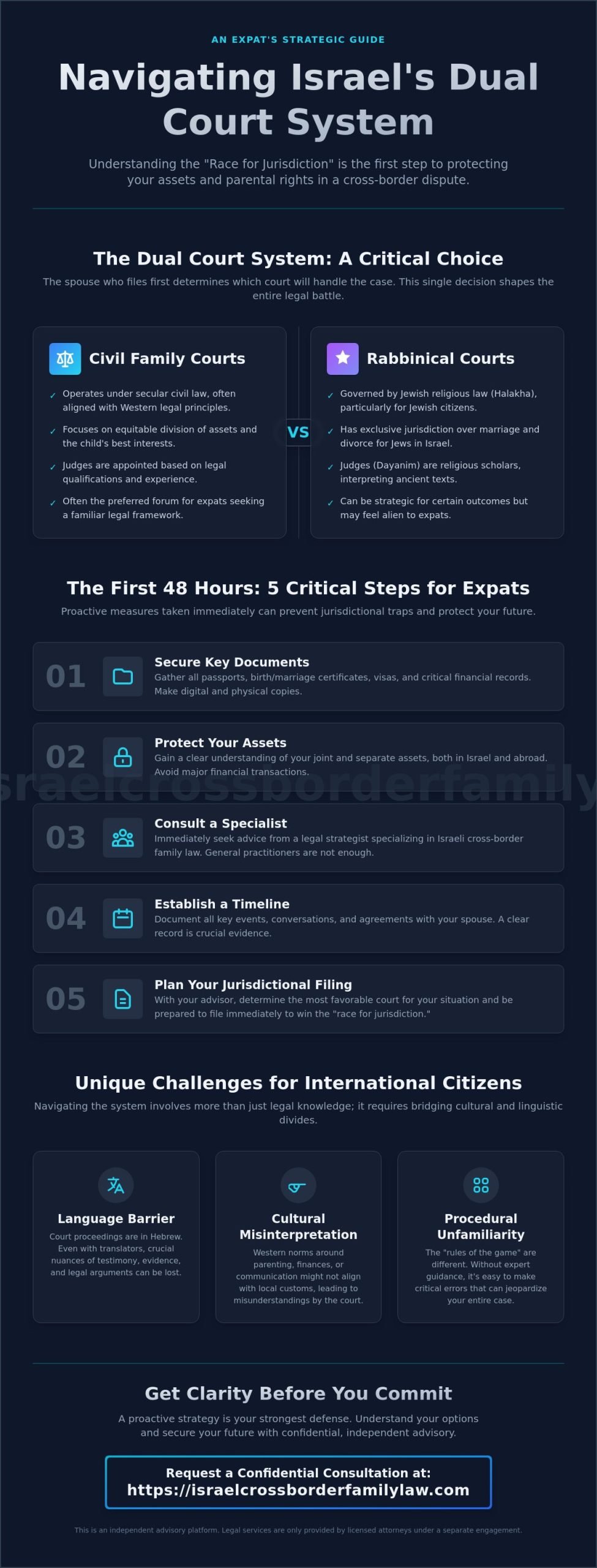
Achieving Clarity: The Role of Independent Advisory
Achieving a sense of control in a foreign legal environment is only possible when you move from emotional reaction to risk-based strategy. For many expats, the feeling that the system is biased isn’t just a fear; it’s a response to the overwhelming complexity of the dual-court structure and linguistic barriers. However, getting a fair outcome in a biased system is achievable when you employ an independent advisory perspective that bridges the gap between your home culture and the IL legal reality. An advisor doesn’t just explain the law. They help you interpret the subtle cultural cues and procedural nuances that often determine success in the Family or Rabbinical courts.
The “Anglo” bridge is essential for international families. You need more than a translation of words; you need a translation of intent and strategy. When you understand why a court might prioritize a specific outcome based on local norms, you can adjust your presentation to align with those expectations. This strategic alignment is the most effective way to mitigate perceived systemic risks. By requesting a confidential case review, you can map out your options before a single document is filed. This allows you to make decisions based on data and risk assessment rather than fear or uncertainty.
Clarity Before Commitment
One of the greatest risks to an expat is “coffee shop advice.” Friends or acquaintances often share horror stories or procedural “tricks” that worked in their specific cases. These anecdotes are rarely applicable to your unique cross-border situation. Every family has different jurisdictional ties, asset locations, and religious considerations. Following informal advice can lead you directly into the jurisdictional traps we discussed in previous sections. A professional roadmap reduces anxiety by providing a clear sequence of moves. You can learn more about how our advisory process works for international families to see how we build these customized strategies. Getting a fair outcome in a biased system starts with reliable, expert information.
Next Steps for Your Case
You can take practical steps today to protect your future and your children’s interests. Focus on gathering your documentation and identifying your primary legal goals before engaging in any formal proceedings. Preparation is your best defense against the “race for jurisdiction.” To deepen your understanding of these topics, we recommend watching our expert videos on the Israel Family Law YouTube channel. These resources provide visual guides to the complex issues of child support, asset division, and court procedures in IL. Get clarity before you commit. Request a confidential consultation.
This article is published on an independent advisory platform and does not constitute legal representation or an attorney-client relationship. Legal services are only provided by licensed attorneys under a separate engagement.
Strategic Planning for Your International Family
Navigating family matters in IL demands a shift from reactive fear to proactive strategy. You’ve seen that the “race for jurisdiction” and the choice of forum are the most critical factors in determining your future financial and parental rights. By prioritizing early decisions and ensuring your IL strategy aligns with your US-based interests, you can effectively manage complex jurisdictional risks. Taking control of the narrative early is the most reliable way to protect your children and your assets.
Getting a fair outcome in a biased system is not about changing the laws of the land. It’s about using specialized advisory and expertise in both US and Israeli legal contexts to level the playing field. A neutral, strategy-first approach allows you to anticipate domestication hurdles before they become obstacles. You don’t have to navigate these complexities alone or rely on informal advice that ignores your specific cross-border needs.
Get clarity before you commit. Request a confidential case review to map out your strategic options today. With the right preparation and a clear roadmap, you can protect your global interests and move forward with confidence.
This article is published on an independent advisory platform and does not constitute legal representation or an attorney-client relationship. Legal services are only provided by licensed attorneys under a separate engagement.
Frequently Asked Questions
Is the Israeli court system really biased against foreigners?
The perception of bias in the Israeli system often stems from procedural unfamiliarity and linguistic barriers rather than intentional discrimination. Many international citizens feel marginalized because proceedings are conducted in Hebrew and follow a dual-court structure that is unique to IL. Getting a fair outcome in a biased system involves bridging these cultural gaps with bicultural advisory that explains the nuances of both civil and religious expectations.
Can a woman get a fair divorce outcome in a Rabbinical Court?
Yes, women can achieve equitable results in the Rabbinical Court, but it requires a specific strategy tailored to the religious framework. While these courts are traditional, the law passed on March 24, 2026, allows them to arbitrate civil disputes if both parties agree. Success in this forum depends on how you present your case and whether your legal team understands the intersection of religious law and modern civil rights.
What should I do if my spouse files for divorce in Israel before I do?
You must seek immediate advisory to assess your jurisdictional standing and determine which court now has authority over your case. In IL, the “race for jurisdiction” is critical because the first person to file often chooses the forum for ancillary matters like property and custody. If your spouse has already filed, you need to evaluate if you can challenge the jurisdiction or if you must shift your strategy to the chosen venue.
How do I ensure my US child support order is honored in Israel?
You must apply for the “domestication” of your foreign order through the IL civil court system to make it legally binding. The U.S.-Israel agreement on child support provides a framework for cooperation, but enforcement isn’t automatic. The local court will verify that the order doesn’t conflict with IL public policy and may review “Center of Life” data to ensure the support amounts are appropriate for the local economic context.
Can I be prevented from leaving Israel with my children during a legal dispute?
Yes, IL courts frequently issue “No-Exit” orders to prevent children from being removed from the country while a case is pending. These orders are a common procedural tool used to prevent international child abduction and ensure that legal obligations are met. This is a significant departure from US law, where such travel restrictions are much harder to obtain without evidence of immediate flight risk.
What are the main differences between the Family Court and the Beit Din?
The Family Court is a secular civil body that applies civil statutes, whereas the Beit Din is a religious court that operates under Halakha. While the Family Court is often preferred by expats for its Western legal approach, the Rabbinical Court has exclusive authority over the “Get.” Since November 18, 2025, the Rabbinical court also has clarified jurisdiction over child support when it’s bound to a divorce suit.
How can I find a lawyer who understands both US and Israeli law?
You should prioritize bicultural and bilingual attorneys who are qualified to practice in both jurisdictions and have a “team on the ground” in IL. Finding a lawyer who understands the nuances of getting a fair outcome in a biased system means looking for someone who can act as a bridge between two different legal cultures. This ensures your US-based interests are protected while you navigate the local IL system.
Is it possible to appeal a decision if I believe the judge was biased?
Both the civil Family Court and the Rabbinical Court systems have established appellate levels where you can challenge a ruling. An appeal must be based on specific legal or procedural errors rather than just a general feeling of unfairness. Documenting every interaction and ensuring accurate translation during the initial trial is vital for building a strong foundation for any future appeal.

Article by
Gabriel Lior
A Personal Journey That Became a Mission
The advisory was founded by an American father Gabriel Lior, LLB, MBA , global entrepreneur, and cross-border advisor who spent more than a decade navigating the Israeli family court system firsthand and now lives in Singapore with his son.
As a divorced parent in a cross-border family, Gabriel faced nearly every legal challenge a foreign parent can encounter in Israel — including child custody disputes, child support proceedings, property matters in Israel and abroad, false accusations, and complex immigration and relocation proceedings.
Over the years, he learned the hard way how difficult it is for non-Israeli parents to understand the system, identify the right legal strategy, and choose the right legal representation — especially when language, culture, and jurisdictional differences are involved. He also witnessed how foreign parents and new immigrants are often disadvantaged or taken advantage of by service providers and institutions simply because they lack local knowledge or fluency.
From Client to Advisor
To truly understand — and survive — the system, Gabriel pursued formal legal education in Israel, completing two Israeli law degrees, alongside a BA and MBA earned in the United States. This was never about becoming a practicing attorney, but about gaining a deep, structural understanding of how the system works — and where it breaks down for foreign parents.
This rare combination of:
Firsthand client experience
Israeli legal and US business education
International business and negotiation training
Decades of commercial execution
created a unique perspective – one that understands both sides of the table.
After years of litigation, persistence, and at times self-representation, he ultimately succeeded in securing custody of his son and relocating abroad through a rare legal victory in the Israeli Supreme Court — becoming one of the first fathers in Israel to do so under these circumstances.
Disclaimer
Important Disclaimer:
The information provided on this website and in its content is for general informational and educational purposes only and does not constitute legal advice, legal opinion, or legal representation.
Gabriel Lior is not licensed to practice law in Israel (nor is he interested in doing so) and does not provide legal services, despite having completed 2 Law Degrees. The services offered are advisory in nature and are intended to provide general guidance, strategic insight, and information regarding cross-border family law considerations.
No attorney-client relationship is formed by accessing this website, reading its content, or communicating with us.
Any decisions made based on this information are at your own discretion and risk. For legal advice specific to your situation, you should consult a licensed attorney in the relevant jurisdiction.
Where appropriate, we may refer clients to independent, licensed attorneys or professionals. Such referrals do not constitute legal representation and no liability is assumed for services provided by third parties.