
This article is published on an independent advisory platform and does not constitute an attorney-client relationship. Legal services are provided only by licensed attorneys under a separate engagement.
In the Israeli legal system, the status quo is often the most powerful defense a parent has against the permanent relocation of their child. When facing a potential international move, the burden of proving a move is not in the child’s best interest falls on the parent wishing to maintain the child’s current center of life in Israel. You likely feel the immense weight of this situation, especially when the distance involves crossing borders and navigating a foreign court system you did not grow up with. It is natural to fear that a relocation might permanently sever the emotional anchors your child has built here.
This guide provides the strategic clarity you need to handle these high stakes. You will learn the specific criteria Israeli judges use to evaluate relocation, from the impact on the child’s social circle to the recommendations of court-appointed social workers. We will also examine the 417 ₪ filing fee updated on January 12, 2026, and how the 1962 Legal Capacity and Guardianship Law shapes every judicial decision. For more visual guidance, you can view resources on the Israel Family Law YouTube channel. Get clarity before you commit. Request a confidential consultation.
This article is published on an independent advisory platform and does not constitute an attorney-client relationship. Legal services are provided only by licensed attorneys under a separate engagement.
Key Takeaways
- Understand the “Center of Life” principle and how Israeli courts prioritize maintaining a child’s established routine and social anchors within Israel.
- Identify the specific documentation and professional testimony required when proving a move is not in the child’s best interest to ensure a strong evidentiary foundation.
- Learn about the influential role of the Pkidat Sa’ad, the court-appointed social worker whose evaluation often dictates the outcome of relocation disputes.
- Discover how to utilize immediate legal safeguards, such as a Stay of Exit order, to prevent a child from being removed from the country while proceedings are active.
- Evaluate the criteria judges use to determine if the relocating parent is truly capable of facilitating a meaningful long-distance relationship with the parent remaining in Israel.
This article is published on an independent advisory platform and does not constitute an attorney-client relationship. Legal services are provided only by licensed attorneys under a separate engagement.
The Best Interest of the Child Standard in Israel (IL)
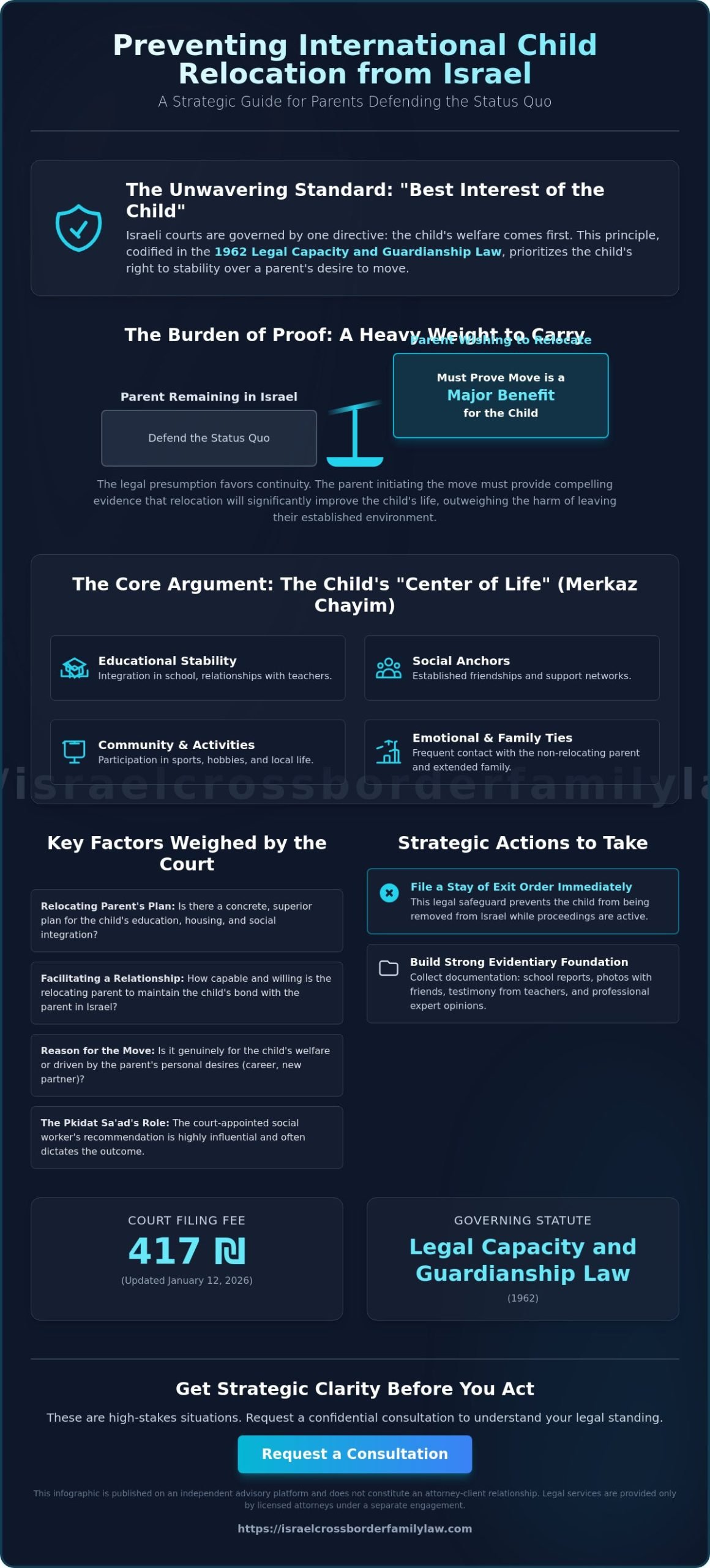
Israeli family courts operate under a singular, guiding directive: the welfare of the child. This principle, formally codified in the Legal Capacity and Guardianship Law of 1962, dictates that every judicial decision regarding custody or relocation must prioritize the child’s needs over the parental desire for movement. When one parent proposes an international move, the court views the entire situation through The Best Interest of the Child Standard. This is not a subjective “feeling” but a rigid legal framework used to assess the potential for emotional, developmental, or social harm to the minor.
Proving a move is not in the child’s best interest requires a strategic focus on the child’s existing stability. While parents have a right to choose their place of residence, the Israeli court system believes that a child has a competing, often superior, right to a stable environment. An international move is treated with far more scrutiny than a local move within Israel because it effectively severs the child’s frequent, physical contact with the non-relocating parent. Judges must weigh the benefits of the move against the certain loss of the child’s current support system.
To better understand how courts evaluate parental fitness and child welfare in these high-stakes scenarios, watch this helpful video:
The court’s analysis often begins by distinguishing between the parent’s interests and the child’s reality. In cases of international custody and relocation, judges look for evidence that the proposed destination offers a concrete improvement to the child’s life that outweighs the trauma of leaving their current home. If the move is primarily motivated by the parent’s career or a new relationship, the court may find that these factors do not satisfy the legal requirements for relocation.
The “Center of Life” Doctrine
In Israeli law, the “Center of Life” (Merkaz Chayim) is the most significant factor in relocation disputes. This doctrine refers to the sum of a child’s social, educational, and emotional anchors within Israel. Judges are traditionally hesitant to uproot a child who is well-integrated into an Israeli school, has a local support network of friends, and participates in community activities. Long-term residency in Israel creates a powerful legal presumption that the child’s welfare is best served by staying in their established environment.
The Presumption of Continuity
The Israeli legal system operates on the belief that maintaining the current living arrangement is inherently safer for a child’s development than introducing radical change. Because of this, the burden of proof rests entirely on the parent who wants to leave the country. You should seek clarity on your legal standing before any changes are made to the child’s daily routine; early decisions often dictate the final outcome of the case.
This article is published on an independent advisory platform and does not constitute an attorney-client relationship. Legal services are provided only by licensed attorneys under a separate engagement.
Key Factors Israeli Courts Consider in Relocation Disputes
Israeli judges examine several objective factors to determine if an international relocation should proceed. While a parent’s career advancement is a valid personal goal, the court views it as secondary to the child’s emotional stability. The primary concern is whether the child can maintain a deep, meaningful relationship with the parent remaining in Israel. Proving a move is not in the child’s best interest often involves demonstrating that the proposed distance is too great to sustain this bond without causing significant psychological distress.
The court also assesses the child’s age and developmental stage. Younger children who haven’t developed long-term memory or the ability to communicate effectively via video calls are often seen as more vulnerable to the “out of sight, out of mind” effect. Conversely, for older children, the court may consider their own expressed preferences, though these are never the sole deciding factor. A critical part of this evaluation involves understanding international custody protections and how they prevent unilateral moves. According to a 2025 report from the U.S. Department of State, 15 countries were cited for a pattern of noncompliance with international abduction standards in 2024. This global context helps Israeli courts understand the risks associated with moving children to jurisdictions where legal cooperation might be limited.
The Practicality of the Proposed Visitation
Distance is a physical reality that no technology can fully bridge. When evaluating a move from Israel to North America or Europe, the court looks at the 10 to 15 hour flight times and significant time zone differences. Judges analyze the financial burden of these trips to ensure they are sustainable over many years. They want to know who will pay for the flights and if the moving parent will actually facilitate the visits. If the visitation plan is deemed “illusory” or financially impossible, it becomes a strong argument for requesting a professional review of your specific circumstances.
The Moving Parent’s Motivation
The court distinguishes between a “good faith” move and one intended to alienate the other parent. If a parent has a history of blocking visitation within Israel, the judge will likely conclude they won’t cooperate from thousands of miles away. This analysis is central to Israel’s implementation of the Hague Convention. Proving a move is not in the child’s best interest requires showing that the relocation is a tactical choice to limit parental contact rather than a necessity for the child’s well-being. Judges value parents who demonstrate a clear, documented plan to keep the other parent involved in every major life decision from abroad.
This article is published on an independent advisory platform and does not constitute an attorney-client relationship. Legal services are provided only by licensed attorneys under a separate engagement.
How to Build Evidence That a Move Is Harmful
Building a successful case requires moving from abstract concerns to concrete, documented facts. When you are proving a move is not in the child’s best interest, the court expects a data-driven illustration of the child’s daily reality in Israel. It isn’t enough to state that you are an involved parent; you must demonstrate the tangible ways your absence will diminish the child’s quality of life. Israeli judges rely heavily on evidence that shows a child is flourishing in their current environment. This process often starts by gathering records from the last 12 to 24 months that highlight your consistent presence in the child’s medical, educational, and social spheres.
Testimony from neutral third parties carries significant weight in these proceedings. Local teachers, therapists, and even long-term neighbors can provide a professional or objective perspective on the child’s integration into the community. If a child is thriving in a specific Israeli school curriculum or has made significant progress with a local Hebrew-speaking therapist, these anchors are difficult to replicate abroad. You should document every instance where the child’s local support network, including extended family like grandparents or cousins, has played a role in their upbringing. For international families, showing that the child has a deep “center of life” in Israel is the most effective way to challenge a relocation request.
Documenting the “Parental Bond”
The court values the “micro-moments” of parenting that define a child’s sense of security. Create a detailed log of your daily involvement, including school drop-offs, attendance at parent-teacher conferences, and participation in routine medical appointments. If you are the parent who handles the 8:00 AM school run or the afternoon activities at the local community center, these facts are vital. Photos of the child with their Israeli peers or at local holiday celebrations serve as visual proof of their social integration. Identifying specific activities the child would lose, such as a unique youth group or a specialized sports team, helps the court visualize the emotional cost of the move.
Critiquing the Relocation Plan
A parent wishing to move must present a comprehensive plan, and identifying gaps in their school or housing research is a key strategy for the opposing parent. Many relocation proposals fail because they don’t account for the lack of a physical support system in the new country. You should highlight how the move might result in the loss of the child’s linguistic ties to Israel or their bicultural identity. Demonstrating that the proposed destination lacks the specific cultural or educational resources the child currently enjoys in Israel can be a decisive factor. Get clarity before you commit; request a confidential consultation to discuss your specific evidence strategy.
This article is published on an independent advisory platform and does not constitute an attorney-client relationship. Legal services are provided only by licensed attorneys under a separate engagement.
The Role of Social Workers and Child Experts in IL
Israeli family courts don’t operate in a vacuum. Judges rely heavily on the Pkidat Sa’ad, a court-appointed welfare officer who acts as the eyes and ears of the court. This professional conducts the “Teskir,” a comprehensive evaluation of the family’s dynamics and the child’s environment. In the context of proving a move is not in the child’s best interest, the social worker’s recommendation is often the single most influential document in the case file. While judges have the final legal authority, they rarely deviate from the welfare officer’s findings without compelling evidence from a private psychologist or expert witness.
Your first meeting with the Pkidat Sa’ad is critical for your case. It’s the moment where the narrative of the child’s life in Israel is established. You must present yourself as a stable, child-focused parent who’s committed to the child’s current routine. This is also where you must address the specific risks of international relocation. If the proposed move is to a country with a history of noncompliance with international treaties, it’s a major red flag. As noted in the 2025 U.S. Department of State report, 15 countries were cited for patterns of noncompliance in 2024. Pointing out these risks helps the expert understand that relocation isn’t just a change of scenery, but a potential threat to the child’s legal and emotional security.
Navigating the “Teskir” Process
The Teskir involves home visits, interviews with both parents, and conversations with the child’s teachers or doctors. It’s a strategic moment where you must remain calm. Avoid disparaging the other parent; instead, focus on the child’s emotional anchors in Israel. The social worker evaluates how the child interacts with their surroundings and how a move would disrupt their developmental progress. Proving a move is not in the child’s best interest requires showing the Pkidat Sa’ad that the child’s “center of life” is deeply rooted in their current Israeli community. These reports are often the deciding factor because they provide the judge with a neutral, professional perspective on the child’s daily reality.
The Voice of the Child
The court begins to give weight to a child’s preference as they mature, typically around age 10 or 12. However, experts are highly trained to detect parental alienation. If a child’s desire to move sounds rehearsed or reflects a sudden, unexplained hostility toward the non-moving parent, it’ll trigger a deeper psychological evaluation. Experts look for signs that one parent is “coaching” the child to support the relocation. For more information on how expert testimony works in these cases, you can explore resources on the Israel Family Law YouTube channel. Understanding these nuances helps you prepare for the psychological scrutiny of a relocation dispute. To ensure your approach is based on sound strategy, contact us for a professional assessment.
This article is published on an independent advisory platform and does not constitute an attorney-client relationship. Legal services are provided only by licensed attorneys under a separate engagement.
Strategic Steps for International Families Facing Relocation
The first step in any relocation dispute is securing the status quo to prevent a unilateral move from becoming a permanent reality. In the Israeli legal system, this often involves applying for a “Stay of Exit” order, known as a Tsav Ikur Yetzia Min HaAretz. This order prevents the child from being taken out of the country while the court evaluates the merits of the case. Proving a move is not in the child’s best interest becomes exponentially more difficult if the child has already left Israel and begun integrating into a new environment abroad. You must act before a “fait accompli” is created; once a child has established a new routine in another country, courts are often hesitant to order a return that causes further disruption.
Coordinating a strategy between Israeli and U.S. jurisdictions is essential for international families. Because legal systems and cultural norms differ fundamentally, a decision made in an Israeli Family Court may require additional steps for registration or enforcement in a foreign court. Early, risk-based decision-making allows you to anticipate these multi-jurisdictional hurdles before they become crises. Waiting for a move to occur before filing a claim is a high-risk strategy that rarely yields a favorable outcome for the parent remaining in Israel.
Immediate Protective Measures
Securing the child’s passport is a practical, immediate step to prevent unauthorized travel. If you suspect a parent may relocate without your written consent, you should notify the relevant authorities and seek a court order to hold the travel documents. This proactive approach aligns with the 1980 Hague Convention on the Civil Aspects of International Child Abduction, which provides a legal framework for the return of children wrongfully removed from their habitual residence. For more detailed information on these protections, see our guide on International Custody & Relocation.
Seeking Professional Advisory
There’s a critical difference between receiving standard legal advice and engaging in strategic cross-border planning. While a licensed attorney handles the specific courtroom filings, a strategic advisor helps you navigate the complex bicultural landscape of international family law. Early decisions, such as how you communicate with the other parent or how you document your daily involvement, have the most significant impact on the final outcome. Proving a move is not in the child’s best interest relies on a strategy that accounts for both the 1962 Legal Capacity and Guardianship Law and the practical realities of international travel. Get clarity before you commit. Request a confidential case review.
This article is published on an independent advisory platform and does not constitute an attorney-client relationship. Legal services are provided only by licensed attorneys under a separate engagement.
Securing Stability for Your Family in Israel
Navigating a relocation dispute requires a deep understanding of how Israeli Family Courts weigh the “Center of Life” against parental mobility. Success in proving a move is not in the child’s best interest depends on early, risk-based strategy and a clear presentation of the child’s established social and emotional anchors. By understanding the influence of the Pkidat Sa’ad and the necessity of immediate protective measures like the Stay of Exit order, you can move forward with confidence and clarity.
Our platform offers a specialized focus on US-Israel cross-border families, providing an advisory approach tailored specifically for international expats and English speakers. We act as a professional bridge between legal systems, grounding abstract legal concepts in the concrete expertise of bicultural professionals who understand the Israeli marketplace. You don’t have to navigate these complex multi-jurisdictional challenges without a steady guide. Get clarity before you commit. Request a confidential consultation.
This article is published on an independent advisory platform and does not constitute an attorney-client relationship. Legal services are provided only by licensed attorneys under a separate engagement.
Frequently Asked Questions
Can I stop my ex-partner from moving our child out of Israel?
You can prevent a relocation by withholding your written consent, which is a legal requirement for any parent wishing to move a child abroad. If consent is refused, the parent who wants to move must file a formal claim in the Family Court to obtain judicial permission. This process places the burden on the moving parent to show that the relocation is necessary, while you focus on proving a move is not in the child’s best interest by highlighting the child’s deep roots in Israel.
What is a “Stay of Exit” order and how do I get one?
A Stay of Exit order is a preventative legal measure that blocks a child from leaving Israel’s borders until a final court decision is reached. To obtain one, you must file an urgent motion with the Family Court, often alongside a 417 ₪ filing fee as updated in January 2026. These orders are common in high conflict cases where there’s a verified risk that one parent might move the child unilaterally without waiting for the court’s approval.
Does the Israeli court always favor the mother in relocation cases?
Israeli law has shifted toward a gender-neutral standard that prioritizes the child’s welfare over parental identity. While historical practices once favored mothers for young children, the 2011 Schnitt Committee recommendations led to a more balanced approach in the Family Courts. Today, judges examine the actual caregiving roles and the emotional bond between the child and both parents, regardless of gender, when evaluating the potential impact of an international move.
How does the court decide what is in the “best interest” of my child?
The court uses a multi-factorial analysis to determine which environment provides the most stability and support for the child’s development. Judges look at the child’s educational progress, social integration, and the quality of the relationship with the parent who’s not moving. Proving a move is not in the child’s best interest involves showing that the child’s current “center of life” in Israel offers emotional and cultural benefits that cannot be replicated in a foreign jurisdiction.
What happens if a parent moves the child without court permission?
Moving a child out of Israel without the other parent’s consent or a court order is considered international child abduction. This triggers the 1980 Hague Convention protocols, which aim to return the child to their “habitual residence” for a custody determination. In addition to the civil return process, the parent who moved the child may face criminal charges and a significant loss of credibility in future Israeli court proceedings.
Will the court listen to my child’s wishes about moving to the US?
Children typically have the opportunity to express their views once they reach the age of 10 or 12 through the “Voice of the Child” unit. A specialist interviews the child in a neutral setting to understand their feelings about the move and their life in Israel. While the judge isn’t bound by the child’s preference, it’s a significant factor that’s weighed alongside professional expert reports and the parents’ documented involvement.
How long does a relocation trial usually take in Israel?
A relocation trial in Israel generally lasts between 12 and 24 months from the initial filing to a final judgment. This timeline is largely dictated by the schedule of the Pkidat Sa’ad, who requires several months to conduct home visits and interviews for the Teskir report. Because these cases involve complex cross-border considerations, the court must move through a structured evidentiary process before making a life-changing decision for the minor.
Can I enforce a US custody order to prevent a move from Israel?
Foreign custody orders are not automatically recognized in Israel and must be formally registered under the Enforcement of Foreign Judgments Law of 1958. If a US court has already ruled on the child’s residence, that order can serve as powerful evidence in an Israeli court, but it doesn’t bypass the need for an Israeli judicial review. You must petition the Family Court to recognize and enforce the foreign decree to ensure it’s binding within the Israeli legal system.

Article by
Gabriel Lior
A Personal Journey That Became a Mission
The advisory was founded by an American father Gabriel Lior, LLB, MBA , global entrepreneur, and cross-border advisor who spent more than a decade navigating the Israeli family court system firsthand and now lives in Singapore with his son.
As a divorced parent in a cross-border family, Gabriel faced nearly every legal challenge a foreign parent can encounter in Israel — including child custody disputes, child support proceedings, property matters in Israel and abroad, false accusations, and complex immigration and relocation proceedings.
Over the years, he learned the hard way how difficult it is for non-Israeli parents to understand the system, identify the right legal strategy, and choose the right legal representation — especially when language, culture, and jurisdictional differences are involved. He also witnessed how foreign parents and new immigrants are often disadvantaged or taken advantage of by service providers and institutions simply because they lack local knowledge or fluency.
From Client to Advisor
To truly understand — and survive — the system, Gabriel pursued formal legal education in Israel, completing two Israeli law degrees, alongside a BA and MBA earned in the United States. This was never about becoming a practicing attorney, but about gaining a deep, structural understanding of how the system works — and where it breaks down for foreign parents.
This rare combination of:
Firsthand client experience
Israeli legal and US business education
International business and negotiation training
Decades of commercial execution
created a unique perspective – one that understands both sides of the table.
After years of litigation, persistence, and at times self-representation, he ultimately succeeded in securing custody of his son and relocating abroad through a rare legal victory in the Israeli Supreme Court — becoming one of the first fathers in Israel to do so under these circumstances.
Disclaimer
Important Disclaimer:
The information provided on this website and in its content is for general informational and educational purposes only and does not constitute legal advice, legal opinion, or legal representation.
Gabriel Lior is not licensed to practice law in Israel (nor is he interested in doing so) and does not provide legal services, despite having completed 2 Law Degrees. The services offered are advisory in nature and are intended to provide general guidance, strategic insight, and information regarding cross-border family law considerations.
No attorney-client relationship is formed by accessing this website, reading its content, or communicating with us.
Any decisions made based on this information are at your own discretion and risk. For legal advice specific to your situation, you should consult a licensed attorney in the relevant jurisdiction.
Where appropriate, we may refer clients to independent, licensed attorneys or professionals. Such referrals do not constitute legal representation and no liability is assumed for services provided by third parties.
Related Insights & Resources

Finding Hidden Assets in a US-Israel Divorce: A Strategic Guide
The dissolution of a marriage is a complex emotional and financial process, a challenge compounded...Read More →
Choosing a Family Law Firm for Anglos in Tel Aviv: A Strategic Guide
Did you know that in Israel, the specific court where your case is first filed...Read More →
International Family Law Firms in Israel: Navigating US-Israel Cross-Border Legalities
A single mistake in where you file your initial claim can determine the fate of...Read More →