A single mistake in where you file your initial claim can determine the fate of your assets and your children’s future for years to come. If you’re an expat or an Anglo living between two cultures, you’ve likely realized that the legal distance between cities like New York and Tel Aviv is much wider than the physical flight. It’s natural to feel overwhelmed by conflicting rules, especially when you’re unsure if a US court order will even be recognized on Israeli soil. Finding the right international family law firms in israel is about more than just hiring a lawyer; it’s about finding a strategic partner who understands exactly how these two distinct legal worlds collide.
We understand the anxiety that comes with the “race for jurisdiction” and the confusion surrounding Israel’s unique dual-court system. This article provides the clarity you need to protect your family’s interests across borders. You’ll learn how specialized firms bridge the gap between US and Israeli law, ensuring that your assets are secure and your parental rights are upheld under the latest 2026 legal standards. We’ll examine the shifting roles of Rabbinical and Civil courts, the practicalities of enforcing foreign judgments, and the essential steps to take before making any legal commitments.
Key Takeaways
- Learn why navigating the US-Israel legal divide requires more than just a bilingual lawyer to protect your global interests.
- Understand the strategic weight of the “race to court” and how early decisions affect whether your case lands in a Rabbinical or Civil court.
- Discover how international family law firms in israel work to make US court orders enforceable and recognized within the Israeli system.
- Identify the specific legal tools, such as Mirror Orders and the Hague Convention, used to manage international child custody and relocation.
- Gain a clear roadmap for evaluating a firm’s cross-border expertise and communication style before you commit to representation.
What Defines International Family Law Firms in Israel?
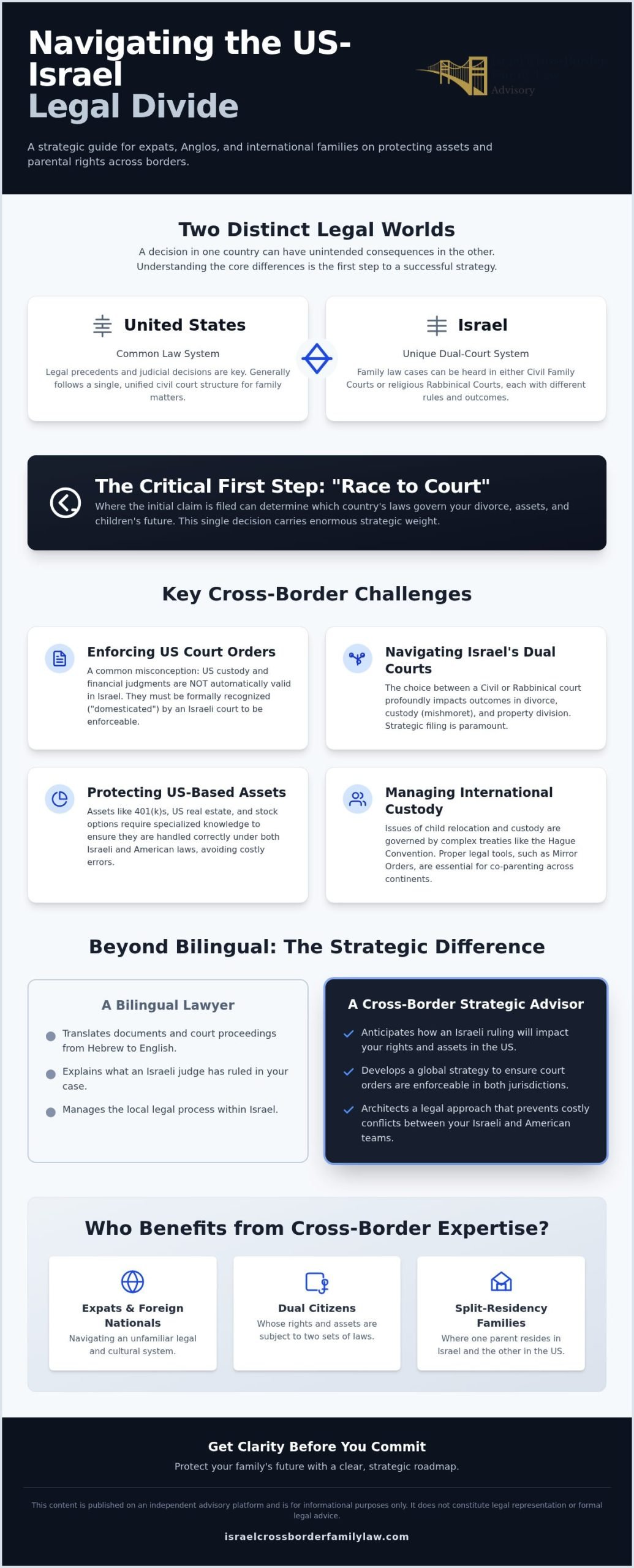
In the Israeli legal context, international family law isn’t merely about translating documents from Hebrew to English. It involves the complex intersection of different legal traditions, specifically where Israeli statutes meet the international matrimonial law standards recognized globally. Many local practitioners advertise themselves as international based solely on their English proficiency. However, true international family law firms in israel offer a deeper level of strategic oversight. They understand how a decision made in an Israeli Rabbinical court might negatively impact your financial standing or parental rights in a US jurisdiction.
To better understand the complexities of managing family dynamics across borders, watch this video on co-parenting plans:
Expats and dual citizens often find themselves caught between two systems that don’t always communicate effectively. A cross-border specialist identifies these gaps before they become liabilities. While a bilingual lawyer can tell you what a judge said, a specialist can explain why that ruling might be unenforceable in your home state. This is where an advisory platform becomes essential. It provides a strategic view of your case, ensuring that every move aligns with your long term global interests rather than just immediate local outcomes. The advisory acts as an architect, overseeing the entire cross-border trajectory to prevent costly contradictions between your Israeli and American legal teams.
The Necessity of Multi-Jurisdictional Expertise
Understanding the US common law system is vital when your life spans two continents. For example, handling assets like a 401(k), US based real estate, or stock options requires a practitioner who recognizes how Israeli property division rules interact with American tax and probate laws. Without this dual perspective, you risk losing significant asset value due to jurisdictional errors. Practitioners who are licensed or have extensive experience in both regions can anticipate these conflicts. They ensure that your strategy in Israel doesn’t inadvertently waive your rights in the United States. True expertise also requires a nuanced understanding of how foreign judgments are domesticated. If you’re an Anglo expat, you should know that your US custody agreement isn’t automatically valid in Israel. It must be formally recognized through a specific legal process to be enforceable.
Who These Firms Serve
These specialized practices primarily support families with “split” residency, where one parent may reside in Israel while the other remains in the US. They also provide essential guidance for expats and foreign nationals who may feel alienated by the Israeli court system’s cultural and procedural nuances. Whether you’re managing international business interests or navigating a complex divorce, the goal is to create a legal bridge. This ensures that your family’s future is protected, regardless of which side of the ocean you call home. By focusing on strategy and risk management, these firms help you achieve clarity before you make significant legal commitments.
This content is published on an independent advisory platform and is intended for informational purposes only. It does not constitute legal representation or formal legal advice.
Navigating the US-Israel Legal Divide: Key Challenges
The legal landscape changes the moment a claim is filed. In many jurisdictions, the process is predictable, but between the US and Israel, you face a unique “race for jurisdiction.” This means the court that receives the initial filing often dictates which laws apply to your divorce, custody, and assets. For many Anglos, the assumption that US court orders are automatically enforceable in Israel is a dangerous misconception. Without formal domestication by an Israeli Family Court, your foreign judgment holds little weight. This complexity is why seeking clarity from international family law firms in israel is a critical first step before taking any action.
Relying on a general practice firm for these disputes often leads to strategic gaps. A lawyer who primarily handles local Israeli cases might not grasp the nuances of US common law or the long-term implications of an Israeli ruling on your American citizenship status or tax obligations. When you’re managing a life that spans two continents, the risks of a jurisdictional error are simply too high to ignore.
Religious vs. Civil Jurisdiction in Israel
Israel operates a dual-court system that often confuses those accustomed to secular US law. Jewish couples are subject to the jurisdiction of Rabbinical courts for the divorce itself. However, matters like property division and child support can be “bound” to the divorce claim in either the Rabbinical court or the secular Family Court. Recent legislation from March 2026 has further expanded the authority of religious courts to arbitrate civil disputes, provided both parties consent. This shift makes early strategic decisions even more impactful. If you don’t choose your forum wisely, you might find yourself navigating a system with vastly different procedural rules than what you expected. It’s often helpful to request a review of your specific situation to understand these jurisdictional risks.
Asset Protection and Disclosure
Valuing global assets requires a high level of technical precision. US-based retirement accounts, such as 401(k)s and IRAs, don’t have direct equivalents in the Israeli financial system. A general practice firm might overlook the tax implications or the specific “Qualified Domestic Relations Orders” (QDROs) required to divide these accounts without penalties. When assets are spread across borders, the risk of non-disclosure or valuation errors increases. Protecting your interests requires a strategy that accounts for:
- The tax consequences of transferring funds between the US and Israel.
- The valuation of international business interests and stock options.
- The lack of formal legal separation in Israel, which affects when the “valuation date” for marital property is set.
Navigating these hurdles alone or with a firm that lacks cross-border experience can lead to significant financial loss. Before committing to a path, ensure you understand the weight of these early decisions and the inherent complexity of the US-Israel divide.
This content is published on an independent advisory platform and is intended for informational purposes only. It does not constitute legal representation or formal legal advice.
Core Services of Cross-Border Family Law Practices
When legal matters cross the Atlantic, the standard family law services provided by local firms often fall short. Specialized international family law firms in israel focus on the friction points between two different legal systems. These practices don’t just handle the paperwork; they manage the strategic interplay of multi-jurisdictional disputes. Whether you’re dealing with a contested divorce or complex property division, the goal is to ensure that a resolution in one country doesn’t create a legal crisis in the other.
Beyond divorce, these firms provide essential oversight for estate planning involving dual-country assets. Wills must be drafted to comply with both Israeli succession law and US probate requirements. Without this dual focus, your heirs might face significant delays or unexpected taxes. Cross-border practices ensure that your global legacy is protected through documents that are recognized and enforceable in both jurisdictions. This proactive approach prevents the common fear of losing family assets due to simple jurisdictional errors.
International Custody and Relocation
Moving children between the US and Israel involves more than just a plane ticket. It requires a deep understanding of the international custody and relocation guidance necessary to prevent accusations of parental abduction. Israel is a signatory to the Hague Convention, which provides a framework for the return of children wrongfully removed from their home country. In 2026, courts increasingly require “Mirror Orders”—legal decrees from the destination country that reflect the original court’s decision—to ensure continuity of enforcement. This is particularly important now that the “Tender Years Presumption” has weakened in Israel, leading to more equitable shared parenting arrangements that must be carefully documented for international travel.
Enforcing Support Orders
A common pain point for international families is the child support cross-border enforcement process. A US court order for child support or alimony isn’t automatically binding in Israel. It must undergo a formal domestication process where an Israeli Family Court reviews and recognizes the judgment. Collecting alimony can be even more challenging, as Israeli law handles spousal support differently than many US states. Specialized firms bridge this gap by navigating the specific treaties and local procedures required to make these foreign orders enforceable. They help you avoid the frustration of having a valid US judgment that remains a “paper win” with no practical power in Israel.
This content is published on an independent advisory platform and is intended for informational purposes only. It does not constitute legal representation or formal legal advice.
How to Evaluate International Family Law Firms in Israel
Choosing between international family law firms in israel requires a shift in how you measure professional value. While many local firms highlight their years of general experience, a cross-border case demands a specific history of navigating the friction between US and Israeli statutes. You aren’t just looking for a lawyer who speaks English; you’re looking for a strategist who understands the long-term impact of an Israeli ruling on your American financial standing. Verifying a firm’s history with multi-jurisdictional cases is the first step toward ensuring your global interests remain protected.
A firm’s network of professional relationships is equally critical. Cross-border issues rarely exist in a vacuum. Effective representation often involves a collaborative approach, where your Israeli team works in tandem with US-based counsel, tax professionals, and forensic accountants. This integrated model prevents the “silo effect,” where decisions made in one country inadvertently cause legal or financial damage in another. Before you commit, it’s vital to reach out for a professional perspective on how these moving parts will be managed in your specific case.
Checklist: 5 Questions to Ask Your Potential Lawyer
To move beyond surface-level claims, use these targeted questions to test a practitioner’s actual cross-border proficiency:
- How many cases have you handled involving [Specific US State] and Israel? Law varies significantly between states like California and New York, and your lawyer must understand these nuances.
- How do you handle the service of process for a party located abroad? Improper service under international treaties can lead to your entire case being dismissed later.
- What is your strategy for protecting assets located in the US? Ensure they have a plan for accounts like 401(k)s or property that the Israeli court may not have direct authority over.
- Do you collaborate with US-based counsel when necessary? A firm that insists on working in isolation may miss critical American legal requirements.
- How do you manage the domestication of foreign judgments? Ask for the specific procedural steps they take to make a US order binding in an Israeli Family Court.
The Importance of a Calm and Educational Approach
In high-stakes international disputes, an aggressive stance often masks a lack of strategic depth. You should be cautious of firms that over-promise immediate results or use emotional, sales-driven marketing. A true specialist takes an educational approach, explaining risks honestly and helping you understand the weight of early decisions. The value of the “Advisory” model lies in its focus on clarity and risk management. It prioritizes long-term stability over short-term “wins” that might not hold up under the scrutiny of a foreign jurisdiction. Look for a partner who provides a structured roadmap, ensuring you understand the inherent complexity of your situation before you take irrevocable steps.
This content is published on an independent advisory platform and is intended for informational purposes only. It does not constitute legal representation or formal legal advice.
Moving Forward: Achieving Clarity in Your Case
Taking the first step in a cross-border legal matter can feel like walking into a storm. For expats and international families, the path to resolution starts with a shift from reaction to strategy. The most effective international family law firms in israel don’t just jump into litigation. Instead, they begin by mapping out the entire jurisdictional landscape. This process ensures that you aren’t blindsided by the differences between US and Israeli procedures. By focusing on clarity first, you protect your assets and your parental rights from the risks of a rushed or uninformed filing.
The weight of early decisions in family law cannot be overstated. A single document filed in the wrong court or an improperly drafted agreement can have irreversible consequences that span continents. This is why the initial phase of your case should be dedicated to setting clear expectations and identifying potential friction points. A confidential case review serves as the tactical starting point. It allows you to explore your options and identify risks without the pressure of immediate litigation. It’s about gaining the clarity needed to make informed choices for your family’s future before any permanent commitments are made.
Building Your Strategic Legal Team
A successful outcome in a multi-jurisdictional dispute depends on a measured and deliberate approach. This is why understanding how our advisory process works is so critical for families with interests in both the US and Israel. We act as a bridge, connecting your local needs in Israel with the realities of the US legal and financial markets. This model allows for strategic oversight that a standard local firm often cannot provide. By building a team that understands both sides of the Atlantic, you ensure that your global interests are managed as a single, cohesive strategy rather than a series of disconnected legal battles.
Requesting a Confidential Consultation
As you navigate these complexities, it is helpful to gather as much educational information as possible. For deeper insights into specific topics like co-parenting plans or asset protection, we recommend visiting the Israel Family Law YouTube channel. These resources are designed to help you understand the Israeli system in plain English, allowing you to feel more confident as you move forward. Remember that every international case is unique, and general information is only the first step toward a personalized strategy.
Disclaimer: This content is published on an independent advisory platform and is not formal legal advice. Legal services are only provided by licensed attorneys under a separate engagement.
Get clarity before you commit. Request a confidential consultation.
Securing Your Future Across Borders
Managing family law across the US-Israel divide is inherently complex, yet it’s manageable with a deliberate strategy. We’ve explored how the “race for jurisdiction” determines your legal forum and why US orders aren’t automatic in Israel. Success depends on recognizing these gaps early and choosing a partner that offers more than just language skills. True international family law firms in israel act as a strategic bridge, leveraging a presence in both Tel Aviv and New York to protect your global interests. By prioritizing specialized expertise and an authoritative advisory model, you can navigate these multi-jurisdictional hurdles with confidence.
You don’t have to face the uncertainty of conflicting legal systems alone. Taking the time to understand the weight of early decisions is the most effective way to ensure your family’s assets and rights remain secure on both sides of the Atlantic. This content is published on an independent advisory platform and is intended for informational purposes only; it does not constitute legal representation or formal legal advice. Legal services are only provided by licensed attorneys under a separate engagement.
Get clarity before you commit. Request a confidential consultation.
This content is published on an independent advisory platform and is intended for informational purposes only. It does not constitute legal representation or formal legal advice.
Frequently Asked Questions
How do I know if an Israeli law firm is truly “international”?
True international firms possess multi-jurisdictional experience and often have practitioners licensed in both Israel and the US. It’s not enough to speak English; they must demonstrate a history of handling cases involving US common law and Israeli statutes. Look for firms that frame their role as a bridge between legal systems and maintain a physical presence or strategic network in both regions to ensure cohesive representation.
Can an Israeli court decide on my assets located in the United States?
Yes, an Israeli court can include foreign assets in a property division ruling if it has jurisdiction over both parties. However, enforcing that ruling in the US is a separate challenge. US courts generally require a process of domestication to recognize an Israeli judgment. Without strategic coordination between international family law firms in israel and US counsel, you risk a ruling that is legally valid in Israel but practically unenforceable in America.
What happens if my spouse files for divorce in the US and I file in Israel?
This creates a “race for jurisdiction” where the court that first establishes authority often dictates the legal framework for the entire case. The outcome depends on which court’s jurisdiction is recognized as primary under international treaties and local laws. This situation carries high strategic risks, as the two systems may produce vastly different results regarding asset division and custody. Seeking immediate advisory oversight is critical to managing these competing filings effectively.
Are US prenuptial agreements enforceable in Israeli courts?
US prenuptial agreements are generally recognized in Israel, but they must be validated by an Israeli court to be fully enforceable. The agreement must meet specific Israeli legal standards; this includes proof that both parties understood the terms and entered into it willingly. If the agreement contradicts Israeli public policy or wasn’t properly domesticated, its weight in a local divorce proceeding may be significantly diminished. Early validation is key to protecting your interests.
How long does it typically take to enforce a foreign child support order in Israel?
The process of domesticating and enforcing a US child support order in Israel usually takes several months to over a year. The timeline depends on whether the other party contests the order and the current backlog of the Israeli Family Court. Because child support enforcement involves specific treaties, the efficiency of the process often rests on how well the initial US order was drafted and served to meet Israeli procedural requirements from the start.
Do I need a separate lawyer in both the US and Israel for my divorce?
Most cross-border cases require a collaborative team that includes legal counsel in both jurisdictions. While one firm may lead the strategy, local attorneys are necessary to navigate the specific procedural rules of their respective courts. international family law firms in israel often coordinate this effort, acting as a central point of contact to ensure that the legal moves made in one country don’t negatively impact your standing or assets in the other.
What is the role of the Hague Convention in US-Israel custody disputes?
The Hague Convention provides the legal framework for the prompt return of children who have been wrongfully removed from their country of habitual residence. It is the primary tool used to resolve international child abduction cases between the US and Israel. The convention focuses on where the child should live while custody is decided, rather than determining the final custody arrangement itself. Israel strictly adheres to these international standards to prevent parental abduction.
Is it possible to manage an Israeli legal case while living in the US?
It is entirely possible to manage an Israeli case remotely through the use of digital tools and legal representation. Many proceedings, including mediation and certain court hearings, can now be conducted via video conference. However, you will still need a firm with a physical presence in Israel to handle filings, serve documents, and represent your interests in local courts. Strategic planning allows you to maintain your life in the US while your case proceeds smoothly.

Article by
Gabriel Lior
A Personal Journey That Became a Mission
The advisory was founded by an American father Gabriel Lior, LLB, MBA , global entrepreneur, and cross-border advisor who spent more than a decade navigating the Israeli family court system firsthand and now lives in Singapore with his son.
As a divorced parent in a cross-border family, Gabriel faced nearly every legal challenge a foreign parent can encounter in Israel — including child custody disputes, child support proceedings, property matters in Israel and abroad, false accusations, and complex immigration and relocation proceedings.
Over the years, he learned the hard way how difficult it is for non-Israeli parents to understand the system, identify the right legal strategy, and choose the right legal representation — especially when language, culture, and jurisdictional differences are involved. He also witnessed how foreign parents and new immigrants are often disadvantaged or taken advantage of by service providers and institutions simply because they lack local knowledge or fluency.
From Client to Advisor
To truly understand — and survive — the system, Gabriel pursued formal legal education in Israel, completing two Israeli law degrees, alongside a BA and MBA earned in the United States. This was never about becoming a practicing attorney, but about gaining a deep, structural understanding of how the system works — and where it breaks down for foreign parents.
This rare combination of:
Firsthand client experience
Israeli legal and US business education
International business and negotiation training
Decades of commercial execution
created a unique perspective – one that understands both sides of the table.
After years of litigation, persistence, and at times self-representation, he ultimately succeeded in securing custody of his son and relocating abroad through a rare legal victory in the Israeli Supreme Court — becoming one of the first fathers in Israel to do so under these circumstances.
Disclaimer
Important Disclaimer:
The information provided on this website and in its content is for general informational and educational purposes only and does not constitute legal advice, legal opinion, or legal representation.
Gabriel Lior is not licensed to practice law in Israel (nor is he interested in doing so) and does not provide legal services, despite having completed 2 Law Degrees. The services offered are advisory in nature and are intended to provide general guidance, strategic insight, and information regarding cross-border family law considerations.
No attorney-client relationship is formed by accessing this website, reading its content, or communicating with us.
Any decisions made based on this information are at your own discretion and risk. For legal advice specific to your situation, you should consult a licensed attorney in the relevant jurisdiction.
Where appropriate, we may refer clients to independent, licensed attorneys or professionals. Such referrals do not constitute legal representation and no liability is assumed for services provided by third parties.