This article is published on an independent advisory platform and does not constitute legal representation or legal advice. Legal services are only provided by licensed attorneys under a separate engagement.
What if the location of your wedding ceremony dictated your future assets, your right to divorce, and your residency status in a way you could not easily reverse? For many international couples, the nuances of israeli marriage laws for foreigners turn a romantic milestone into a high-stakes jurisdictional choice. You likely understand that the intersection of religious law and civil registration is complex, particularly when your life spans multiple countries and legal systems. It is common to feel concerned about the reach of religious courts or whether a ceremony in Israel will be recognized by authorities in the US or Europe.
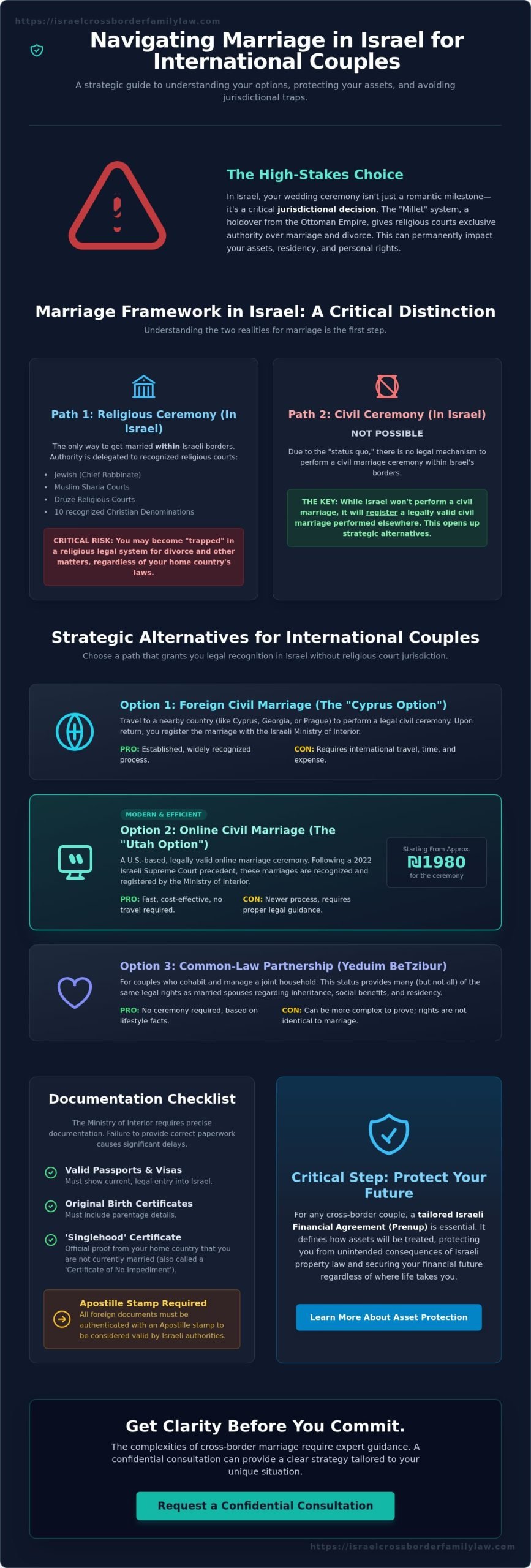
This guide will help you navigate these complexities and discover strategic alternatives for international couples. We will provide clarity on residency rights and asset protection, ensuring you understand the implications of your choices before you stand under the canopy. You will find a breakdown of modern options, such as the ₪1980 Utah online marriage recognized by the Supreme Court, and insights from our video resources at the Israel Family Law YouTube channel. Get clarity before you commit. Request a confidential consultation.
Key Takeaways
- Understand the “Millet” system and why religious courts maintain exclusive authority over all marriage ceremonies performed within Israeli borders.
- Identify the specific paperwork required for foreign nationals, including the “Singlehood” certificate and the necessity of apostille stamps for foreign documents.
- Navigate israeli marriage laws for foreigners by evaluating the legal recognition of civil marriages performed abroad or via authorized online platforms.
- Explore the Yeduim BeTzibur framework, which provides common-law couples with many of the same legal rights as married spouses.
- Learn why a tailored Israeli financial agreement is a critical tool for protecting assets in complex cross-border family situations.
This article is published on an independent advisory platform and does not constitute legal representation or legal advice. Legal services are only provided by licensed attorneys under a separate engagement.
The Unique Framework of Marriage in Israel: Religious vs. Civil
Understanding the legal landscape is the first step for any international couple considering a wedding in Israel. Unlike many Western nations where civil marriage is a standard option, the legal framework for Marriage in Israel is based on a historical system known as the ‘Millet’ system. This structure dates back to the Ottoman Empire and delegates the authority to perform and dissolve marriages to specific religious courts rather than a central civil authority. For those exploring israeli marriage laws for foreigners, this means that your religious background determines which court has jurisdiction over your personal status.
In this context, a ‘foreigner’ is generally defined as an individual who is not a citizen or permanent resident registered in the Israeli Population Registry. If you are an expat, a tourist, or a temporary resident, you are entering a system where your legal rights are deeply tied to religious affiliation. Deciding to marry within this system is a significant jurisdictional choice that can impact your future rights regarding property, inheritance, and potential divorce proceedings. It’s essential to seek clarity on these implications before making any commitments.
The Role of Religious Courts (Jewish, Muslim, Christian, Druze)
The Israeli legal system recognizes several established religious communities. For Jewish couples, the Chief Rabbinate holds exclusive jurisdiction. Other recognized groups include Muslim, Druze, and ten specific Christian denominations. To marry within one of these frameworks, you must first satisfy a ‘status’ requirement. This involves providing documented proof of your religious affiliation that is acceptable to the specific court. For many expats and foreign nationals, gathering this proof from their home country can be a complex and time-consuming process.
Why There is No Civil Marriage for Foreigners in IL
As of 2026, there remains no mechanism to perform a civil marriage ceremony within the borders of IL. This is a result of long-standing political and social status quo agreements. It’s vital to distinguish between ‘performing’ a marriage and ‘registering’ one. While the state won’t perform a civil ceremony, it does register civil marriages that were legally performed elsewhere. Israeli marriage laws for foreigners can feel restrictive because interfaith couples or those who don’t wish to marry under religious law cannot wed locally. Entering a religious marriage without a cross-border strategy can lead to ‘trapping’ yourself in a legal system that may not align with your expectations or your home country’s laws. Get clarity before you commit. Request a confidential consultation.
This article is published on an independent advisory platform and does not constitute legal representation or legal advice. Legal services are only provided by licensed attorneys under a separate engagement.
Marriage Procedures for Foreigners: Requirements and Documentation
Registration is the legal bridge between a ceremony and state recognition. When dealing with israeli marriage laws for foreigners, the burden of proof rests entirely on the couple to demonstrate their eligibility and marital status. The Ministry of Interior (MIA) acts as the gatekeeper for these records. They require a specific set of documents to update your status in the Population Registry, even if you marry through a religious authority or abroad. As of May 2026, the fee to open a marriage file with a local religious council for a Jewish wedding is 709 NIS. It’s a procedural step that requires precision.
Primary requirements for the registration process include:
- Valid passports with current entry visas.
- Original birth certificates with parentage details.
- A ‘Certificate of No Impediment’ or ‘Singlehood’ certificate.
The singlehood certificate is often the most challenging document for Anglos to obtain. Since many Western countries, including the US and UK, don’t have a centralized national marriage registry, you may need to provide a series of affidavits or local records to prove you aren’t currently married elsewhere. The MIA will not accept a simple verbal declaration. They require high-level verification before they will recognize your union.
Proving Religious Status for Foreigners
If you choose a religious ceremony within IL, you must undergo a verification process. For Jewish couples, this involves the ‘Birur Yahadut’ performed by the Rabbinical Court. You’ll need letters from recognized community rabbis abroad confirming your status and Jewish lineage. This process can be daunting for converts or those with non-traditional backgrounds. The court looks for a clear chain of evidence. If your family history is complex, gathering the right evidence early can prevent significant delays in your wedding plans.
Legalizing Foreign Documents in IL
Every document issued outside of IL must be legalized to be accepted by local authorities. Under the 1961 Hague Convention, this is done via an Apostille stamp. Without this stamp, a US birth certificate or a UK divorce decree is legally invisible to the MIA. Beyond the Apostille, you must provide notarized translations into Hebrew or Arabic. A common pitfall is submitting documents that are too old. Many IL authorities require certificates to be issued within the last six months. Errors in names or dates across different documents can also stall your application for months. Ensuring your paperwork is consistent and properly legalized is a foundational step in your cross-border legal strategy. Get clarity before you commit. Request a confidential consultation.
This article is published on an independent advisory platform and does not constitute legal representation or legal advice. Legal services are only provided by licensed attorneys under a separate engagement.
The ‘Cyprus Option’ and Recognition of Foreign Civil Marriages
Why do thousands of couples leave IL annually to marry in Cyprus or Prague? In 2023 alone, 9,035 marriages that took place abroad involved at least one spouse registered in the Israeli Population Registry. This phenomenon exists because israeli marriage laws for foreigners and citizens alike do not offer a civil ceremony option within the country. The High Court of Justice (Bagatz) has established clear precedents requiring the state to recognize these unions. Once you present a valid marriage certificate with an apostille stamp, the Population and Immigration Authority must update your marital status. This registration is essential for securing social security benefits, tax credits, and residency rights.
For international couples, the cross-border implications are significant. The US government generally recognizes any marriage that is legal in the jurisdiction where it was performed. If your Cyprus or Prague wedding is registered and recognized in IL, it usually satisfies the requirements for US immigration and legal standing. Registration at the Ministry of the Interior is free of charge, but the strategy behind where you marry can impact your future legal obligations in both countries.
Online Marriages (The ‘Utah’ Model) in 2026
Online marriages have become a popular and legally sound alternative to travel. By May 2026, the “Utah Model” is a well established path. For approximately ₪1980, couples can marry via Zoom with an officiant in Utah, USA. The Supreme Court confirmed the validity of these remote ceremonies in late 2025, ordering the state to register them. While this offers a convenient way to gain residency status, it’s vital to understand that an online ceremony carries the same legal weight and jurisdictional risks as a physical wedding. You should evaluate how this choice affects your long term asset protection before proceeding.
Divorce Risks: The ‘Trap’ of Religious Jurisdiction
A common misconception is that a foreign civil marriage completely bypasses the religious court system. It doesn’t. If both spouses are Jewish and reside in IL, the Rabbinical Court may still claim exclusive jurisdiction over the divorce, even if the wedding was a civil one in Cyprus or via Utah. This is often referred to as the “religious trap.” A foreign marriage provides a civil status for registration, but it doesn’t always shield you from religious law during a separation. Integrating a divorce and separation strategy early in your planning is the only way to manage these overlapping jurisdictions. Get clarity before you commit. Request a confidential consultation.
This article is published on an independent advisory platform and does not constitute legal representation or legal advice. Legal services are only provided by licensed attorneys under a separate engagement.
Common-Law Marriage (Yeduim BeTzibur) for Foreigners
For many international couples, the rigid framework of israeli marriage laws for foreigners makes formal registration unattractive or impossible. Israel offers a robust legal alternative known as “Yeduim BeTzibur,” or publicly known couples. This status recognizes partners who live together as a family unit and manage a joint household without a formal marriage certificate. It provides significant legal protections, including rights to shared property, inheritance, and parental status. Many expats choose this path to avoid the jurisdiction of religious courts or because they are an interfaith couple who cannot wed locally.
One critical distinction for cross-border families is the lack of a formal government document. While IL recognizes your rights based on the reality of your life together, the US legal system generally requires a government-issued marriage certificate for federal benefits, tax filings, or immigration sponsorship. This gap means that while you are “married” in the eyes of Israeli social services, you may still be considered “single” under US law. Understanding how these two systems interact is the first step in protecting your global interests and ensuring your status is recognized where it matters most.
Financial Agreements for Common-Law Couples
Because there is no “default” legal code for common-law separation, a “Coexistence Agreement” (Heskem Chayim Meshutafim) is essential. These documents serve a similar purpose to prenuptial agreements. They allow you to define which assets remain separate and how joint property should be divided. In a cross-border context, these agreements help protect pre-marital assets or family inheritances located abroad. Without a clear, written strategy, your assets could be subject to “joint property” claims by the Israeli courts if the relationship ends. If you are unsure how to structure these protections, request a confidential consultation to discuss your specific needs.
Residency Rights for Foreign Common-Law Partners
The Ministry of Interior (MIA) allows foreign partners of Israeli residents to obtain legal status through the “Graduated Procedure” (Shelavi). However, the timeline differs significantly from that of married couples. For common-law partners, the process of obtaining permanent residency or citizenship typically takes seven years of continuous proof. This is longer than the five-year process for married spouses. During this time, the couple must prove their “center of life” remains in IL through shared finances, leases, and social ties. Making early decisions about your legal status can have a profound impact on your long-term right to live and work in the country. You should evaluate these timelines carefully before choosing between common-law status and formal marriage. Get clarity before you commit.
This article is published on an independent advisory platform and does not constitute legal representation or legal advice. Legal services are only provided by licensed attorneys under a separate engagement.
Strategic Planning: Prenuptial Agreements and Cross-Border Protection
Cross-border couples face significantly higher risks during property division because their assets are often spread across different legal systems. When you marry in IL, you aren’t just entering a personal union; you’re entering a specific financial regime. Understanding how israeli marriage laws for foreigners interact with your home country’s regulations is essential for long-term security. A Confidential Case Review is a vital step to take before signing any documents, as it allows you to identify potential jurisdictional conflicts early on.
There is a fundamental difference between a US prenuptial agreement and an Israeli Financial Agreement, known as a “Heskem Mamon.” In the US, these are often treated as standard contracts. In IL, a Financial Agreement must be validated by a judge or a specific government official to be legally binding. Without this formal approval, the agreement may be ignored by an Israeli court during a divorce. For international families, the most effective strategy is a “dual-jurisdiction” prenup. This document is drafted to meet the strict legal requirements of both IL and your home state, ensuring your protections are enforceable regardless of where a future dispute might arise.
Protecting Foreign Assets and Inheritances
Israeli law typically follows a “balance of resources” principle, where assets accumulated during the marriage are split equally. However, the court’s reach can extend to properties, bank accounts, and investments held abroad. If you own US-based real estate or expect a significant inheritance, you must take active steps to keep these assets outside the communal pool. Strategies might include maintaining strict separation of funds or utilizing specific trust structures. International estate planning requires a nuanced approach to ensure that a trust created in one country is recognized and respected by the authorities in another.
Custody and Relocation Clauses
For families with ties to multiple countries, the most complex challenges often involve international custody and relocation. It’s common for one parent to wish to return to their home country after a separation, which can trigger intense legal battles. The Hague Convention provides a framework for addressing the wrongful removal of children, but it’s a difficult process to navigate. Including specific relocation clauses in your marriage contract can provide a pre-agreed roadmap for these scenarios. Clarity before commitment is the ultimate protection for your children’s stability and your parental rights. Get clarity before you commit. Request a confidential consultation.
This article is published on an independent advisory platform and does not constitute legal representation or legal advice. Legal services are only provided by licensed attorneys under a separate engagement.
Securing Your Global Future in Israel
Choosing how to formalize your relationship in IL is a decision that extends far beyond the ceremony itself. It’s a jurisdictional choice with long-term implications for your residency, your assets, and your family’s legal standing in both Israel and the US. You now understand that while the religious framework is the local standard, alternatives like common-law status or online civil registration offer flexibility for international couples. Success depends on proactive documentation and a clear strategy for protecting foreign assets before any legal commitments are made.
Navigating the complexities of israeli marriage laws for foreigners requires a nuanced understanding of two distinct legal cultures. Our advisory provides specialized US-Israel cross-border expertise with a dedicated team on the ground in Tel Aviv and New York. This bilingual and bicultural approach ensures that your interests are represented accurately across both jurisdictions. Get clarity before you commit. Request a confidential consultation to discuss your specific situation. Taking the time to plan today provides the steady foundation your international life deserves.
This article is published on an independent advisory platform and does not constitute legal representation or legal advice. Legal services are only provided by licensed attorneys under a separate engagement.
Frequently Asked Questions
Can two non-Jewish foreigners get married in Israel?
No, you cannot perform a wedding ceremony within the borders of IL if both partners are non-Jewish and don’t belong to a recognized religious community. The state delegates marriage authority exclusively to religious courts, which only perform ceremonies for their own members. Most international couples who find themselves in this position choose to marry in a nearby jurisdiction like Cyprus or utilize an online civil marriage platform.
Is a civil marriage performed in the US or Cyprus recognized in IL?
Yes, Israel recognizes civil marriages performed abroad as long as the marriage certificate is properly legalized with an apostille stamp. Once you submit the document to the Population and Immigration Authority, your status in the registry will be updated to “married.” This registration is a critical step for securing residency rights and tax benefits, though it doesn’t exempt Jewish couples from religious jurisdiction in the event of a divorce.
Do I need an Israeli lawyer if I get married abroad?
While a lawyer isn’t required for the ceremony itself, an advisor is essential for navigating the registration process and document verification. The Ministry of Interior often requires specific proof of singlehood and parental details that can be difficult to obtain from Western countries. Professional guidance ensures that your paperwork meets the strict standards of israeli marriage laws for foreigners, preventing costly delays or rejections at the Ministry.
What happens to my US citizenship if I marry an Israeli citizen?
Your US citizenship remains entirely secure regardless of your marriage to an Israeli national. Marriage to a foreign citizen does not result in the loss of your original nationality, and you’ll continue to hold your US passport. You must, however, remain mindful of US tax reporting obligations for global assets. If you later choose to apply for Israeli citizenship through your spouse, you can typically maintain dual nationality in both countries.
Can I get a prenuptial agreement that works in both the US and Israel?
Yes, it’s possible to draft a dual-jurisdiction financial agreement that satisfies the legal requirements of both the US and IL. In the US, the agreement is generally treated as a contract, while in Israel, it must be validated by a judge to be enforceable. A strategically drafted document ensures that your assets are protected under both legal systems, providing a consistent safety net regardless of where you reside.
How does ‘Common-Law’ status affect my rights to my partner’s assets in IL?
Common-law partners, or “Yeduim BeTzibur,” are subject to a legal presumption of shared property for assets accumulated during the relationship. This means that without a written coexistence agreement, your partner could claim a 50% share of your joint lifestyle assets if the relationship ends. Because these rights are established through court precedent rather than a simple certificate, having a clear financial strategy is the only way to protect separate property.
What is the ‘Graduated Procedure’ for a foreign spouse?
The Graduated Procedure is the multi-year process through which a foreign partner obtains legal residency and eventually citizenship. For married couples, the process generally spans five years; for common-law partners, the timeline is extended to seven years. Throughout this period, you’ll be required to provide continuous proof of a shared life and demonstrate that your “center of life” remains firmly within the country.
Will the Rabbinical Court have jurisdiction over my divorce if I had a civil wedding?
Yes, if both spouses are Jewish and live in Israel, the Rabbinical Court maintains exclusive jurisdiction over the dissolution of the marriage. This is a central feature of israeli marriage laws for foreigners that often surprises international couples. While a civil court can handle property and custody, only the religious court can issue the “Get” required for a divorce. Understanding this overlap is vital for any Jewish couple marrying abroad.

Article by
Gabriel Lior
A Personal Journey That Became a Mission
The advisory was founded by an American father Gabriel Lior, LLB, MBA , global entrepreneur, and cross-border advisor who spent more than a decade navigating the Israeli family court system firsthand and now lives in Singapore with his son.
As a divorced parent in a cross-border family, Gabriel faced nearly every legal challenge a foreign parent can encounter in Israel — including child custody disputes, child support proceedings, property matters in Israel and abroad, false accusations, and complex immigration and relocation proceedings.
Over the years, he learned the hard way how difficult it is for non-Israeli parents to understand the system, identify the right legal strategy, and choose the right legal representation — especially when language, culture, and jurisdictional differences are involved. He also witnessed how foreign parents and new immigrants are often disadvantaged or taken advantage of by service providers and institutions simply because they lack local knowledge or fluency.
From Client to Advisor
To truly understand — and survive — the system, Gabriel pursued formal legal education in Israel, completing two Israeli law degrees, alongside a BA and MBA earned in the United States. This was never about becoming a practicing attorney, but about gaining a deep, structural understanding of how the system works — and where it breaks down for foreign parents.
This rare combination of:
Firsthand client experience
Israeli legal and US business education
International business and negotiation training
Decades of commercial execution
created a unique perspective – one that understands both sides of the table.
After years of litigation, persistence, and at times self-representation, he ultimately succeeded in securing custody of his son and relocating abroad through a rare legal victory in the Israeli Supreme Court — becoming one of the first fathers in Israel to do so under these circumstances.
Disclaimer
Important Disclaimer:
The information provided on this website and in its content is for general informational and educational purposes only and does not constitute legal advice, legal opinion, or legal representation.
Gabriel Lior is not licensed to practice law in Israel (nor is he interested in doing so) and does not provide legal services, despite having completed 2 Law Degrees. The services offered are advisory in nature and are intended to provide general guidance, strategic insight, and information regarding cross-border family law considerations.
No attorney-client relationship is formed by accessing this website, reading its content, or communicating with us.
Any decisions made based on this information are at your own discretion and risk. For legal advice specific to your situation, you should consult a licensed attorney in the relevant jurisdiction.
Where appropriate, we may refer clients to independent, licensed attorneys or professionals. Such referrals do not constitute legal representation and no liability is assumed for services provided by third parties.