Last month, a resident of the Sharon region sat in a Hod Hasharon cafe, looking at a Hebrew court summons that could potentially impact their assets in the United States. This person realized that a single misunderstanding of the Israeli legal system might jeopardize a lifetime of planning. If you’ve felt that same anxiety, you aren’t alone. Many Anglos and expats find that the local legal framework feels alien, especially when cross-border assets or family matters are at stake. It’s frustrating to feel that your native language and cultural background are barriers to receiving clear, strategic advice.
Finding an english speaking family lawyer Hod Hasharon isn’t just about finding a translator; it’s about securing a guide who understands the multi-jurisdictional complexity of your life. Israel Cross Border Law Firm specializes in precisely these challenges, offering expert guidance to Anglos and expats navigating the US-Israel legal landscape. In this article, our aim is to help you bridge the gap between the Israeli system and your international needs. We’ll preview the critical “race of jurisdiction,” discuss how to protect global assets, and outline a roadmap for approaching the Sharon region’s legal landscape with total clarity. Please note: The information provided here is for general educational purposes and strategic guidance only, and does not constitute legal advice or establish an attorney-client relationship with Israel Cross Border Law Firm.
Key Takeaways
- Understand the critical distinction between conversational Hebrew and the specialized legal English required to protect your interests in Israeli courts.
- Identify how US-based assets, including retirement accounts and real estate, are treated under Israeli family and estate law frameworks.
- Learn why a multi-qualified english speaking family lawyer Hod Hasharon is essential for managing the complex “race of jurisdiction” between Rabbinical and Civil systems.
- Gain insight into the specific roles of the Kfar Saba and Petah Tikva courts in handling legal matters for residents of the Sharon region.
- Discover why seeking strategic clarity before signing documents or making formal commitments is the most effective way to mitigate cross-border legal risks.
Why Language Proficiency is Secondary to Legal Fluency in Hod Hasharon
Language is often the first hurdle for expats settling in the Sharon region. While many residents in Hod Hasharon are comfortably bilingual in social settings, the courtroom environment demands a vastly different level of precision. Conversational English lacks the technical “terms of art” necessary to interpret the Israeli legal system effectively. For an Anglo expat, the risk isn’t just a misunderstanding; it’s the potential for a binding agreement that doesn’t reflect their actual intent. Engaging an english speaking family lawyer Hod Hasharon ensures that your legal strategy isn’t lost in the transition between Hebrew-dominated courts and your own expectations.
A cross-border perspective is vital because it anticipates how an Israeli court’s decision might conflict with US regulations or tax obligations. Without this foresight, a standard divorce settlement or estate plan could trigger unintended financial penalties or jurisdictional disputes. Strategic guidance focuses on preventing these conflicts before they manifest in a courtroom. You can learn more about how this guidance works on our about the advisory page.
The Cultural Gap in Israeli Legal Proceedings
Israeli courtrooms operate with a “Sabra” dynamic that can feel jarring to those accustomed to Western legal traditions. The pace is often rapid. Communication is direct. This style sometimes appears aggressive to the uninitiated. In the Sharon region, negotiations frequently happen in high-pressure environments where tone and cultural nuance carry significant weight. A qualified advisor acts as a cultural translator, ensuring you don’t misinterpret the judge’s directives or the opposing party’s stance. They provide the steady, authoritative presence needed to maintain your composure and focus on long-term objectives.
Risks of Using Non-Specialized Translation Services
Many people mistakenly believe that a notarized translation is sufficient for legal clarity. However, a literal translation of a Hebrew contract often fails to capture the underlying legal concepts that govern family law or asset division. Mistranslated terms can lead to significant errors in how your claims are filed or how your intent is perceived by the court. When you work with an english speaking family lawyer Hod Hasharon, you gain a partner who can articulate your needs within the local framework while respecting your cultural background. Ensuring your filings are accurate requires a professional who understands the multi-jurisdictional complexity of your situation. This goes beyond simple linguistics; it involves aligning your legal goals with the specific requirements of the Israeli system.
Disclaimer: This content is published on an independent advisory platform (not a law firm). It focuses on strategy, risks, and decision-making guidance rather than an attorney-client relationship. Legal services are only provided by licensed attorneys under a separate engagement.
Navigating US-Israel Legal Complexities from Hod Hasharon
Living in Hod Hasharon while managing assets or family ties in the United States requires more than just local legal knowledge. For many Anglo residents in the Sharon area, common triggers like a change in marital status or the drafting of a will can set off a chain of multi-jurisdictional events. Managing US-based assets, such as 401(k) accounts or real estate in New York or Florida, within an Israeli divorce or estate plan is a delicate process. It involves aligning two distinct legal systems to avoid double taxation or the loss of parental rights. Choosing an english speaking family lawyer Hod Hasharon allows you to address these complexities without the added burden of a language barrier.
Family Law for International Families
When a marriage dissolves and one spouse resides in the US while the other is in Israel, the legal trajectory becomes exponentially more complicated. Decisions made in the first few weeks often dictate the outcome of property division and child support. In Israel, the minimum child essential needs baseline is currently between ₪1,400 and ₪1,600 per month as of early 2026, but these figures can vary significantly in cross-border cases where US standards of living are considered. This is particularly true in cases involving the Hague Convention on the Civil Aspects of International Child Abduction, which governs the return of children taken across borders without consent. For families in the Sharon region, understanding the nuances of international custody and relocation is essential for long-term stability. Early strategic planning helps prevent the “race of jurisdiction” from undermining your family’s future.
Corporate and Transactional Law for Expats
Hod Hasharon is a hub for entrepreneurs and tech professionals who often launch ventures targeting the US market. Structuring these business entities requires a deep understanding of the US-Israel tax treaty to ensure regulatory compliance on both sides. Whether you are managing a startup or participating in a cross-border merger, the weight of early structural decisions cannot be overstated. Strategic guidance is often required for expats and foreign nationals to protect intellectual property and shareholder interests. Understanding these risks before you commit to a partnership is the best way to safeguard your commercial goals. If you are facing these challenges, it’s often helpful to seek a confidential case review with a professional who understands both markets.
Disclaimer: This content is published on an independent advisory platform (not a law firm). It focuses on strategy, risks, and decision-making guidance rather than an attorney-client relationship. Legal services are only provided by licensed attorneys under a separate engagement.
Criteria for Choosing a Cross-Border Lawyer in the Sharon Region
Selecting the right legal advocate in the Sharon region involves looking beyond a simple list of reviews or a high search ranking. For residents of Hod Hasharon and neighboring Ra’anana, the priority should be finding a professional who possesses a deep understanding of transnational operations. An english speaking family lawyer Hod Hasharon must serve as more than a translator; they need to be a strategic bridge between two distinct legal cultures. This requires a history of handling complex cases that span multiple continents, ensuring that your interests in Israel don’t negatively impact your legal standing in the United States.
Establishing a physical presence within the target market is a hallmark of a committed advisor. While remote firms in Tel Aviv offer convenience, a local presence in the Sharon area allows for a more integrated professional environment. This proximity facilitates seamless collaboration with your existing professional teams, such as CPAs or wealth managers, in both countries. A collaborative approach ensures that your legal strategy is aligned with your broader financial and personal goals without requiring you to manage multiple disconnected advisors.
Verifying Cross-Border Credentials
Confirming a lawyer’s authority to practice in both Israel and a specific US state is the first step toward peace of mind. This dual qualification ensures the practitioner understands the nuanced differences between civil law and common law systems. You should also assess their experience with federal agency investigations or international asset reporting requirements. To gain a deeper understanding of these requirements, you can watch our perspective on choosing a lawyer. Checking for historical longevity in the field provides reassurance that the advisor has navigated various regulatory shifts over the decades.
Accessibility and Communication Standards
Clear communication in native-level English is a non-negotiable standard for international families. You should expect structured updates that explain complex legal concepts without relying on dense jargon. Transparency is equally vital. In the Israeli market, hourly rates for practitioners with cross-border expertise typically range from ₪600 for junior associates to ₪2,500 for senior partners as of 2026. Understanding how it works and reviewing pricing structures before engagement helps prevent future misunderstandings and ensures the advisory relationship is built on trust.
Local Legal Landscapes: Hod Hasharon and the Sharon Courts
For residents of neighborhoods like Green Park and Gil Amal, legal matters are typically processed through the Sharon district’s specialized court system. Understanding the jurisdiction of the Kfar Saba and Petah Tikva courts is the first step in any legal proceeding. While the civil Family Court in Kfar Saba handles most custody and property disputes, the Rabbinical Court in Petah Tikva maintains exclusive authority over the act of divorce itself for Jewish citizens. This dual system requires a strategic approach to filing, as the location where you initiate a claim can fundamentally alter the legal outcome. Securing an english speaking family lawyer Hod Hasharon provides the advantage of local proximity, which significantly speeds up the filing and service process within these specific jurisdictions.
Navigating the Kfar Saba Family Court
A family law hearing in the Sharon district can be a high-pressure experience if you are unfamiliar with local procedures. The Kfar Saba Family Court is known for its efficient yet demanding schedule. Having an advisor who maintains professional relationships with local court clerks can be invaluable for ensuring that your documents are processed without administrative delays. For many expats, the language barrier in these settings isn’t just about the words spoken, but about understanding the procedural expectations of the Israeli judiciary. Detailed guidance for expats and foreign nationals in Israel is essential for navigating these hearings with confidence. As of early 2026, the mandatory “Settlement of Dispute” application fee is ₪119, a small but critical first step that must be managed correctly to protect your rights.
Business and Corporate Access in the Sharon Region
Hod Hasharon’s vibrant tech community is deeply intertwined with US investment opportunities, creating a unique set of legal requirements for local startups. Entrepreneurs in the Sharon region must navigate both Israeli corporate law and US regulatory standards to attract international capital. Strategic relationships with local professionals, including specialized accountants and tax advisors, are vital for structuring ventures that remain compliant in both jurisdictions. This integrated approach ensures that your business objectives aren’t hindered by local legal oversights. If you are managing a cross-border venture or facing a complex family matter, you should request a confidential consultation to discuss your specific needs.
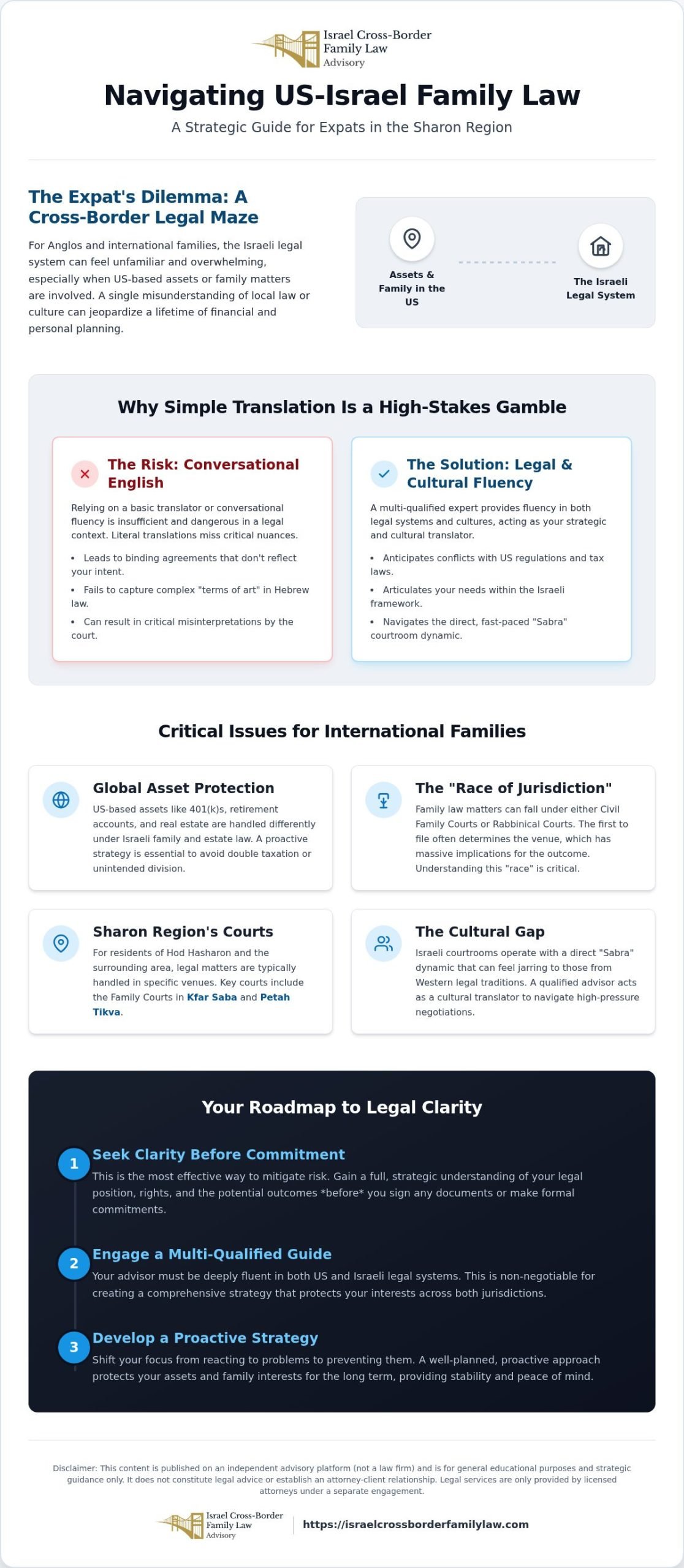
Strategic Advisory: Your Path to Legal Clarity in IL
Seeking clarity before making commitments is the most effective way to safeguard your future when living between two legal systems. In Israel, the weight of early decisions cannot be overstated; once a document is signed or a claim is filed, the legal trajectory is often set in stone. Whether you are drafting a prenuptial agreement to protect a US-based inheritance or structuring a financial settlement, you need to understand the long-term implications before you act. An english speaking family lawyer Hod Hasharon serves as a strategic partner, helping you identify these risks before they become permanent liabilities.
The Weight of Early Decisions
The “Race of Jurisdiction” remains one of the most critical factors in Israeli family law. For residents of the Sharon area, the decision to file in the Kfar Saba Family Court versus the Petah Tikva Rabbinical Court can fundamentally change how assets are divided. This choice is often the single most expensive decision made in a divorce. Because Israel recognizes no formal process for legal separation, couples must be particularly diligent when creating enforceable agreements regarding custody and assets. You should request a confidential case review to evaluate which path best serves your specific multi-jurisdictional needs. Understanding these nuances early prevents the emotional and financial drain of a contested process.
The Advisory Model vs. Traditional Law Firms
Traditional law firms often focus on the mechanics of representation, but an independent advisory platform prioritizes overarching strategy and risk mitigation. This model acts as a bridge between the emerging innovation hubs of the Sharon region and established global markets. Engaging an english speaking family lawyer Hod Hasharon through an advisory model ensures your Israeli legal strategy doesn’t inadvertently trigger tax penalties or jurisdictional conflicts in the United States. By focusing on decision-making guidance, this approach helps you manage the inherent complexity of cross-border issues without the pressure of immediate litigation. It ensures that your interests are protected by a steady guide who understands both the “Sabra” courtroom dynamic and Western corporate expectations.
Securing Your Cross-Border Future in the Sharon Region
Navigating the intersection of the Israeli legal system and US regulations requires more than just basic translation. It demands a sophisticated understanding of how local court decisions in Kfar Saba or Petah Tikva reverberate across international borders. By prioritizing strategic advisory over simple representation, you ensure that your assets and family rights remain protected under both jurisdictions. The weight of early decisions, particularly regarding the choice of court, can dictate your financial and personal outcomes for years to come.
Partnering with a specialized english speaking family lawyer Hod Hasharon provides the local accessibility and authoritative expertise necessary to bridge this cultural and legal gap. This specialized US-Israel family and corporate advisory focuses on risk mitigation and clear communication for the Anglo expat community. It’s about having a steady guide through a multi-jurisdictional landscape that often feels alien. Get clarity before you commit. Request a confidential consultation today to begin building your strategic legal roadmap.
Frequently Asked Questions
Why do I need an English-speaking lawyer if I live in Hod Hasharon?
You need an English-speaking lawyer to ensure that your specific intent is accurately translated into the Hebrew legal framework. While you may speak conversational Hebrew, the technical “terms of art” used in family and estate law are exceptionally complex. An english speaking family lawyer Hod Hasharon prevents “lost in translation” errors that could jeopardize your assets. This level of clarity is essential for understanding court orders from the Kfar Saba Family Court.
Can an Israeli lawyer handle my assets located in the United States?
An Israeli lawyer can manage these matters only if they possess multi-jurisdictional licensing or work with a specialized advisory that understands US property laws. Handling US-based retirement accounts or real estate during an Israeli divorce requires aligning Israeli court rulings with US tax and inheritance regulations. Without this cross-border expertise, you risk double taxation or the inability to enforce an Israeli decree in a US state court. It’s about bridging two distinct systems.
Are US prenuptial agreements enforceable in the Hod Hasharon courts?
US prenuptial agreements are generally recognized in Israel, but they aren’t automatically enforceable. The Israeli Family Court or Rabbinical Court must review the document to ensure it doesn’t conflict with local public policy. To be fully valid, the agreement often needs to be formally validated by an Israeli court, especially if it involves assets located within Israel. Seeking strategic advice early helps you understand if your US agreement requires a local “mirror” document for full protection.
How do I enforce a US child support order for a resident of Hod Hasharon?
Enforcing a US child support order involves a specific petition to the Family Court for a declaratory judgment or enforcement under international treaties. Israel recognizes foreign judgments if they meet criteria like proper jurisdiction and finality. You’ll need an Apostille on the original document, which costs approximately ₪38 per document as of 2026. This process ensures that the Sharon district courts recognize and enforce the financial obligations set abroad, protecting the child’s essential needs baseline.
What is the difference between an advisory platform and a traditional law firm?
An advisory platform focuses on overarching strategy, risk mitigation, and decision-making guidance rather than direct legal representation. While a traditional law firm manages the mechanics of a case, an advisory platform acts as a bridge between emerging innovation hubs and global markets. This model allows you to build a strategic roadmap before committing to litigation. Legal representation is provided by licensed attorneys under separate engagements, ensuring you have the right specialist for each specific jurisdiction.
Does the lawyer need to be physically located in Hod Hasharon to represent me?
While physical proximity isn’t a legal requirement, having an english speaking family lawyer Hod Hasharon or one in the nearby Sharon region offers significant advantages. Local presence facilitates faster document service and a deeper understanding of the Kfar Saba and Petah Tikva court dynamics. It also allows for in-person meetings, which are often more effective for discussing sensitive family or corporate matters. Local proximity ensures your legal team is accessible for urgent Sharon district filings.
How does the US-Israel tax treaty affect my business in Hod Hasharon?
The US-Israel tax treaty is designed to prevent double taxation on income earned by residents and businesses operating in both countries. For entrepreneurs in Hod Hasharon, this treaty dictates how corporate profits, dividends, and individual income are reported to the ITA and the IRS. Navigating these rules is essential for maintaining regulatory compliance while maximizing market opportunities. Strategic advisory helps you structure your business ventures to align with these complex, multi-jurisdictional tax obligations and reporting requirements.
What should I bring to my first legal consultation in Israel?
You should bring all relevant identity documents, existing court orders, and a comprehensive list of global assets. For family matters, this includes prenuptial agreements or previous divorce decrees from the US. If the case involves business interests, bring corporate governance documents and recent tax filings. Having these materials ready allows your advisor to identify potential jurisdictional conflicts and provide a clear roadmap. It’s the first step toward gaining total clarity before you make significant legal commitments.

Article by
Gabriel Lior
A Personal Journey That Became a Mission
The advisory was founded by an American father Gabriel Lior, LLB, MBA , global entrepreneur, and cross-border advisor who spent more than a decade navigating the Israeli family court system firsthand and now lives in Singapore with his son.
As a divorced parent in a cross-border family, Gabriel faced nearly every legal challenge a foreign parent can encounter in Israel — including child custody disputes, child support proceedings, property matters in Israel and abroad, false accusations, and complex immigration and relocation proceedings.
Over the years, he learned the hard way how difficult it is for non-Israeli parents to understand the system, identify the right legal strategy, and choose the right legal representation — especially when language, culture, and jurisdictional differences are involved. He also witnessed how foreign parents and new immigrants are often disadvantaged or taken advantage of by service providers and institutions simply because they lack local knowledge or fluency.
From Client to Advisor
To truly understand — and survive — the system, Gabriel pursued formal legal education in Israel, completing two Israeli law degrees, alongside a BA and MBA earned in the United States. This was never about becoming a practicing attorney, but about gaining a deep, structural understanding of how the system works — and where it breaks down for foreign parents.
This rare combination of:
Firsthand client experience
Israeli legal and US business education
International business and negotiation training
Decades of commercial execution
created a unique perspective – one that understands both sides of the table.
After years of litigation, persistence, and at times self-representation, he ultimately succeeded in securing custody of his son and relocating abroad through a rare legal victory in the Israeli Supreme Court — becoming one of the first fathers in Israel to do so under these circumstances.
Disclaimer
Important Disclaimer:
The information provided on this website and in its content is for general informational and educational purposes only and does not constitute legal advice, legal opinion, or legal representation.
Gabriel Lior is not licensed to practice law in Israel (nor is he interested in doing so) and does not provide legal services, despite having completed 2 Law Degrees. The services offered are advisory in nature and are intended to provide general guidance, strategic insight, and information regarding cross-border family law considerations.
No attorney-client relationship is formed by accessing this website, reading its content, or communicating with us.
Any decisions made based on this information are at your own discretion and risk. For legal advice specific to your situation, you should consult a licensed attorney in the relevant jurisdiction.
Where appropriate, we may refer clients to independent, licensed attorneys or professionals. Such referrals do not constitute legal representation and no liability is assumed for services provided by third parties.