This article is published on an independent advisory platform and does not constitute legal representation or an attorney-client relationship. Legal services are only provided by licensed attorneys under a separate engagement.
Could a child’s simple “no” be enough to halt a multi-year, cross-border career move or a family’s return to Israel? It’s a question that keeps many parents awake at night, especially when faced with the daunting reality of what if my child doesn’t want to move. You likely feel a deep sense of anxiety about how the Israeli legal system might intervene or whether your decision to relocate could inadvertently damage the bond you have worked so hard to build.
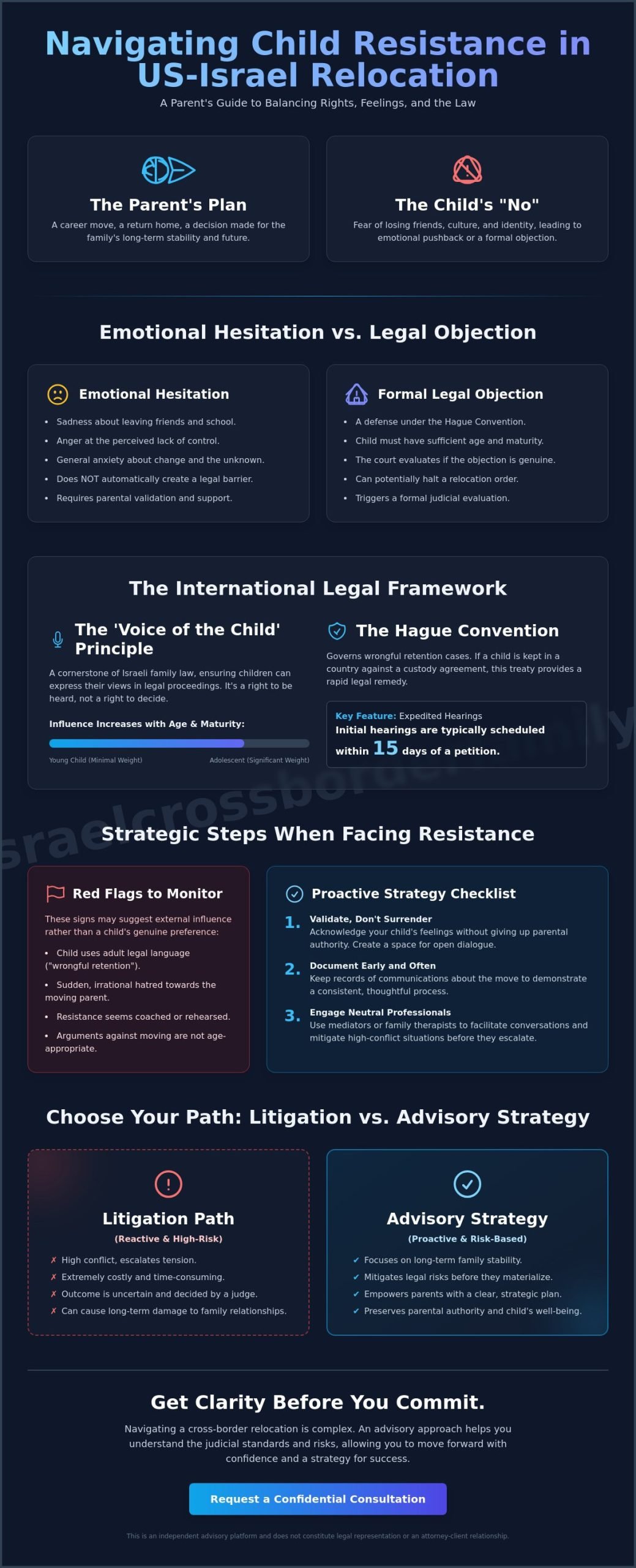
We understand that the intersection of family dynamics and international law is incredibly complex. In this guide, you’ll learn how Israeli courts balance parental rights with the “Voice of the Child” and the specific criteria used to evaluate a child’s objection. We will provide clarity on the risks of wrongful retention under the Hague Convention, where initial hearings are typically scheduled within 15 days of a petition. By understanding these judicial standards before you commit, you can navigate this transition with a clear strategy and a focus on your family’s long-term stability. Get clarity before you commit. Request a confidential consultation.
Key Takeaways
- Distinguish between a child’s emotional hesitation and a formal legal objection within the Israeli Family Court system to better align your relocation strategy.
- Understand how the “Voice of the Child” principle and the Best Interests of the Child (BIOC) standard influence judicial decisions in complex US-Israel matters.
- Evaluate the specific legal risks of wrongful retention and the “Child’s Objection” defense when navigating the concern of what if my child doesn’t want to move.
- Discover why a risk-based advisory strategy often provides more long-term stability for international families than pursuing a path of traditional litigation.
- Learn the importance of early documentation and neutral professional facilitation to mitigate the inherent complexities of cross-border family transitions.
This article is published on an independent advisory platform and does not constitute legal representation or an attorney-client relationship. Legal services are only provided by licensed attorneys under a separate engagement.
Understanding the Conflict: When Relocation Plans Meet Child Resistance
Relocation is rarely a unanimous family decision. When you ask yourself, what if my child doesn’t want to move, you are often dealing with a complex mix of emotional resistance and potential legal hurdles. It is vital to distinguish between a child being emotionally unwilling and a formal legal objection. While a child may express sadness or anger about leaving their friends, this does not automatically grant them a legal veto over a parent’s right to relocate. However, in cross-border situations between the US and IL, these feelings can escalate quickly if not managed with a clear strategy.
To better understand the dynamics of child resistance and how to respond constructively, watch this helpful video:
A move between the US and IL often amplifies a child’s sense of loss because it involves a complete shift in culture, language, and time zones. This perceived lack of control can lead to intense pushback. If a child’s resistance is sudden or seems coached, it may even lead to accusations of parental alienation by the other parent. Understanding the Hague Convention on the Civil Aspects of International Child Abduction is crucial here. This international treaty governs how courts handle children who are wrongfully retained against a legal custody agreement. You must find a way to validate your child’s feelings without surrendering your parental authority.
The Emotional Reality of Anglo Expats in Israel
English-speaking children often live in community bubbles in cities like Tel Aviv or Jerusalem. Moving away from these familiar environments can feel like losing their entire identity. The cultural differences between the US and IL are stark. A child used to the structured suburban life of the US might find the high-energy, direct nature of IL society overwhelming. Conversely, a child integrated into IL culture may struggle with the different social norms in the US. These factors significantly impact a child’s willingness to cooperate with a relocation plan.
Parental Authority vs. Child Autonomy
Family units are not democracies. Parents have the legal right to make major life decisions, including where the family lives. Still, Israeli courts are not indifferent to a child’s perspective. If you are considering international custody and relocation, you need a strategy before the child’s resistance becomes part of a court record. Look for red flags, such as a child using adult legal language or showing a sudden, irrational hatred toward the moving parent. These signs often suggest external influence rather than a genuine personal preference. Identifying these issues early allows you to address them through mediation or professional guidance rather than high-conflict litigation.
This article is published on an independent advisory platform and does not constitute legal representation or an attorney-client relationship. Legal services are only provided by licensed attorneys under a separate engagement.
The ‘Voice of the Child’ in the Israeli Family Court System
Israel is a signatory to the UN Convention on the Rights of the Child. This commitment has led to the “Voice of the Child” principle becoming a cornerstone of Israeli family law. It establishes that children have a fundamental right to express their views in legal proceedings that directly affect their lives. When parents ask what if my child doesn’t want to move, they must understand that the court views the child as an independent participant with their own interests, not merely an extension of the parents’ wishes.
The primary lens through which judges view these cases is the “Best Interests of the Child” (BIOC) standard. This is a comprehensive evaluation of the child’s physical, emotional, and social needs. It is not a fixed formula. Instead, it is a fact-specific inquiry into how a move to or from the US will impact the child’s stability and development. Professionals often look at the child’s integration into their current community versus the opportunities and support systems available in the new location.
The ‘Schonit’ Unit: How Israel Hears Children
Israeli courts utilize a specialized “Voice of the Child” unit, often referred to as the Schonit unit. This unit consists of trained social workers and psychologists who interview the child in a neutral, child-friendly setting. Their goal is to understand the child’s genuine feelings without the pressure of a courtroom or the presence of parents. They assess the child’s maturity and determine if their stated preference is a result of their own thoughts or parental influence. If you are preparing for such a process, developing a clear international custody and relocation strategy is essential to ensure the child’s perspective is presented accurately.
When a Child’s Objection Becomes a Legal Barrier
The weight a judge gives to a child’s “no” depends heavily on their age and developmental stage. While a 7-year-old’s refusal might be viewed as a temporary emotional reaction to change, a 14-year-old’s objection carries significant weight. In many cases involving older teenagers, the court may find it nearly impossible to force a relocation against their will. Independent will is the legal standard used by Israeli courts to assess whether a child’s expressed preference is authentic and free from parental influence or manipulation. If a child demonstrates this level of maturity, their refusal can become a formidable legal barrier to your relocation plans. If you are concerned about how these standards apply to your specific situation, you can reach out for a preliminary assessment. Get clarity before you commit. Request a confidential consultation.
This article is published on an independent advisory platform and does not constitute legal representation or an attorney-client relationship. Legal services are only provided by licensed attorneys under a separate engagement.
Cross-Border Risks: Refusal and the Hague Convention
When a parent asks what if my child doesn’t want to move, they usually focus on the emotional fallout within the home. However, in a cross-border context between the US and IL, a child’s refusal can quickly transform into a high-stakes legal dispute. If a child remains in Israel after a scheduled return to the US because they “refuse to board the plane,” the parent left behind may file a claim for wrongful retention. This triggers international treaties that prioritize the child’s swift return to their country of habitual residence, regardless of the child’s current preference.
Moving or keeping a child in a different country without explicit written consent or a formal court order is a significant risk. In the eyes of the law, a child’s “no” is not a valid substitute for legal authorization. You should review the legal frameworks surrounding international custody and relocation before making any commitments or travel arrangements. The Israeli legal system is highly efficient in these matters. An initial hearing for a Hague petition is typically scheduled within 15 days of filing, leaving very little time for a parent to build a defense without a pre-existing strategy.
The ‘Grave Risk’ Exception and Child Refusal
The Hague Convention includes a specific “Child’s Objection” defense. This allows a court to refuse a return order if the child objects and has reached an age and degree of maturity where it is appropriate to take their views into account. Still, the bar is exceptionally high. Israeli courts distinguish between a child’s preference and a formal legal objection. A simple desire to stay with friends or a preference for the Israeli school system is rarely enough to satisfy international treaty requirements. Judges also examine the “grave risk” exception, which applies if returning the child would expose them to physical or psychological harm. In 2021, approximately 2,757 Hague Convention applications were filed globally, demonstrating the prevalence of these complex multi-jurisdictional conflicts.
Preventing Legal Kidnapping Charges
Some parents believe that having primary custody means they can “just go” if the child resists returning to the other parent. This is a dangerous misconception. In US-Israel family law, “just going” is never a viable strategy. It can lead to criminal abduction charges or a court-ordered return. You must obtain a formal Relocation Order from the Israeli Family Court before leaving IL. This process provides the legal clarity needed to move without the threat of a Hague petition. For a deeper understanding of these risks, see our overview of the Hague Convention and child abduction. Get clarity before you commit. Request a confidential consultation.
This article is published on an independent advisory platform and does not constitute legal representation or an attorney-client relationship. Legal services are only provided by licensed attorneys under a separate engagement.
Strategic Steps When Relocation Plans Meet Resistance
When you are confronted with the question of what if my child doesn’t want to move, your approach must shift from emotional reaction to calculated strategy. This transition requires building a documented foundation that justifies the relocation as being in the child’s best interests. You should compile concrete evidence regarding career advancements, the presence of supportive extended family in Israel, and the specific cost of living benefits. Engaging a neutral professional, such as a parental coordinator or a specialized therapist familiar with cross-border dynamics, can help facilitate a dialogue that feels less like a confrontation and more like a family transition.
Consider exploring trial periods or robust visitation schedules that allow the child to acclimate to their new environment gradually. An advisory review can help you assess the “legal temperature” of your child’s refusal and determine if their objections meet the threshold of independent will. A comprehensive Parenting Plan should address the child’s specific fears, such as losing contact with a parent or social circle. By addressing these concerns in a formal document, you demonstrate to the court that you are prioritizing the child’s stability. Understanding how the advisory process works can provide the framework needed for these early decisions.
Mediation vs. Litigation in IL
Israel utilizes a mandatory “Settlement of Dispute” process that requires parents to attempt mediation before proceeding to high-conflict litigation. This phase is critical because it prevents the child from being caught in the middle of a courtroom battle. While the filing fee for a child custody claim in an Israeli Family Court is 417 NIS as of January 2026, the emotional cost of litigation is far higher. A collaborative approach ensures the child is not treated like a witness, which helps preserve the parent-child bond. A structured financial agreement for cross-border travel should be part of this negotiation to ensure visitation remains a practical reality.
Preparing the Child for the Move
Practical steps are essential to maintain the child’s connection to their current life. Use technology for frequent video calls and plan regular travel back to the US to mitigate the fear of permanent loss. Developing an early legal strategy prevents the child from becoming a pawn in court by ensuring that the relocation is framed as a structured family plan rather than a unilateral parental demand. If you are ready to evaluate your options, you can schedule an advisory review to gain clarity on your next steps. Get clarity before you commit. Request a confidential consultation.
This article is published on an independent advisory platform and does not constitute legal representation or an attorney-client relationship. Legal services are only provided by licensed attorneys under a separate engagement.
Gaining Clarity: The Advisory Approach to International Relocation
Traditional litigation often operates as a blunt instrument in the delicate environment of international relocation. While a court can issue a ruling, it cannot repair a fractured parent-child bond or resolve the underlying cultural friction that often fuels a child’s resistance. This is particularly true in divorce and separation for international families, where the stakes involve multiple jurisdictions and conflicting legal philosophies. When you reach the point of asking what if my child doesn’t want to move, the situation has already progressed beyond simple parenting challenges. It requires a sophisticated, risk-based strategy.
Before you file any court papers in IL, you must understand the long-term impact of early judicial intervention. A cross-border advisory helps you navigate the significant differences between the US and IL legal systems, ensuring that your decisions are based on data and strategy rather than emotion. With Hague Convention decisions in Israel typically issued within 45 to 90 days, there is no room for error once a case is filed. Success depends on making informed choices before the legal system takes over the narrative of your family’s move.
The Value of an Independent Perspective
An independent advisory provides a global view that traditional local counsel may overlook. By learning more about the advisory model, families can reduce the intense anxiety that often accompanies a relocation threat. The goal is to move away from “winner-takes-all” court battles and toward a collaborative solution that respects the child’s perspective while achieving the parents’ objectives. Strategy allows you to anticipate how the Schonit unit or a Hague petition might unfold; this gives you the power to pivot before a legal catastrophe occurs.
Next Steps for Your Family
Clarity is your most valuable asset. You should never make firm commitments to employers or enroll children in schools until you have assessed the legal feasibility of the move. A confidential review of your situation allows you to identify red flags and hidden risks early in the process. This proactive approach ensures that your family’s transition is built on a foundation of legal security and emotional awareness. Get clarity before you commit. Request a confidential consultation.
This article is published on an independent advisory platform and does not constitute legal representation or an attorney-client relationship. Legal services are only provided by licensed attorneys under a separate engagement.
Securing Your Family’s Cross-Border Future
Successful relocation between the US and Israel requires more than just logistical planning; it demands a sophisticated understanding of how the Israeli Family Court weighs a child’s preference against parental rights. You’ve seen that while a child’s preference is a significant factor, it is rarely an absolute veto. Navigating the “Voice of the Child” and avoiding the severe risks of a Hague Convention dispute requires a strategy that prioritizes family stability over courtroom conflict.
Our advisory approach leverages specialized expertise in US-Israel cross-border law and a deep understanding of the unique “Anglo” expat experience in Israel. We focus on a calm, strategy-first methodology to protect your parent-child bond and your legal standing. If you are struggling with the question of what if my child doesn’t want to move, don’t leave the outcome to chance. Early strategy is the most effective way to avoid the pitfalls of traditional litigation and ensure a seamless transition for your family. Get clarity before you commit. Request a confidential consultation today to move forward with confidence.
This article is published on an independent advisory platform and does not constitute legal representation or an attorney-client relationship. Legal services are only provided by licensed attorneys under a separate engagement.
Frequently Asked Questions
Can a 12-year-old child refuse to move in Israel?
A 12-year-old cannot unilaterally veto a relocation, but their opinion carries significant weight in the Israeli Family Court. Judges evaluate the child’s maturity and determine if their objection represents a genuine “independent will.” While parents retain decision-making authority, the court is unlikely to ignore a consistent, well-reasoned refusal from a pre-teen. A successful move requires a strategy that aligns the child’s preferences with the legal best interests standard.
What happens if I move my child to the US without the other parent’s consent?
Moving a child without explicit written consent or a court order is classified as wrongful removal under the Hague Convention. This action often triggers an immediate petition for the child’s return to Israel. Legal proceedings move rapidly; initial hearings are typically scheduled within 15 days of filing according to the Israeli Judicial Authority. You risk facing criminal abduction charges and a court-ordered return, which can severely damage your future relocation claims.
How much does the ‘Voice of the Child’ unit influence an Israeli judge?
The report from the specialized “Schonit” unit is highly influential and often serves as a primary guide for the judge’s decision. These neutral social workers and psychologists are trained to identify whether a child’s preference is authentic or the result of parental pressure. Their assessment of the child’s emotional state and developmental needs provides the court with the professional foundation required to rule on complex cross-border relocation matters.
Is a child’s preference the same as the ‘Best Interests of the Child’?
No, a child’s preference is just one of many factors used to determine the “Best Interests of the Child” (BIOC). While the court listens to what the child wants, it must also consider their long-term stability, educational opportunities, and the ability to maintain relationships with both parents. A judge may approve a move even if a child objects, provided the evidence shows the relocation offers a superior environment for the child’s overall growth.
Can I be charged with child abduction if my child wants to stay in Israel?
Yes, you can be charged with “wrongful retention” if you keep a child in Israel past an agreed-upon date, regardless of the child’s wishes. The law prioritizes legal custody agreements over a child’s stated desire to stay. If you are asking what if my child doesn’t want to move back to the US after a visit, you must obtain a legal extension or court order. Failing to do so can lead to a Hague Convention petition.
How do Israeli courts handle relocation when the child is an Anglo expat?
Israeli courts consider the specific cultural and social integration of Anglo expat children, including their reliance on English-speaking “community bubbles.” Judges examine how a move will disrupt the child’s social network in cities like Tel Aviv or Jerusalem versus the benefits of moving to the US. The court’s focus remains on minimizing the sense of loss and ensuring the child can adapt successfully to the new cultural environment without losing parental bonds.
What if my child is being influenced by the other parent to stay?
If the court suspects a child is being coached or influenced, it may discount their stated preference. Professionals in the Voice of the Child unit look for red flags, such as a child using adult legal terminology or showing irrational hostility toward the moving parent. When a child’s refusal lacks a foundation in their own experience, the court often concludes that the objection does not represent their true independent will.
Can a US court order my child to return if they are already in Israel?
A US court can issue a return order, but its enforcement within Israel is governed by the Hague Convention. The parent seeking the return must file a petition in the Israeli Family Court to have the US order recognized and enforced. This process involves a specific legal timeline, with final decisions typically expected within 45 to 90 days. It is a complex multi-jurisdictional matter that requires a coordinated strategy across both legal systems.

Article by
Gabriel Lior
A Personal Journey That Became a Mission
The advisory was founded by an American father Gabriel Lior, LLB, MBA , global entrepreneur, and cross-border advisor who spent more than a decade navigating the Israeli family court system firsthand and now lives in Singapore with his son.
As a divorced parent in a cross-border family, Gabriel faced nearly every legal challenge a foreign parent can encounter in Israel — including child custody disputes, child support proceedings, property matters in Israel and abroad, false accusations, and complex immigration and relocation proceedings.
Over the years, he learned the hard way how difficult it is for non-Israeli parents to understand the system, identify the right legal strategy, and choose the right legal representation — especially when language, culture, and jurisdictional differences are involved. He also witnessed how foreign parents and new immigrants are often disadvantaged or taken advantage of by service providers and institutions simply because they lack local knowledge or fluency.
From Client to Advisor
To truly understand — and survive — the system, Gabriel pursued formal legal education in Israel, completing two Israeli law degrees, alongside a BA and MBA earned in the United States. This was never about becoming a practicing attorney, but about gaining a deep, structural understanding of how the system works — and where it breaks down for foreign parents.
This rare combination of:
Firsthand client experience
Israeli legal and US business education
International business and negotiation training
Decades of commercial execution
created a unique perspective – one that understands both sides of the table.
After years of litigation, persistence, and at times self-representation, he ultimately succeeded in securing custody of his son and relocating abroad through a rare legal victory in the Israeli Supreme Court — becoming one of the first fathers in Israel to do so under these circumstances.
Disclaimer
Important Disclaimer:
The information provided on this website and in its content is for general informational and educational purposes only and does not constitute legal advice, legal opinion, or legal representation.
Gabriel Lior is not licensed to practice law in Israel (nor is he interested in doing so) and does not provide legal services, despite having completed 2 Law Degrees. The services offered are advisory in nature and are intended to provide general guidance, strategic insight, and information regarding cross-border family law considerations.
No attorney-client relationship is formed by accessing this website, reading its content, or communicating with us.
Any decisions made based on this information are at your own discretion and risk. For legal advice specific to your situation, you should consult a licensed attorney in the relevant jurisdiction.
Where appropriate, we may refer clients to independent, licensed attorneys or professionals. Such referrals do not constitute legal representation and no liability is assumed for services provided by third parties.