The most loving conversation you have with your children could become the most dangerous piece of evidence against you in an Israeli family court. When navigating a complex cross-border separation, even well-intentioned words can be misinterpreted as a threat of international child abduction, triggering difficult Hague Convention proceedings.
Your primary goal is, and should be, to protect your children’s emotional stability during this transition. You naturally want to be open and reassuring, especially when grappling with the challenges of maintaining family connections across different cultures, time zones, and legal systems.
This guide offers a strategic framework for explaining divorce to children living abroad that prioritizes their well-being while mitigating your legal exposure. We will help you navigate the nuanced expectations of both the Israeli Rabbinical and Civil courts to ensure your communication is seen as supportive, not subversive.
Inside, you’ll find a clear roadmap for structuring the "divorce talk," practical advice for sustaining a strong parent-child bond from afar, and a definitive explanation of the difference between legal relocation and international visitation rights.
Key Takeaways
Develop a clear strategy for explaining divorce to children living abroad that accounts for the unique challenges of families separated by international jurisdictions.
Learn how to tailor your message about the separation to your child’s specific age and maturity level, from toddlers to teenagers.
Understand the critical legal risks associated with relocation and the Hague Convention before making any informal promises to your children about moving.
Implement a practical communication plan to maintain a consistent presence in your child’s life, creating a stable "two-home" feeling despite the distance.
Table of Contents
Age-Appropriate Strategies for Explaining International Separation
Legal Realities: Relocation, Visitation, and Hague Convention Risks
The Unique Challenges of Cross-Border Divorce for Children
This article is provided by Israel Cross Border Law Firm, focusing on strategy, risks, and decision-making guidance for families navigating international divorce.
A cross-border divorce occurs when a family unit is separated by international borders and subject to multiple legal jurisdictions, for example, between the United States and Israel. For parents, the conversation about separation is no longer about one parent moving to a new apartment across town. It may involve a fundamental change in country, culture, school system, and even primary language. This complexity elevates the task of explaining divorce to children living abroad from a difficult conversation to a critical strategic exercise with long-term consequences for a child’s stability and sense of belonging.
Children often have a surprisingly direct perspective on these adult issues. The video below offers insight into how kids process the concept of divorce.
The Intersection of Emotion and International Law
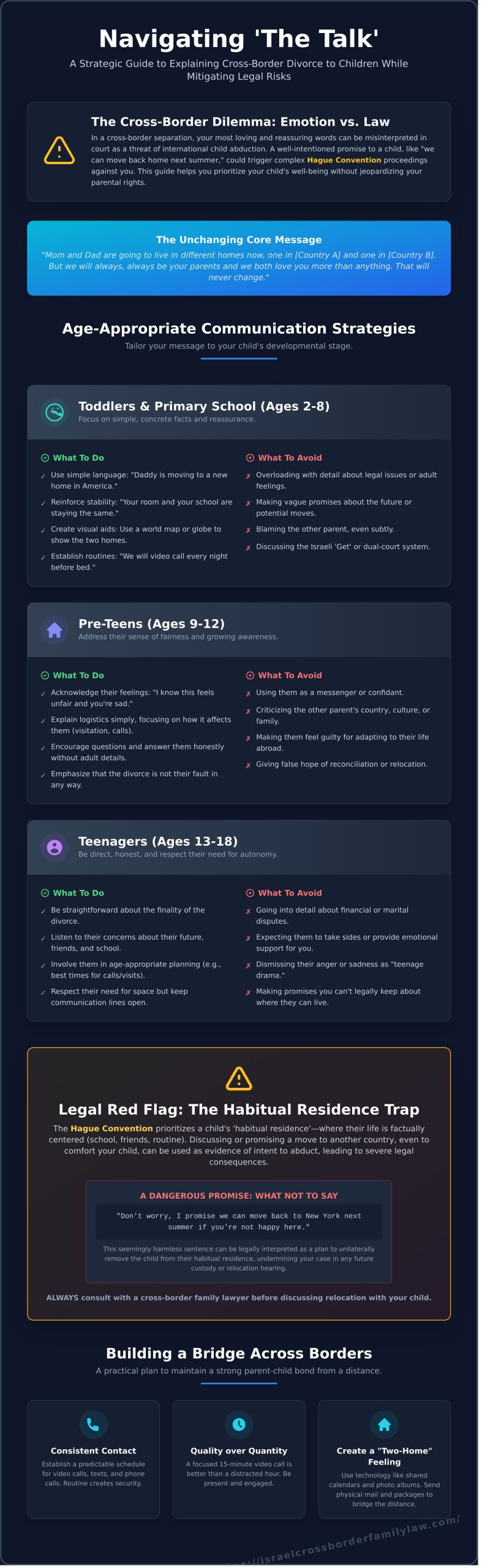
Your first conversation with your child is emotionally charged, but in a cross-border context, it also carries significant legal weight. An offhand promise made to comfort a child, such as, "Don’t worry, we can move back to New York next summer," could be presented as evidence in a future custody or relocation hearing. It’s critical for parents to present a unified and carefully considered message, even when separated by thousands of miles and multiple time zones. Before making any promises about moving, you must understand the legal principle of the child’s ‘habitual residence’. This concept is a cornerstone of international matrimonial law and often determines which country’s courts have jurisdiction over custody. It refers to where the child’s life is factually centered, including their school, friends, and daily routine, not just their passport country.
Avoiding the "Get" Confusion in International Families
For many ‘Anglo’ expat families, the Israeli divorce process itself is a source of confusion. In most Western countries, divorce is a purely civil matter. In Israel, however, Jewish citizens must navigate a two-tiered system: the civil family court for matters like finances and the religious rabbinical court for the formal dissolution of the marriage, known as a ‘Get’. This can sound intimidating, but it’s best explained to children in simple, reassuring terms. You might say, "In Israel, Mom and Dad have to sign two sets of papers to finalize everything. One is for the country, and one is for our Jewish tradition." This approach distinguishes the civil process from the religious requirement, providing a sense of finality and security for children despite the unfamiliar dual-court system.
Navigating the Israeli legal system while trying to maintain familiar Western parenting norms is a significant challenge. The initial conversation is the foundation for the entire process that follows. A strategic, informed approach to explaining divorce to children living abroad protects their emotional well-being and preserves your parental rights. It requires prioritizing clarity and a well-defined strategy over immediate, emotion-driven reactions.
For strategic guidance on your cross-border divorce, contact Israel Cross Border Law Firm to request a confidential consultation.
Age-Appropriate Strategies for Explaining International Separation
Communicating a family separation across borders requires a carefully calibrated approach. The core message of love and stability remains constant, but the delivery must align with a child’s cognitive and emotional development. Effectively explaining divorce to children living abroad is not a single conversation; it is an ongoing dialogue that evolves as they grow. The goal is to provide clarity and security, ensuring they understand the logistical changes without feeling the weight of adult legal or emotional burdens.
Toddlers and Primary School Children (Ages 2-8)
For young children, the world is concrete and centered on their immediate environment. Abstract concepts like distance and time zones are difficult to grasp. Your explanation should focus on simple, tangible facts that reinforce stability.
Use Concrete Language: Avoid ambiguity. Instead of saying, "Ima is moving far away," be specific: "Ima is going to live in London, which is a city in a different country. You will stay here in our home in Tel Aviv." Follow this with a predictable schedule for contact: "We will video chat with her every night before bed."
Reinforce Routine: A child’s sense of security is tied to their daily life. Reassure them about what is not changing. "Your gan, your friends, your toys, and your bed are all staying right here. I will still take you to the park on Shabbat."
Make it Tangible: Use visual aids. A large world map can help them see Israel and the other parent’s new country. A dedicated calendar with stickers marking video calls and future visits makes the concept of time and connection visible. A "transitional object," like a special stuffed animal that travels with them on visits, can provide comfort and a physical link between their two homes.
Tweens and Teenagers (Ages 9-18)
Older children require more sophisticated explanations. They are capable of abstract thought, will ask probing questions about the "why," and have a strong sense of fairness. Honesty, respect, and clear boundaries are critical when navigating this conversation.
Address the ‘Why’ Honestly: You don’t need to share every detail of the marital breakdown, but a simple, unified, and non-blaming reason is necessary. For example, "Your father and I have realized we want different things in life and can be better parents living apart." Blaming one parent creates loyalty conflicts that are deeply damaging.
Respect Their Autonomy (Within Limits): Invite them to share their preferences regarding international visitation schedules. However, it’s vital to explain that final decisions must comply with legal agreements and international law. You can frame this as a shared responsibility: "While we want to hear your thoughts on visiting during the summer or chagim, both parents must follow the rules set by the court. These rules are based on international agreements, and resources from the U.S. State Department abduction prevention program help explain why these legal structures are in place to protect everyone."
Manage Digital Communication: Acknowledge that they will have private communication with the other parent via text or social media. Encourage this connection but establish reasonable boundaries. This includes respecting family time when they are with you and ensuring they know they can come to you if any online conversation makes them uncomfortable.
Finally, you will inevitably face questions about legal processes, such as visa applications or court dates. It’s crucial to be honest without making your child feel like a ‘case number’. Instead of detailing bureaucratic frustrations, frame it simply: "The paperwork for the move is complex and is taking some time to complete, but both of us are working on it." This protects them from anxiety while acknowledging the reality of the situation. Understanding how to frame these complex legal realities is a key part of building a successful cross-border co-parenting plan from the very beginning.
Legal Realities: Relocation, Visitation, and Hague Convention Risks
While your focus is rightly on your children’s emotional well-being, the conversations you have must be grounded in legal reality. For international families in Israel, discussions about moving "home" are not just sensitive; they are governed by complex international treaties and the strict oversight of the Israeli family court. Making promises you cannot legally keep can create profound disappointment for your children and severe legal consequences for you.
A premature conversation about moving, based on an informal agreement or one parent’s hope, is a significant risk. If the other parent objects or legal permission is not granted, you will be forced to walk back your promises, causing confusion and eroding your child’s trust. The challenge of explaining divorce to children living abroad is therefore inseparable from understanding the legal framework that dictates their future.
The Risk of Unilateral Decisions
The desire to return to one’s country of origin with the children is a powerful and understandable impulse. However, one parent cannot simply decide to take the children and leave Israel. Doing so without the explicit, written consent of the other parent or a specific order from the Israeli family court constitutes parental kidnapping. The court’s primary mandate is to protect the child’s best interests, which often involves maintaining stability and access to both parents. Navigating the legal protocols is a non-negotiable first step in any discussion about relocation. These legal frameworks are a core component of managing divorce and separation for international families and must be respected.
A particularly dangerous scenario involves the Hague Convention on the Civil Aspects of International Child Abduction, to which both Israel and the United States are signatories. If you take your child to the U.S. for a "vacation" and then refuse to return, the other parent can initiate a Hague Convention case. The Convention’s purpose isn’t to decide custody; its goal is the immediate return of the child to their country of habitual residence-Israel-so the Israeli courts can make that determination. This treaty turns what you might see as a simple trip into a potential case of international child abduction.
Defining Visitation Across Borders
A well-structured plan provides the stability children need. Instead of vague promises, a legally binding agreement offers clarity. A common arrangement involves the children spending the school year in Israel and having extended visits, such as summer and holidays, in the United States. This provides a predictable rhythm to their lives. To ensure this plan is followed, it’s critical to obtain "mirror orders." An Israeli custody order is not automatically enforceable in the U.S. A mirror order is a corresponding judgment from a U.S. court that recognizes and enforces the terms of the Israeli agreement, making your visitation rights secure across borders. Securing these enforceable orders is a critical step in any successful plan for international custody and relocation.
Ultimately, a detailed, court-approved strategy must be in place before you begin explaining divorce to children living abroad and the changes it will bring. Clarity comes before commitment. Your legal plan is the foundation upon which all family conversations should be built. It protects you, it provides certainty for your co-parent, and most importantly, it gives your children the security of a clear and predictable future.
A Practical Communication Plan for Long-Distance Parenting
Once the legal framework is established, the focus must shift to the day-to-day realities of co-parenting between jurisdictions like the United States and Israel. A structured communication plan is not a mere suggestion; it is the essential architecture for maintaining a strong parent-child relationship across thousands of miles. This plan provides the predictability and security children need, transforming abstract legal agreements into a tangible, loving presence. A robust plan is a critical component of explaining divorce to children living abroad, as it demonstrates through action that both parents remain fully engaged in their lives.
The goal is to create a ‘Two-Home’ philosophy where the child feels a genuine sense of belonging in both countries. This means having a dedicated space, however small, in the non-custodial parent’s home-a bed, a drawer for their clothes, and familiar toys. This physical anchor reinforces the message that they are not a visitor but a cherished member of both households.
Leveraging Technology for Connection
Creating a digital bridge requires more than occasional video calls. It demands a proactive strategy to integrate the distant parent into the child’s daily life. Standardize call times to align with the child’s routine in Israel, such as a call from the US parent in their morning that coincides with the child’s bedtime story. Go beyond passive conversation; use technology for shared activities like playing online chess, watching a movie simultaneously using a streaming party service, or reading a book together chapter by chapter. Handling the ‘time zone math’ is the responsibility of the parent abroad; the child should never feel like an afterthought.
Watch: For deeper insights into the legal and practical aspects of cross-border parenting, the Israel Family Law YouTube Channel offers valuable perspectives.
The Importance of Consistency
Children thrive on routine. When rules regarding screen time, homework, and bedtimes are similar in both the US and Israeli homes, it dramatically reduces the stress of transitioning between households. This consistency creates a single, unified parenting front. Co-parenting applications like OurFamilyWizard or 2houses are invaluable tools for this, centralizing schedules, expense tracking, and communication. They keep the focus on the child’s needs and help manage logistics, which is particularly vital when dealing with complex issues like child support cross-border enforcement, ensuring financial obligations are met with clarity and transparency.
Maintaining cultural continuity is also a key part of this plan. The parent in the US can enroll the child in a local Hebrew class or celebrate Israeli holidays, while the parent in Israel can ensure the child maintains connections to American culture. This dual heritage is a gift, not a complication.
Finally, managing the ‘airport handover’ requires careful planning to reduce anxiety. Create a predictable ritual for departures and arrivals. Ensure the child travels with a comfort item. A clear plan for who is picking them up and a scheduled call shortly after they land provides immense reassurance. These thoughtful strategies are fundamental to successfully navigating a multi-jurisdictional family life.
A well-executed communication and logistics plan provides the stability your child needs to thrive across two homes and two cultures. Get clarity on building a resilient cross-border parenting strategy.
Gaining Clarity: Your Strategy for a Cross-Border Future
For international families, particularly those with ties to both the US and Israel, the standard Israeli divorce process is often inadequate. The system is not inherently designed to manage the sophisticated financial, legal, and custodial challenges that span two continents and two distinct legal frameworks. This is where an advisory approach becomes essential. Moving forward without a comprehensive cross-border strategy can expose your family to unforeseen risks, turning a difficult transition into a multi-jurisdictional crisis.
The objective is to shift from a state of confusion to a structured, forward-looking plan. This isn’t merely about filing paperwork with the Rabbanut or Family Court. It’s about building a durable framework that safeguards your children’s emotional health and financial security. A strategic plan anticipates challenges related to international travel, relocation rights under the Hague Convention, enforcement of support orders across borders, and the tax implications in both countries. A well-devised strategy provides the stability required for effectively explaining divorce to children living abroad, giving them the reassurance they need during a period of profound change.
Clarity Before You Commit
Traditional litigation-first models often escalate conflict and expense before a clear picture of the cross-border complexities has even been established. An independent advisory platform operates differently. We focus on a comprehensive analysis of your unique situation to identify risks and opportunities before you commit to a specific legal path. Preparing for an initial consultation involves gathering key documents, such as passports for all family members, visa information, and financial statements from both your Israeli and US accounts. Understanding how it works can help you organize your information to maximize the value of this strategic overview.
Next Steps for Your Family
We encourage a calm, neutral, and information-gathering approach for the next 90 days. This period is critical for setting the tone of your transition. Avoid reactive decisions or confrontational communication. Instead, focus on understanding your options and the long-term consequences of each potential action. Your primary goal is to build a foundation for a stable co-parenting future, which is the most critical element in successfully explaining divorce to children living abroad and helping them adapt.
This is about strategic risk mitigation, not just legal procedure. By identifying hidden liabilities in your specific US-Israel situation, you can navigate your divorce with confidence and control. Get clarity before you commit. We invite you to request a confidential case review to assess your situation. For more immediate guidance on your strategic options, you can also reach out via WhatsApp.
Navigating Your Family’s Cross-Border Future with Confidence
Successfully managing a cross-border separation hinges on two core principles: a united communication front and a clear understanding of international law. Your children need consistent, age-appropriate answers, which is the foundation of explaining divorce to children living abroad. Equally important is recognizing the legal realities of relocation and visitation before any decisions are made, as proactive planning is the most effective strategy to mitigate potential Hague Convention risks.
This isn’t just about legal procedure; it’s about building a stable, long-term strategy for your family. Our advisory approach is designed specifically for US-Israel international families, focusing on comprehensive risk mitigation and Hague Convention prevention. We help you understand the complexities of the multi-jurisdictional system so you can make informed choices.
Get clarity before you commit. Request a confidential consultation. With a clear strategy in place, you can build a secure and positive new chapter for your family, no matter where you live.
Frequently Asked Questions
How do I explain to my child that one parent is moving to another country?
Start with a simple, honest, and age-appropriate message, reassuring them they are loved by both parents. It’s crucial to state that the move is an adult decision and not their fault. Use a globe or map to show the new location and create a clear plan for staying in touch. Detailing a schedule for video calls and future visits helps manage their expectations, which is a key part of explaining divorce to children living abroad.
Can my spouse stop me from taking the children to visit family abroad during the divorce?
Yes, your spouse can legally prevent international travel with your children during divorce proceedings in Israel. If one parent objects, they can petition the Family Court for a "stay of exit" order. To get permission to travel, you’ll likely need to provide a detailed itinerary and financial guarantees, such as a bank guarantee of ₪50,000 to ₪100,000, to ensure the children’s timely return to Israel.
What happens if my child doesn’t want to go on international visitation?
A child’s refusal to attend a court-ordered international visit must be addressed formally, as the order is legally binding. Israeli courts will consider the wishes of an older child, but they will first investigate the reasons behind the refusal. The court may appoint a social worker to assess if the child is being improperly influenced. The goal is always to find a solution that supports the parent-child relationship, not to punish a reluctant child.
Is it better to tell the children together or separately in a cross-border situation?
It’s almost always better to tell your children about the divorce together, as a united parental front. This approach provides a powerful message of security and shows that you can still cooperate for their well-being, even when living apart. Presenting the information together helps establish a healthy foundation for co-parenting across thousands of miles and prevents the child from feeling caught between two conflicting stories or parents.
How do I handle the time zone difference when my kids want to talk to their other parent?
Establish a clear and predictable communication schedule in your parenting agreement that accounts for both time zones. For example, specify certain weekdays for after-school calls that align with the other parent’s morning. Use shared calendar apps to track the schedule. While a routine is vital for stability, it’s also important to be flexible and facilitate spontaneous calls when possible to foster a strong connection between your child and the other parent.
What should I do if my child is afraid they won’t come back from a trip to the US?
You should acknowledge your child’s fear directly and provide concrete, tangible reassurance. Explain that court orders in both Israel and the US legally require their return. Show them their round-trip ticket and talk about specific, fun plans for when they get back to Israel. If the anxiety continues, consider engaging a child therapist who specializes in cross-border family issues to provide professional support and coping strategies.
Can I use an international move as a reason to change our custody agreement?
Yes, a significant international relocation is considered a "material change of circumstances" in Israel, which is a valid reason to petition the court to modify a custody agreement. The court’s decision will be based entirely on the child’s best interests. It will assess the reasons for the move, the child’s ties to each country, and the specific plan proposed for maintaining a strong and consistent relationship with the non-relocating parent.
How do I explain the Israeli Rabbinical court process to an older child?
Explain that the Rabbinical court, known as the Beit Din, is the specific court in Israel responsible for marriage and divorce for Jewish citizens. Describe it as a formal process involving three religious judges (dayanim) who follow Jewish law to issue the divorce document, called a Get. Reassure your teen that while the Beit Din officially ends the marriage, the Family Court handles all decisions regarding their custody and well-being.

Article by
Gabriel Lior
A Personal Journey That Became a Mission
The advisory was founded by an American father Gabriel Lior, LLB, MBA , global entrepreneur, and cross-border advisor who spent more than a decade navigating the Israeli family court system firsthand and now lives in Singapore with his son.
As a divorced parent in a cross-border family, Gabriel faced nearly every legal challenge a foreign parent can encounter in Israel — including child custody disputes, child support proceedings, property matters in Israel and abroad, false accusations, and complex immigration and relocation proceedings.
Over the years, he learned the hard way how difficult it is for non-Israeli parents to understand the system, identify the right legal strategy, and choose the right legal representation — especially when language, culture, and jurisdictional differences are involved. He also witnessed how foreign parents and new immigrants are often disadvantaged or taken advantage of by service providers and institutions simply because they lack local knowledge or fluency.
From Client to Advisor
To truly understand — and survive — the system, Gabriel pursued formal legal education in Israel, completing two Israeli law degrees, alongside a BA and MBA earned in the United States. This was never about becoming a practicing attorney, but about gaining a deep, structural understanding of how the system works — and where it breaks down for foreign parents.
This rare combination of:
Firsthand client experience
Israeli legal and US business education
International business and negotiation training
Decades of commercial execution
created a unique perspective – one that understands both sides of the table.
After years of litigation, persistence, and at times self-representation, he ultimately succeeded in securing custody of his son and relocating abroad through a rare legal victory in the Israeli Supreme Court — becoming one of the first fathers in Israel to do so under these circumstances.
Disclaimer
Important Disclaimer:
The information provided on this website and in its content is for general informational and educational purposes only and does not constitute legal advice, legal opinion, or legal representation.
Gabriel Lior is not licensed to practice law in Israel (nor is he interested in doing so) and does not provide legal services, despite having completed 2 Law Degrees. The services offered are advisory in nature and are intended to provide general guidance, strategic insight, and information regarding cross-border family law considerations.
No attorney-client relationship is formed by accessing this website, reading its content, or communicating with us.
Any decisions made based on this information are at your own discretion and risk. For legal advice specific to your situation, you should consult a licensed attorney in the relevant jurisdiction.
Where appropriate, we may refer clients to independent, licensed attorneys or professionals. Such referrals do not constitute legal representation and no liability is assumed for services provided by third parties.