This article is published on an independent advisory platform and is not a law firm. The information provided is for educational and advisory purposes only and does not constitute legal representation or an attorney-client relationship. Legal services are only provided by licensed attorneys under a separate engagement.
What if the legal document that establishes your parentage in a surrogacy-friendly state like Michigan or Hawaii is the same document that causes citizenship delays at the Israeli Ministry of Health? Most international families realize that navigating surrogacy laws us-israel requires more than just medical matching; it demands a bridge between Israel’s centralized national regulations and the decentralized, state-level diversity of the US. You likely feel the weight of this complexity already, especially when faced with the conflicting requirements of two different legal systems and cultures.
This guide provides a clear understanding of the legal intersection between these jurisdictions to protect your family’s future and ensure a path to legal parenthood. We’ll examine eligibility requirements for Israeli residents, the roadmap for securing status and citizenship, and risk mitigation strategies to help you make informed choices through strategy and risk-based decision-making. Get clarity before you commit. Request a confidential consultation.
Key Takeaways
- Understand the fundamental differences between Israel’s centralized Embryo Carrying Agreements Law and the decentralized, state-led legal landscape of the US.
- Compare the regulated cost structures in IL against the market-driven fees in the US to better manage your family’s financial planning.
- Identify the specific residency and genetic link requirements essential for successfully navigating surrogacy laws us-israel without citizenship delays.
- Learn the necessary steps for securing a Consular Report of Birth Abroad and establishing immediate legal status for your newborn in both jurisdictions.
- Discover how early strategic planning and risk mitigation can protect your parental rights before you sign any formal carriage agreements.
This article is published on an independent advisory platform and is not a law firm. The information provided is for educational and advisory purposes only and does not constitute legal representation or an attorney-client relationship. Legal services are only provided by licensed attorneys under a separate engagement.
The Legal Framework: Israel’s Surrogacy Law vs. US State Regulations
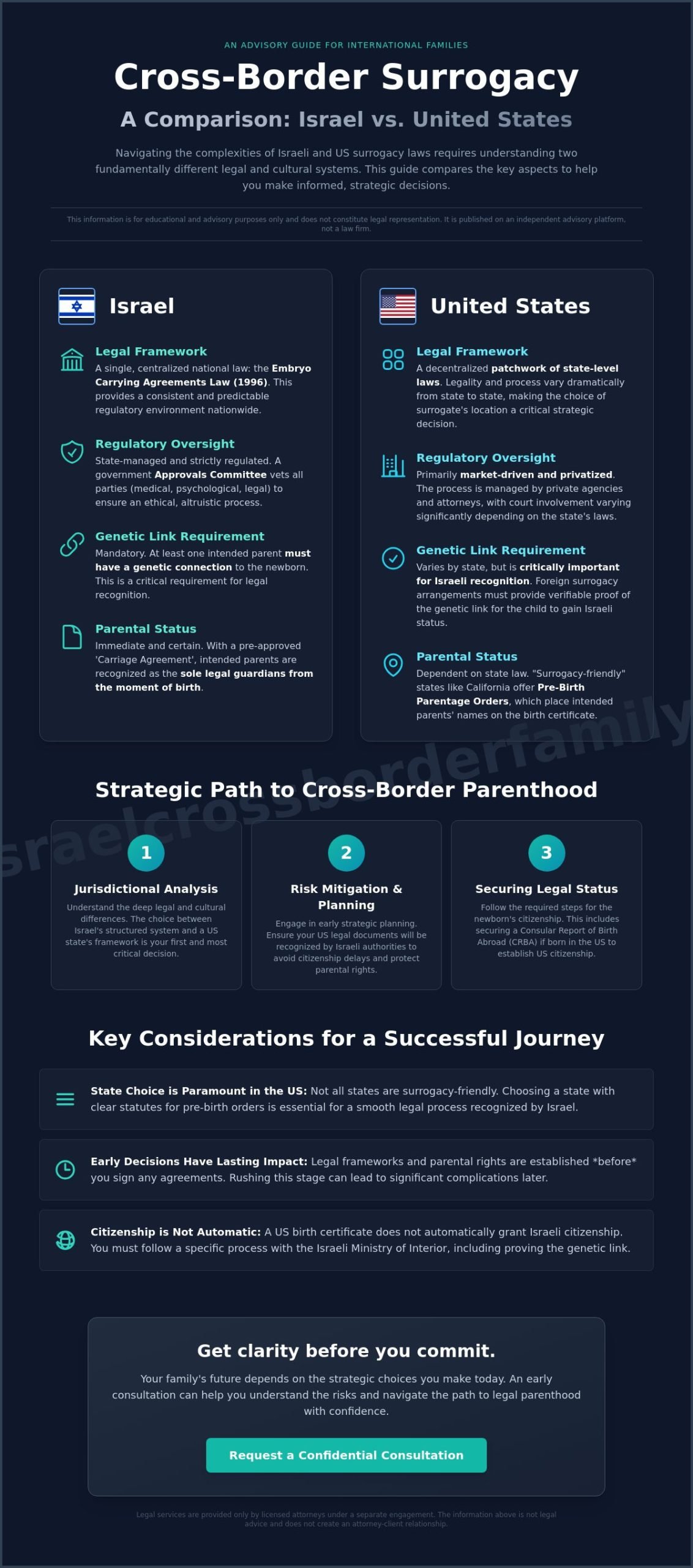
The legal foundation for surrogacy in IL is the Embryo Carrying Agreements Law 5756-1996. This legislation established IL as a pioneer in regulated surrogacy, though it remains strictly limited to gestational surrogacy. In this model, the surrogate has no genetic connection to the child; the embryo is created using the egg and sperm of the intended parents or donors. Understanding surrogacy laws by country reveals that while IL operates under a single national framework, the US relies on a complex patchwork of state-level statutes. This distinction is the primary source of confusion for international families.
For families with ties to both nations, the challenge lies in reconciling these two distinct legal philosophies. Successfully navigating surrogacy laws us-israel requires a deep understanding of how the Israeli Ministry of Health’s Approvals Committee views foreign arrangements. This committee acts as a gatekeeper, reviewing the psychological, medical, and legal readiness of all parties involved to ensure the process remains altruistic and ethical.
To better understand the core concepts of these legal systems, watch this helpful video:
Key Provisions of the Israeli 1996 Law
Israeli law mandates a genetic link between the newborn and at least one intended parent. Before any medical procedures begin, parties must sign a ‘Carriage of Fetuses Agreement’ which requires formal vetting by the state. This process ensures that the surrogate is an Israeli resident and meets specific age and health criteria. A unique feature of the IL system is the immediate transition of legal status. Intended parents are recognized as the sole guardians from the moment of birth, provided the pre-approved legal steps are followed. This provides a level of certainty that is often missing in less regulated jurisdictions.
The US Landscape: Why State Choice Matters
In the US, the legality of your journey depends entirely on the state where the surrogate resides. States like California and Nevada are considered surrogacy-friendly because they offer pre-birth parentage orders. These orders allow intended parents to be placed directly on the birth certificate before the child is even born. However, when navigating surrogacy laws us-israel, it’s vital to remember that IL authorities often require additional verification of the genetic link before recognizing these US orders. For those living abroad, understanding the specific requirements for expats and foreign nationals is a critical first step. Choosing a state with clear legal frameworks is essential for ensuring that the transition back to IL is smooth and free from citizenship delays. Get clarity before you commit. Request a confidential consultation.
This article is published on an independent advisory platform and is not a law firm. The information provided is for educational and advisory purposes only and does not constitute legal representation or an attorney-client relationship. Legal services are only provided by licensed attorneys under a separate engagement.
Deciding Between Israel and the US: A Comparative Analysis
For international families, the choice between pursuing surrogacy in IL or the US often comes down to a preference between a state-managed regulatory system and a private, market-driven environment. Each jurisdiction offers distinct advantages, but the path you choose will fundamentally change your legal obligations and financial commitments. Successfully navigating surrogacy laws us-israel requires an honest assessment of how these two systems interact with your specific family structure and residency status.
Financial transparency is a major differentiator. In IL, the process is altruistic and heavily controlled by the state. The estimated cost for a surrogacy arrangement in IL is approximately 250,000 NIS. In contrast, the US market is decentralized and significantly more expensive. Total costs in the US typically range from $140,000 to $200,000, with high-demand states like California often exceeding the $200,000 mark. While the US offers greater speed and agency-led matching, the financial entry point is substantially higher due to agency fees, specialized medical insurance, and private legal counsel.
Religion and eligibility also create sharp contrasts. According to Israel’s Surrogacy Law and Regulations, the surrogate must generally share the same religion as the intended mother, and all parties must be Israeli residents. The US system is entirely secular and open to foreign citizens, providing a viable path for those who don’t meet Israel’s specific residency or religious criteria. You can learn more about how these cross-border dynamics function by reviewing our guide on how the advisory process works for international families.
Pros and Cons of the Israeli Regulatory Model
The Israeli model provides high legal certainty and lower costs because surrogate compensation is regulated by law. The Ministry of Health mandates rigorous medical and psychological screening, ensuring a high level of protection for all parties. However, the eligibility criteria are narrow. The requirement for Israeli residency and the involvement of the Approvals Committee can lead to longer wait times compared to the US private sector.
The US Market Approach: Flexibility and Speed
The US offers unparalleled flexibility for all family types, including single parents and same-sex couples, regardless of their religious background. Surrogacy-friendly states have established judicial precedents that streamline the parentage process through pre-birth orders. While this provides a fast and efficient roadmap, it carries the risk of multi-jurisdictional complexity when bringing the child back to IL. Managing these risks involves careful strategy before any contracts are signed. Get clarity before you commit. Request a confidential case review to discuss your specific situation.
This article is published on an independent advisory platform and is not a law firm. The information provided is for educational and advisory purposes only and does not constitute legal representation or an attorney-client relationship. Legal services are only provided by licensed attorneys under a separate engagement.
Eligibility and Threshold Requirements for Intended Parents
The path to parenthood through surrogacy involves meeting strict threshold requirements that differ significantly between jurisdictions. When navigating surrogacy laws us-israel, the first hurdle is often proving eligibility to the Israeli Ministry of Health. Unlike the relatively open access found in many US states, IL maintains a highly structured vetting process designed to ensure the welfare of all parties involved. Understanding these criteria early is essential for avoiding bureaucratic delays that can stall your journey for months.
A landmark 2021 High Court ruling fundamentally changed the landscape in IL by expanding surrogacy access to same-sex couples and single fathers. This shift moved the country toward a more inclusive model, though the underlying medical and residency requirements remain rigorous. Regardless of your family structure, a genetic link between at least one intended parent and the child is a non-negotiable requirement for legal recognition in IL. This genetic connection serves as the foundation for establishing parentage and securing the child’s future citizenship rights.
Medical and Psychological Screening
In IL, intended parents must demonstrate a medical necessity for surrogacy, such as proven infertility or a significant health risk to the intended mother. For many Anglos and expats, this involves coordinating with US-based physicians to provide comprehensive medical histories. The Israeli Approvals Committee requires specific documentation that may not always align with standard US medical summaries. We recommend ensuring all foreign medical records are translated and formatted to meet the specific expectations of the Israeli Matching Committee. This committee plays a central role in vetting the psychological readiness of both the parents and the surrogate, acting as a gatekeeper for the entire process.
Marital Status and Identity Considerations
While the 2021 ruling opened doors for diverse family types, the ‘religion matching’ factor still carries weight in IL. The law generally requires the surrogate to share the same religion as the intended mother. This is intended to prevent future complications regarding the child’s personal status under the religious courts, which still govern marriage and divorce in IL. For those pursuing cross-border arrangements, the ‘Status of the Newborn’ proceedings in Israeli family court are a critical step. These proceedings ensure that the child’s legal identity is clearly established from birth. To see how these factors play out in real-world scenarios, you can explore detailed discussions on Surrogacy in Israel via our video resources.
Managing these identity considerations requires a clear strategy before you commit to a specific path. For many expats and foreign nationals, the intersection of US secular birth certificates and Israeli religious requirements can create unexpected friction. Get clarity before you commit. Request a confidential consultation.
This article is published on an independent advisory platform and is not a law firm. The information provided is for educational and advisory purposes only and does not constitute legal representation or an attorney-client relationship. Legal services are only provided by licensed attorneys under a separate engagement.
Cross-Border Citizenship and Legal Status of the Newborn
The moment a child is born via surrogacy, the focus shifts from medical procedures to the critical task of establishing legal identity. Under the ‘Status of the Newborn’ framework, there is often an immediate transition of custody to the intended parents. However, for international families, this is where the most significant bureaucratic hurdles begin. Successfully navigating surrogacy laws us-israel requires a synchronized approach to ensure the child is recognized as a citizen in both the US and IL without falling into a state of legal limbo.
Legal limbo occurs when one jurisdiction recognizes your parental rights while the other does not. This can lead to severe complications regarding the child’s ability to travel, access healthcare, or receive social benefits. Avoiding these risks involves managing two distinct government entities: the US Embassy in Tel Aviv and the Israeli Ministry of Interior, known as Misrad HaPnim. Each has its own set of evidentiary requirements that must be met to bridge the gap between US state-level parentage orders and Israeli national citizenship laws.
Securing US Citizenship for the Baby
For children born to a US citizen parent, the primary goal is obtaining a Consular Report of Birth Abroad (CRBA). This document serves as official proof of US citizenship. The process requires proving a genetic link between the child and the US citizen parent, which almost always necessitates DNA testing through specific, accredited laboratories. You should prepare for a structured timeline at the US Embassy in Tel Aviv. While the CRBA and passport applications are often processed together, delays can occur if the documentation regarding the surrogacy agreement or the genetic link is incomplete. Families should review specific guidance for expats and foreign nationals to understand how their residency status impacts these federal requirements.
Israeli Parentage Orders and Registration
Even with a US birth certificate in hand, the Israeli government typically requires its own judicial confirmation of parentage. This is achieved through a Parentage Order, or Tzav Horut, granted by the Israeli Family Court. The court acts as a safeguard to ensure the surrogacy arrangement aligns with Israeli public policy. A key part of this process is the mandatory genetic test conducted under court supervision, which Misrad HaPnim requires before registering the child in the Israeli population registry. This step is vital for families who may eventually face issues related to international custody and relocation, as a clear legal status in IL is the only way to protect your rights locally. Get clarity on these registration steps before you travel. Speak with an advisor about your documentation strategy to ensure a smooth transition for your family.
This article is published on an independent advisory platform and is not a law firm. The information provided is for educational and advisory purposes only and does not constitute legal representation or an attorney-client relationship. Legal services are only provided by licensed attorneys under a separate engagement.
Strategic Planning: Risk Mitigation for International Surrogacy
Successful surrogacy is a multi-year project that requires a cohesive strategy long before any medical procedures begin. When navigating surrogacy laws us-israel, families often focus on the immediate joy of matching with a surrogate. However, the true complexity lies in the long-term legal and financial risks of cross-border arrangements. Without a proactive plan, you may encounter a conflict of laws where a contract that is perfectly valid in a US state is viewed with skepticism by the Israeli Ministry of Health. Strategy is about identifying these friction points early to ensure your parental rights remain secure in both jurisdictions.
Financial risk management is another critical pillar of this journey. Beyond the initial agency fees, international families must account for the volatility of cross-border medical costs and potential insurance gaps. While US surrogacy-friendly states have established frameworks for medical coverage, these policies don’t always align with Israeli healthcare expectations for a newborn returning from abroad. Additionally, long-term security involves more than just birth certificates. High-net-worth and international families should consider how their surrogacy journey impacts their wills and estates. Ensuring that your estate planning accounts for a child born through a cross-border arrangement is a vital step in protecting your family’s legacy.
Coordinating Multi-Jurisdictional Legal Teams
A common pitfall is relying solely on local counsel in each country without a unifying oversight. A US lawyer understands the specific statutes of their state, while an Israeli lawyer understands national regulations. However, you need a ‘bridge’ advisory to ensure these two systems don’t work at cross-purposes. For example, a US agency contract must be carefully drafted to meet the specific transparency and altruistic expectations of the Israeli Ministry of Health. You can learn more about how the advisory works to synchronize these moving parts and provide a seamless transition between legal systems.
The Impact of Early Decisions
The decisions you make in the first month of your journey will resonate for years. Choosing a specific US state isn’t just about cost; it’s about how that state’s judicial precedents are recognized by the Israeli Family Court during parentage proceedings. Some states offer more streamlined paths for international families, while others may require additional litigation that adds months to your timeline. A confidential review of your situation before you make financial commitments can prevent costly errors and bureaucratic delays. Get clarity before you commit. Request a confidential consultation to build a risk-based roadmap for your family’s future.
This article is published on an independent advisory platform and is not a law firm. The information provided is for educational and advisory purposes only and does not constitute legal representation or an attorney-client relationship. Legal services are only provided by licensed attorneys under a separate engagement.
Securing Your Family’s Future Through Strategic Planning
Reaching the end of this guide is the first step toward a successful cross-border journey. Successfully navigating surrogacy laws us-israel involves more than just understanding the rules; it requires a proactive approach to multi-jurisdictional complexity. We’ve explored how the 1996 Embryo Carrying Agreements Law provides a foundation in IL, while US state choice dictates your speed and flexibility. Managing the transition of the newborn’s legal status through the US Embassy and the Israeli Family Court is the final, critical hurdle in ensuring a clear path to parenthood.
The intersection of US and Israeli legal systems presents unique challenges, particularly when balancing the secular market approach of the US with the regulated requirements of IL. By prioritizing early strategic planning, you can mitigate the financial and legal risks inherent in these situations. Establishing a clear roadmap for citizenship and parentage recognition ensures that your focus remains on the well-being of your new family. Get clarity before you commit. Request a confidential consultation for your cross-border family matter. With the right strategy, you can move forward with confidence, knowing your family’s future is protected across every border.
This article is published on an independent advisory platform and is not a law firm. The information provided is for educational and advisory purposes only and does not constitute legal representation or an attorney-client relationship. Legal services are only provided by licensed attorneys under a separate engagement.
Frequently Asked Questions
Is surrogacy in Israel legal for US citizens living there?
Surrogacy in IL is available to US citizens provided they maintain legal residency in the country. When navigating surrogacy laws us-israel, intended parents must prove they are residents of IL to the Ministry of Health. Those on temporary visas should verify their status early, as the state requires a stable connection to the local community before approving a carriage agreement.
Can same-sex couples use surrogacy services in Israel in 2026?
Same-sex couples and single fathers have had full legal access to surrogacy services in IL since the 2021 High Court ruling. This landmark decision ended years of exclusion, ensuring that all family structures are evaluated based on medical and psychological fitness rather than sexual orientation or marital status. The process remains highly regulated, requiring the same committee approvals as any other arrangement.
How long does the Israeli surrogacy approval process typically take?
The approval process typically spans between eight and fourteen months from the initial application to the final committee decision. This timeframe accounts for the mandatory psychological assessments of all parties and the detailed legal review of the surrogacy contract. Families should prepare for a deliberate pace, as the state prioritizes ethical compliance and the long-term welfare of the child over speed.
Does a baby born via surrogacy in Israel automatically get US citizenship?
A baby born via surrogacy in IL does not automatically receive US citizenship; the parents must apply for a Consular Report of Birth Abroad. This involves a visit to the US Embassy in Tel Aviv to provide evidence of the genetic link, typically through DNA testing. The US citizen parent must also demonstrate they met the physical presence requirements in the US prior to the birth.
What is the difference between gestational and traditional surrogacy in Israel?
Gestational surrogacy is the only form permitted under Israeli law, meaning the surrogate cannot have a genetic link to the child. Traditional surrogacy, where the surrogate’s egg is fertilized, is strictly illegal in IL. This regulation ensures that the legal and biological roles are clearly defined, which simplifies the transition of parental rights at the moment of birth.
How does the Israeli Ministry of Health monitor surrogacy agreements?
The Ministry of Health monitors these arrangements through the Approvals Committee, which acts as a centralized regulatory body. This committee reviews the financial, medical, and psychological aspects of every agreement to prevent commercial exploitation. Their oversight continues throughout the process, ensuring that all payments remain within regulated limits and that the surrogate receives proper medical care and support.
What happens if the surrogate and intended parents have different religions?
The law generally mandates that the surrogate and the intended mother share the same religion to prevent future complications regarding the child’s personal status. While this is the standard rule, the Approvals Committee may allow exceptions if they are convinced it won’t harm the child’s future standing in religious courts. This is a complex area where seeking clarity early in the matching process is vital.
Can I use a US surrogate and bring the baby back to Israel legally?
You can legally bring a baby born to a US surrogate back to IL, but the process requires careful coordination between both legal systems. Successfully navigating surrogacy laws us-israel involves obtaining a Parentage Order from an Israeli Family Court and completing a court-supervised DNA test. This strategy ensures the child is properly registered with the Ministry of Interior and avoids citizenship delays at the border.

Article by
Gabriel Lior
A Personal Journey That Became a Mission
The advisory was founded by an American father Gabriel Lior, LLB, MBA , global entrepreneur, and cross-border advisor who spent more than a decade navigating the Israeli family court system firsthand and now lives in Singapore with his son.
As a divorced parent in a cross-border family, Gabriel faced nearly every legal challenge a foreign parent can encounter in Israel — including child custody disputes, child support proceedings, property matters in Israel and abroad, false accusations, and complex immigration and relocation proceedings.
Over the years, he learned the hard way how difficult it is for non-Israeli parents to understand the system, identify the right legal strategy, and choose the right legal representation — especially when language, culture, and jurisdictional differences are involved. He also witnessed how foreign parents and new immigrants are often disadvantaged or taken advantage of by service providers and institutions simply because they lack local knowledge or fluency.
From Client to Advisor
To truly understand — and survive — the system, Gabriel pursued formal legal education in Israel, completing two Israeli law degrees, alongside a BA and MBA earned in the United States. This was never about becoming a practicing attorney, but about gaining a deep, structural understanding of how the system works — and where it breaks down for foreign parents.
This rare combination of:
Firsthand client experience
Israeli legal and US business education
International business and negotiation training
Decades of commercial execution
created a unique perspective – one that understands both sides of the table.
After years of litigation, persistence, and at times self-representation, he ultimately succeeded in securing custody of his son and relocating abroad through a rare legal victory in the Israeli Supreme Court — becoming one of the first fathers in Israel to do so under these circumstances.
Disclaimer
Important Disclaimer:
The information provided on this website and in its content is for general informational and educational purposes only and does not constitute legal advice, legal opinion, or legal representation.
Gabriel Lior is not licensed to practice law in Israel (nor is he interested in doing so) and does not provide legal services, despite having completed 2 Law Degrees. The services offered are advisory in nature and are intended to provide general guidance, strategic insight, and information regarding cross-border family law considerations.
No attorney-client relationship is formed by accessing this website, reading its content, or communicating with us.
Any decisions made based on this information are at your own discretion and risk. For legal advice specific to your situation, you should consult a licensed attorney in the relevant jurisdiction.
Where appropriate, we may refer clients to independent, licensed attorneys or professionals. Such referrals do not constitute legal representation and no liability is assumed for services provided by third parties.