This article is published on an independent advisory platform and does not constitute a law firm relationship or legal representation. Legal services are only provided by licensed attorneys under a separate engagement.
The assumption that a primary caregiver has an automatic right to move a child abroad is one of the most dangerous misconceptions in international family law. In reality, the legal grounds for denying relocation request in Israel are rooted in a rigorous, child-centered analysis that often overrides a parent’s personal or professional desires. With divorce rates in Israel increasing by 6.5% in 2024, more families are finding themselves caught in these high-stakes disputes between the Israeli and U.S. legal systems. Understanding how the court evaluates these petitions is the first step in protecting your parental rights.
You likely feel the immense pressure of protecting your child’s future while fearing the potential loss of a meaningful, daily connection. This article provides a strategic overview of how Israeli courts apply the “Best Interests of the Child” standard and the procedural traps that can derail a case. You’ll gain clarity on cross-border risks and the specific criteria used to evaluate whether a move genuinely serves a child’s welfare. Get clarity before you commit. Request a confidential consultation. For more insights, view our resources at https://www.youtube.com/@IsraelFamilyLaw.
Key Takeaways
- Understand why the “Best Interests of the Child” is the primary legal standard used by Israeli courts to prioritize a child’s welfare over a parent’s personal goals.
- Identify the procedural failures and jurisdictional conflicts between Israel and the U.S. that can lead to an immediate dismissal of a relocation petition.
- Learn the specific legal grounds for denying relocation request that center on preserving the child’s essential relationship with the left-behind parent.
- Recognize how the Hague Convention and concerns over international enforcement of visitation orders influence a judge’s willingness to allow a move.
- Assess the success probability of your case by understanding the significant strategic risks and litigation costs involved in the Israeli family court system.
Defining Relocation and the ‘Best Interests’ Standard
This article is published on an independent advisory platform and does not imply an attorney-client relationship. In the context of the Israeli legal system, relocation is defined as a formal request to change a child’s residence in a manner that significantly impacts the existing parenting schedule and visitation rights. Both Israeli and U.S. jurisdictions treat the “Best Interests of the Child” as the paramount consideration when determining whether to grant or deny such a move. In cross-border disputes, Israeli courts weigh the ‘Best Interests’ standard by examining if the child’s developmental and emotional needs are better served in a foreign environment than by maintaining the current stability within the Israeli borders.
To better understand how courts approach these sensitive decisions, watch this helpful video:
Understanding the legal grounds for denying relocation request requires a shift in perspective from parental desire to child-centered welfare. While a parent might have a lucrative job offer or a support network abroad, the court views these as secondary factors. The primary focus remains on the child’s right to maintain a stable environment and consistent contact with both parents.
The Core Philosophy of the Best Interests Standard
Modern jurisprudence in Israel has transitioned from a focus on “parental rights” to a robust defense of “child’s rights.” Courts increasingly view the child’s welfare as a distinct entity, independent of a parent’s career trajectory or personal fulfillment. A central pillar of this philosophy is the preservation of the status quo. If a child is thriving in their current Israeli school, social circle, and family dynamic, the court often presumes that staying is in their best interest unless the relocating parent can prove otherwise. This framework is heavily influenced by the Hague Convention on International Child Abduction, which emphasizes the return of children to their habitual residence to prevent unilateral moves.
The Threshold for a Relocation Request
Not every move requires a court’s intervention, but international relocation always triggers a formal hearing. While a move from Tel Aviv to Haifa might only require a minor adjustment to the schedule, moving a child to New York or London represents a fundamental shift in the child’s life. This threshold is met the moment a move prevents the non-relocating parent from exercising their court-ordered visitation. Because the stakes are so high, developing an early strategy is vital. Decisions made in the months leading up to a petition, such as changes in school enrollment or housing, can significantly impact the court’s view of the child’s current stability. For those dealing with these complexities, reviewing the international custody and relocation protocols is a necessary step before making any commitments.
Procedural Failures and Jurisdictional Conflicts
Many parents believe that a relocation case is won or lost solely on the child’s emotional needs. However, technical procedural errors often serve as the primary legal grounds for denying relocation request before a judge even considers the merits of the move. The most common pitfall is the failure to provide proper legal notice to the non-relocating parent. In the Israeli legal system, transparency is not just a courtesy; it is a statutory requirement. Attempting to bypass this through “Self-Help,” such as moving a child without a court order, is the fastest way to have a petition dismissed. Israeli courts view unilateral moves as a violation of the other parent’s rights and a potential breach of international treaties.
The Requirement of Written Consent or Court Order
A formal relocation requires either a signed, notarized agreement from both parents or a decree from an Israeli Family Court. Many expats make the mistake of relying on informal “permission” letters, emails, or WhatsApp messages. These documents frequently fail to meet the evidentiary standards required in contested litigation. A vague promise of consent can be revoked at any time, leaving the relocating parent vulnerable to claims of child abduction. Securing international custody relocation expertise early helps ensure that any agreement is enforceable and recognized by both Israeli and foreign authorities. Without a clear, legally binding framework, the court is likely to maintain the status quo to protect the child’s stability.
Jurisdictional Challenges in Cross-Border Families
Jurisdiction is often the most complex hurdle for international families. The “Habitual Residence” of the child determines which court has the authority to make decisions. If a child has lived in Israel for a significant period, the Israeli courts will likely claim jurisdiction, regardless of where the parents were married. This is particularly relevant when there are existing U.S. custody orders. The U.S. Department of Justice on the Hague Convention notes that Israel is a signatory to the treaty, meaning Israeli courts must respect international standards regarding the wrongful removal of children.
A unique factor in Israel is the “Race to the Court” between the Civil Family Court and the Rabbinical Court. These two systems have concurrent jurisdiction, but they often apply different nuances to relocation cases. Rabbinical courts, for instance, may place a higher weight on the child’s upbringing within the Jewish state, which can influence a denial. With over 14,000 divorces registered in Israel in 2024, the competition for jurisdiction has become a central strategic element. It is vital to understand your jurisdictional standing before filing any motions to avoid being trapped in the wrong legal forum.
Substantial Harm to Child-Parent Relationships
Israeli courts place a heavy premium on the child’s right to a meaningful relationship with both parents. If a judge determines that a move will effectively sever the bond between the child and the non-relocating parent, this becomes one of the strongest legal grounds for denying relocation request. The court doesn’t just look at the physical distance; it examines the emotional and developmental cost of that distance. Judges are tasked with protecting the child’s right to be parented by both individuals, even when the parents no longer live in the same country.
During these proceedings, the court often applies a “Selfish Motivation” test. This isn’t meant to judge a parent’s character but to understand the primary driver behind the move. Is the relocation based on a genuine necessity, such as a unique career advancement or a return to a vital family support network? Or is it a strategic attempt to frustrate the other parent’s access? If the court suspects the move is intended to alienate the child from the left-behind parent, the petition is likely to face a denial. A realistic and enforceable parenting plan is the only way to mitigate these concerns.
The “Stability Factor” also carries significant weight in the judge’s decision. If a child has deep educational, social, and cultural roots in Israel, the court is hesitant to uproot them. With divorce rates in Israel reaching approximately 14,000 registered cases in 2024, judges are increasingly cautious about disrupting an established Israeli life. They look for evidence that the child is thriving in their current environment and weigh that against the uncertainty of a new life abroad.
Quantifying the Impact on Visitation
Distance is a logistical hurdle that the court must quantify through a practical lens. A judge will examine the cost and duration of international travel to determine if visitation is actually feasible. For a family moving from Tel Aviv to New York, round-trip flights often exceed ₪4,000 per person, creating a financial barrier that might prevent regular, in-person contact. While technology has bridged many gaps, Israeli courts generally agree that “Virtual Visitation” via Zoom is a supplement, not a replacement, for physical presence. Understanding the nuances of Israel-US child custody laws is essential when drafting a schedule that respects these logistical and financial realities.
The Child’s Voice and Preference
As children grow older, their own perspectives gain more influence in the courtroom. While there isn’t a fixed age for this, Israeli courts typically begin to weigh a child’s wishes more heavily around age 10 to 12. To assess this fairly, judges rely on court-appointed experts, such as social workers and psychologists, who provide a nuanced view of the child’s emotional state. These professionals are trained to distinguish between a child’s genuine preference and dynamics of “Parental Alienation.” The principles outlined in the HCCH Child Abduction Section guide these experts in ensuring that the child’s voice is heard without being manipulated by a parent to justify a move that could cause long-term psychological harm.
International Enforcement and Hague Convention Risks
A significant concern for any judge is whether an Israeli court order will be worth more than the paper it’s printed on once the child crosses the border. The potential for a parent to ignore visitation schedules once they’re in a foreign jurisdiction is one of the most critical legal grounds for denying relocation request. If the court isn’t convinced that the destination country will honor and enforce Israeli visitation rights, the request will likely be denied to protect the left-behind parent’s access. This is why moving to a country that is not a signatory to the 1980 Hague Convention is almost always an immediate reason for denial. Judges rarely risk sending a child to a jurisdiction where they lose their legal ability to intervene.
To ensure continuity, courts often require a ‘Mirror Order,’ which is a legal requirement where the relocating parent must obtain an identical court order in the destination country before the child is allowed to leave Israel. This ensures the new jurisdiction recognizes the Israeli court’s authority from day one.
The Hague Convention Framework
The 1980 Hague Convention serves as a global safety net against the wrongful removal or retention of children. It establishes a civil mechanism to ensure the prompt return of a child to their country of habitual residence. You can find a detailed breakdown of these protections in our Hague Convention child abduction resource. Even with well-intentioned parents, a judge may deny a move if the legal framework in the new country makes it difficult to resolve disputes quickly. The risk of non-return is a heavy weight in the court’s final assessment of the child’s safety and parental rights.
Guaranteeing Future Access
Courts often demand more than just a promise to return the child for summer holidays. They may require substantial financial bonds or bank guarantees, sometimes totaling ₪100,000 or more, held in escrow as security. These funds are forfeited if the child is not returned to Israel according to the agreed schedule. Additionally, specific legal mechanisms must be in place so the destination court recognizes that the Israeli court retains continuing jurisdiction over the family matter. For visual guidance on these complex enforcement strategies and how they impact international families, you can explore the videos on our YouTube channel at https://www.youtube.com/@IsraelFamilyLaw. If you’re worried about the enforceability of your current parenting plan across borders, it’s time to discuss your international enforcement strategy with a knowledgeable advisor.
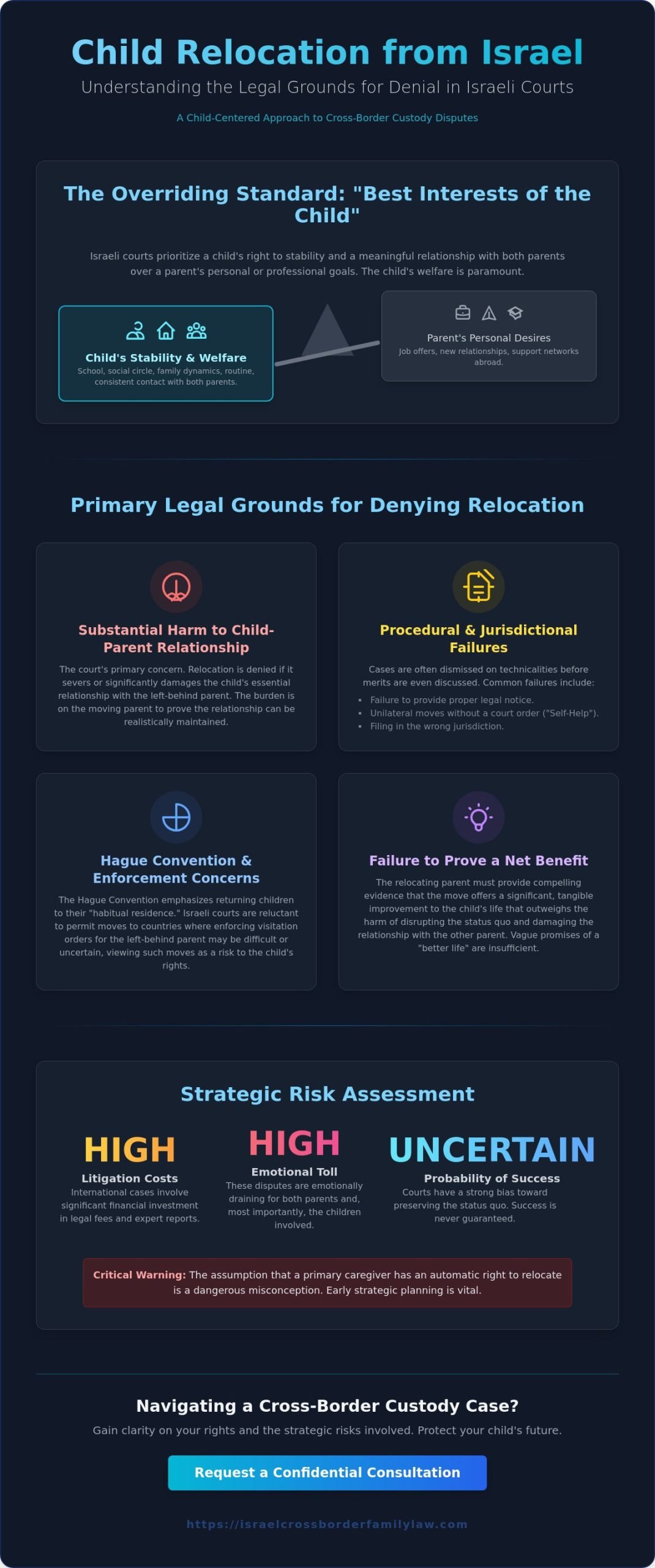
Strategic Risk Assessment and Decision Making
Contested relocation litigation in Israel is notoriously expensive and emotionally draining. Legal fees for high-stakes international matters can easily exceed ₪50,000 to ₪100,000 per case, not including the potential long-term damage to the co-parenting relationship. Before you file a petition or prepare a defense, you must honestly assess your “Success Probability.” This involves evaluating the legal grounds for denying relocation request through the eyes of a judge rather than through your own personal or professional needs. If the child’s connection to the left-behind parent is deep and the destination lacks enforceable legal frameworks, the risk of a denial is substantial.
Every decision you make in the early stages of a dispute acts as a ripple in a pond. A poorly timed notice or a lack of transparency can create a negative impression that lasts throughout the entire litigation process. Strategic clarity is your most valuable asset. You need to weigh the benefits of a potential move against the very real possibility of a court-mandated stay in Israel. Get clarity before you commit. Request a confidential consultation to understand the specific risks associated with your cross-border situation.
The Role of Expert Evidence
Israeli courts rely heavily on neutral third-party assessments to make their determinations. You might need vocational experts to prove that a job offer abroad is a unique, life-changing opportunity that cannot be replicated in Israel. Educational consultants may be required to demonstrate that a specific school system serves the child’s unique developmental needs. Preparing for a relocation hearing involves gathering meticulous documentation, from travel cost breakdowns to written commitments from support networks in the new country. These early tactical decisions often dictate the final outcome, and waiting until the hearing to gather this evidence is a common mistake.
Alternative Dispute Resolution (ADR)
Many international families find that relocation issues are better settled outside of the courtroom. A detailed “Relocation Agreement” provides a level of certainty that a court decree simply cannot match. This document can specify exact visitation dates, how travel costs will be shared, and what specific legal grounds for denying relocation request would apply if the agreement is breached. Settling through mediation or ADR allows parents to maintain control over their family’s future and avoids the “all-or-nothing” nature of a judicial ruling. It is often the most stable path for children caught between two cultures. To explore your options and protect your parental rights, we invite you to Request a confidential case review today.
Protecting Your Family’s Future in a Global Context
Successfully managing an international move requires more than just a plane ticket and a job offer. It demands a sophisticated understanding of the legal grounds for denying relocation request within the Israeli court system. Judges prioritize the “Best Interests of the Child” above all else, often weighing the emotional impact of distance against the child’s existing roots in Israel. With divorce rates in Israel rising by 6.5% in 2024, the judicial scrutiny on relocation petitions has never been higher. Whether you’re navigating the complexities of the Hague Convention or coordinating between Israeli and U.S. jurisdictional authorities, early strategic planning is the most effective way to avoid a costly and emotional denial.
Our advisory provides specialized US-Israel cross-border expertise and a deep understanding of the Hague Convention. We offer an authoritative advisory for international families who need to bridge the gap between two distinct legal cultures and systems. Don’t leave your child’s stability to chance in a legal environment that strongly values the status quo. Get clarity before you commit. Request a confidential consultation.
Making informed, strategy-based choices today ensures that your child’s relationships remain strong tomorrow, no matter where in the world you call home.
This article is published on an independent advisory platform and does not constitute a law firm relationship or legal representation. Legal services are only provided by licensed attorneys under a separate engagement.
Frequently Asked Questions
Can a parent move with a child without the other parent’s permission?
No parent can legally move a child’s residence out of Israel without written consent from the other parent or a formal order from the Family Court. Moving without this authority is viewed as a unilateral breach of the existing parenting arrangement. Such actions often trigger immediate legal proceedings under international treaties. It’s vital to secure a signed agreement or court decree before making any travel arrangements to avoid severe legal repercussions.
What is the most common reason a judge denies a relocation request?
The most frequent reason for denial is the court’s determination that the move will cause substantial harm to the child’s relationship with the left-behind parent. This serves as one of the primary legal grounds for denying relocation request in the Israeli system. Judges prioritize the child’s right to maintain a consistent, physical bond with both parents over the relocating parent’s personal or professional aspirations.
Does the ‘Best Interests of the Child’ standard differ between IL and the US?
While both systems use the “Best Interests” standard, Israeli courts often place a heavier emphasis on the child’s cultural and religious “status quo” within the land. The Israeli system frequently views the preservation of a child’s existing social and educational roots as a critical component of their welfare. In contrast, some U.S. jurisdictions may focus more on the primary caregiver’s ability to provide a better quality of life elsewhere.
How does the Hague Convention affect my ability to move to the US?
The Hague Convention ensures that any child wrongfully removed from Israel to the U.S. is promptly returned to their habitual residence. Since both countries are signatories, the U.S. courts will generally honor an Israeli order for the child’s return. This treaty makes it nearly impossible to relocate permanently without legal authorization. It effectively prevents parents from using “self-help” to bypass the Israeli judicial process.
Will the court let me move if I have a much better job offer in the US?
A lucrative job offer is rarely enough on its own to justify a relocation in the eyes of an Israeli judge. The court views the parent’s career advancement as a secondary factor that doesn’t necessarily translate to the child’s best interests. You must demonstrate how the move provides specific, tangible benefits to the child’s developmental and emotional well-being that outweigh the loss of daily contact with the other parent.
At what age can a child decide for themselves if they want to relocate?
There is no specific age where a child has the final say, but their preferences are typically given significant weight starting around age 10 to 12. The court doesn’t allow the child to “choose” in a vacuum. Instead, court-appointed psychologists and social workers evaluate the child to ensure their wishes are genuine and not the result of parental pressure or alienation. The judge makes the final decision.
What happens if I relocate without a court order?
Relocating without a court order is legally classified as international child abduction. This triggers an immediate application for the child’s return under the Hague Convention, often resulting in the parent being ordered to return the child to Israel at their own expense. Beyond civil penalties, it can lead to criminal charges and severely damage that parent’s standing in future custody and relocation hearings within the Family Court.
Can a relocation request be denied even if I am the primary caregiver?
Yes, being the primary caregiver does not grant you an automatic right to move the child to a different country. The legal grounds for denying relocation request apply equally to all parents regardless of their role in daily care. The court’s focus is on the child’s right to both parents, meaning your status as the main provider doesn’t override the other parent’s right to maintain their bond.

Article by
Gabriel Lior
A Personal Journey That Became a Mission
The advisory was founded by an American father Gabriel Lior, LLB, MBA , global entrepreneur, and cross-border advisor who spent more than a decade navigating the Israeli family court system firsthand and now lives in Singapore with his son.
As a divorced parent in a cross-border family, Gabriel faced nearly every legal challenge a foreign parent can encounter in Israel — including child custody disputes, child support proceedings, property matters in Israel and abroad, false accusations, and complex immigration and relocation proceedings.
Over the years, he learned the hard way how difficult it is for non-Israeli parents to understand the system, identify the right legal strategy, and choose the right legal representation — especially when language, culture, and jurisdictional differences are involved. He also witnessed how foreign parents and new immigrants are often disadvantaged or taken advantage of by service providers and institutions simply because they lack local knowledge or fluency.
From Client to Advisor
To truly understand — and survive — the system, Gabriel pursued formal legal education in Israel, completing two Israeli law degrees, alongside a BA and MBA earned in the United States. This was never about becoming a practicing attorney, but about gaining a deep, structural understanding of how the system works — and where it breaks down for foreign parents.
This rare combination of:
Firsthand client experience
Israeli legal and US business education
International business and negotiation training
Decades of commercial execution
created a unique perspective – one that understands both sides of the table.
After years of litigation, persistence, and at times self-representation, he ultimately succeeded in securing custody of his son and relocating abroad through a rare legal victory in the Israeli Supreme Court — becoming one of the first fathers in Israel to do so under these circumstances.
Disclaimer
Important Disclaimer:
The information provided on this website and in its content is for general informational and educational purposes only and does not constitute legal advice, legal opinion, or legal representation.
Gabriel Lior is not licensed to practice law in Israel (nor is he interested in doing so) and does not provide legal services, despite having completed 2 Law Degrees. The services offered are advisory in nature and are intended to provide general guidance, strategic insight, and information regarding cross-border family law considerations.
No attorney-client relationship is formed by accessing this website, reading its content, or communicating with us.
Any decisions made based on this information are at your own discretion and risk. For legal advice specific to your situation, you should consult a licensed attorney in the relevant jurisdiction.
Where appropriate, we may refer clients to independent, licensed attorneys or professionals. Such referrals do not constitute legal representation and no liability is assumed for services provided by third parties.