This article is published on an independent advisory platform, not a law firm. The information provided is for educational purposes only and does not constitute legal advice or an attorney-client relationship. Legal services are only provided by licensed attorneys under a separate engagement.
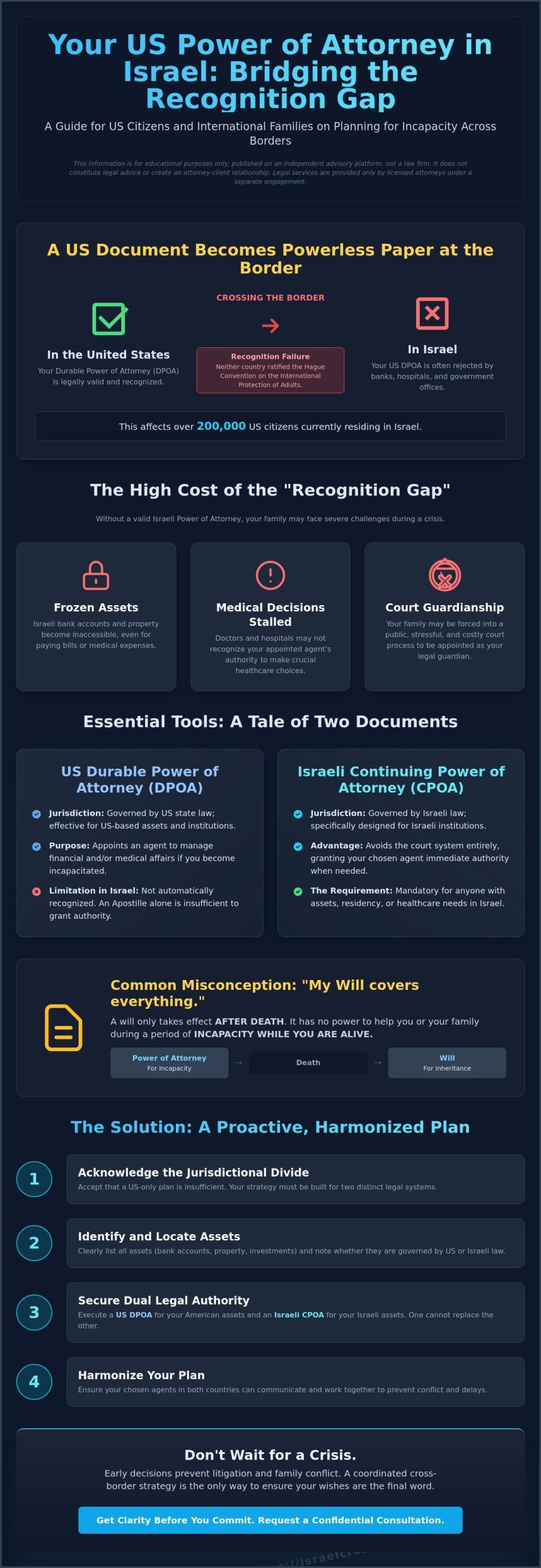
Your US Durable Power of Attorney is essentially a stack of powerless paper the moment you cross the Israeli border. It’s a stressful realization for many of the 200,000 US citizens currently residing in Israel who haven’t yet learned how to plan for incapacity across borders. You’ve worked hard to build a life across two jurisdictions, and it’s natural to assume your legal protections will travel with you. However, since neither country has ratified the Hague Convention on the International Protection of Adults as of May 2026, your US documents aren’t automatically recognized by Israeli institutions.
We understand the anxiety that comes with conflicting legal systems and the fear of having your assets frozen during a medical crisis. This guide will show you how to harmonize your legal authority in both countries so your personal wishes remain the final word. We’ll examine the specific requirements for the Israeli Continuing Power of Attorney, explain why dual planning is mandatory for 2026, and provide a strategy to give your family true peace of mind. Get clarity before you commit. Request a confidential consultation.
Key Takeaways
- Understand why standard US legal documents often fail to protect your medical and financial interests once you are in Israel.
- Discover how to plan for incapacity across borders by identifying which jurisdiction governs your specific international assets.
- Learn the essential differences between a US Durable Power of Attorney and the Israeli Enduring Power of Attorney (CPOA).
- Identify why an Apostille alone cannot bridge the “recognition gap” between the US and Israeli legal systems during a crisis.
- Develop a proactive strategy to harmonize your legal authority and prevent your family from facing frozen assets or complex litigation.
This article is published on an independent advisory platform, not a law firm. The information provided is for educational purposes only and does not constitute legal advice or an attorney-client relationship. Legal services are only provided by licensed attorneys under a separate engagement.
Understanding Incapacity Planning in an International Context
Incapacity planning is the legal process of designating decision-makers before you lose the ability to do so. It’s a proactive strategy to ensure your health and finances are managed by people you trust if you become unable to speak for yourself. When your life spans the US-Israel corridor, this process becomes significantly more complex. You must learn how to plan for incapacity across borders because the definition of “capacity” and the requirements for document validity change between jurisdictions. A foundational Power of Attorney created in one country may not be recognized in the other, leading to a dangerous “recognition gap.”
To better understand the logistical hurdles of managing affairs in two different countries, watch this helpful video:
The “recognition gap” occurs when a document that’s perfectly valid in a US state is rejected by an Israeli institution. Israeli banks and medical facilities typically require specific local legal instruments to grant authority to a third party. If you rely solely on foreign documents, your family may face a situation where assets are frozen and medical decisions are stalled. This disconnect often forces families into the Israeli court system to seek guardianship. It’s a public and often stressful experience that could’ve been avoided with early coordination and the right jurisdictional tools.
Why a Will is Not Enough
A common misconception is that a comprehensive will covers all bases. A will only takes effect after death. It provides no authority while you’re alive but incapacitated. Professionals often call this “living probate.” If you cannot sign documents or make choices due to illness, your will remains dormant. For expats and foreign nationals, the stakes are higher because assets are often split between two countries. Without specific incapacity tools, your US assets might be accessible while your Israeli accounts remain locked, or vice versa.
The Reality of Cross-Border Complexity
Moving between cultures and legal systems impacts your standing in ways that are rarely straightforward. You’re balancing two different legal traditions and bureaucratic expectations. Understanding how to plan for incapacity across borders means looking at US and IL laws as a single, integrated puzzle. Early decisions regarding who holds authority can prevent years of potential litigation and family conflict. We focus on providing plain English guidance so the Anglo community can navigate the IL system with confidence and strategic clarity. Get clarity before you commit. Request a confidential consultation.
This article is published on an independent advisory platform, not a law firm. The information provided is for educational purposes only and does not constitute legal advice or an attorney-client relationship. Legal services are only provided by licensed attorneys under a separate engagement.
Essential Legal Tools: Power of Attorney in the US and Israel
Effective planning requires an understanding that a single document cannot bridge the Atlantic. To master how to plan for incapacity across borders, you must navigate two distinct legal philosophies and their respective instruments. In the United States, the Durable Power of Attorney is a state-governed tool designed to remain valid even if you lose mental capacity. In Israel, the legal landscape shifted significantly with the introduction of the Continuing Power of Attorney (CPOA), also known as the Enduring Power of Attorney. These documents serve similar goals but operate under very different sets of rules and oversight mechanisms.
The Israeli Enduring Power of Attorney (CPOA)
The Israeli CPOA, or Yipui Koach Mitmayshech, represented a revolutionary change in IL law when it was introduced in 2017. Before this reform, the only real option for an incapacitated person was a court-appointed guardian, which was often a slow and intrusive process. The CPOA allows you to choose your decision-makers while you’re still healthy and capable. A critical requirement is that this document must be drafted and signed before a lawyer who holds a special certification from the Ministry of Justice. It isn’t a standard form; it’s a personalized roadmap where you can set specific instructions for your future medical care, personal affairs, and financial management.
US Durable Power of Attorney for Assets
In the US, “durability” is the essential feature that ensures the document survives your incapacity. However, US banks are generally more accustomed to these state-specific forms than Israeli financial institutions. An Israeli bank will almost certainly reject a document from New York or California, even if it has an Apostille. This is particularly relevant for families managing international divorce and family law matters where the control of assets is vital. You’ll likely need separate documents for each jurisdiction to ensure your agents can actually access funds when they are needed most.
The activation and supervision of these tools also differ sharply. In Israel, the CPOA is deposited with the Guardian General’s office (Apotropos Haklali) for safekeeping. When the time comes to use it, the appointed agent must notify the Guardian General to activate the authority. In contrast, US activation often depends on the document’s specific wording, such as “springing” triggers that require a letter from a physician. Academic research into the cross-border regulation of guardianship alternatives highlights how these divergent oversight mechanisms can create friction for international families. If you’re unsure which tool fits your specific situation, it’s wise to seek professional guidance to avoid future complications. Get clarity before you commit. Request a confidential consultation.
This article is published on an independent advisory platform, not a law firm. The information provided is for educational purposes only and does not constitute legal advice or an attorney-client relationship. Legal services are only provided by licensed attorneys under a separate engagement.
The Challenge of Cross-Border Recognition and Enforcement
Planning for a future crisis is already difficult, but the complexity doubles when your life is split between two nations. One of the primary hurdles in learning how to plan for incapacity across borders is the absence of a unified treaty between the United States and Israel regarding adult protection. While both countries participate in other international agreements, they haven’t ratified a shared framework for the recognition of powers of attorney or guardianship orders. This means each country operates within its own legal vacuum, often ignoring the directives issued by the other.
Many people believe that obtaining an Apostille—a specialized certificate attached to a document for use in another country—is the ultimate solution. However, an Apostille only verifies that the signature of the notary or official is authentic. It doesn’t guarantee that the substance of the document is legally binding under Israeli law. An Israeli bank manager or a hospital administrator isn’t required to honor a US document just because it has a gold seal. Without local legal instruments, you risk having your accounts frozen or your healthcare decisions delayed at the most critical moment.
For business owners, the stakes are even higher. If you’re a shareholder or a director in a company that operates in both jurisdictions, your sudden incapacity can paralyze transnational operations. Conflicts of law can lead to a situation where neither your US agent nor your Israeli family has the clear authority to manage business interests or sign contracts. This confusion often leads to a “legal stalemate” where assets in both countries become inaccessible until a court intervenes.
Medical Decision-Making Across Borders
Healthcare proxies in the US are generally broad, but Israeli medical directives require specific adherence to local regulations. If you’re in a Tel Aviv hospital, doctors might not recognize a US living will, especially if it isn’t translated or doesn’t meet IL legal standards. Having local directives in Hebrew ensures that your wishes regarding life-sustaining treatment are understood and respected by the medical staff on the ground. It removes the burden from your family of having to explain your wishes through a foreign legal lens during an emotional crisis.
Financial Institutions and Their Strict Rules
Israeli banks are notoriously conservative when dealing with foreign legal documents. They often prefer to see a court-ordered guardianship, known in Israel as “Apoteopsus,” rather than risk accepting an unfamiliar US power of attorney. This can lead to a situation where your family is forced into a lengthy and expensive court process just to pay your bills. To learn more about navigating these specific hurdles, you can explore the resources on the Israel Family Law YouTube channel. Understanding how to plan for incapacity across borders involves more than just signing papers; it requires a strategy that respects the strict rules of both jurisdictions. Get clarity before you commit. Request a confidential consultation.
This article is published on an independent advisory platform, not a law firm. The information provided is for educational purposes only and does not constitute legal advice or an attorney-client relationship. Legal services are only provided by licensed attorneys under a separate engagement.
A Step-by-Step Approach to Harmonising Your International Plan
Harmonising your legal affairs across two countries requires a tactical, multi-step approach. It’s not enough to simply have documents in both places; they must work in concert to prevent administrative paralysis. To master how to plan for incapacity across borders, you should follow a structured sequence that addresses the specific requirements of both the US and Israeli systems.
- Step 1: Audit your assets. Map out exactly where your property, bank accounts, and business interests are located. If you own a home in Jerusalem but keep your retirement accounts in Florida, you have two distinct legal environments to satisfy.
- Step 2: Create a local IL Continuing Power of Attorney. As previously mentioned, this must be drafted by a specially certified Israeli lawyer and deposited with the Guardian General. It is your primary tool for managing your life within Israel.
- Step 3: Update your US Durable Power of Attorney. Ensure your US documents are compliant with the current laws of the specific state where your assets are held. If you haven’t updated these since moving abroad, they may no longer meet local bank requirements.
- Step 4: Cross-reference your documents. This is a critical technical step. You must ensure the language in your US document does not accidentally revoke your Israeli CPOA, and vice-versa. Standard “revocation clauses” in boilerplate forms can unintentionally cancel your entire international strategy.
- Step 5: Appoint ‘Successor Agents.’ Choose representatives who understand your cross-border lifestyle. They should be comfortable managing affairs across different time zones and bureaucratic cultures.
Drafting with a ‘Bridge’ Strategy
Effective planning avoids generic, one-size-fits-all forms. Your documents should include specific “bridge” language that acknowledges your international status and the existence of parallel documents in other jurisdictions. This clarity helps bank officials and medical professionals understand that your plan is intentional rather than contradictory. Ideally, your professional advisors in both countries should have a baseline level of communication to ensure the strategy is seamless. This is especially vital for expats and foreign nationals who maintain significant ties to their home country.
Practical Logistics: Storage and Access
In an emergency, the location of your documents is as important as their content. While Israeli law requires the CPOA to be registered digitally with the Guardian General, many local banks still insist on seeing physical originals or certified copies. Keep your original US and Israeli documents in a secure but accessible location. Ensure your appointed agents know exactly where these papers are kept and how to access them. Informing your agents of their roles early on reduces confusion and prevents family conflict during a high-stress period. If you need help structuring this transition, you can start building your strategy today. Get clarity before you commit. Request a confidential consultation.
This article is published on an independent advisory platform, not a law firm. The information provided is for educational purposes only and does not constitute legal advice or an attorney-client relationship. Legal services are only provided by licensed attorneys under a separate engagement.
Strategic Decision-Making for Global Families
Strategic planning for international families is about more than just signing forms; it’s about building a bridge between two distinct legal cultures. When you understand how to plan for incapacity across borders, you’re choosing a strategy-based approach over simple document preparation. This distinction is vital. A strategy considers how your US assets and your Israeli life will continue to function if you are no longer at the helm. It requires seeking clarity before you commit to a specific legal structure to ensure your plan doesn’t unravel during a crisis.
Early decisions in this process are the most effective way to prevent years of litigation. When directives are clear, cross-referenced, and jurisdictionally compliant, there’s little room for family disputes or institutional rejection. Without this foresight, your family may be forced to navigate the Israeli Family Court or US probate courts to gain the authority they need. This path is often slow, public, and significantly more expensive than proactive planning.
Managing the Risks of Procrastination
The “Window of Capacity” is a biological reality that dictates your legal options. You cannot wait until you feel “old” or “frail” to begin this process. To sign an Israeli Continuing Power of Attorney or a US Durable Power of Attorney, you must possess the mental capacity to understand the documents. Once that window closes, you lose the ability to choose your own decision-makers. The high cost of court-appointed guardianship, or “Apoteopsus” in Israel, far outweighs the investment in proactive planning. More importantly, early planning allows you to maintain control over your own narrative and dignity rather than leaving your future in the hands of a court-appointed stranger.
Next Steps for Your Family
Your first task is to evaluate if your current plan is truly “cross-border” compliant. Does your US document acknowledge your interests in Israel? Does your Israeli CPOA account for your US-based financial obligations? If your documents exist in isolation, they aren’t yet a complete plan. Achieving a harmonised strategy provides the peace of mind that your family won’t be left guessing or struggling with frozen accounts. Get clarity before you commit. Request a confidential case review to see how your international life can be protected.
Final Advisory: The content of this article is for informational and educational purposes only. It does not constitute legal advice or legal representation. Legal systems and regulations are subject to change, and you should always verify current requirements with a qualified professional.
This article is published on an independent advisory platform, not a law firm. The information provided is for educational purposes only and does not constitute legal advice or an attorney-client relationship. Legal services are only provided by licensed attorneys under a separate engagement.
Securing Your Future Across the US-Israel Corridor
Protecting your health and assets in a multi-jurisdictional environment requires more than just standard paperwork. We’ve explored the significant differences between the US Durable Power of Attorney and the Israeli Continuing Power of Attorney. Relying on a single document in one country often leaves a dangerous gap in the other. True security comes from a strategy-based approach that audits your global assets and ensures your legal tools work in harmony rather than in conflict. This coordination prevents administrative paralysis and protects your family from the emotional and financial toll of legal stalemates.
Understanding how to plan for incapacity across borders is the primary way to avoid the stress of frozen accounts or court-appointed guardianship. By making these decisions while you have full capacity, you protect your family from unnecessary litigation and ensure your dignity is preserved. Our platform provides strategy-based risk management and calm, plain-English guidance tailored for the Anglo community in IL. Get clarity before you commit. Request a confidential consultation to begin harmonising your international plan. Taking these steps today provides the peace of mind you and your family deserve.
This article is published on an independent advisory platform, not a law firm. The information provided is for educational purposes only and does not constitute legal advice or an attorney-client relationship. Legal services are only provided by licensed attorneys under a separate engagement.
Frequently Asked Questions
Can I use my US Durable Power of Attorney in Israel?
Generally, no, Israeli banks and medical facilities will not accept a US Durable Power of Attorney. Israeli institutions require a specific legal instrument called a Continuing Power of Attorney (CPOA) that is registered with the Israeli Guardian General. Even if your US document has an Apostille, it often fails to meet the strict local regulatory requirements, leading to frozen assets during a medical crisis.
What is the difference between a Will and a Power of Attorney in a cross-border context?
A Will only takes effect after your death, while a Power of Attorney is designed to function while you are alive but unable to make decisions. Relying on a Will to manage incapacity is a common mistake that leads to “living probate.” In a cross-border context, you need specific incapacity tools in both the US and IL to ensure your daily needs are met without court intervention.
What happens if I become incapacitated in Israel without an Enduring Power of Attorney?
If you lose capacity without a valid CPOA, the Israeli Family Court will likely appoint a guardian, known as an “Apotropos.” This process is often slow, expensive, and intrusive for your family members. It also means a court, rather than you, decides who will manage your personal and financial affairs. Proactive planning allows you to maintain control over your own narrative and dignity.
Do I need a separate Power of Attorney for my assets in the US and my assets in Israel?
Yes, maintaining jurisdiction-specific documents is the most effective way how to plan for incapacity across borders. Having separate documents ensures that a bank in Florida and a bank in Jerusalem both recognize your agent’s authority immediately. This dual approach prevents the “recognition gap” where one country’s institutions reject the other’s legal forms, ensuring your global assets remain accessible to your representatives.
How much does it cost to set up an Israeli Enduring Power of Attorney?
The cost of an Israeli CPOA depends on the complexity of your international estate and the level of specific instruction you wish to provide. Professional fees vary among specially certified lawyers who are authorized by the Ministry of Justice to draft these documents. While there is an initial investment, it is significantly lower than the long-term costs of court-appointed guardianship and potential litigation between family members.
Can a US citizen living in Israel appoint a guardian who lives in the US?
You can appoint an agent who resides in the US, but you must consider the practical logistics of cross-border management. Your agent will need to coordinate with the Israeli Guardian General and local institutions, which can be difficult from a different time zone. Many families choose to appoint one local agent in Israel and one in the US to ensure a seamless response to both immediate and long-term needs.
What is the role of the Israeli Guardian General in incapacity planning?
The Israeli Guardian General (Apotropos Haklali) serves as the official registry and oversight body for all Continuing Powers of Attorney. They handle the formal deposition of the document and the notification process required to activate it when incapacity occurs. This centralized system ensures that your document is officially recognized by the state, providing a layer of security that state-level US systems often lack.
How do I ensure my medical wishes are respected if I travel between the US and Israel?
You should maintain medical directives in both English and Hebrew to ensure healthcare providers in both countries understand your wishes. This is a vital component of how to plan for incapacity across borders for frequent travelers. Having a local directive in the local language ensures that medical staff can act quickly without needing to translate or interpret foreign legal concepts during a life-threatening emergency.

Article by
Gabriel Lior
A Personal Journey That Became a Mission
The advisory was founded by an American father Gabriel Lior, LLB, MBA , global entrepreneur, and cross-border advisor who spent more than a decade navigating the Israeli family court system firsthand and now lives in Singapore with his son.
As a divorced parent in a cross-border family, Gabriel faced nearly every legal challenge a foreign parent can encounter in Israel — including child custody disputes, child support proceedings, property matters in Israel and abroad, false accusations, and complex immigration and relocation proceedings.
Over the years, he learned the hard way how difficult it is for non-Israeli parents to understand the system, identify the right legal strategy, and choose the right legal representation — especially when language, culture, and jurisdictional differences are involved. He also witnessed how foreign parents and new immigrants are often disadvantaged or taken advantage of by service providers and institutions simply because they lack local knowledge or fluency.
From Client to Advisor
To truly understand — and survive — the system, Gabriel pursued formal legal education in Israel, completing two Israeli law degrees, alongside a BA and MBA earned in the United States. This was never about becoming a practicing attorney, but about gaining a deep, structural understanding of how the system works — and where it breaks down for foreign parents.
This rare combination of:
Firsthand client experience
Israeli legal and US business education
International business and negotiation training
Decades of commercial execution
created a unique perspective – one that understands both sides of the table.
After years of litigation, persistence, and at times self-representation, he ultimately succeeded in securing custody of his son and relocating abroad through a rare legal victory in the Israeli Supreme Court — becoming one of the first fathers in Israel to do so under these circumstances.
Disclaimer
Important Disclaimer:
The information provided on this website and in its content is for general informational and educational purposes only and does not constitute legal advice, legal opinion, or legal representation.
Gabriel Lior is not licensed to practice law in Israel (nor is he interested in doing so) and does not provide legal services, despite having completed 2 Law Degrees. The services offered are advisory in nature and are intended to provide general guidance, strategic insight, and information regarding cross-border family law considerations.
No attorney-client relationship is formed by accessing this website, reading its content, or communicating with us.
Any decisions made based on this information are at your own discretion and risk. For legal advice specific to your situation, you should consult a licensed attorney in the relevant jurisdiction.
Where appropriate, we may refer clients to independent, licensed attorneys or professionals. Such referrals do not constitute legal representation and no liability is assumed for services provided by third parties.