This article is published on an independent advisory platform (not a law firm) and must not imply an attorney-client relationship. Legal services are only provided by licensed attorneys under a separate engagement.
What if the custody agreement you signed in Israel or the U.S. suddenly feels like a useless piece of paper because your ex-partner moved to a country you never even discussed? When a co-parent relocates to a new jurisdiction, you are likely wondering what happens if my ex moves to a third country and how it affects your existing court orders. You might worry about the high costs of multi-jurisdictional litigation or, even worse, the risk of international parental kidnapping. It’s a stressful situation, and you’re right to be concerned about the complexities of international law. We understand that navigating the differences between legal systems is daunting for expat families who just want stability for their children.
This article provides a clear framework to help you protect your parental rights and navigate these legal hurdles. You’ll learn about the risks of a third-country move, how to prevent unauthorized relocation, and how international treaties like the Hague Convention function in 2026. We will also explain how “habitual residence” determines which country has the power to make decisions about your child. Understanding these risks early allows you to make informed, strategy-based decisions. Get clarity before you commit. Request a confidential consultation.
Key Takeaways
- Gain a clear framework for understanding what happens if my ex moves to a third country and how it impacts the “exclusive continuing jurisdiction” of your original court order.
- Identify the critical requirements of the 1980 Hague Convention to determine if international treaties will support the prompt return of your child from a new jurisdiction.
- Learn how to evaluate the legal landscape of a potential third country to assess its willingness to recognize and enforce foreign family law decisions.
- Discover immediate steps to protect your parental rights, including the implementation of geographic restriction clauses and enrollment in the Children’s Passport Issuance Alert Program.
- Develop a strategy-based approach to international relocation that prioritizes the child’s best interests while minimizing the high costs of multi-jurisdictional litigation.
Understanding the ‘Third Country’ Relocation Scenario
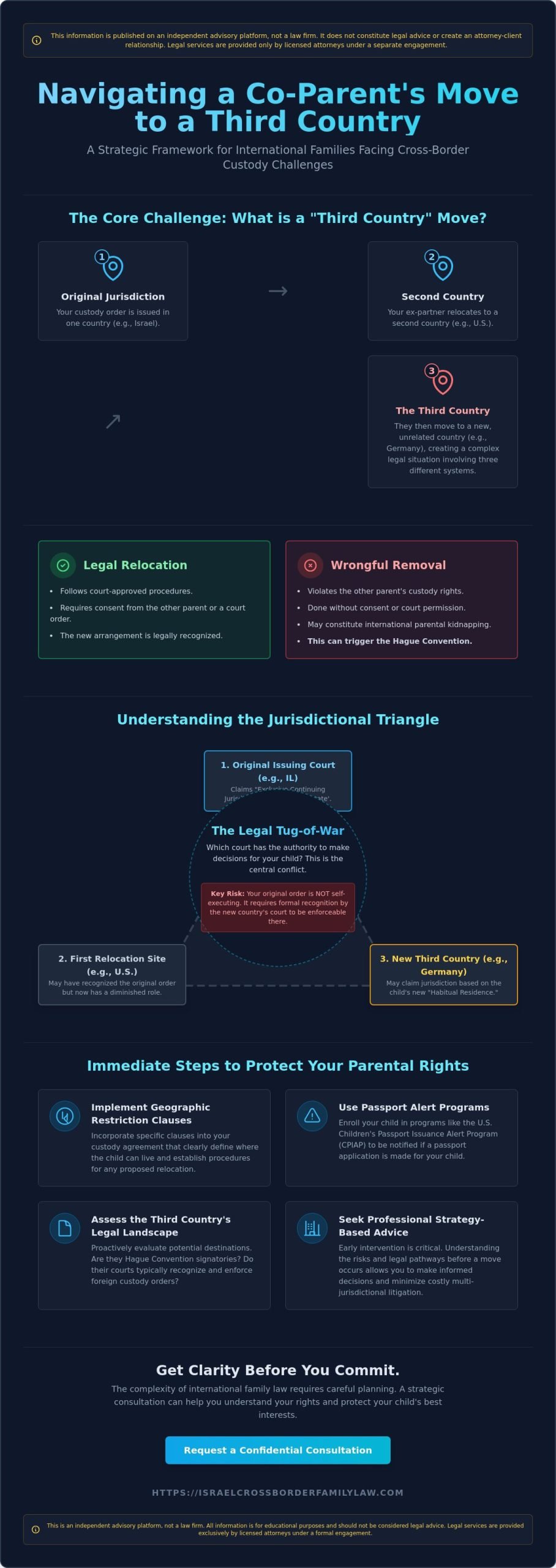
This article is published on an independent advisory platform and does not constitute an attorney-client relationship. Legal services are only provided by licensed attorneys under a separate engagement. A “third country” move occurs when a co-parent relocates from the jurisdiction that issued the original custody order to an entirely new, unrelated country. For example, if you finalized your divorce in IL and your ex-partner initially moved to the United States but later relocated to Germany, Germany is the third country. These situations are significantly more complex than standard cross-border disputes because they involve three different legal systems. You are likely asking what happens if my ex moves to a third country regarding your visitation rights or the enforceability of your current agreement. It’s vital to distinguish between a legal relocation, which follows court-approved procedures, and a wrongful removal, which may trigger the Hague Convention on the Civil Aspects of International Child Abduction.
To better understand the legal framework surrounding parental relocation, watch this helpful video:
The Concept of the Jurisdictional Triangle
In these cases, a jurisdictional triangle forms between the original issuing court, the parent’s first relocation site, and the new third country. The original court in IL might claim authority because it issued the first order, but the new country may eventually view the child as a “habitual resident” once they’ve settled in. Your existing order isn’t usually “self-executing” in a third country. This means you can’t simply show up with your IL court documents and expect local authorities in a place like Singapore to enforce them without a local court’s formal recognition. You can find more details on how these processes work on our international custody relocation page. The tug-of-war between the “Home State” and the “Habitual Residence” is the primary legal pivot point in these disputes.
Common Triggers for Third Country Moves
Relocations to a third country often stem from professional opportunities in global hubs like London, Dubai, or Singapore. In other cases, a parent might return to a country where they hold secondary citizenship or have an established support network. Sometimes, these moves are strategic. A parent might seek a jurisdiction they perceive as more favorable for their specific custody goals or one that makes visitation more difficult for the left-behind parent. Regardless of the reason, early intervention is essential. Once a child establishes deep roots in a new location, changing the legal status quo becomes much harder. Understanding what happens if my ex moves to a third country requires evaluating the legal “friendliness” of that specific nation toward foreign orders. Get clarity before you commit. Request a confidential consultation.
This article is published on an independent advisory platform (not a law firm) and must not imply an attorney-client relationship. Legal services are only provided by licensed attorneys under a separate engagement.
The Role of the Hague Convention and International Treaties
When considering what happens if my ex moves to a third country, the primary legal mechanism involved is the 1980 Hague Convention on the Civil Aspects of International Child Abduction. This treaty acts as an international safety net, but its application is strictly conditional. It doesn’t automatically protect your rights in every corner of the globe. Instead, it provides a procedural framework to ensure that children who are wrongfully removed are returned to their country of habitual residence as quickly as possible.
To invoke this treaty, three fundamental requirements must be met. First, both the country where the child was originally living and the new third country must be active treaty partners. As of early 2026, there are over 100 contracting states to The Hague Child Abduction Convention. If the third country isn’t on this list, the treaty cannot be used. Second, the child must have been “habitually resident” in the original country immediately before the move. Finally, you must prove that the relocation breached your “rights of custody” under the laws of the original jurisdiction. It’s vital to understand that a Hague case doesn’t determine who should have custody based on the child’s best interests. It simply decides which country’s court has the authority to make that decision.
Defining Habitual Residence
Habitual residence is defined as the specific place where the child’s life has a center of gravity. Courts determine this by looking at practical factors like where the child attends school, their social ties, and the shared intent of the parents regarding the move. While many legal systems reference a “6-month rule” to establish residency, international courts in 2026 are increasingly focused on the child’s actual integration into their new environment. If a child has been in a third country for a significant period, the original court may lose its ability to order a return. Understanding what happens if my ex moves to a third country requires a careful analysis of when this residency shift actually occurs.
Non-Hague Convention Countries
If your ex-partner moves to a country that has not signed the Hague treaty, the legal landscape becomes far more unpredictable. Enforcing orders from IL or the U.S. in non-signatory nations is notoriously difficult because those countries are not legally bound to return the child. In these instances, you may have to rely on “international comity,” which is a voluntary recognition of one country’s laws by another, or pursue assistance through diplomatic channels. The complexity of these situations underscores the need for a strategic risk assessment. If you’re facing this uncertainty, it’s wise to reach out for guidance to understand your options. Get clarity before you commit. Request a confidential consultation.
This article is published on an independent advisory platform (not a law firm) and must not imply an attorney-client relationship. Legal services are only provided by licensed attorneys under a separate engagement.
Determining Which Court Has Authority: The Jurisdictional Triangle
Most legal disputes involve two parties in two locations. However, international families often face a more complex “Jurisdictional Triangle.” You might have an original custody order from a U.S. state, a period of residence in IL, and a sudden relocation to a new jurisdiction like the UK or Canada. You are left wondering what happens if my ex moves to a third country regarding which court actually has the power to make decisions. This scenario often triggers a tug-of-war between the original “Issuing Court” and the “New Residence Court” in the third country. The original court typically wants to maintain its authority, while the new country may eventually claim jurisdiction based on the child’s physical presence and integration.
A significant risk in these cases is “forum shopping.” This occurs when a parent seeks a new court order in the third country because they believe the local laws will be more favorable to their position. They might try to bypass the original order entirely. Additionally, enforcing child support becomes exponentially more difficult across three borders. Tracking income and coordinating between different national enforcement agencies requires a sophisticated strategy. Without a clear plan, the left-behind parent often faces high costs and procedural delays that can last for years. Decisions made early in this process will have a lasting impact on your ability to maintain a relationship with your child.
The UCCJEA and International Application
U.S. courts follow the Uniform Child Custody Jurisdiction and Enforcement Act (UCCJEA), which treats foreign nations as if they were other U.S. states for jurisdictional purposes. If a New York court issued the original order, it generally maintains “exclusive continuing jurisdiction” as long as one parent remains in New York. However, IL courts may not always defer to a U.S. ruling if they believe the child’s connection to the U.S. has faded. It’s essential to have a custody order that specifically addresses international relocation to minimize these conflicts. Clarity in the initial document is your best defense against future jurisdictional disputes.
Enforcement vs. Modification
It’s vital to understand the difference between asking a third country to “enforce” your order versus “modifying” it. Enforcement means the new court simply makes the ex-partner follow the existing rules. Modification means the new court re-opens the entire case to decide what’s in the child’s best interests. You should generally avoid litigating custody merits in a new country if possible. Modification often leads to long, expensive battles in a foreign legal system you don’t fully understand. For more information on protecting your rights, visit our page on International Custody & Relocation. Get clarity before you commit. Request a confidential consultation.
This article is published on an independent advisory platform (not a law firm) and must not imply an attorney-client relationship. Legal services are only provided by licensed attorneys under a separate engagement.
Immediate Steps to Protect Your Parental Rights
If you suspect a move is imminent, you must act with precision and speed. Understanding what happens if my ex moves to a third country requires you to take proactive measures before the child leaves their current jurisdiction. While some advisors suggest “talking it out” as a first step, doing so without legal safeguards can backfire. It may tip off a parent who is planning a wrongful removal, giving them time to disappear. Instead, follow these structured steps to secure your parental standing.
- Review geographic restrictions: Examine your current custody order for clauses that limit where the child can live. Many IL and U.S. orders require written consent or a specific court ruling for moves beyond a certain radius.
- Secure the child’s passport: If you hold the passport, keep it in a secure location. You should also apply for the Children’s Passport Issuance Alert Program (CPIAP) through the U.S. Department of State to be notified if a new passport application is filed for your child.
- Document all intent: Save every email, text, and voice message where the other parent mentions relocation. This evidence is vital for proving a breach of custody rights in future litigation.
- Consult a cross-border professional: Seek guidance from someone licensed to handle the multi-jurisdictional complexities of your specific case.
- File a Mirror Order: If you eventually agree to a relocation, ensure a “Mirror Order” is filed in the destination country. This legal step ensures the new country recognizes and enforces your original agreement immediately.
The Danger of Acquiescence
In the world of international family law, silence is often legally interpreted as consent. If you wait several months to protest a move, a court may decide you have “acquiesced” to the new arrangement. This can be a fatal mistake if you later decide to file for a child’s return under the Hague Convention. The treaty generally requires parents to file within a 12-month window from the date of the wrongful removal. To protect yourself, you should protest any unauthorized move in writing immediately to establish a clear record of non-consent. If you are unsure of your current standing, it is best to consult an expert regarding your specific situation.
Utilizing Technology and Supervision
While legal proceedings are pending, you can implement “virtual visitation” schedules to maintain a consistent bond with your child. This includes scheduled video calls and digital communication platforms. If a parent is established as a flight risk, you might need to request supervised visitation or the temporary surrender of travel documents. These protective strategies are common in Divorce & Separation for International Families where cross-border risks are present. Protecting your rights involves building a practical strategy that keeps you connected to your child regardless of the distance. Get clarity before you commit. Request a confidential consultation.
This article is published on an independent advisory platform (not a law firm) and must not imply an attorney-client relationship. Legal services are only provided by licensed attorneys under a separate engagement.
Strategic Risk Assessment for Cross-Border Families
When evaluating what happens if my ex moves to a third country, you must assess the legal “friendliness” of that specific destination. Some nations are highly cooperative and respect orders from IL or the U.S., while others may prioritize local residency over foreign agreements. This assessment involves a rigorous cost-benefit analysis. You must decide if the high price of multi-jurisdictional litigation to prevent the move is more effective than negotiating a robust international parenting plan that guarantees access. A key part of this strategy is the use of Mirror Orders. These are local court orders in the third country that “mirror” your original agreement, ensuring it is recognized and enforceable without starting a new custody battle from scratch. Without such an order, you are essentially relying on the goodwill of the relocating parent, which is a high-risk position in international family law.
A move also complicates financial obligations significantly. Tracking income and enforcing payments across three different national systems requires specific expertise and an understanding of international treaties like the 2007 Hague Child Support Convention. You can learn more about these complexities on our page regarding Child Support Cross-Border Enforcement. Enforcing these orders often requires a combination of local legal action and diplomatic cooperation to ensure your child continues to receive the necessary financial support regardless of where the other parent resides.
Negotiating an International Parenting Plan
A successful plan must address the logistical realities of global distance with extreme specificity. This includes defining who pays for international travel costs and establishing large blocks of holiday time for the parent living abroad to ensure continuity of the relationship. You should also include “choice of law” provisions to clarify which country’s laws will govern any future disputes. For more in-depth relocation strategy insights, we recommend reviewing the resources on the Israel Family Law YouTube channel. These strategies ensure the parent remaining in IL or the U.S. maintains guaranteed, meaningful access to the child through specific, non-negotiable dates that account for school calendars and travel logistics.
Seeking Clarity Before Commitments
The decisions you make in the first weeks of a cross-border dispute often dictate the legal outcome for years to come. Mapping out the jurisdictional triangle is a complex task that requires a nuanced understanding of how different legal systems interact and conflict. Our role is to provide the advisory support necessary to navigate these risks through strategy and informed decision-making. By understanding what happens if my ex moves to a third country before the move occurs, you can protect your rights more effectively and avoid the high costs of multi-jurisdictional litigation. Get clarity before you commit. Request a confidential consultation.
This article is published on an independent advisory platform (not a law firm) and must not imply an attorney-client relationship. Legal services are only provided by licensed attorneys under a separate engagement.
Securing Your Child’s Future Across Borders
Managing the fallout of an international move requires legal foresight and strategic timing. Understanding what happens if my ex moves to a third country involves more than just reading a custody agreement; it requires a deep understanding of the Hague Convention and how different nations define habitual residence. Whether you’re dealing with a move between the U.S. and IL or a relocation to a new global hub, your priority is establishing a clear jurisdictional anchor.
Our expertise in US-Israel cross-border family law helps international families and expats navigate these multi-jurisdictional complexities. We provide a clear framework for enforcing orders and preventing unauthorized relocation before a child establishes deep roots in a new country. By using mirror orders and formal risk assessments, you can protect your parental rights and avoid the high costs of multi-jurisdictional litigation.
Get clarity before you commit. Request a confidential consultation to begin mapping out your strategy. Taking the right steps today ensures your relationship with your child remains protected regardless of where they live.
This article is published on an independent advisory platform (not a law firm) and must not imply an attorney-client relationship. Legal services are only provided by licensed attorneys under a separate engagement.
Frequently Asked Questions
Can my ex move the children to a third country without my consent?
No, a parent generally cannot move children to a new country without your written consent or a specific court order. In IL and the U.S., unilateral relocation is often viewed as a breach of custody rights. If this occurs, it may be classified as a wrongful removal under international law, potentially triggering a Hague Convention application for the child’s prompt return to their original home.
What is a ‘Mirror Order’ and why do I need one for a move to a third country?
A Mirror Order is a legal document issued by a court in the destination country that identicaly matches the terms of your original custody agreement. You need one to ensure that local authorities in the new jurisdiction have a direct, familiar order to enforce. Without a Mirror Order, you might face significant delays or be forced to re-litigate custody if disputes arise in the new location.
Does the Hague Convention apply if my ex moves to a country that isn’t their home country?
Yes, the Hague Convention applies as long as both the original country and the new destination are treaty signatories. The citizenship of the parent is not the deciding factor. Instead, the court focuses on the child’s habitual residence. If you are wondering what happens if my ex moves to a third country that is a treaty partner, the Convention remains your primary tool for protection.
How do I stop my ex from taking our child’s passport?
You can protect the child’s passport by maintaining physical possession or by enrolling the child in the Children’s Passport Issuance Alert Program (CPIAP). In the IL legal system, you can also apply for a “stay of exit” order. This order prevents the child from leaving the country through any border crossing until the court specifically lifts the restriction, providing a high level of security.
Will my US child support order be enforced if my ex moves to Israel or Europe?
Yes, child support orders are often enforceable through the 2007 Hague Child Support Convention, which includes IL and most European nations. This treaty allows for the reciprocal enforcement of financial orders across borders. You will typically work with a central authority to ensure payments are collected. This process helps maintain the child’s standard of living regardless of the parent’s new professional hub.
What happens if the country my ex moves to is not a Hague Convention signatory?
Enforcement becomes significantly more complex if the third country has not signed the Hague treaty. You cannot rely on the streamlined return processes provided by international law. Instead, you must often initiate new legal proceedings within that country’s specific court system. In these cases, courts may rely on international comity, but there are no guarantees that your original order will be recognized or respected.
How long does it take for a child to establish ‘habitual residence’ in a new country?
While many jurisdictions use a six-month threshold as a general guideline, there is no fixed timeline for establishing habitual residence. Courts look at the child’s “center of gravity,” including their integration into school, social circles, and local community. If you don’t protest a move quickly, the child may be considered a habitual resident of the new country sooner than you might expect.
Can I modify my custody order after my ex has already moved abroad?
You can modify your order, but you must first determine which court has the authority to hear the case. If the original court maintains “exclusive continuing jurisdiction,” you can file there. However, if the child has established a new habitual residence in the third country, that country’s courts may claim the right to modify the order. This is a primary risk of what happens if my ex moves to a third country without a clear agreement.

Article by
Gabriel Lior
A Personal Journey That Became a Mission
The advisory was founded by an American father Gabriel Lior, LLB, MBA , global entrepreneur, and cross-border advisor who spent more than a decade navigating the Israeli family court system firsthand and now lives in Singapore with his son.
As a divorced parent in a cross-border family, Gabriel faced nearly every legal challenge a foreign parent can encounter in Israel — including child custody disputes, child support proceedings, property matters in Israel and abroad, false accusations, and complex immigration and relocation proceedings.
Over the years, he learned the hard way how difficult it is for non-Israeli parents to understand the system, identify the right legal strategy, and choose the right legal representation — especially when language, culture, and jurisdictional differences are involved. He also witnessed how foreign parents and new immigrants are often disadvantaged or taken advantage of by service providers and institutions simply because they lack local knowledge or fluency.
From Client to Advisor
To truly understand — and survive — the system, Gabriel pursued formal legal education in Israel, completing two Israeli law degrees, alongside a BA and MBA earned in the United States. This was never about becoming a practicing attorney, but about gaining a deep, structural understanding of how the system works — and where it breaks down for foreign parents.
This rare combination of:
Firsthand client experience
Israeli legal and US business education
International business and negotiation training
Decades of commercial execution
created a unique perspective – one that understands both sides of the table.
After years of litigation, persistence, and at times self-representation, he ultimately succeeded in securing custody of his son and relocating abroad through a rare legal victory in the Israeli Supreme Court — becoming one of the first fathers in Israel to do so under these circumstances.
Disclaimer
Important Disclaimer:
The information provided on this website and in its content is for general informational and educational purposes only and does not constitute legal advice, legal opinion, or legal representation.
Gabriel Lior is not licensed to practice law in Israel (nor is he interested in doing so) and does not provide legal services, despite having completed 2 Law Degrees. The services offered are advisory in nature and are intended to provide general guidance, strategic insight, and information regarding cross-border family law considerations.
No attorney-client relationship is formed by accessing this website, reading its content, or communicating with us.
Any decisions made based on this information are at your own discretion and risk. For legal advice specific to your situation, you should consult a licensed attorney in the relevant jurisdiction.
Where appropriate, we may refer clients to independent, licensed attorneys or professionals. Such referrals do not constitute legal representation and no liability is assumed for services provided by third parties.