This article is published on an independent advisory platform and is not a law firm. The following information is for educational purposes only and does not constitute an attorney-client relationship. Legal services are only provided by licensed attorneys under a separate engagement.
What if the first court you file in actually limits your rights instead of protecting them? In the high-stakes environment of cross-border divorce, many people rush to file because they believe speed is their only defense. However, an early decision without a strategic roadmap can lead to the permanent loss of assets or parental access. When you search for an international family law firm israel us, you’re looking for more than a lawyer; you’re seeking a bridge between two vastly different legal cultures.
You likely understand that a single mistake in a foreign court can result in years of litigation. This guide provides the clarity you need to navigate these systems with confidence. You’ll learn how to assess jurisdictional risks, especially following the November 2025 expansion of Rabbinical Court authority, and understand the impact of the January 2026 fee updates. We’ll explore the “Race to Jurisdiction” and provide a roadmap to protect your family’s future across borders. Get clarity before you commit. Request a confidential consultation.
Key Takeaways
- Understand the “Race to Jurisdiction” and how filing first in either the Rabbinical or Civil court determines the legal rules for your case.
- Learn why a risk-based strategy with an international family law firm israel us is vital before making any commitments or legal moves.
- Identify the challenges of enforcing U.S. child support orders in Israel and how relocation is legally distinguished from abduction.
- Gain clarity on the significant differences between U.S. and Israeli law to avoid high costs and misaligned legal strategies.
- Discover how bicultural and bilingual professionals act as a bridge to help you navigate two complex legal systems simultaneously.
What is International Family Law in the US-Israel Context?
This article is published on an independent advisory platform (not a law firm) and does not imply an attorney-client relationship. Legal services are only provided by licensed attorneys under a separate engagement. In the US-Israel context, international family law is the specific set of legal rules that apply when a family’s life spans both nations. It is a specialized field built on the foundations of international matrimonial law, which governs how different countries recognize and enforce legal decisions across borders.
Choosing an international family law firm israel us requires a different mindset than hiring a local attorney. Domestic cases usually involve one set of laws and one culture. Cross-border situations are more complex because a move in a U.S. court can have immediate and sometimes permanent consequences in Israel. Success depends on having a “team on the ground” that understands the cultural and legal nuances of both jurisdictions. This proactive approach helps families avoid jurisdictional traps that could separate parents from their children or assets for years.
To better understand this concept, watch this helpful video:
Common Scenarios for US-Israel Families
Many families encounter these complexities during major life transitions. For instance, a couple might start divorce proceedings while one spouse resides in the U.S. and the other has already moved to Israel. Other common issues include intense custody and relocation disputes, where the 1980 Hague Convention becomes a central factor in determining where a child should live. Families also frequently struggle with the enforcement of U.S. financial or support orders. An Israeli court doesn’t automatically recognize a U.S. decree, often requiring a separate legal process to ensure the order is valid in the Israeli system.
The Complexity of Multi-Jurisdictional Law
Understanding the Israeli legal system is difficult if you didn’t grow up in it. The system is a unique mix of modern statutes and religious law, which can be confusing for those used to U.S. procedures. This is why plain English explanations are essential. You need to understand the risks of your case without the fog of legal jargon. A bilingual and bicultural approach acts as a bridge between these two worlds. For more visual guides and insights, visit the Israel Family Law YouTube channel. You can also find tailored information in our resources for expats and foreign nationals. Get clarity before you commit.
The Dual Legal System in Israel: Religious vs. Civil Courts
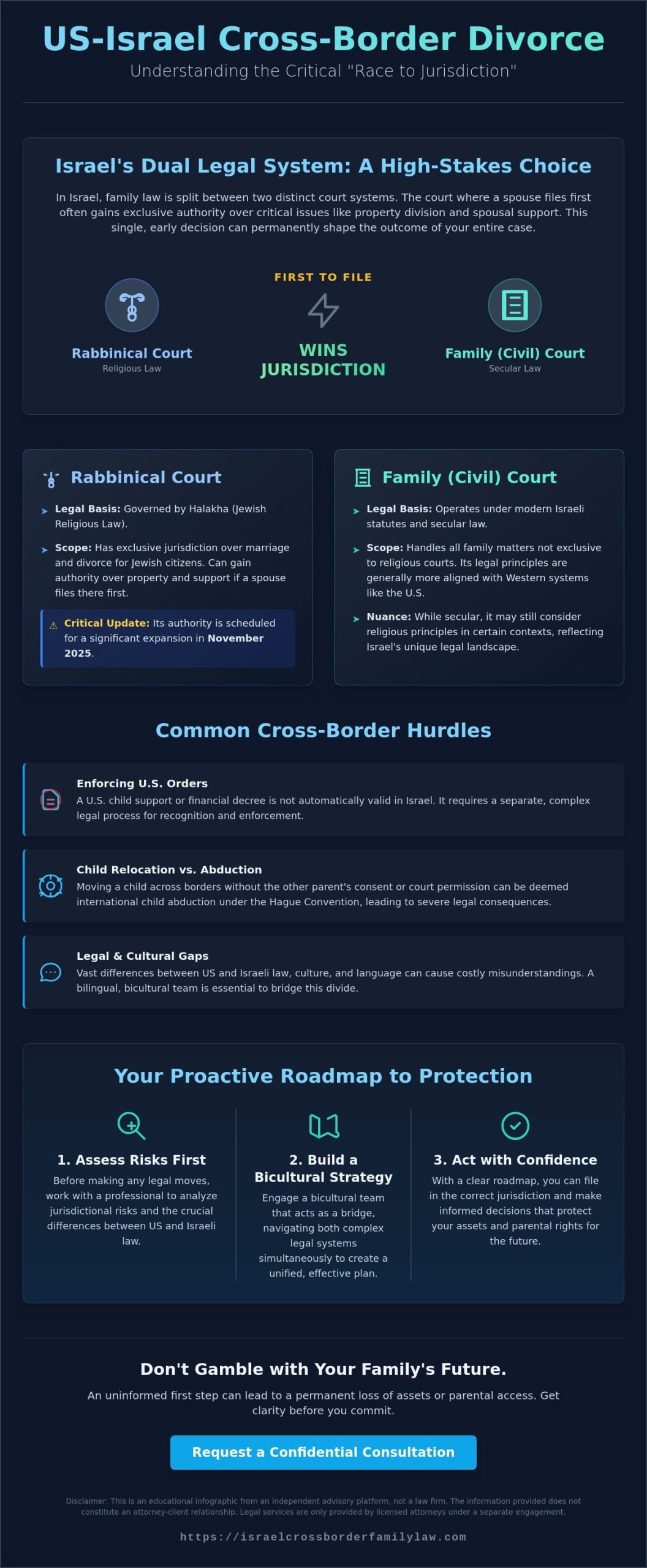
Israel operates under a unique “split” jurisdiction that often confuses those accustomed to the U.S. legal system. Family law matters are handled by two separate entities: the Rabbinical (Religious) Courts and the civil Family Courts. This coexistence creates what is known as the “Race to Jurisdiction.” In this environment, the court where a spouse files first often gains the authority to decide on related issues like property division and alimony. For anyone seeking an international family law firm israel us, understanding this race is the most critical part of an early strategy. The choice of court doesn’t just change the venue; it can change the legal principles applied to your entire life.
The influence of religious law, or Halakha, is a significant departure from U.S. common law. While American courts are strictly secular, Israeli civil courts may still consider religious principles in certain contexts. This complexity makes it vital to seek clarity before making any legal commitments. Identifying the differences between Israeli and U.S. principles early on can prevent the high costs of a misaligned strategy. It’s helpful to speak with a professional who understands how these two systems interact before you file any paperwork.
The Rabbinical Court (Beit Din)
The Rabbinical Court holds exclusive power over the act of marriage and divorce for Jewish residents. It’s the only place to obtain a “Get,” the religious divorce decree. However, its role expanded significantly on November 18, 2025. A new provision now allows these courts to adjudicate all child support matters within a divorce lawsuit, including education and healthcare costs. For U.S. citizens, this can be a startling shift from the secular proceedings they expect. Filing a claim here requires a fee of 536 NIS for agreements between spouses as of the January 1, 2026, schedule.
The Israeli Family Court
The Israeli Family Court is the secular alternative. It handles custody, support, and property division through civil statutes. This court is the primary authority for international matters, including the Hague Convention. If you are managing divorce and separation for international families, this court is often the preferred venue for those seeking a process similar to Western systems. The Family Court focuses on civil rights and is generally where international treaties are enforced, providing a more familiar framework for expats and international families.
Navigating Child Custody and Support Across Borders
Managing the care of children across two continents is one of the most complex challenges a family can face. In the US-Israel context, the legal landscape is shifting. For example, while the “Tender Years Doctrine” once presumed mothers were the better fit for children under age 6, this principle is being phased out in Israel. Decisions made during the initial stages of a dispute often have permanent jurisdictional consequences. If you don’t secure a strategic roadmap from an international family law firm israel us early on, you may find yourself litigating in a court that doesn’t reflect your family’s actual needs or habits.
The Israeli Judicial Authority recently updated its fee schedule. As of January 1, 2026, filing a claim for child support or accommodations costs 280 NIS. However, the true cost of these cases often lies in the lack of alignment between U.S. and Israeli systems. A U.S. support order isn’t automatically recognized in Israel. It requires a formal legal process to become enforceable, and the methods for calculating support differ greatly. In Israel, support for children aged 6 to 15 is increasingly shared between parents based on income and time spent with the child, following a landmark 2017 Supreme Court ruling.
Cross-Border Child Support Enforcement
Enforcement requires more than just a valid U.S. decree. You must register the foreign order with the Israeli Family Court to give it local power. This involves navigating practical hurdles, such as translating documents and proving the original court had the authority to issue the order. For more details on this process, see our guide on child support cross-border enforcement. Understanding these local mechanisms is the first step toward ensuring financial stability for your children.
International Relocation and the Hague Convention
The line between a legal move and “wrongful removal” depends on a child’s “habitual residence.” This is a legal term that describes where a child is actually settled. If a parent moves a child without consent, the other parent may invoke the Hague Convention to seek the child’s return. It’s important to remember that Hague cases aren’t about who is the better parent; they’re about which country has the right to decide custody. You can learn more about these protections in our overview of the Hague Convention and child abduction. Get clarity before you commit.
This article is published on an independent advisory platform and is not a law firm. The following information is for educational purposes only and does not constitute an attorney-client relationship. Legal services are only provided by licensed attorneys under a separate engagement.
Strategic Planning: A Risk-Based Approach to Family Law
Jumping into litigation without a comprehensive cross-border strategy is a high-risk move that often leads to irreversible outcomes. In domestic cases, the rules are usually contained within a single legal system. However, for families with ties to both countries, an action taken in a U.S. court can trigger an immediate and defensive response in an Israeli Rabbinical Court. When you engage an international family law firm israel us, the priority is to identify these “tripwires” before they are triggered. You must seek clarity before you commit to any legal path.
The financial and emotional toll of mismanaged jurisdictional disputes is significant. For context, as of early 2026, a median USCIS I-130 petition filed by a U.S. citizen takes approximately 14.5 months to process. If a custody battle is layered on top of immigration delays, the stress on the family unit multiplies. Coordinating legal teams in both Israel and the United States ensures that your strategy remains consistent across both borders. Without this coordination, you risk receiving conflicting orders that are impossible to enforce in either country.
Step-by-Step Strategy Development
- Step 1: Identify all potential jurisdictions. We analyze your ties to Israel and specific U.S. states to determine which courts have the legal authority to hear your case.
- Step 2: Conduct a risk-assessment. We weigh the pros and cons of the Rabbinical court versus the civil Family Court path. This is especially vital following the November 2025 expansion of Rabbinical jurisdiction over child support.
- Step 3: Analyze enforceability. We evaluate whether a potential order will be recognized under the 2026 Israeli fee and enforcement schedules or U.S. state laws.
Avoiding Common Pitfalls for Expats
Expats often fall into the trap of applying “U.S. logic” to Israeli legal procedures. They might assume that a signed agreement is always final or that religious courts only handle spiritual matters. This is a dangerous assumption. Signing any document in Israel without a full understanding of the Hebrew text and the local context can waive your rights to assets or custody. You can learn more about our process by reviewing how the advisory works. Strategy always precedes action. To begin building your specific roadmap, schedule a strategic review today.
This article is published on an independent advisory platform and is not a law firm. The following information is for educational purposes only and does not constitute an attorney-client relationship. Legal services are only provided by licensed attorneys under a separate engagement.
The Role of a Specialized US-Israel Family Law Firm
An international family law firm israel us serves as a vital bridge between two distinct legal cultures. Traditional litigation models often prioritize immediate court victories. However, an advisory-led model focuses on the total impact of legal decisions across borders. This approach is essential because a family’s life isn’t contained within one set of borders. Bicultural understanding is just as vital as legal expertise. It allows a firm to interpret the nuances of both systems, from the secular U.S. courts to the religious traditions that influence Israeli law.
Having a “team on the ground” is a key differentiator. It signals active engagement within the Israeli market rather than remote counsel. This physical presence is necessary for navigating the updated judicial landscape, such as the 2026 fee changes or the 2025 expansion of Rabbinical jurisdiction. A specialized firm doesn’t just provide a lawyer; it provides a strategic partner who understands the bilingual and bicultural needs of the Anglo community. They act as steady guides capable of navigating clients through challenging legal and business landscapes while providing a seamless Israeli/U.S. professional home.
Why Specialized Advisory Matters
Managing assets in multiple countries requires a global perspective and sophisticated planning. You might have property in New York and a tech venture in the “Start-up Nation.” For business-owning families, you can explore our guide on navigating US-Israel M&A to see how corporate and family interests overlap. A steady guide provides a calm, authoritative voice during high-stress transitions. They help you walk through the logical progression of your case without the panic that often accompanies cross-border disputes. This strategic awareness is necessary to maximize opportunities and achieve your specific family objectives.
Taking the First Step
The first step toward a resolution is gaining clarity. A confidential case review helps determine the right strategy before you file a single document or make a commitment you can’t undo. This is especially helpful for expats and foreign nationals who aren’t familiar with the local system. Given that the divorce rate for Jewish couples in Israel is estimated between 35% and 40%, having a clear roadmap is a practical necessity. Early decisions impact everything from property division to the 280 NIS fee for child support applications. Get clarity before you commit. Request a confidential consultation.
Securing Your Family’s Cross-Border Future
Success in international legal matters depends on the strength of your initial strategy. You now understand that the choice between civil and religious courts isn’t just a procedural detail; it’s a decision that shapes your rights for years. Navigating these complexities requires a bridge between two distinct legal cultures. An international family law firm israel us provides the bilingual and bicultural expertise necessary to manage cases that span both nations. By prioritizing a strategy-first advisory model, you can avoid the common pitfalls of misaligned legal paths.
Managing assets and parental rights across borders is inherently complex. However, having a specialized focus on the US-Israel connection ensures that your international interests remain protected. You don’t have to face these transitions without a roadmap. Identifying risks early and seeking professional guidance is the most effective way to ensure a stable outcome for your family. Get clarity before you commit. Request a confidential consultation to begin building your specific strategy. You can move forward with confidence when you have the right information in hand.
This article is published on an independent advisory platform and is not a law firm. The following information is for educational purposes only and does not constitute an attorney-client relationship. Legal services are only provided by licensed attorneys under a separate engagement.
Frequently Asked Questions
Can a U.S. divorce decree be enforced in Israel?
A U.S. divorce decree is not automatically valid in Israel and requires a formal recognition process through the Israeli Family Court. You must file a specific petition to have the foreign judgment recognized as enforceable. The court will examine the decree to ensure it doesn’t violate local public policy or basic principles of justice. This process is necessary before you can enforce financial or custody orders locally.
What is the ‘Race to Jurisdiction’ in Israeli family law?
The “Race to Jurisdiction” describes the competition between Israel’s civil Family Courts and the religious Rabbinical Courts. Because both systems have the authority to hear certain family matters, the court where a spouse files first usually gains control over the case. This choice significantly impacts property division and alimony rules. Engaging an international family law firm israel us early helps you determine which venue best protects your specific interests.
Does Israel recognize U.S. prenuptial agreements?
Israel generally recognizes foreign prenuptial agreements, but they must be validated by an Israeli court to be fully enforceable within the country. If you signed an agreement in the U.S., a judge will review it for procedural fairness and clarity. It’s a mistake to assume a U.S. document will be applied exactly as written without this local validation. Get clarity before you commit. Request a confidential consultation.
How is child support calculated in Israel for U.S. citizens?
Child support in Israel is determined by the court based on the child’s individual needs and the parents’ relative incomes rather than a codified national calculator. While many U.S. states use fixed formulas, Israeli judges have more discretion. For children aged 6 to 15, support is typically shared between parents based on a 2017 Supreme Court ruling. For children under 6, the father generally bears the primary financial obligation.
What happens if my child is taken to Israel without my permission?
If a child is removed to Israel without consent, the 1980 Hague Convention provides the legal framework for seeking their return. You must file a claim for “wrongful removal” based on the child’s habitual residence before the move. These cases are extremely time-sensitive and focus on which country has the legal right to decide custody. It’s vital to act quickly to prevent the child from becoming legally settled in the new location.
Do I need a lawyer in both the U.S. and Israel for my divorce?
Most cross-border cases require legal counsel in both jurisdictions to ensure your strategy is fully aligned. An international family law firm israel us acts as a bridge, coordinating with your U.S. attorney to prevent conflicting court orders. This collaboration is necessary because a decision in a U.S. court can have immediate, unintended consequences in Israel. Managing both sides of the case prevents jurisdictional gaps that could harm your rights.
How long does the Israeli probate process take for U.S. beneficiaries?
The Israeli probate process for foreign beneficiaries typically takes between four and eight months to complete. This timeline depends on the complexity of the estate and whether any parties file objections to the inheritance order. As of January 1, 2026, the fee for an objection to a probate or inheritance order is 1,140 NIS. Having a clear strategy helps manage expectations for beneficiaries living outside of Israel.
Is mediation an option for cross-border family disputes in Israel?
Mediation is a highly encouraged option for resolving international family disputes in Israel. Courts often suggest alternative dispute resolution to help families save time and reduce the high costs of litigation. It’s particularly effective for property division when assets are located in both the U.S. and Israel. Mediation allows parents to create a customized plan that reflects their bicultural reality rather than leaving the decision to a judge.

Article by
Gabriel Lior
A Personal Journey That Became a Mission
The advisory was founded by an American father Gabriel Lior, LLB, MBA , global entrepreneur, and cross-border advisor who spent more than a decade navigating the Israeli family court system firsthand and now lives in Singapore with his son.
As a divorced parent in a cross-border family, Gabriel faced nearly every legal challenge a foreign parent can encounter in Israel — including child custody disputes, child support proceedings, property matters in Israel and abroad, false accusations, and complex immigration and relocation proceedings.
Over the years, he learned the hard way how difficult it is for non-Israeli parents to understand the system, identify the right legal strategy, and choose the right legal representation — especially when language, culture, and jurisdictional differences are involved. He also witnessed how foreign parents and new immigrants are often disadvantaged or taken advantage of by service providers and institutions simply because they lack local knowledge or fluency.
From Client to Advisor
To truly understand — and survive — the system, Gabriel pursued formal legal education in Israel, completing two Israeli law degrees, alongside a BA and MBA earned in the United States. This was never about becoming a practicing attorney, but about gaining a deep, structural understanding of how the system works — and where it breaks down for foreign parents.
This rare combination of:
Firsthand client experience
Israeli legal and US business education
International business and negotiation training
Decades of commercial execution
created a unique perspective – one that understands both sides of the table.
After years of litigation, persistence, and at times self-representation, he ultimately succeeded in securing custody of his son and relocating abroad through a rare legal victory in the Israeli Supreme Court — becoming one of the first fathers in Israel to do so under these circumstances.
Disclaimer
Important Disclaimer:
The information provided on this website and in its content is for general informational and educational purposes only and does not constitute legal advice, legal opinion, or legal representation.
Gabriel Lior is not licensed to practice law in Israel (nor is he interested in doing so) and does not provide legal services, despite having completed 2 Law Degrees. The services offered are advisory in nature and are intended to provide general guidance, strategic insight, and information regarding cross-border family law considerations.
No attorney-client relationship is formed by accessing this website, reading its content, or communicating with us.
Any decisions made based on this information are at your own discretion and risk. For legal advice specific to your situation, you should consult a licensed attorney in the relevant jurisdiction.
Where appropriate, we may refer clients to independent, licensed attorneys or professionals. Such referrals do not constitute legal representation and no liability is assumed for services provided by third parties.