This article is published on an independent advisory platform and does not constitute a law firm relationship or legal representation. Legal services are only provided by licensed attorneys under a separate engagement.
Most executors assume that what works in a US probate court will translate seamlessly to Israeli bureaucracy, but the reality is that the two systems often operate in direct opposition. It’s natural to feel overwhelmed by the prospect of managing a deceased loved one’s affairs while navigating foreign tax laws and multi-jurisdictional filings. Understanding the responsibilities of an international executor is the first step toward preventing asset freezing and protecting yourself from personal liability.
This guide provides a clear roadmap for managing an estate that spans across Israel and the United States. You’ll gain clarity on the specific administrative duties required, from handling the 25% Israeli capital gains tax on inherited property to meeting US FATCA and FBAR reporting thresholds for 2026. We’ll explore how to synchronize these legal systems so you can make informed decisions and avoid the stress of foreign bureaucracy. Get clarity before you commit. Request a confidential consultation.
Key Takeaways
- Identify how a cross-border fiduciary balances the conflicting legal requirements of the deceased’s home country and the location of their assets.
- Understand the core responsibilities of an international executor when managing simultaneous probate applications in both Israel and the United States.
- Learn the critical differences between the two systems, including how Israel’s lack of estate tax interacts with the US federal tax system.
- Recognize the risks of personal liability for unpaid taxes and how to use the US-Israel Tax Treaty to minimize the risk of double taxation.
- Gain a realistic perspective on the timeline for estate closure and the importance of early coordination with dual-qualified advisors.
The Role of an International Executor: Defining Cross-Border Responsibility
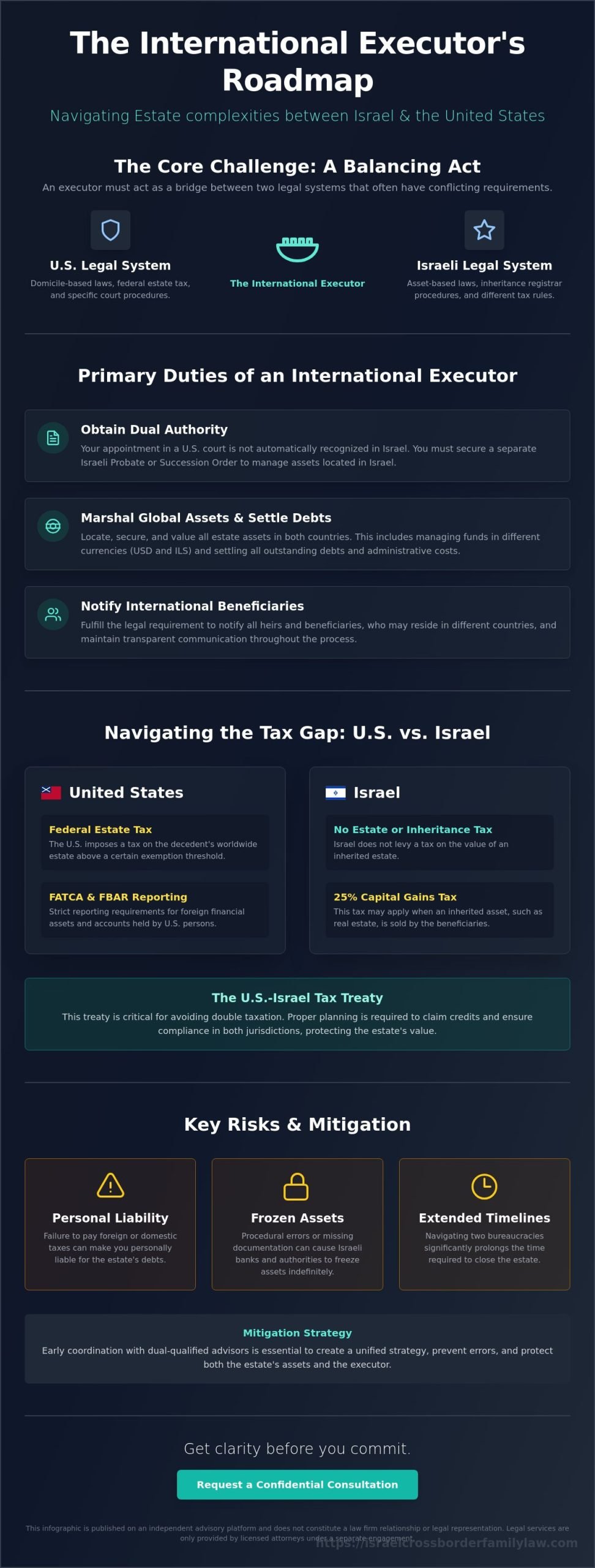
An international executor acts as the primary fiduciary for an estate that holds assets across multiple national borders. While the fundamental duties of an executor include gathering assets and paying debts, these tasks become significantly more complex when they involve different legal jurisdictions. The core challenge you will face is balancing the laws of the deceased’s last domicile with the specific regulations of the country where the assets are physically located. When a border is crossed, the standard procedural rules often change, requiring a higher level of strategic coordination.
To better understand the weight of these obligations, watch this helpful video regarding the general expectations of the role:
In a cross-border context, you must act as a bridge between two distinct legal cultures. The responsibilities of an international executor involve more than just following instructions in a will; they require you to translate the requirements of one system into the language of another. For example, an Israeli bank may require specific documentation that a US court does not typically issue. You can learn more about how this process works through our advisory platform, which focuses on synchronizing these divergent systems.
The Fiduciary Duty in an International Context
Your fiduciary duty is a strict legal obligation to act in the best interest of the beneficiaries at all times. In a multi-jurisdictional estate, the risk of an unintentional breach increases because you are navigating conflicting deadlines and tax requirements. You must maintain absolute transparency across all jurisdictions to ensure that beneficiaries in both Israel and the US understand the progress of the estate. Failing to account for foreign tax liabilities can lead to personal liability, making it vital to seek clarity before distributing any funds.
Executor vs. Administrator: Key Distinctions
The distinction between an executor and an administrator is often a matter of how you were appointed. An executor is named in a will, while an administrator is appointed by a court when no will exists. However, the Israeli Succession Authority does not always automatically recognize a foreign court appointment. Even if you have been granted probate in a US court, you will likely need to obtain a separate Israeli Probate Order to manage assets located in Israel. Understanding that your US authority does not grant you immediate power in Israel is essential for setting a realistic timeline for the estate’s closure.
This article is published on an independent advisory platform and does not constitute a law firm relationship or legal representation. Legal services are only provided by licensed attorneys under a separate engagement.
Core Responsibilities: From Probate to Asset Distribution
Managing an estate across borders requires a high level of organization and a proactive approach to administration. The responsibilities of an international executor shift from legal theory to practical management once you begin the physical search for assets. Unlike a domestic case where you might simply monitor the deceased’s mail, cross-border estates require you to investigate records in different languages and interact with foreign registries. You must act quickly to secure assets, as delays can lead to security risks or the loss of value in fluctuating markets.
One of your primary duties involves notifying beneficiaries who may be scattered across international borders. This isn’t just a courtesy; it’s a legal requirement in both jurisdictions. You’ll also need to settle debts and administrative expenses, which often involves managing funds in different currencies. Balancing US dollars and Israeli shekels requires careful accounting to ensure that currency fluctuations don’t inadvertently reduce the value of the final inheritance for the beneficiaries.
Asset Discovery and Protection
Locating Israeli bank accounts or real estate often requires interacting with Hebrew-speaking institutions and the “Tabu” (the Israeli Land Registry). For many expats and foreign nationals, the challenge lies in the lack of a centralized “missing money” database like those found in many US states. You must also secure physical property in Israel immediately to prevent unauthorized access. Managing digital assets and international investment portfolios adds another layer of complexity, as financial institutions in each country have different compliance standards for verifying your authority.
The Probate and Order of Succession Process
Navigating US estate systems is usually the first step for families based in America. However, a Grant of Probate from a US court isn’t a “golden ticket” that works everywhere. In Israel, you must file for an Inheritance Order or a Probate Order with the Israeli Succession Authority. Timing is a strategic choice. In some cases, waiting for the US probate to finish before filing in Israel can streamline the process, while in others, simultaneous filings are necessary to prevent assets from being frozen for years.
Documents from the US must be authenticated with an apostille to be legally recognized in Israel. You’ll also need certified Hebrew translations of the will and the death certificate. These procedural steps are often where executors encounter the most frustration, as the Israeli bureaucracy is strict about documentation. It is often helpful to get a clear assessment of your specific situation before you start the formal filing process to avoid costly mistakes.
This article is published on an independent advisory platform and does not constitute a law firm relationship or legal representation. Legal services are only provided by licensed attorneys under a separate engagement.
Navigating the Gap: Differences Between Israeli and US Estate Systems
Israel and the United States approach estate management from fundamentally different legal philosophies. In the US, the system is rooted in common law, where testamentary freedom allows an individual to distribute assets almost entirely at their discretion. Israel, however, operates under the Succession Law of 1965, which is a codified civil system that incorporates elements of religious law. One of the most significant responsibilities of an international executor is reconciling these two frameworks to ensure that the distribution is legally valid in both countries.
Taxation highlights another major gap between the two nations. As of 2026, the US federal estate tax exemption stands at $15 million per individual, which covers a majority of estates. Conversely, Israel has not had an estate or inheritance tax since it was abolished on April 1, 1981. However, executors must be aware that Israel levies a 25% capital gains tax, known as “Mas Shevach,” on the real gain in value when inherited property is sold. Unlike the US “step-up in basis,” Israel calculates this tax based on the original purchase price paid by the deceased. This distinction can create unexpected financial burdens for beneficiaries if the executor doesn’t plan for the lack of a basis adjustment.
Common Law vs. Israeli Civil/Religious Law
The procedural divide is stark. US courts often prioritize the intent expressed in a will, while the Israeli Succession Authority focuses on strict compliance with the 1965 law. In some instances, religious courts in Israel may have jurisdiction over estate matters if all heirs provide written consent. This can introduce specific maintenance rights for surviving spouses or children that do not exist in the US system. Consulting a Cross-Border Estate Administration Guide can help you understand how these conflicting principles might impact your specific case.
The Impact of Residency and Domicile
The legal system that governs an estate is often determined by the deceased’s “center of life” at the time of their passing. For US citizens living in Israel, this creates a complex overlap where US tax obligations remain due to citizenship, but Israeli succession rules apply due to residency. This dual exposure requires a nuanced understanding of Inheritance Law in Israel for US Residents to avoid procedural delays. The responsibilities of an international executor include verifying the legal domicile to prevent the estate from being tied up in jurisdictional disputes between US state courts and the Israeli Succession Authority. Get clarity before you commit. Request a confidential consultation.
This article is published on an independent advisory platform and does not constitute a law firm relationship or legal representation. Legal services are only provided by licensed attorneys under a separate engagement.
Managing Risks: Tax Compliance and Fiduciary Liability
The most daunting aspect of your role is the potential for personal financial risk. One of the primary responsibilities of an international executor is ensuring that all tax obligations are met before any assets are distributed to beneficiaries. If you release funds prematurely and the estate is later found to owe taxes to either the IRS or the Israeli Tax Authority, you may be held personally liable for the shortfall. This makes a thorough understanding of the US-Israel Tax Treaty essential. While the treaty exists to prevent double taxation, it is not an automatic shield; you must actively claim its benefits through proper filings to ensure the estate is not taxed twice on the same dollar.
Compliance also extends to rigorous reporting requirements for foreign financial accounts. As an executor, you must oversee the filing of the FBAR (Report of Foreign Bank and Financial Accounts). For the 2025 calendar year, the filing deadline is April 15, 2026, with an automatic extension available until October 15, 2026. Additionally, FATCA (Foreign Account Tax Compliance Act) thresholds must be monitored. For US citizens living abroad, these thresholds can be as high as $400,000 for married couples filing jointly at year-end, but they drop significantly for those residing in the US. Managing these filings alongside currency exchange risks during asset liquidation requires a strategic approach to protect the estate’s total value.
US Tax Obligations for International Estates
Even if the deceased lived in Israel, their US citizenship triggers a requirement to report worldwide assets to the IRS. You may need to file IRS Form 706 if the estate exceeds the 2026 federal exemption of $15 million per individual. A critical step in this process is obtaining a professional appraisal for Israeli property that meets US Treasury standards. Without a qualified valuation, you risk underreporting assets or facing challenges during a future audit. Handling US beneficiaries of an Israeli estate also requires careful planning to ensure they receive their inheritance without triggering unnecessary withholding taxes.
Israeli Tax Considerations
While you won’t encounter a “death tax” in Israel, you must account for the 25% capital gains tax on the real gain of any property sales. Because Israel does not offer a “step-up in basis,” the tax is calculated from the original purchase price. This can result in a substantial tax bill if the property was held for decades. Understanding Israeli Inheritance Tax for US Beneficiaries is vital for anyone managing assets in this jurisdiction. If you are unsure about your current exposure, it is wise to consult with a cross-border professional to review your reporting obligations.
This article is published on an independent advisory platform and does not constitute a law firm relationship or legal representation. Legal services are only provided by licensed attorneys under a separate engagement.
Strategic Planning for International Executors
Success in this role depends on your ability to look ahead rather than simply reacting to paperwork. The responsibilities of an international executor require a high degree of strategic planning to ensure that the estate moves through two different legal systems without stalling. You must establish a realistic timeline from the outset. While a domestic probate might conclude in a few months, a cross-border estate involving Israel often takes 12 to 18 months. This delay is usually due to the time required for translated documents, apostilles, and the specific verification processes of the Israeli Succession Authority.
Managing the expectations of beneficiaries is equally critical. Families often feel anxious when assets are located thousands of miles away in a different jurisdiction. Regular, transparent updates about the “Order of Succession” process in Israel can help mitigate this stress. By explaining the procedural steps early, you reduce the likelihood of disputes and demonstrate that you are fulfilling your fiduciary duties with care. Clear communication is your best defense against the friction that often arises in international families.
Building Your Professional Team
You shouldn’t attempt to manage this multi-jurisdictional complexity alone. An effective strategy involves assembling a team that understands the inherent friction between US and Israeli law. This team typically includes:
- Dual-Qualified Advisors: Professionals who understand the nuances of both systems can prevent you from making a decision in the US that creates a tax trap in Israel.
- International Accountants: You’ll need expertise in managing US IRS reporting, such as the $15 million individual exemption for 2026, alongside Israeli capital gains calculations.
- Local Representatives: Having a physical presence or a dedicated contact in Israel is essential for dealing with banks and government offices that may not respond well to remote inquiries.
Coordinating between a US executor and an Israeli administrator requires a unified vision. You can learn more about how our advisory platform supports this collaboration to ensure a smoother transition of assets across borders.
Mitigating Conflict and Stress
Distance often leads to misunderstandings among heirs. To resolve potential disputes between beneficiaries in different countries, you must maintain meticulous records of every cross-border transaction and currency exchange. Being able to show exactly how funds were handled protects you from claims of mismanagement or personal liability. If tensions rise, having a neutral, third-party perspective can help ground the conversation in legal reality rather than family history.
The complexity of these situations means that early decisions have long-term consequences for the inheritance. Whether you are dealing with a small apartment or a large investment portfolio, the strategy you choose today will determine the ease of the distribution tomorrow. Get clarity before you commit. Request a confidential consultation.
This article is published on an independent advisory platform and does not constitute a law firm relationship or legal representation. Legal services are only provided by licensed attorneys under a separate engagement.
Securing a Cross-Border Legacy through Strategic Oversight
Managing an estate across Israel and the US is a task of significant technical complexity. You’ve seen how the responsibilities of an international executor extend far beyond simple asset distribution. It involves navigating the 25% Israeli capital gains tax and meeting strict US FBAR reporting deadlines for 2026. Success requires more than just following the instructions in a will; it demands a synchronized approach that respects the legal cultures and administrative requirements of both nations.
By building a professional team and prioritizing transparency with beneficiaries, you can transform a potentially overwhelming process into a structured roadmap. Early coordination helps you avoid personal liability and ensures that the transition of assets is handled with the precision it deserves. Our advisory for international families provides a specialized US-Israel legal bridge with a focus on risk-based strategy.
Get clarity before you commit. Request a confidential consultation. You have the tools to manage this transition effectively and protect the legacy entrusted to your care.
This article is published on an independent advisory platform and does not constitute a law firm relationship or legal representation. Legal services are only provided by licensed attorneys under a separate engagement.
Frequently Asked Questions
What is the first thing an international executor should do?
The first step is to locate the original will and identify the deceased’s “center of life” or legal domicile. This determination dictates which country’s laws primary probate will follow. You should also immediately secure physical assets, such as real estate in Israel, and notify financial institutions to prevent unauthorized access while you begin the formal legal process.
Can a US citizen act as an executor for an estate in Israel?
Yes, a US citizen can fulfill the responsibilities of an international executor for assets located in Israel. While you don’t need to be an Israeli resident, you must obtain a Probate Order from the Israeli Succession Authority. Most foreign executors appoint a local representative to handle the day to day interactions with Israeli banks and government registries.
Does Israel have an inheritance or estate tax for foreign beneficiaries?
Israel does not have an inheritance or estate tax; it was abolished on April 1, 1981. However, you must account for a 25% capital gains tax on the sale of inherited real estate. Because Israel doesn’t offer a step-up in basis like the US, the tax is calculated from the original purchase price paid by the deceased person.
How long does the Israeli probate process typically take for foreigners?
The process generally takes between 12 and 18 months for estates involving foreign executors or beneficiaries. This timeline includes the time required for obtaining apostilles on US documents, performing certified Hebrew translations, and the mandatory public notice period required by the Israeli Succession Authority. Delays often occur if the documentation doesn’t strictly meet Israeli bureaucratic standards.
Am I personally liable for the debts of the estate?
You aren’t generally liable for the deceased’s debts, but you can face personal liability for errors in administration. If you distribute assets to beneficiaries before settling tax obligations or valid creditor claims, authorities may hold you responsible for the shortfall. This risk highlights why understanding the full responsibilities of an international executor is essential before making any financial commitments.
What happens if there is a will in the US but not in Israel?
Israeli law typically recognizes a valid US will as long as it meets specific legal requirements under the Succession Law of 1965. You’ll need to submit the US will to the Israeli Succession Authority along with a certified translation and an apostille. The court will then determine if the will is valid under Israeli law for the distribution of local assets.
Do I need to travel to Israel to fulfill my duties as executor?
You don’t usually need to travel to Israel to manage the estate. Most administrative tasks, including filing for probate and communicating with banks, can be handled through a Power of Attorney granted to a local professional. Digital communication and international courier services allow you to fulfill your duties from the US while maintaining oversight of the Israeli assets.
How are cross-border legal fees typically handled by the estate?
Legal fees and administrative costs are considered estate expenses and are typically paid directly from the estate’s assets. As an executor, you should keep meticulous records of these payments for the final accounting. It’s important to ensure that the estate has sufficient liquidity in the correct currency to cover these costs in both Israel and the United States.

Article by
Gabriel Lior
A Personal Journey That Became a Mission
The advisory was founded by an American father Gabriel Lior, LLB, MBA , global entrepreneur, and cross-border advisor who spent more than a decade navigating the Israeli family court system firsthand and now lives in Singapore with his son.
As a divorced parent in a cross-border family, Gabriel faced nearly every legal challenge a foreign parent can encounter in Israel — including child custody disputes, child support proceedings, property matters in Israel and abroad, false accusations, and complex immigration and relocation proceedings.
Over the years, he learned the hard way how difficult it is for non-Israeli parents to understand the system, identify the right legal strategy, and choose the right legal representation — especially when language, culture, and jurisdictional differences are involved. He also witnessed how foreign parents and new immigrants are often disadvantaged or taken advantage of by service providers and institutions simply because they lack local knowledge or fluency.
From Client to Advisor
To truly understand — and survive — the system, Gabriel pursued formal legal education in Israel, completing two Israeli law degrees, alongside a BA and MBA earned in the United States. This was never about becoming a practicing attorney, but about gaining a deep, structural understanding of how the system works — and where it breaks down for foreign parents.
This rare combination of:
Firsthand client experience
Israeli legal and US business education
International business and negotiation training
Decades of commercial execution
created a unique perspective – one that understands both sides of the table.
After years of litigation, persistence, and at times self-representation, he ultimately succeeded in securing custody of his son and relocating abroad through a rare legal victory in the Israeli Supreme Court — becoming one of the first fathers in Israel to do so under these circumstances.
Disclaimer
Important Disclaimer:
The information provided on this website and in its content is for general informational and educational purposes only and does not constitute legal advice, legal opinion, or legal representation.
Gabriel Lior is not licensed to practice law in Israel (nor is he interested in doing so) and does not provide legal services, despite having completed 2 Law Degrees. The services offered are advisory in nature and are intended to provide general guidance, strategic insight, and information regarding cross-border family law considerations.
No attorney-client relationship is formed by accessing this website, reading its content, or communicating with us.
Any decisions made based on this information are at your own discretion and risk. For legal advice specific to your situation, you should consult a licensed attorney in the relevant jurisdiction.
Where appropriate, we may refer clients to independent, licensed attorneys or professionals. Such referrals do not constitute legal representation and no liability is assumed for services provided by third parties.