This article is published on an independent advisory platform and does not constitute legal representation or an attorney-client relationship.
For international families, a handshake agreement is often a liability rather than a convenience. You likely already feel the weight of managing complex travel logistics and the underlying worry about how an international co-parenting agreement israel or the Hague Convention might impact your children’s future. It is a significant challenge to balance time zones and school calendars while ensuring your parental rights remain enforceable across different legal systems.
Establishing a comprehensive legal framework is the most effective way to move from uncertainty to strategic clarity. This 2026 guide explains how to draft a legally sound cross-border parenting plan that ensures effective communication and protects your rights. We will examine the differences between the Family and Rabbinical courts and the strategic importance of Mirror Orders. You will also learn about the 45 to 90 day Hague Convention decision timelines and how recent 2026 amendments to the Legal Capacity and Guardianship Law affect your parental authority. Get clarity before you commit. Request a confidential consultation.
For more insights on these topics, view our guidance here: https://www.youtube.com/@IsraelFamilyLaw
Key Takeaways
- Define clear jurisdictional boundaries to prevent legal disputes between the Israeli and foreign court systems.
- Navigate travel logistics with precision by managing airport exit orders and establishing secure international travel protocols.
- Understand how the choice between Family and Rabbinical courts affects your international co-parenting agreement israel and your parental rights.
- Create structured communication frameworks that use digital logs and predefined response times to reduce daily conflict.
- Apply the “Clarity Before Commitment” strategy to ensure your legal documents are future-proof and protect your child’s best interests.
This article is published on an independent advisory platform and does not constitute legal representation or an attorney-client relationship.
Understanding the International Co-parenting Agreement in IL
An international co-parenting agreement israel, known locally as a Heskem Horut, is a comprehensive legal document that outlines how parents will raise their children following a separation. In the Israeli legal system, this document serves as the foundational roadmap for custody, visitation, and decision making authority. While local families often use standard templates, these basic forms usually lack the sophisticated clauses required for families with ties to other countries, such as the United States. The primary objective is to create a stable environment for children who must navigate multiple cultures and legal jurisdictions. It’s about more than just a schedule; it is a strategic framework designed to prevent future litigation.
To better understand how these arrangements function in practice, watch this helpful video:
The Israeli Ministry of Justice plays a critical role in cross-border family matters, specifically through the Office of the Legal Counsel and Legislative Affairs. This department ensures that domestic agreements align with international treaties and manages cases involving the wrongful removal of children. Because Israeli marriage and divorce laws are deeply intertwined with religious and civil frameworks, an international co-parenting agreement israel must be drafted with precision. This ensures it can withstand the scrutiny of both the civil Family Court and the Rabbinical Court system.
The Legal Standing of Shared Parenting in Israel
The Legal Capacity and Guardianship Law of 1962 remains the primary statute governing parental responsibilities. However, the legal landscape has evolved significantly with recent updates. Amendment 21, which became effective in September 2025, and the January 2026 amendment have streamlined how guardians manage financial affairs and digital payments. Despite these procedural improvements, the core principle remains the “Best Interest of the Child.” This standard is the lens through which every clause is viewed. Parents must remember that an agreement is not legally binding until an Israeli court formally ratifies it. Without this judicial stamp, the document is merely a statement of intent rather than an enforceable order.
Why International Families Need a Specialized Agreement
For international families, a standard agreement poses significant risks, particularly regarding the concept of “habitual residence” under the Hague Convention. Without specific language, a parent’s temporary visit abroad could be misinterpreted as a permanent move, potentially triggering a legal battle that can take between 45 and 90 days to resolve in court. Additionally, logistics like coordinating Jewish holidays in Israel with US school breaks require customized scheduling that standard templates ignore. These complexities often arise during separation for international families, where early strategic decisions can prevent years of conflict. Using a document that accounts for time zone differences and international travel costs is essential for long-term peace. Get clarity before you commit. Request a confidential consultation.
This article is published on an independent advisory platform and does not constitute legal representation or an attorney-client relationship.
The 5 Essential Legal Pillars of a Cross-Border Agreement
Creating a robust international co-parenting agreement israel requires moving beyond basic custody schedules to address the unique pressures of transnational life. A successful plan acts as a preventative shield, addressing potential conflicts before they escalate into high-stakes litigation. To achieve this level of security, your agreement must be built upon five essential legal pillars:
- Jurisdictional Certainty: Explicit clauses that designate Israel as the exclusive forum for future disputes, effectively preventing “forum shopping” where a parent might seek a more favorable ruling in a foreign court.
- Travel Sovereignty: Detailed protocols for international trips, including specific timelines for notification and the management of Ben Gurion Airport exit orders.
- The Mirror Order: A strategic requirement ensuring that the Israeli agreement is formally recognized and registered in the other parent’s country of residence.
- Alternative Dispute Resolution: Mandatory mediation or arbitration steps that must be exhausted before either party can file a new claim in court.
- Financial Granularity: Total transparency regarding the division of “extraordinary” costs, such as international school tuition, multi-country health insurance, and trans-Atlantic flight expenses.
Jurisdiction and the Mirror Order Strategy
An Israeli court order is a powerful domestic tool, but it doesn’t always carry automatic weight in a US state court. This creates a legal vulnerability for the parent remaining in Israel or the parent hosting the child abroad. To close this gap, we often utilize a “Mirror Order” strategy. This involves taking the finalized Israeli agreement and having it mirrored by a court in the relevant US jurisdiction. This process ensures that both legal systems recognize the same terms, significantly reducing the risk of conflicting orders. Without this, a parent could theoretically initiate a new custody case in a different country, bypassing the protections established in your original international co-parenting agreement israel. This is particularly vital when navigating International Parental Child Abduction laws in Israel, as it reinforces the child’s habitual residence.
Travel Protocols and Exit Orders
In the Israeli legal system, “Stay of Exit” orders (Tzav Ikul) are a standard mechanism used to prevent a child from being removed from the country without consent. While these orders provide security, they can also cause immense stress during legitimate travel if not managed correctly. Your agreement should define exactly how and when these orders are temporarily lifted for vacations. This includes clear rules for passport custody and the specific number of days required for advanced notice. A child departing Israel generally requires a valid passport, a court-approved travel authorization, and, in many cases, the formal cancellation of a standing Stay of Exit order. Understanding these requirements early helps maintain a sense of normalcy for the child while protecting parental rights. If you are concerned about how these rules apply to your specific situation, it is wise to review your current travel arrangements. Get clarity before you commit. Request a confidential consultation.
This article is published on an independent advisory platform and does not constitute legal representation or an attorney-client relationship.
Navigating Jurisdictional Tensions: Civil vs. Rabbinical Courts
Israel operates under a unique dual-court system where civil Family Courts and religious Rabbinical Courts share concurrent jurisdiction over many domestic issues. For Jewish couples, the Rabbinical Court has exclusive authority over the marriage itself and the “Get,” which is the religious divorce decree. However, ancillary matters like child custody and property division can be heard in either forum. This creates a situation known as the “Race to the Court.” The first parent to file a claim in a specific court typically establishes that court’s jurisdiction over those issues. For an international co-parenting agreement israel, choosing the correct forum is a strategic decision that impacts how your cross-border logistics are interpreted and enforced.
Many non-religious Anglos or expats feel a sense of unease regarding religious courts, fearing they might impose lifestyle restrictions. It’s helpful to understand that these courts primarily focus on the legalities of the religious divorce. While the Rabbinical Court can hear custody cases if they are “attached” to a divorce filing, their procedural focus differs from the civil system. Misconceptions often lead to unnecessary stress; however, the choice of venue remains a critical tactical move that should be decided before any legal papers are served. A decision made in one system is not easily moved to the other later on.
The Family Court Advantage for Expats
The civil Family Court is generally the preferred venue for international families because its judges are often more accustomed to global legal standards and the intricacies of the Hague Convention. This system relies heavily on the Pekidat Sa’ad, a court-appointed social worker who evaluates the child’s environment and provides recommendations based on the “Best Interest of the Child.” These professionals are trained to assess the complexities of international custody and relocation, ensuring that the child’s needs are prioritized in a way that aligns with modern psychological standards. This civil focus provides a level of predictability that many expats find reassuring.
Protecting Against Involuntary Jurisdiction
To prevent being forced into a court system that doesn’t align with your goals, your international co-parenting agreement israel must explicitly name the civil Family Court as the exclusive forum for future disputes. This clause acts as a safeguard against a parent “snatching” jurisdiction by filing in the Rabbinical court first during a period of conflict. Organizations like the New Family Organization highlight the necessity of these early legal safeguards to maintain the stability of shared parenting. Furthermore, Israeli courts are bound by international treaties, which offer an additional layer of protection for your parental rights regardless of the specific forum. Get clarity before you commit. Request a confidential consultation.
This article is published on an independent advisory platform and does not constitute legal representation or an attorney-client relationship.
Steps to Establish Effective Communication Protocols
Effective communication is the operational core of any international co-parenting agreement israel. While the legal pillars provide the structural framework, these protocols serve as the daily mechanics that keep the arrangement functional. Without clear rules, the physical distance between Israel and a parent’s home country can amplify minor misunderstandings into significant disputes. Establishing a predictable routine helps reduce the anxiety children often feel when moving between two different worlds.
To maintain a stable environment, we recommend following these five steps:
- Step 1: Choose a primary digital platform. Centralizing all logs in one place creates a transparent, court-admissible record of all interactions.
- Step 2: Define response times. Set a 24-hour window for routine matters and a “reply-as-soon-as-possible” rule for medical or travel emergencies.
- Step 3: Schedule fixed virtual visitation. Consistency is vital for children; set specific days and times for FaceTime or Zoom calls that respect both time zones.
- Step 4: Create a shared digital calendar. Synchronize school holidays, medical appointments, and international travel dates so both parents have real-time access to the child’s schedule.
- Step 5: Establish a “Right of First Refusal.” If the parent currently with the child needs childcare for more than four hours, they should offer that time to the other parent first if they are in the same country.
Reducing Conflict Through Digital Tools
For high-conflict situations, direct interaction often leads to unnecessary friction. In these cases, parallel parenting is an effective strategy. This approach limits direct contact and relies on structured digital tools to exchange necessary information regarding the child’s welfare. We often recommend platforms like OurFamilyWizard because they provide verified, unalterable logs that Israeli courts can review if disputes arise. By removing parental conflict from the child’s digital space, you prioritize their emotional well-being and adhere to the “Best Interest of the Child” standard. If you are struggling with a high-conflict dynamic, you can request a review of your communication plan.
Managing Time Zone Logistics
The 7 to 10 hour time difference between Israel and the United States requires precise scheduling to prevent exhaustion for both the child and the parents. An effective international co-parenting agreement israel should include a clause that protects the child’s sleep schedule from intrusive calls. For example, virtual visits should not occur before 8:00 AM or after 8:00 PM in the child’s local time zone. Additionally, parents living abroad should have independent access to school portals and medical records. This ensures they don’t have to rely on the other parent for routine updates, fostering a sense of involvement despite the distance. Get clarity before you commit. Request a confidential consultation.
This article is published on an independent advisory platform and does not constitute legal representation or an attorney-client relationship.
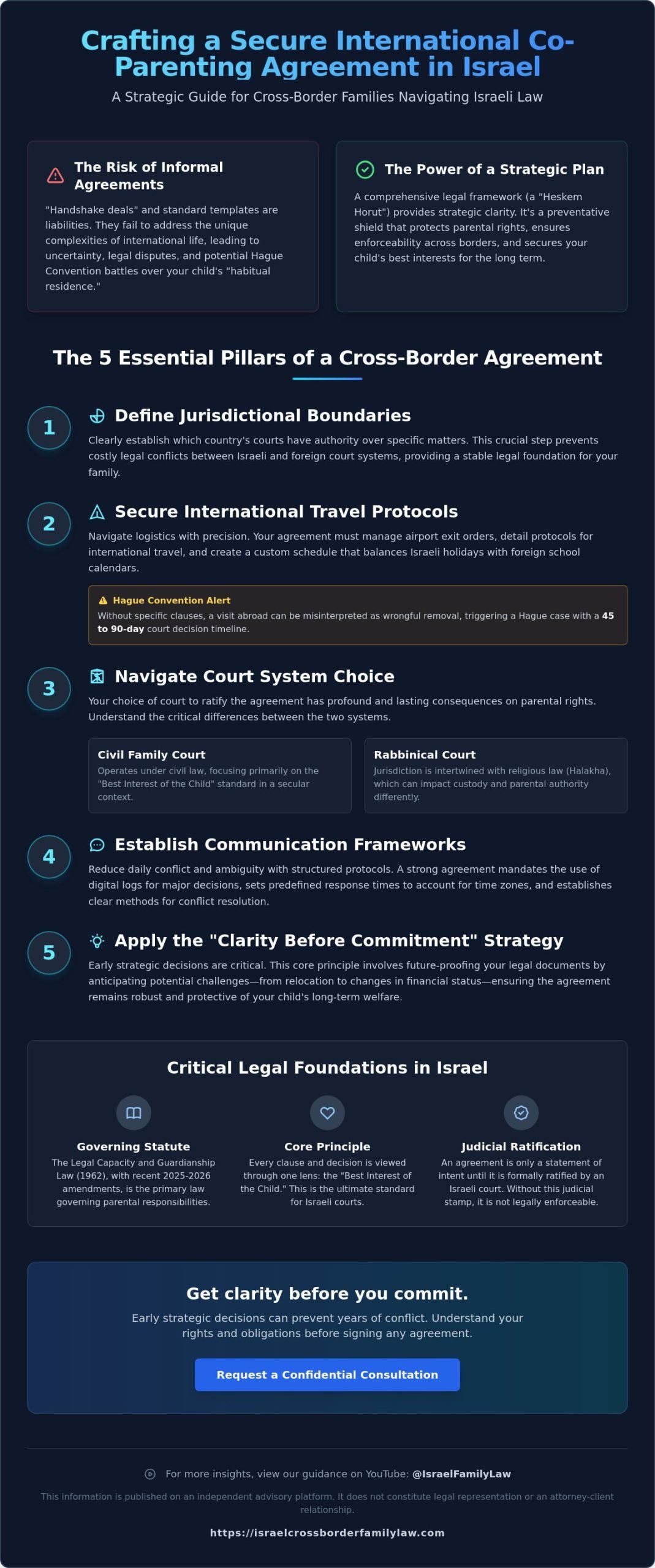
Securing Your Future: The “Clarity Before Commitment” Strategy
The final stage of establishing an international co-parenting agreement israel is perhaps the most critical. It requires a shift from immediate emotional needs to long-term strategic planning. A common mistake for many international families is rushing into a generic agreement to end the stress of a separation. However, the financial and emotional cost of correcting a poorly drafted document in the Israeli court system is substantial. Resolving a contested application to modify a child custody or support order can take anywhere from three months to two years. It’s much more effective to invest the necessary time upfront to ensure every clause is precise and enforceable across borders.
Beyond the legal protections, a future-proofed agreement offers a significant psychological benefit for the child. It provides a stable, predictable environment that remains consistent even as school schedules change or parents relocate. This level of clarity reduces the likelihood of future litigation, which is always in the child’s best interest. By acting as a bridge between the legal cultures of Israel and the United States, a well-constructed plan accounts for the nuances of both systems, ensuring that your parental rights are recognized globally. This approach prioritizes strategy over emotion, allowing you to make decisions based on risk assessment rather than temporary impulses.
Risk Mitigation and Long-Term Planning
Generic templates often fail because they don’t account for “relocation triggers.” These are specific life events or conditions that might allow or prevent a parent from moving a child to another country. Without these triggers clearly defined, families often find themselves entangled in Hague Convention child abduction proceedings. These cases move rapidly in Israel, with initial hearings often held within 15 days of filing. To avoid this high-stress litigation, your initial agreement should incorporate detailed relocation protocols. This proactive planning protects both parents and ensures that any potential move is handled through agreed-upon legal channels rather than emergency court orders.
The Advisory Approach to Family Law
Before you sign any document in Israel, it is essential to seek a confidential case review. This step allows you to understand how the specific terms of your international co-parenting agreement israel will function in practice. Working with multi-qualified practitioners who are licensed in both Israel and the US provides a unique advantage. These professionals understand the divergent business and legal cultures, ensuring that your agreement is not just a piece of paperwork but a functional strategic tool. This advisory approach focuses on guiding you toward informed choices that protect your family’s future for years to come. Get clarity before you commit. Request a confidential consultation.
This article is published on an independent advisory platform and does not constitute legal representation or an attorney-client relationship.
Building a Sustainable Cross-Border Framework
Establishing a secure international co-parenting agreement israel is an essential strategic investment in your family’s long term stability. By prioritizing jurisdictional precision and utilizing the Mirror Order strategy, you effectively mitigate the risk of conflicting court orders across different countries. Implementing structured digital communication and clear travel protocols further shields your children from the logistical complexities of a cross-border life. These steps move the focus away from emotional conflict and toward a predictable, legal reality.
Navigating these multi-jurisdictional challenges requires expertise that spans both the Israeli and US legal systems. Our independent advisory platform maintains a physical presence in both Tel Aviv and New York to provide the cross-cultural insights necessary for these delicate matters. Our multi-qualified practitioners focus on risk based strategy rather than just paperwork, helping you build a framework that stands up to international scrutiny. You don’t have to navigate these complexities alone.
Get clarity before you commit. Request a confidential consultation.
Taking proactive steps now will provide the security and peace of mind your family deserves as you move forward into this new chapter.
This article is published on an independent advisory platform and does not constitute legal representation or an attorney-client relationship.
Frequently Asked Questions
Is an international co-parenting agreement signed in Israel enforceable in the United States?
An agreement ratified in Israel is not automatically enforceable in the United States without a formal registration process. To ensure the terms are recognized abroad, parents typically use a “Mirror Order” strategy. This involves filing the Israeli agreement in a US state court to obtain a matching order. This step is vital for protecting parental rights and ensuring the agreement is respected in both jurisdictions.
What happens if my ex-partner refuses to let the children travel back to Israel?
If a parent retains a child abroad beyond the agreed time, the other parent can initiate a return claim under the Hague Convention. In Israel, an initial hearing is usually held within 15 days of filing a claim. A final decision is generally reached within 45 to 90 days. These strict timelines are designed to restore the child’s status quo quickly and prevent long-term jurisdictional disputes.
Can I move back to my home country if I have a shared parenting agreement in IL?
Relocating with a child requires either the written consent of the other parent or a specific court order. The Israeli courts will only grant permission if the move is determined to be in the child’s best interest. This is a complex legal process that considers the child’s social, educational, and emotional ties to Israel versus their prospective life in the new country.
How does the Israeli Rabbinical court view international co-parenting?
The Rabbinical Court has concurrent jurisdiction with civil courts and can handle custody if it is “attached” to a divorce claim. While they apply religious law, they must still prioritize the child’s welfare and respect international treaties. Your international co-parenting agreement israel should specify the preferred court forum to avoid jurisdictional “snatching” during the divorce process, which can complicate cross-border logistics.
What is a Mirror Order and do I really need one for my US-Israel case?
A Mirror Order is a separate court order obtained in a second country that contains the exact same terms as your original agreement. It acts as a jurisdictional bridge, ensuring that if a dispute occurs while the child is in the US, the local court can enforce the terms immediately. It provides a necessary layer of security that a single-country order simply cannot offer.
How is child support calculated in a cross-border Israeli agreement?
Israeli courts recognize a minimum floor for essential living costs of approximately NIS 1,300 to NIS 1,500 per child per month as of 2026. In an international co-parenting agreement israel, parents must also account for extraordinary expenses. These often include international health insurance, private school fees, and the significant costs of trans-Atlantic travel, which are not typically covered in standard domestic support calculations.
What should I do if my ex-spouse violates the communication protocols in our agreement?
You should first document the violation using your primary digital communication platform, such as OurFamilyWizard, to create a court-admissible record. These logs provide unalterable evidence that can be presented to the Family Court if the breaches continue. If informal resolution fails, you may need to file a motion for enforcement. Consistent documentation is the most effective way to address non-compliance without escalating conflict.
How does the Hague Convention affect my international parenting plan in Israel?
The Hague Convention is the primary legal tool used to prevent the wrongful removal or retention of a child across international borders. It ensures that the courts in the child’s country of “habitual residence” decide custody matters. Any international parenting plan must be drafted to align with these treaty requirements to prevent accidental triggers of abduction clauses during routine holiday travel or extended visits.
Get clarity before you commit. Request a confidential consultation. For further details on these procedures, visit: https://www.youtube.com/@IsraelFamilyLaw

Article by
Gabriel Lior
A Personal Journey That Became a Mission
The advisory was founded by an American father Gabriel Lior, LLB, MBA , global entrepreneur, and cross-border advisor who spent more than a decade navigating the Israeli family court system firsthand and now lives in Singapore with his son.
As a divorced parent in a cross-border family, Gabriel faced nearly every legal challenge a foreign parent can encounter in Israel — including child custody disputes, child support proceedings, property matters in Israel and abroad, false accusations, and complex immigration and relocation proceedings.
Over the years, he learned the hard way how difficult it is for non-Israeli parents to understand the system, identify the right legal strategy, and choose the right legal representation — especially when language, culture, and jurisdictional differences are involved. He also witnessed how foreign parents and new immigrants are often disadvantaged or taken advantage of by service providers and institutions simply because they lack local knowledge or fluency.
From Client to Advisor
To truly understand — and survive — the system, Gabriel pursued formal legal education in Israel, completing two Israeli law degrees, alongside a BA and MBA earned in the United States. This was never about becoming a practicing attorney, but about gaining a deep, structural understanding of how the system works — and where it breaks down for foreign parents.
This rare combination of:
Firsthand client experience
Israeli legal and US business education
International business and negotiation training
Decades of commercial execution
created a unique perspective – one that understands both sides of the table.
After years of litigation, persistence, and at times self-representation, he ultimately succeeded in securing custody of his son and relocating abroad through a rare legal victory in the Israeli Supreme Court — becoming one of the first fathers in Israel to do so under these circumstances.
Disclaimer
Important Disclaimer:
The information provided on this website and in its content is for general informational and educational purposes only and does not constitute legal advice, legal opinion, or legal representation.
Gabriel Lior is not licensed to practice law in Israel (nor is he interested in doing so) and does not provide legal services, despite having completed 2 Law Degrees. The services offered are advisory in nature and are intended to provide general guidance, strategic insight, and information regarding cross-border family law considerations.
No attorney-client relationship is formed by accessing this website, reading its content, or communicating with us.
Any decisions made based on this information are at your own discretion and risk. For legal advice specific to your situation, you should consult a licensed attorney in the relevant jurisdiction.
Where appropriate, we may refer clients to independent, licensed attorneys or professionals. Such referrals do not constitute legal representation and no liability is assumed for services provided by third parties.