What if the legal document you spent years perfecting in your home country is essentially invisible to the Israeli authorities? Many expats and international families are surprised to learn that they can’t simply present a US or UK document to a local bank to access inherited assets. To successfully probate a foreign will in Israel, you must navigate a specific legal bridge that reconciles two different systems, often involving mandatory expert opinions and a rigid digital bureaucracy.
It’s understandable to feel overwhelmed by Hebrew-language portals and the realization that your foreign will isn’t automatically accepted. This article provides the clarity you need to manage this process with confidence. You’ll learn how to navigate the Registrar of Inheritance Affairs, understand the strategic role of foreign law expert opinions, and identify ways to minimize significant delays in asset distribution.
We’ll examine the 2026 digital filing requirements, the impact of Israeli capital gains tax on inherited property, and the specific steps required to protect your family’s interests. Please note that this content is published on an independent advisory platform, not a law firm. It’s intended for informational and educational purposes and does not constitute legal representation or formal legal advice.
Key Takeaways
- Understand why an Israeli probate order is the only legal path to release local assets such as real estate or bank accounts.
- Learn the essential requirements for Apostilles and notarized Hebrew translations to ensure your documents meet strict Israeli standards.
- Discover the role of a mandatory expert opinion when you need to probate a foreign will in Israel and how it bridges different legal systems.
- Identify the specific evidentiary hurdles you’ll face if the original will is missing or held by a court in another jurisdiction.
- Explore the strategic benefits of a Dual Will approach to prevent future legal delays and keep your Israeli assets accessible.
This content is published on an independent advisory platform and does not constitute an attorney-client relationship. Legal services are only provided by licensed attorneys under a separate engagement.
Understanding the Recognition of Foreign Wills in Israel
When a family member passes away leaving assets in Israel, such as a Jerusalem apartment or a local bank account, the legal path to distribution isn’t always direct. Many families assume that a validly executed will from their home country is sufficient to begin the transfer of property. However, to legally probate a foreign will in Israel, you must obtain a specific Israeli probate order. This requirement exists because Israeli financial institutions and the Land Registry operate under domestic jurisdiction; they cannot recognize foreign judicial orders without local validation.
The Israeli Succession Law of 1965 serves as the primary legal framework for these matters. It establishes that the Registrar of Inheritance Affairs has the authority to recognize a will made outside of Israel. There’s an important distinction between a will being “valid” and it being “executable.” A document might meet every legal standard in California or Florida, but it remains effectively dormant in Israel until it undergoes the formal recognition process. This intersection of different legal systems falls under the principles of Conflicts of Law, where the Israeli system determines how to apply its domestic rules to a document created in a foreign jurisdiction.
The Legal Basis for Foreign Will Recognition
Israel generally respects the validity of wills drafted in the US, UK, or Europe, provided they meet the formal requirements of the place where they were signed. Under the Succession Law, the testator’s domicile at the time of death is a critical factor in determining which law governs the inheritance. Israel is also a signatory to the Hague Convention on the Form of Testamentary Dispositions, which simplifies the recognition of the “form” of the will. For many expats and foreign nationals, this means their existing estate plan can be recognized, but it must first be bridged into the Israeli system through a formal petition.
Why Your Foreign Probate Order Isn’t Enough
A common point of frustration for families is the discovery that “Letters Testamentary” or a Grant of Probate from a foreign court holds no weight within Israeli borders. Israeli banks are risk-averse. They won’t release funds or transfer titles based on a New York or London court order. To move forward, you must submit a petition to the Registrar of Inheritance Affairs. This administrative body oversees the process, ensuring the foreign will doesn’t conflict with local public policy and that all legal requirements, such as professional translations and expert opinions, are met before the assets are released.
The 6 Essential Steps to Probate a Foreign Will in Israel
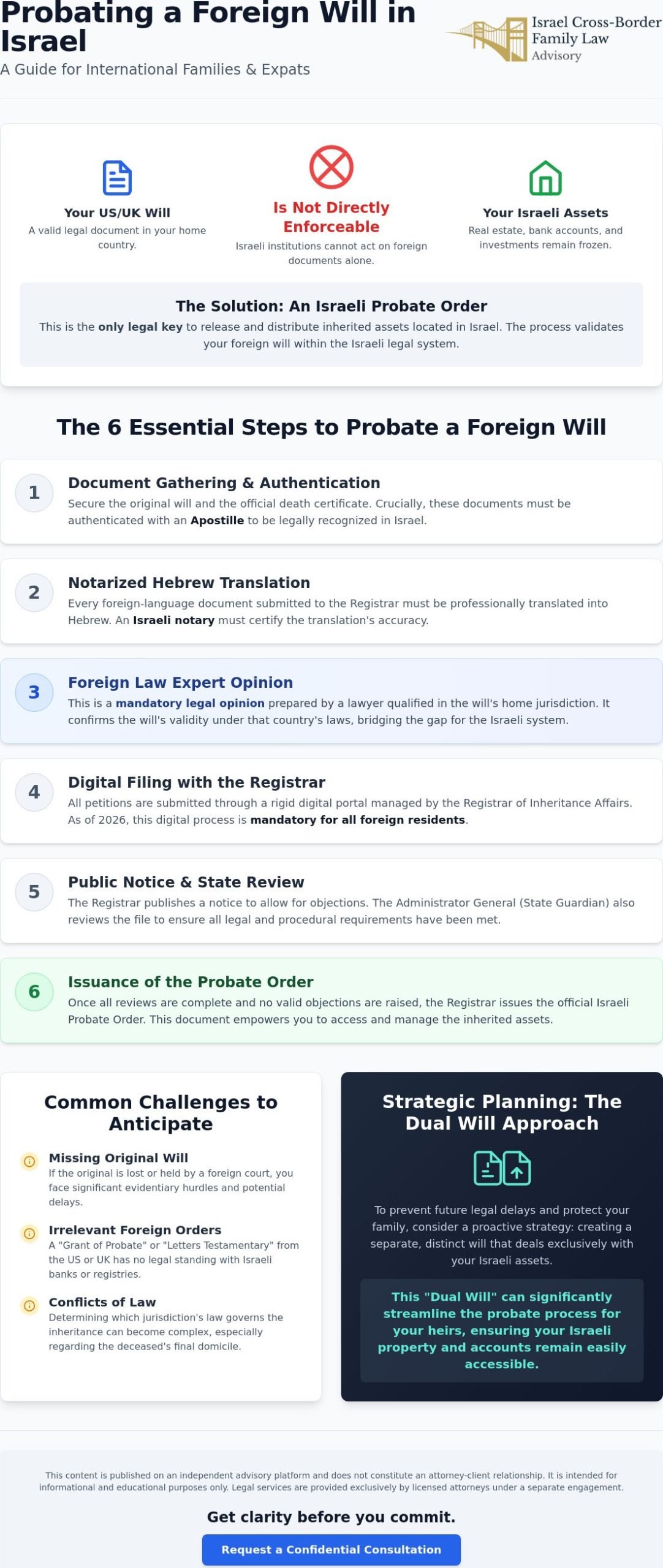
The process to probate a foreign will in Israel is a multi-layered administrative journey that requires precision at every stage. Because the Israeli legal system is highly formalistic, even a minor clerical error in a foreign document can lead to months of delays. Success depends on following a structured workflow that satisfies the Registrar of Inheritance Affairs.
- Step 1: Document Gathering and Authentication. You must secure the original will and the official death certificate. These documents require an Apostille to be recognized in Israel.
- Step 2: Notarized Hebrew Translation. Every foreign document must be translated into Hebrew by an Israeli notary who can certify the accuracy of the translation.
- Step 3: The Foreign Law Expert Opinion. This mandatory document, prepared by a practitioner qualified in the foreign jurisdiction, explains why the will is valid under that specific country’s laws.
- Step 4: Digital Filing. As of 2026, all petitions for foreign residents are submitted through a mandatory digital portal managed by the Registrar of Inheritance Affairs.
- Step 5: Public Notice and State Review. The Registrar publishes a notice in an Israeli newspaper to allow for potential objections. Simultaneously, the Administrator General (State Guardian) reviews the file for compliance.
- Step 6: Issuance of the Order. Once all requirements are met and no objections are filed, the Registrar issues the formal Order of Probate.
Document Preparation and Authentication
An Apostille is a specific international certification that validates the authenticity of a public official’s signature. For families in the US or UK, this means your local death certificates and probate records aren’t ready for use in Israel until they’ve been “Apostilled” by the relevant state or national authority. Dealing with these requirements early is vital, especially when coordinating between different state offices. For more tailored information, you may find our Guidance for Expats and Foreign Nationals helpful in understanding these initial hurdles.
The Filing and Review Phase
The Israeli probate system has modernized significantly. By 2026, the transition to a fully digital submission process has streamlined how files are tracked, but it hasn’t necessarily shortened the wait times. For an uncontested foreign will, the typical timeline ranges from 8 to 12 months. This duration accounts for the mandatory public notice period and the detailed review by the Administrator General’s office. Because these timelines are influenced by the complexity of the foreign legal opinion, it’s often wise to consider requesting a confidential case review to understand the specific risks associated with your family’s estate before you begin the formal filing process.
The Role of the Foreign Law Expert Opinion
The most critical component of the petition to probate a foreign will in Israel is the mandatory “Expert Opinion on Foreign Law.” In the Israeli legal system, foreign law is treated as a matter of fact that must be proven through evidence rather than a legal principle the judge is expected to know. Just as an Israeli court wouldn’t be expected to know the specific building codes of Chicago or the tax regulations of London, it cannot “know” the inheritance laws of New York, California, or Ontario without a formal expert declaration.
This document serves as the legal bridge between two jurisdictions. It must be prepared by a practitioner who is licensed and currently practicing in the specific foreign jurisdiction where the will was executed. For example, if the deceased lived in Florida, the opinion must come from a Florida-licensed attorney. A general understanding of US law isn’t sufficient; the Registrar requires a granular analysis of the specific state or provincial statutes that governed the testator at the time of their death. If this opinion is drafted poorly or lacks the necessary depth, the Registrar may reject the entire petition, leading to significant delays and additional costs.
What the Expert Opinion Must Establish
The expert doesn’t simply state that the will looks authentic. They must provide a comprehensive analysis that addresses several key legal pillars:
- Formal Validity: Confirmation that the document was signed and witnessed in strict accordance with local laws at the time of execution.
- Testamentary Capacity: A statement on the legal requirements for “sound mind” in that jurisdiction and how the will meets those standards.
- Non-Revocation: Evidence or a professional declaration that the will has not been revoked by later documents or subsequent life events, such as marriage or divorce, under local law.
- Jurisdictional Nuances: Addressing complex issues like community property rights or elective shares that might impact how the Israeli assets are distributed.
Cost and Strategy in Selecting an Expert
Providing this level of detail makes the expert opinion one of the more significant investments in the probate process. In 2026, the typical cost for a qualified foreign law opinion ranges from ₪3,000 to ₪8,000, depending on the complexity of the estate and the jurisdiction involved. While it may be tempting to find the least expensive option, a strategic approach often yields better results. Using an expert who understands the cross-border context helps ensure the document is framed in a way that the Israeli Registrar can easily process. You can learn more about our advisory approach to see how we prioritize early clarity in these complex multi-jurisdictional matters to avoid common filing pitfalls.
Common Challenges: Missing Originals and Conflicts of Law
Attempting to probate a foreign will in Israel from thousands of miles away introduces logistical hurdles that domestic cases rarely face. The most frequent complication arises when the original will is physically unavailable. Under Israeli law, the Registrar typically requires the original document with “wet ink” signatures. If the original is held in a foreign court’s permanent archives or has been lost over time, you must file a “Petition to Prove a Will by Copy.” This isn’t a mere formality; it’s a separate legal procedure that demands a high threshold of proof to convince the Israeli court that the copy is authentic and hasn’t been revoked.
Another layer of complexity involves objections from heirs. In Israel, once a probate petition is published, any interested party has two weeks to file an objection. These disputes often center on claims of “undue influence” or lack of capacity. When a will is foreign, these challenges are harder to resolve because the witnesses and medical records are located outside Israel. This highlights the weight of early decisions; if your documentation isn’t airtight from the start, you provide disgruntled relatives with the leverage needed to freeze assets for years.
Navigating the “Lost Will” Procedure
To succeed with a petition by copy, you must provide “clear and convincing” evidence of the will’s contents and the circumstances of its loss. The court won’t simply take your word for it. You’ll likely need formal affidavits from the witnesses who saw the original signed or a declaration from the drafting attorney explaining why the original isn’t available. If the evidence falls short, the court may revert to “intestate succession.” This is the legal default where assets are distributed according to Israeli law rather than your family member’s specific wishes, which often leads to unintended results for the surviving spouse or children.
Managing Cross-Border Legal Conflicts
Conflicts of law frequently emerge when a foreign will uses terms that don’t exist in the Israeli system, such as “Life Estates” or certain types of US trusts. Israel’s Succession Law of 1965 governs how assets within its borders are handled, even if the testator lived abroad. For instance, some European jurisdictions have “Forced Heirship” rules that require a specific percentage of the estate to go to children. Israel, however, generally prioritizes testamentary freedom. If you’re managing an estate with elements in both jurisdictions, it’s vital to understand which law will take precedence for specific assets. You can watch our videos on US-Israel Inheritance Law to see how these conflicts typically play out in practice. If you are concerned about how these legal frictions might impact your family’s inheritance, you can contact us for a confidential consultation to discuss your specific situation.
This content is published on an independent advisory platform and does not constitute an attorney-client relationship. Legal services are only provided by licensed attorneys under a separate engagement.
Strategic Planning for Cross-Border Estates
Managing a multi-jurisdictional estate requires a shift from reactive filing to proactive strategy. While the primary goal is to successfully probate a foreign will in Israel, the most efficient results often come from decisions made long before a petition is drafted. Early clarity is essential; once assets like bank accounts or real estate are frozen by Israeli institutions, the cost and complexity of rectification rise significantly. The weight of early decisions cannot be overstated. If the initial submission to the Registrar contains inconsistencies with foreign probate records, the resulting legal friction can span years.
For those planning for the future, a “Dual Will” strategy is often the most effective preventative measure. By maintaining a separate Israeli will that covers only local assets, you bypass the need for foreign law expert opinions and the complex reconciliation of two different legal systems. This approach ensures that Israeli property passes directly under domestic law, which significantly reduces both timelines and administrative costs. It allows your family to avoid the 8 to 12 month wait time typical of foreign probate cases.
Expats and families living abroad should also know that the entire process can be managed remotely. In 2026, the mandatory digital filing system and the use of notarized powers of attorney mean that beneficiaries rarely need to fly to Israel to resolve these matters. Coordination between your home country executors and your local representatives is the key to a seamless transition and the eventual repatriation of funds.
The Value of a Comprehensive Case Review
Before committing to a specific legal path, identifying potential red flags is a strategic priority. A detailed review helps uncover conflicts between foreign estate plans and Israeli succession rules before they reach the Registrar’s desk. This is particularly important for US citizens who must balance Israeli requirements with US federal estate tax obligations. You can Request a Confidential Case Review to gain a clear understanding of the risks and requirements specific to your family’s cross-border situation.
Final Steps and Asset Distribution
Obtaining the Probate Order is a major milestone, but it isn’t the final step in the process. You must move from the order to the actual transfer of title, known as Tabu, for real estate or the formal closing of bank accounts. Repatriating funds to a foreign jurisdiction involves navigating Israeli anti-money laundering regulations and ensuring total tax compliance. While Israel does not have an inheritance tax, the sale of inherited property may trigger a capital gains tax, or Mas Shevach, which is currently 25% of the real gain. Seeking professional clarity at this stage ensures that the final distribution of assets is as steady and secure as the rest of the process.
Get clarity before you commit. Request a confidential consultation.
Securing Your Family’s Israeli Legacy
Bridging the gap between two legal systems requires more than just submitting paperwork; it demands a strategic understanding of how Israeli authorities view foreign documents. From the mandatory expert opinion to the nuances of digital filing, every detail in the process to probate a foreign will in Israel must be handled with precision to avoid unnecessary delays. As we’ve discussed, accuracy in your initial filing is the most effective way to prevent years of frozen assets and administrative friction.
While the complexities of cross-border inheritance are significant, they’re manageable with a structured approach. We specialize in US-Israel cross-border strategy and bring deep experience to complex multi-jurisdictional estates. With a physical presence in both Tel Aviv and New York, we serve as a steady, knowledgeable guide for families navigating these divergent legal cultures. This dual-market engagement ensures that your strategy accounts for the requirements of both jurisdictions from the very beginning.
Get clarity before you commit. Request a confidential consultation.
Taking the first step toward professional clarity ensures your family’s interests are protected and your assets are distributed according to your wishes.
Frequently Asked Questions
Is a US will valid in Israel for real estate?
Yes, a US will is valid if it meets the formal requirements of the state where it was signed, but it isn’t automatically executable. To transfer title at the Land Registry, you must first obtain a local probate order. This process bridges the gap between US estate law and the Israeli system, ensuring the document is recognized as legally binding for local property.
How long does it take to probate a foreign will in Israel?
The process to probate a foreign will in Israel typically takes between 8 to 12 months for uncontested cases. This timeline accounts for the preparation of expert opinions, notarized translations, and the mandatory public notice period. It’s longer than domestic probate because the Registrar must verify foreign documents and coordinate with the Administrator General’s office for a thorough review.
Do I need to travel to Israel to probate a will?
No, you don’t need to travel to Israel to manage these proceedings. Most administrative steps are handled through a mandatory digital portal by your local representative. You can sign required documents, such as a Power of Attorney, in your home country before an Israeli consul or by using an Apostille, allowing for the entire estate to be managed remotely.
What happens if there is no original will available?
If the original document is lost or held in a foreign court’s archives, you must file a “Petition to Prove a Will by Copy.” This requires providing clear evidence that the original existed and wasn’t revoked. You’ll likely need supporting affidavits from the original witnesses or the drafting attorney to satisfy the court’s high threshold for proving a copy’s authenticity.
Is there inheritance tax in Israel for foreign beneficiaries?
Israel does not have an inheritance or estate tax as of July 2026. While the distribution of assets is tax-free, beneficiaries should be aware of other obligations. For example, selling inherited real estate may trigger a 25% Capital Gains Tax on the real gain. Additionally, US citizens remain subject to US federal estate tax on their worldwide assets, including those located in Israel.
Can I contest a foreign will that is being probated in Israel?
Yes, any interested party can file an objection within the two-week public notice period following the petition’s publication. Disputes often involve claims of undue influence or lack of testamentary capacity. If an objection is filed, the case is transferred from the Registrar to the Family Court for a formal legal hearing to determine the will’s validity under the probate a foreign will in Israel framework.
Why do I need a Hebrew translation of my English will?
Hebrew is the official language of the Israeli legal system, and all documents submitted to the Registrar must be accessible to state officials. A notarized Hebrew translation ensures there’s no ambiguity regarding the testator’s wishes. This step is a formal requirement, and the translation must be certified by an Israeli notary to be accepted as part of your official probate petition.
What is the cost of the foreign law expert opinion?
In 2026, a mandatory foreign law expert opinion generally costs between ₪3,000 and ₪8,000. This fee covers the professional analysis required to prove the will meets the legal standards of the foreign jurisdiction where it was created. The exact price depends on the complexity of the estate and the specific state or provincial laws that the expert must address for the Israeli court.

Article by
Gabriel Lior
A Personal Journey That Became a Mission
The advisory was founded by an American father Gabriel Lior, LLB, MBA , global entrepreneur, and cross-border advisor who spent more than a decade navigating the Israeli family court system firsthand and now lives in Singapore with his son.
As a divorced parent in a cross-border family, Gabriel faced nearly every legal challenge a foreign parent can encounter in Israel — including child custody disputes, child support proceedings, property matters in Israel and abroad, false accusations, and complex immigration and relocation proceedings.
Over the years, he learned the hard way how difficult it is for non-Israeli parents to understand the system, identify the right legal strategy, and choose the right legal representation — especially when language, culture, and jurisdictional differences are involved. He also witnessed how foreign parents and new immigrants are often disadvantaged or taken advantage of by service providers and institutions simply because they lack local knowledge or fluency.
From Client to Advisor
To truly understand — and survive — the system, Gabriel pursued formal legal education in Israel, completing two Israeli law degrees, alongside a BA and MBA earned in the United States. This was never about becoming a practicing attorney, but about gaining a deep, structural understanding of how the system works — and where it breaks down for foreign parents.
This rare combination of:
Firsthand client experience
Israeli legal and US business education
International business and negotiation training
Decades of commercial execution
created a unique perspective – one that understands both sides of the table.
After years of litigation, persistence, and at times self-representation, he ultimately succeeded in securing custody of his son and relocating abroad through a rare legal victory in the Israeli Supreme Court — becoming one of the first fathers in Israel to do so under these circumstances.
Disclaimer
Important Disclaimer:
The information provided on this website and in its content is for general informational and educational purposes only and does not constitute legal advice, legal opinion, or legal representation.
Gabriel Lior is not licensed to practice law in Israel (nor is he interested in doing so) and does not provide legal services, despite having completed 2 Law Degrees. The services offered are advisory in nature and are intended to provide general guidance, strategic insight, and information regarding cross-border family law considerations.
No attorney-client relationship is formed by accessing this website, reading its content, or communicating with us.
Any decisions made based on this information are at your own discretion and risk. For legal advice specific to your situation, you should consult a licensed attorney in the relevant jurisdiction.
Where appropriate, we may refer clients to independent, licensed attorneys or professionals. Such referrals do not constitute legal representation and no liability is assumed for services provided by third parties.