This article is published on an independent advisory platform, not a law firm, and does not imply an attorney-client relationship. All content is for informational purposes only. Legal services are only provided by licensed attorneys under a separate engagement.
Can a digital interface truly bridge the gap when 6,000 miles and a ten hour time difference stand between a parent and their child? Families managing lives across the US and Israel face the constant friction of mismatched school calendars and high travel costs. You likely feel the strain of trying to stay connected while navigating two different legal cultures. It’s a complex situation that requires more than just a video call, which is why choosing the right technology for co-parenting long distance is essential for maintaining family stability.
We promise to show you how strategic use of digital tools can create a reliable communication routine and a transparent record of your responsibilities. By leveraging specific software and cross-border planning, you can reduce conflict and ensure both parents remain active in the child’s life. This guide previews apps like OurFamilyWizard, explains the importance of Mirror Orders for legal security, and offers practical steps to sync your global schedule. For further visual guidance, you can also explore our resources on the Israel Family Law YouTube channel.
Key Takeaways
- Navigate the practical complexities of a 7-to-10-hour time difference and the unique Sunday-through-Thursday Israeli work week.
- Identify the most effective technology for co-parenting long distance to ensure transparent communication and secure digital record-keeping.
- Implement the “Golden Window” strategy to schedule reliable virtual visits that respect the child’s routine in both the US and Israel.
- Learn how Israeli family courts interpret digital logs and why specific technology clauses are essential in your legal parenting agreement.
- Establish clear protocols for sharing hardware costs and managing cloud-based access to school and medical records across different jurisdictions.
This article is published on an independent advisory platform, not a law firm, and does not imply an attorney-client relationship. All content is for informational purposes only. Legal services are only provided by licensed attorneys under a separate engagement.
The Reality of Long-Distance Co-Parenting Between the US and Israel
International co-parenting is fundamentally different from domestic arrangements. While many US state laws define “long distance” as a mere 50 or 100 miles, families moving between the United States and Israel deal with a 6,000-mile separation. This requires managing parental responsibilities across sovereign borders where different legal systems, languages, and social norms apply. To understand the foundation of these arrangements, it’s helpful to ask, What is Co-Parenting? Essentially, it’s the shared responsibility for a child’s upbringing, which becomes significantly more complex when jurisdictions collide and physical access is limited by oceans and time zones.
To better understand this concept, watch this helpful video:
The unique dynamic between the US and Israel introduces structural challenges that standard parenting plans aren’t designed to handle. Israel operates on a Sunday through Thursday work week, while the US follows a Monday through Friday schedule. Combined with a time difference that ranges from 7 to 10 hours depending on the season, the “window of opportunity” for direct contact is narrow. Without a dedicated strategy for technology for co-parenting long distance, these logistical gaps can lead to missed calls and a growing sense of disconnection. Early decisions about communication tools will define the stability of the family unit for years to come.
Understanding the Cross-Border Challenge
Logistical hurdles extend beyond the clock. Transcontinental flights are expensive and exhausting; this makes physical visitation a rare, high-stakes event. School holiday schedules rarely align. Israeli schools follow the Jewish calendar, while US schools follow secular and Christian holidays. These misalignments make the framework of international custody and relocation vital for setting clear expectations. Parents must shift their mindset from physical presence to digital engagement as the primary mode of parenting during the months apart. It’s about staying present for the small, daily moments that build a lasting bond.
The Role of Technology as a Bridge
Technology serves as a critical safeguard against the risk of emotional distance for the parent living abroad. Moving from informal, cluttered WhatsApp threads to formal co-parenting platforms allows for a structured, professional approach to family management. Digital tools help document school reports, medical updates, and financial transfers. This creates a reliable record that can be useful if clarity is needed later. However, it’s important to set realistic expectations. While technology for co-parenting long distance facilitates connection, it cannot replace a physical hug. It is a bridge, not a destination. Using these tools ensures that even when you aren’t in the same room, you remain in the same loop.
Get clarity before you commit. Request a confidential consultation.
This article is published on an independent advisory platform, not a law firm, and does not imply an attorney-client relationship. All content is for informational purposes only. Legal services are only provided by licensed attorneys under a separate engagement.
Essential Digital Platforms for International Families
Selecting the right technology for co-parenting long distance involves balancing professional oversight with daily usability. While the distance between the US and Israel is vast, the digital tools available in 2026 provide several layers of support. Dedicated platforms like OurFamilyWizard and TalkingParents are often recommended because they create unalterable communication logs. These logs are frequently admissible in court, which provides a level of security that standard messaging apps cannot offer. For instance, as of April 30, 2026, OurFamilyWizard offers an Essentials Plan at approximately $12.50 per month, while TalkingParents provides options starting from $7 per month. It is important to remember that for most of these services, each co-parent requires a separate subscription.
Dedicated Co-Parenting Apps vs. General Tools
Subscription-based apps offer specialized features like expense logs and GPS-verified check-ins. These tools are designed to address the specific challenges of long-distance co-parenting by centralizing all interactions. However, general-purpose technology also plays a vital role. Shared Google Calendars are excellent for tracking the Sunday-to-Thursday Israeli work week alongside the US schedule. Cloud storage solutions like Dropbox or Google Drive allow both parents to access school transcripts, medical records, and passport copies instantly. Maintaining clarity in these documents reduces the need for legal intervention later. Transparent digital ledgers are particularly useful for managing child support cross-border enforcement, as they provide a clear history of payments and shared expenses.
Video and Messaging: Maintaining the Bond
Synchronous video calls like FaceTime are standard, but the 7-to-10-hour time gap often makes them difficult to coordinate. Asynchronous video tools, such as Marco Polo, allow parents and children to exchange video messages at their own convenience. This removes the pressure of the “Golden Window” and allows for a more natural flow of communication. You might also consider interactive digital activities like gaming together or watching movies remotely to foster a low-pressure connection. Consistent “Virtual Visitation” windows should be formally integrated into your parenting schedule to provide the child with a sense of routine. For more visual examples of how to implement these strategies, you can visit the Israel Family Law YouTube channel.
Establishing a clear digital infrastructure early on helps prevent misunderstandings from escalating into complex legal disputes. If you are unsure which platform suits your family’s specific needs, you might want to request a confidential case review before finalizing your agreement.
This article is published on an independent advisory platform, not a law firm, and does not imply an attorney-client relationship. All content is for informational purposes only. Legal services are only provided by licensed attorneys under a separate engagement.
Synchronizing Lives: Managing the US-Israel Time Zone Gap
Managing a family across 6,000 miles is more than a test of patience; it is a test of logistics. The 7-to-10-hour time difference between the US and Israel makes spontaneous communication nearly impossible. Unlike domestic arrangements where a quick call after dinner is simple, international parents must contend with what we call the “Golden Window.” This is the brief 2-to-3-hour period where both parties are awake and available. For those in Israel, this usually falls in the late evening, while for parents on the US East Coast, it is mid-day. Effectively using technology for co-parenting long distance requires moving away from a “call whenever” mindset toward a highly structured, shared digital schedule that respects both time zones.
Calculating the Overlap
Consistency starts with identifying your specific overlap. If you live in New York and your child is in Tel Aviv, a 7 PM call in Israel is 12 PM for you. However, those on the West Coast face a steeper challenge, as 7 PM in Israel is 9 AM in California. These windows shift twice a year because Israel and the US change their clocks on different dates. For example, the US typically begins Daylight Savings Time in early March, while Israel often waits until late March. This creates a “floating” time difference for several weeks that can easily lead to missed appointments and frustration. Automating reminders within your co-parenting app helps mitigate this risk. When live calls aren’t feasible due to school or work, recorded video messages provide a way to maintain presence without the stress of a ticking clock.
Managing Different Holiday Calendars
The conflict between work weeks and holidays is a frequent source of friction. Israel’s Sunday-to-Thursday schedule means Sunday is a high-energy school day, while it remains a quiet weekend for the parent in the US. Integrating the Jewish calendar with secular US holidays into a single digital view is essential for long-term peace. Early decisions regarding long-haul summer visits or Hanukkah breaks prevent high-stress travel conflicts and last-minute expenses. You should also be aware of how virtual visitation laws might influence your parenting plan, as these regulations often provide a framework for how digital contact is enforced. For families navigating divorce or separation as international families, a shared calendar reduces the mental load of tracking two different cultures simultaneously. Setting these boundaries early helps prevent “Time Zone Fatigue” and ensures that late-night calls don’t disrupt the child’s local routine or the parent’s professional responsibilities.
Get clarity before you commit. Request a confidential consultation.
This article is published on an independent advisory platform, not a law firm, and does not imply an attorney-client relationship. All content is for informational purposes only. Legal services are only provided by licensed attorneys under a separate engagement.
Legal Implications of Digital Communication in Israel
Israeli family courts are increasingly accustomed to managing families that exist across borders. While these courts are modern, the presentation of digital evidence requires specific care to be effective. Judges in Israel operate under the “best interests of the child” principle, which serves as the primary lens for evaluating any technology for co-parenting long distance. This means the court isn’t just looking at the facts of the communication, but how that communication affects the child’s emotional well-being and their relationship with both parents. Early strategy is vital, as digital interactions often form the basis of a judge’s perception of parental cooperation.
Digital Records in the Israeli Court System
In the Israeli court system, unalterable communication logs are viewed as a tool for transparency. They provide a clear record of parental cooperation, or lack thereof, which can be critical during a “Race to the Court” scenario where jurisdiction is being established. However, there’s a distinct risk of “over-documentation.” If you use these platforms to record every minor grievance, a judge may view this as a sign of high conflict rather than a genuine attempt at co-parenting. The goal is to show a consistent, civil effort to maintain the child’s connection to the parent living abroad. Israeli judges often prefer the Family Court for these matters, as it’s generally more familiar with global standards than the religious Rabbinical courts.
Privacy and Data Across Borders
Privacy considerations are equally vital when using digital tools. Using technology for “digital surveillance”—such as tracking a parent’s location without consent or demanding excessive video access to the other parent’s home—is often viewed negatively by the court. It’s also important to consider international data privacy. Third-party apps store sensitive family data, and you should understand where that data is held and who has access to it. Before you begin using digital logs in a contentious case, you should consult a professional to ensure your documentation strategy aligns with Israeli legal standards and doesn’t inadvertently damage your position.
A well-drafted divorce or separation agreement can formally incorporate digital schedules and app requirements. This ensures that the use of technology is not just an option, but a legally binding part of your parenting plan. Recent legal updates in Israel, such as the January 2026 amendments to the Legal Capacity and Guardianship Law, have further streamlined how digital payments and financial affairs are managed by guardians. These changes make it easier to integrate modern financial tech into your formal legal structure. To ensure your digital parenting plan is enforceable in both jurisdictions, request a strategic consultation.
This article is published on an independent advisory platform, not a law firm, and does not imply an attorney-client relationship. All content is for informational purposes only. Legal services are only provided by licensed attorneys under a separate engagement.
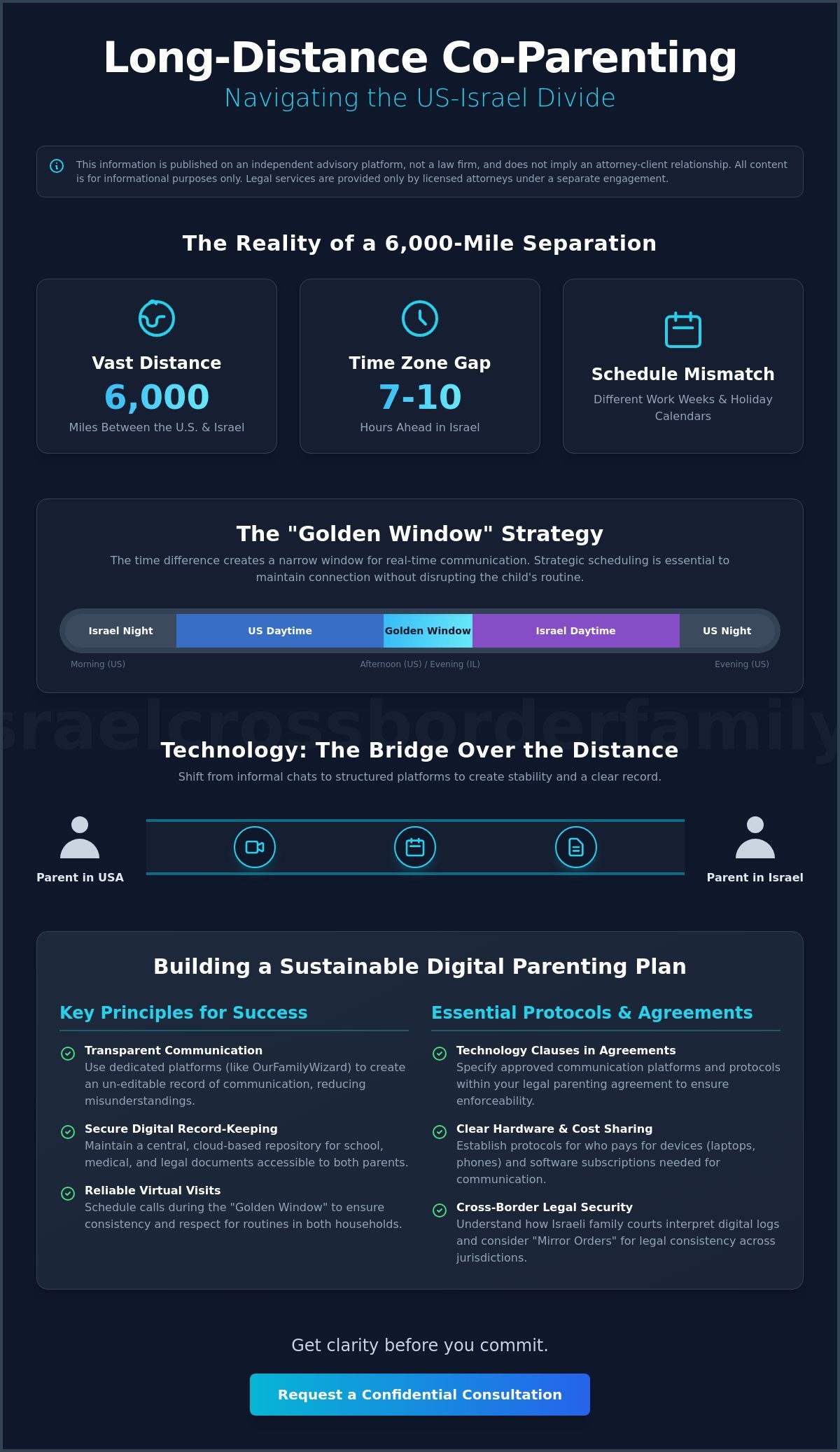
Building a Sustainable Digital Parenting Plan
Building a sustainable digital parenting plan is about more than just downloading an app; it is about creating a legally recognized framework that protects your relationship with your child. To bridge the gap between the US and Israel effectively, your agreement must be granular. Vague terms like “reasonable contact” often lead to friction when dealing with a nine hour time difference. Instead, successful families use their legal agreements to define the specific technology for co-parenting long distance they will use, ensuring both parents have equal access to the child’s digital life. This clarity helps reduce the mental load for everyone involved.
Allocating costs is a practical necessity that parents often overlook until a dispute arises. International co-parenting involves unique overhead, from app subscriptions to hardware maintenance. Your plan should specify who pays for the monthly fees of platforms like OurFamilyWizard and who is responsible for providing the child with a reliable, updated device. High-speed internet is no longer a luxury in this context; it is a requirement for maintaining the “Virtual Visitation” bond. Setting clear financial boundaries regarding hardware and software helps prevent small technical issues from escalating into expensive legal hurdles.
The “Right of First Refusal” can also be adapted for the digital age. If the parent in Israel is unavailable for an evening due to work or personal commitments, the parent in the US could be offered that time for an extra video call. This ensures the child remains connected to a parent rather than a third-party caregiver whenever possible. It’s a strategic way to maximize connection despite the 6,000-mile separation.
Drafting Tech-Specific Clauses
When drafting your agreement, use specific language for “Virtual Visitation.” For example, you might state that the non-residential parent has the right to a video call every Tuesday and Thursday at 7:00 PM Israel Time for a minimum of twenty minutes. It is also vital to distinguish between “emergency communication,” which should be via a direct phone call, and “routine updates,” which belong in the co-parenting app. Understanding how the advisory works can help you structure these clauses to be both practical and enforceable across different legal systems.
The Evolution of the Digital Plan
A plan for a toddler won’t work for a fifteen-year-old. Young children need a parent to facilitate the call and hold the device, but as children age, they should transition to direct, private communication. For teenagers, technology for co-parenting long distance might include playing an online game together or sharing social media posts. This allows for “passive” connection that feels more natural to a teen than a formal video interview. Your plan must evolve to allow this independence while maintaining safe boundaries. Technology is just the bridge; a well-considered strategy is what ensures the family bond remains intact over the years.
Get clarity before you commit. Request a confidential consultation.
This article is published on an independent advisory platform, not a law firm, and does not imply an attorney-client relationship. All content is for informational purposes only. Legal services are only provided by licensed attorneys under a separate engagement.
Securing Your Family’s Global Future
Managing a family across two continents is a significant undertaking that requires precision and a proactive mindset. By integrating technology for co-parenting long distance into a legally sound strategy, you can transform a logistical challenge into a stable routine. You’ve learned that success depends on selecting the right platforms for unalterable records, synchronizing mismatched work weeks, and drafting specific technology clauses in your parenting plan. These early decisions provide the clarity needed to protect your relationship with your child while minimizing the risk of future conflict.
Our advisory specializes in the multi-jurisdictional complexity of US-Israel cross-border matters. We focus on helping expats and international families navigate sovereign borders with established strategic guidance. Licensed legal representation is available through a separate engagement to ensure your agreements are enforceable in both systems. Get clarity before you commit. Request a confidential consultation to discuss your family’s specific needs and digital infrastructure.
With the right tools and a clear plan in place, you can maintain a meaningful and consistent presence in your child’s life, no matter how many miles stand between you.
This article is published on an independent advisory platform, not a law firm, and does not imply an attorney-client relationship. All content is for informational purposes only. Legal services are only provided by licensed attorneys under a separate engagement.
Frequently Asked Questions
What is the best app for co-parenting between the US and Israel?
The best technology for co-parenting long distance is often a dedicated platform like OurFamilyWizard or TalkingParents. These apps are designed to provide unalterable logs and professional communication structures that standard messaging tools lack. As of April 2026, OurFamilyWizard costs approximately $12.50 per month, while TalkingParents offers plans starting from $7 per month. These tools are particularly effective for bridging the gap between the US and Israel because they centralize all family data in one secure location.
Are messages from co-parenting apps admissible in Israeli family courts?
Israeli family courts generally accept records from co-parenting apps as evidence of parental cooperation or conflict. Judges prioritize the “best interests of the child” and value the civil, structured tone these platforms encourage. While IL courts are modern, it is important to present these logs clearly and without excessive clutter. Avoid the trap of over-documentation, as judges may view a constant stream of minor grievances as a sign of high conflict rather than a genuine effort to co-parent.
How do we handle the 10-hour time difference for daily calls?
Managing a 10-hour difference requires identifying a consistent “Golden Window” where both parents and children are awake. This usually falls in the Israeli evening, which corresponds to the morning on the US West Coast or midday on the East Coast. When live calls are impossible due to school or work, asynchronous video tools like Marco Polo allow for meaningful connection. This ensures the child stays in touch with the parent abroad without disrupting their local routine in Israel.
Who should pay for the subscription to co-parenting software?
The responsibility for paying for technology for co-parenting long distance should be defined in your formal parenting agreement. Most dedicated apps require each parent to have a separate subscription to maintain individual account security. You might choose to split the costs equally or allocate them as part of extraordinary expenses. Establishing these financial protocols early prevents technical access from becoming a source of friction in your international arrangement.
Can I use technology to monitor my child when they are at the other parent’s house in Israel?
Using technology to monitor a child at the other parent’s home is generally viewed as digital surveillance and is discouraged by Israeli courts. Judges value the privacy of both parents and the child’s right to an undisturbed relationship in each household. Demanding constant video access or using unauthorized GPS tracking can negatively impact your legal standing. It is more effective to focus on scheduled virtual visitation windows that respect the boundaries of both homes.
What happens if my ex-partner refuses to use co-parenting technology?
If a co-parent refuses to use digital tools, you should seek to have specific technology clauses included in a court order or separation agreement. Israeli judges can mandate the use of certain apps if they believe it reduces conflict and serves the child’s best interests. Formalizing these requirements ensures that communication remains documented and professional. This approach provides a clear framework for accountability, even when one party is initially reluctant to use the technology.
How does Daylight Savings Time affect our international parenting schedule?
Daylight Savings Time creates a “floating” time difference because the US and Israel change their clocks on different dates. For several weeks in March and October, your usual call window will shift by an hour. This period requires extra coordination and patience to avoid missed connections. Using automated reminders in a shared digital calendar is a practical way to manage these shifts and ensure that the parent abroad remains connected during these transitional weeks.
Is FaceTime enough, or do we need a dedicated co-parenting platform?
While FaceTime is useful for spontaneous video calls, it lacks the accountability features of a dedicated co-parenting platform. Dedicated apps provide unalterable messaging logs, shared calendars, and expense trackers that are essential for long-distance families. These features are vital for managing the complex logistics of two different school systems and work weeks. Using a professional platform helps keep your interactions organized and focused on the long-term stability of the child.

Article by
Gabriel Lior
A Personal Journey That Became a Mission
The advisory was founded by an American father Gabriel Lior, LLB, MBA , global entrepreneur, and cross-border advisor who spent more than a decade navigating the Israeli family court system firsthand and now lives in Singapore with his son.
As a divorced parent in a cross-border family, Gabriel faced nearly every legal challenge a foreign parent can encounter in Israel — including child custody disputes, child support proceedings, property matters in Israel and abroad, false accusations, and complex immigration and relocation proceedings.
Over the years, he learned the hard way how difficult it is for non-Israeli parents to understand the system, identify the right legal strategy, and choose the right legal representation — especially when language, culture, and jurisdictional differences are involved. He also witnessed how foreign parents and new immigrants are often disadvantaged or taken advantage of by service providers and institutions simply because they lack local knowledge or fluency.
From Client to Advisor
To truly understand — and survive — the system, Gabriel pursued formal legal education in Israel, completing two Israeli law degrees, alongside a BA and MBA earned in the United States. This was never about becoming a practicing attorney, but about gaining a deep, structural understanding of how the system works — and where it breaks down for foreign parents.
This rare combination of:
Firsthand client experience
Israeli legal and US business education
International business and negotiation training
Decades of commercial execution
created a unique perspective – one that understands both sides of the table.
After years of litigation, persistence, and at times self-representation, he ultimately succeeded in securing custody of his son and relocating abroad through a rare legal victory in the Israeli Supreme Court — becoming one of the first fathers in Israel to do so under these circumstances.
Disclaimer
Important Disclaimer:
The information provided on this website and in its content is for general informational and educational purposes only and does not constitute legal advice, legal opinion, or legal representation.
Gabriel Lior is not licensed to practice law in Israel (nor is he interested in doing so) and does not provide legal services, despite having completed 2 Law Degrees. The services offered are advisory in nature and are intended to provide general guidance, strategic insight, and information regarding cross-border family law considerations.
No attorney-client relationship is formed by accessing this website, reading its content, or communicating with us.
Any decisions made based on this information are at your own discretion and risk. For legal advice specific to your situation, you should consult a licensed attorney in the relevant jurisdiction.
Where appropriate, we may refer clients to independent, licensed attorneys or professionals. Such referrals do not constitute legal representation and no liability is assumed for services provided by third parties.