
This article is published on an independent advisory platform and is not a law firm. It does not constitute or imply an attorney-client relationship. Legal services are only provided by licensed attorneys under a separate engagement.
What if your final wishes regarding your estate were overruled by a legal system you didn’t realize applied to you? For many expats and international families, the fear that a rigid legal framework might dictate their legacy is a significant source of anxiety. You likely assume that a standard will is enough to protect your testamentary freedom across borders. However, avoiding forced heirship rules in Israel requires a more strategic approach. The Succession Law of 1965 provides specific, mandatory protections for minor children that can bypass your stated intentions, regardless of what your foreign documents say.
We recognize the importance of maintaining control over your assets and preventing future family disputes. This article provides a clear understanding of the risks involved when your estate spans the US and Israel. You will learn how to navigate the complexities of “lex situs” for real estate and how to ensure your cross-border strategy remains effective. We will also explore the practical steps needed to protect your freedom of testation under current Israeli law. Get clarity before you commit. Request a confidential consultation.
For more information on family law matters in Israel, you may find these resources helpful: https://www.youtube.com/@IsraelFamilyLaw
This article is published on an independent advisory platform and is not a law firm. It does not constitute or imply an attorney-client relationship. Legal services are only provided by licensed attorneys under a separate engagement.
Key Takeaways
- Understand how the Israeli Succession Law of 1965 balances the principle of testamentary freedom with mandatory protections for specific heirs.
- Identify strategic methods for avoiding forced heirship rules, including the use of international trusts to shield assets from local probate complications.
- Learn why the “lex situs” doctrine ensures that Israeli law governs the succession of real property located in IL, regardless of your foreign legal documents.
- Determine how your jurisdictional domicile affects the distribution of movable assets like stocks and bank accounts in a cross-border context.
- Recognize the importance of proactive asset titling and early decision-making to maintain control over your estate and prevent future family disputes.
This article is published on an independent advisory platform and is not a law firm. It does not constitute or imply an attorney-client relationship. Legal services are only provided by licensed attorneys under a separate engagement.
What is Forced Heirship and Why Does It Threaten Your Estate Plan?
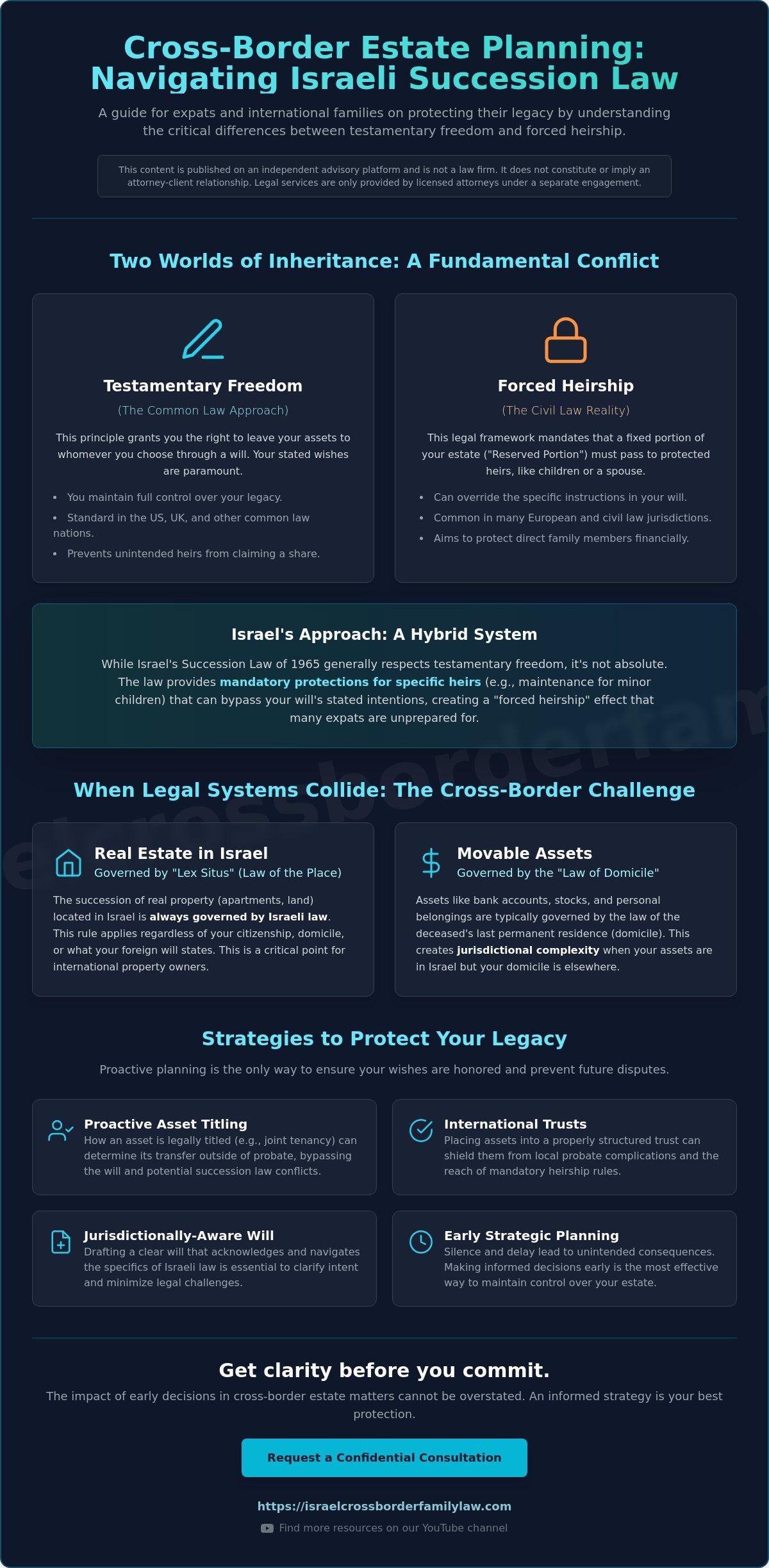
Forced heirship is a legal framework that mandates a specific portion of an individual’s estate must pass to certain heirs, such as children or a spouse. This system often overrides the deceased’s personal wishes expressed in a will. While common in many civil law jurisdictions, it can create significant friction for those accustomed to the legal systems of the United States or the United Kingdom. It represents a fundamental shift from the idea that you own your assets and should decide their ultimate destination.
Families living between countries often find themselves caught between conflicting rules. If you have assets in Israel but are a citizen of another country, your estate might be subject to laws you didn’t anticipate. Avoiding forced heirship rules starts with recognizing where these mandatory provisions exist and how they interact with your overall plan. The emotional and financial toll on a surviving spouse can be heavy if a significant portion of the estate is legally diverted to other relatives against the couple’s shared intent. This uncertainty often leads to family disputes that last for years.
To better understand this concept, watch this helpful video:
Forced Heirship vs. Testamentary Freedom
Most Anglos are familiar with testamentary freedom. This is the common law right to leave your assets to anyone you choose. In contrast, many jurisdictions use the concept of a “Reserved Portion” or Réserve Héréditaire. This reserves a fixed percentage of the estate for descendants or spouses. While Israel’s legal system generally respects the freedom of testation, it’s not absolute. Foreign laws can sometimes leak into cross-border estates, especially when real property is involved. These overlaps often lead to unexpected litigation if not addressed during the planning phase. For more tailored information, you can explore our resources for expats and foreign nationals.
The Risks of Silence in Your Estate Plan
Silence is a choice that often leads to unintended consequences. When a person dies intestate, the law steps in to fill the void. In Israel, the Succession Law of 1965 establishes a rigid hierarchy for distribution. Your informal verbal wishes carry no weight in court. For cross-border families, the complexity doubles as multiple jurisdictions may claim authority over different assets. You must identify protected heirs, such as minor children, who have specific rights under Israeli law. Avoiding forced heirship rules requires a proactive approach to titling and documentation. Early strategy is the only way to ensure your legacy follows your design rather than a default statutory formula.
Get clarity before you commit. Request a confidential consultation.
This article is published on an independent advisory platform and is not a law firm. It does not constitute or imply an attorney-client relationship. Legal services are only provided by licensed attorneys under a separate engagement.
The US-Israel Legal Intersection: Comparing Succession Frameworks
The procedural path for an estate differs significantly between the United States and Israel. In the US, succession usually moves through state-level Probate Courts, which oversee the distribution of assets according to a will or state law. In Israel, the process begins with the Registrar of Inheritance, an administrative body that issues probate or succession orders. This jurisdictional divide is a primary hurdle when avoiding forced heirship rules, as a document valid in one system may face administrative challenges in the other. Understanding the nuances of U.S.-Israeli Tax and Estate Planning is essential for ensuring your instructions are recognized by both authorities.
Succession Law in Israel (IL)
While we previously noted that Israeli law generally respects the testator’s wishes, the Israeli Succession Law 5725-1965 introduces specific protections that function as quasi-forced heirship. The most notable is the “Maintenance from the Estate” provision. This allows dependents, such as a surviving spouse or children, to claim financial support from the estate assets if they are not sufficiently provided for in the will. Unlike US systems that focus on fixed percentages, the Israeli approach is based on the actual financial needs of the survivors. This creates a layer of complexity for those with assets in IL, as these maintenance claims can effectively override the literal instructions of your will.
US Testamentary Freedom and Its Limits
American estate law varies by state, but most jurisdictions, such as New York or Florida, provide “elective share” protections for surviving spouses. This prevents a person from completely disinheriting their spouse, regardless of what the will says. However, US law generally allows for the total disinheritance of adult children, a concept that often surprises those from civil law backgrounds. If you have a US-based will, it must be carefully reviewed to ensure it doesn’t conflict with Israeli administrative requirements. Many families find that a confidential review of their legal strategy helps identify these procedural gaps early. By aligning your US state domicile rules with Israeli statutory requirements, you can maintain control over your international legacy.
Get clarity before you commit. Request a confidential consultation.
This article is published on an independent advisory platform and is not a law firm. It does not constitute or imply an attorney-client relationship. Legal services are only provided by licensed attorneys under a separate engagement.
Conflict of Laws: Domicile, Situs, and Jurisdictional Hurdles
Managing an estate that spans two continents introduces a complex “conflict of laws.” This occurs when the legal systems of the US and Israel disagree on which rules apply to your specific assets. A primary strategy for avoiding forced heirship rules involves understanding the distinction between where you live and where your property is located. If these two factors aren’t aligned, your beneficiaries might face unexpected legal hurdles in the Israeli courts. This is particularly true when one legal system attempts to apply its own standards to assets located in another country, leading to jurisdictional friction.
Real Estate vs. Movable Assets
The “Situs” rule is a cornerstone of international succession. It dictates that immovable property, such as a house or apartment, is governed by the law of the place where it sits. Consequently, an apartment in Tel Aviv is subject to the Israeli Succession Law of 1965, even if your US will specifies otherwise. Conversely, movable assets like cash, jewelry, or stock portfolios usually follow the “Domicile” rule. This means the law of your permanent home determines who inherits these items. Managing these two categories requires a nuanced approach, particularly for expats and foreign nationals who hold significant wealth in both nations. Without a clear plan, the “Renvoi” doctrine can trigger a cycle where each country’s legal system points to the other, leaving your heirs in a state of expensive limbo.
Determining Your Domicile
Your domicile isn’t simply where you happen to be staying. Israeli courts look for your “center of life” to decide which laws apply to your movable estate. They examine several factors, including your primary residence, your family’s location, and where you conduct your professional life. If you maintain strong ties to both a US state and Israel, you risk a dual-residency conflict. This can lead to competing heirship claims from relatives in different jurisdictions. Consistency is vital. Your tax filings, voter registration, and legal documents should all point to a single, intended domicile. Avoiding forced heirship rules often depends on this clarity. By choosing a governing law clause in your will, you provide a roadmap for the court, though you must remember that Israeli law will always have the final say over property on its soil.
Get clarity before you commit. Request a confidential consultation.
This article is published on an independent advisory platform and is not a law firm. It does not constitute or imply an attorney-client relationship. Legal services are only provided by licensed attorneys under a separate engagement.
Strategies for Avoiding Forced Heirship and Protecting Your Legacy
While previous sections established that Israeli law generally respects the testator’s wishes, achieving total certainty requires specific strategic tools. A unique factor in the Israeli legal landscape is the role of religious courts. In IL, Rabbinical courts have concurrent jurisdiction with civil courts over inheritance matters if all heirs provide written consent. This can lead to outcomes based on religious law rather than civil statutes, which may conflict with your original intent. Successfully avoiding forced heirship rules involves layering your protection so that your estate remains under the jurisdiction you intended.
The Role of Cross-Border Trusts
A trust serves as a powerful shield by removing assets from your personal estate before probate even begins. By transferring ownership to a trustee, the assets are no longer “yours” in the eyes of the succession registrar, which effectively places them outside the reach of statutory inheritance claims. You must decide between a revocable trust, which offers flexibility, and an irrevocable trust, which provides a higher level of protection but less control. It’s vital to consider the tax implications for Israeli residents. Israel’s tax code has specific reporting requirements for beneficiaries of foreign trusts, and failing to align these can lead to significant financial penalties. If you are concerned about how these structures might impact your family, you may want to discuss your specific situation with a professional.
Tailored Wills for Specific Jurisdictions
Relying on a single “global” will is a high-risk strategy that often leads to administrative delays or rejection by the Israeli Registrar. Each jurisdiction has its own formal requirements for signatures, witnesses, and language. A dual-will strategy involves drafting one document for your US assets and a separate, complementary document for your property in IL. This ensures that your Israeli assets are distributed according to local formalities without interfering with your US probate process. This is particularly important for those managing divorce and separation for international families, where asset division must be clearly defined to prevent future litigation. A well-drafted Israeli will must comply strictly with the Succession Law to be enforceable.
Lifetime Transfers and Joint Ownership
Another practical method for avoiding forced heirship rules is the use of “pay-on-death” (POD) or “transfer-on-death” (TOD) designations for US-based accounts. These designations allow assets to pass directly to a beneficiary, bypassing the probate court entirely. Similarly, holding property as “Joint Tenants with Right of Survivorship” ensures that the surviving owner automatically takes full control upon your passing. Lifetime gifting is the strategic process of transferring assets to your chosen heirs while you are still alive to reduce the total value of the estate subject to future claims. While these methods offer clarity, they also involve a loss of control. You must weigh the benefit of an easier transfer against the risk of giving up ownership of your assets prematurely.
Get clarity before you commit. Request a confidential consultation.
This article is published on an independent advisory platform and is not a law firm. It does not constitute or imply an attorney-client relationship. Legal services are only provided by licensed attorneys under a separate engagement.
Seeking Clarity: Strategic Advisory for Cross-Border Estates
Effective estate planning for international families requires more than just drafting a document. It demands a risk-based strategy that accounts for the friction between different legal traditions. Avoiding forced heirship rules isn’t a one-time task; it’s a continuous strategy that requires early decisions regarding your domicile and the specific way your assets are titled. A cross-border advisor acts as a bridge, ensuring that the legal steps taken in the United States don’t inadvertently trigger complications in the Israeli courts. By analyzing your global footprint now, you can prevent the administrative paralysis that often follows a death in the family. This strategic alignment is especially important for families with diverse asset classes, from high-tech equity in IL to traditional investments in the US.
Avoiding Common Cross-Border Pitfalls
One of the most frequent errors is the reliance on “standard” templates designed for a single jurisdiction. A will that is perfectly valid in Florida might lack the specific language required to be easily probated in IL. This can leave your US executors and Israeli heirs working at cross-purposes, leading to delays that can last for months. It’s essential to ensure that all parties understand how the two systems interact. For those who prefer visual explanations of these complex topics, the Israel Family Law Channel provides extensive guidance on navigating the intersection of these legal systems. Coordination is the key to preventing litigation; your US-based professional team should be in communication with your Israeli advisors to ensure every document reinforces the other.
Next Steps for International Families
The first step toward securing your legacy is to gather a comprehensive inventory of your assets across all jurisdictions. You should look specifically for items that might be subject to the “Situs” rule, such as real estate in IL, which we discussed in previous sections. Identifying potential conflicts between US state law and Israeli civil law early allows for the implementation of the trusts or gifting strategies mentioned earlier. This proactive stance is the most effective way of avoiding forced heirship rules and ensuring that your distribution plan remains enforceable. Every international family has a unique risk profile that deserves a tailored review. Get clarity before you commit. Request a confidential consultation to begin evaluating your international holdings and protecting your testamentary freedom.
This article is published on an independent advisory platform and is not a law firm. It does not constitute or imply an attorney-client relationship. Legal services are only provided by licensed attorneys under a separate engagement.
Securing Your Legacy Across Borders
Protecting your testamentary freedom in a cross-border environment requires a proactive and informed strategy. You’ve seen how the distinction between real estate “situs” and personal “domicile” creates the foundation for a resilient estate plan. By choosing the right tools, such as dual wills or international trusts, you take the most effective step toward avoiding forced heirship rules that might otherwise disrupt your final wishes. Every decision made today reduces the risk of family disputes and administrative delays in the future.
Our advisory platform brings deep expertise in US-Israel transnational operations. We focus on the specific needs of international families and expats, working with practitioners who are licensed in multiple jurisdictions to provide a nuanced understanding of both legal systems. We’re here to help you bridge the gap between different legal cultures with confidence and clarity. You don’t have to face these multi-jurisdictional complexities without a steady guide.
Get clarity before you commit. Request a confidential consultation to review your international holdings and ensure your legacy is protected. Your peace of mind is our priority.
This article is published on an independent advisory platform and is not a law firm. It does not constitute or imply an attorney-client relationship. Legal services are only provided by licensed attorneys under a separate engagement.
Frequently Asked Questions
Does Israel have forced heirship rules like France or Italy?
Israel does not have a general forced heirship regime like those found in France or Italy. The primary principle is the freedom of testation, allowing you to choose your heirs. However, the Succession Law of 1965 provides for “maintenance from the estate” (mezonot) for dependent relatives. Additionally, minor children are considered protected heirs and are entitled to a share of the estate regardless of the will’s instructions.
Can my US will protect my property in Israel from mandatory inheritance laws?
A US will can protect your Israeli property, but it must be valid under Israeli law. Because real estate is governed by the “lex situs” rule, Israeli law will always control the succession of property located in IL. For your US will to be effective, it must meet specific formal requirements. Often, a separate Israeli will is the most reliable method for avoiding forced heirship rules and ensuring local assets pass smoothly.
What happens to my Israeli assets if I die without a will?
If you die without a will, your Israeli assets are distributed according to the rules of intestate succession. The Succession Law of 1965 establishes a clear hierarchy where the surviving spouse and children are the primary beneficiaries. If you have no children, the estate is shared between the spouse and your parents. If no legal heirs are found, the State of Israel eventually inherits the assets.
Can I disinherit a child in my Israeli will?
You can generally disinherit an adult child in your Israeli will. Unlike many European systems, there is no mandatory “reserved portion” for adult children who are not dependents. However, minor children have a protected legal status. They are entitled to a share of what they would have received without a will. This makes careful planning essential for families wishing to deviate from standard distribution patterns.
How does ‘domicile’ affect which country’s inheritance laws apply to me?
Your domicile, or your “center of life,” determines which country’s laws govern your movable assets like bank accounts and stocks. If your domicile is in the US, those assets may follow US state law. If your domicile is in Israel, Israeli law applies. This is why consistency in your residency and tax filings is critical. Conflicting domiciles can lead to expensive legal battles over which jurisdiction has authority.
What is the difference between a civil court and a religious court regarding inheritance in Israel?
Civil courts apply the state’s Succession Law, while religious courts follow the specific religious laws of the parties involved. In Israel, religious courts only have jurisdiction over inheritance if all legal heirs provide their written consent. If even one heir objects, the case must be heard in a civil family court. This choice can significantly impact the distribution of assets, especially in complex family situations.
Is a US trust effective for avoiding heirship issues in Israel?
A US trust can be an effective tool for avoiding forced heirship rules by moving assets out of your personal name. Since the trust owns the assets, they are not part of your estate when you pass away. However, you must account for Israeli tax implications. Israeli residents are subject to specific reporting requirements for foreign trusts. Failing to coordinate these rules can lead to unexpected tax liabilities for your beneficiaries.
How much does it cost to set up a cross-border estate plan?
The cost of a cross-border estate plan is driven by the complexity of your global holdings. Factors include the number of jurisdictions involved, the type of assets you own, and whether you require specialized structures like trusts. Real estate in IL adds a layer of complexity due to local registration requirements. A plan tailored to multiple legal systems requires more coordination than a simple local will, but it provides much greater security.

Article by
Gabriel Lior
A Personal Journey That Became a Mission
The advisory was founded by an American father Gabriel Lior, LLB, MBA , global entrepreneur, and cross-border advisor who spent more than a decade navigating the Israeli family court system firsthand and now lives in Singapore with his son.
As a divorced parent in a cross-border family, Gabriel faced nearly every legal challenge a foreign parent can encounter in Israel — including child custody disputes, child support proceedings, property matters in Israel and abroad, false accusations, and complex immigration and relocation proceedings.
Over the years, he learned the hard way how difficult it is for non-Israeli parents to understand the system, identify the right legal strategy, and choose the right legal representation — especially when language, culture, and jurisdictional differences are involved. He also witnessed how foreign parents and new immigrants are often disadvantaged or taken advantage of by service providers and institutions simply because they lack local knowledge or fluency.
From Client to Advisor
To truly understand — and survive — the system, Gabriel pursued formal legal education in Israel, completing two Israeli law degrees, alongside a BA and MBA earned in the United States. This was never about becoming a practicing attorney, but about gaining a deep, structural understanding of how the system works — and where it breaks down for foreign parents.
This rare combination of:
Firsthand client experience
Israeli legal and US business education
International business and negotiation training
Decades of commercial execution
created a unique perspective – one that understands both sides of the table.
After years of litigation, persistence, and at times self-representation, he ultimately succeeded in securing custody of his son and relocating abroad through a rare legal victory in the Israeli Supreme Court — becoming one of the first fathers in Israel to do so under these circumstances.
Disclaimer
Important Disclaimer:
The information provided on this website and in its content is for general informational and educational purposes only and does not constitute legal advice, legal opinion, or legal representation.
Gabriel Lior is not licensed to practice law in Israel (nor is he interested in doing so) and does not provide legal services, despite having completed 2 Law Degrees. The services offered are advisory in nature and are intended to provide general guidance, strategic insight, and information regarding cross-border family law considerations.
No attorney-client relationship is formed by accessing this website, reading its content, or communicating with us.
Any decisions made based on this information are at your own discretion and risk. For legal advice specific to your situation, you should consult a licensed attorney in the relevant jurisdiction.
Where appropriate, we may refer clients to independent, licensed attorneys or professionals. Such referrals do not constitute legal representation and no liability is assumed for services provided by third parties.
Related Insights & Resources

Planning for Holidays and Vacations Across Continents: A Checklist for International Families
This article is published on an independent advisory platform and does not constitute a law...Read More →
Israeli Child Custody Laws for Foreigners: A Guide for International Families (2026)
This article is published on an independent advisory platform (not a law firm) and must...Read More →
Anastasia Fux: Understanding Her Legal Expertise in Israel for Expats
This article is published on an independent advisory platform (not a law firm) and does...Read More →