This article is published on an independent advisory platform and does not constitute a law firm or an attorney-client relationship.
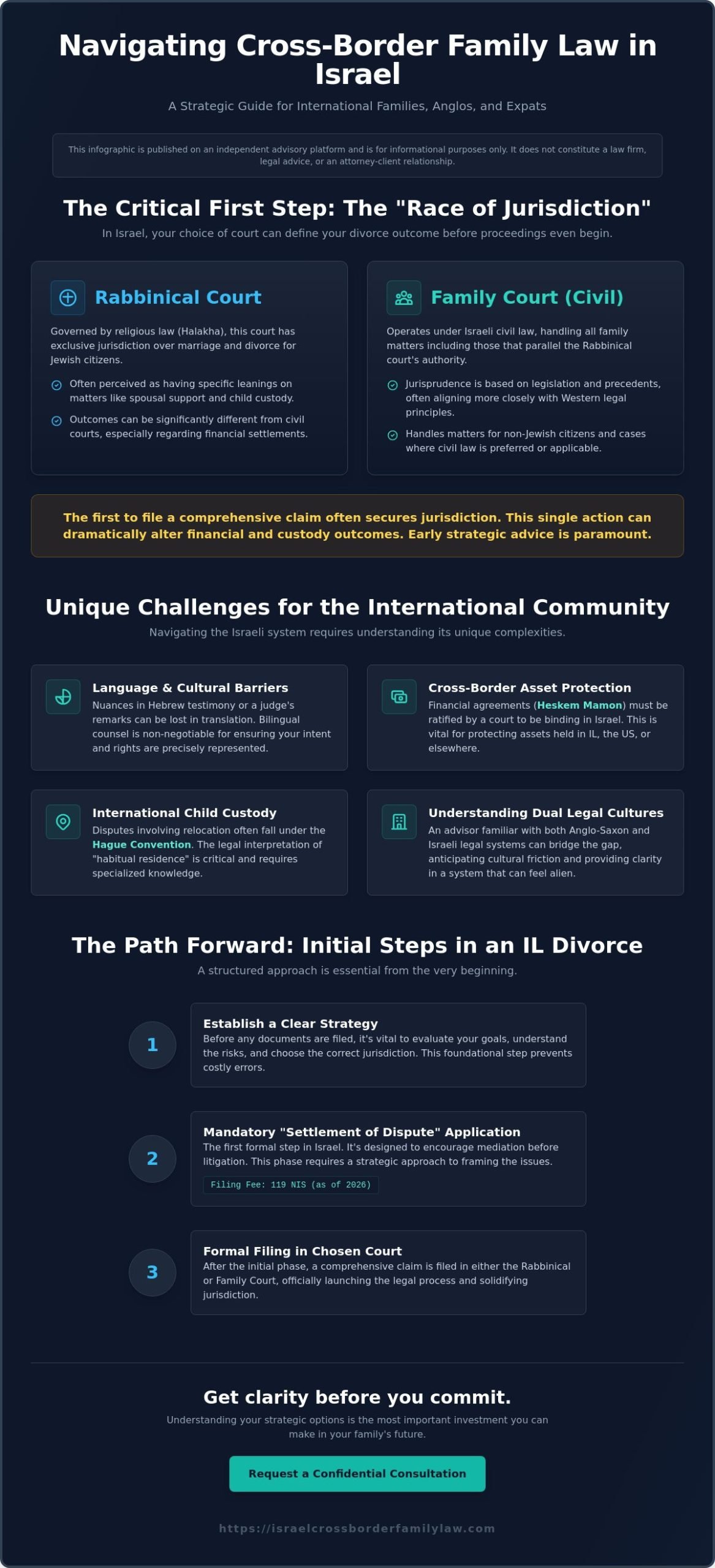
Last year, an expat mother in Tel Aviv discovered that her future financial security depended entirely on which building she entered first on a Sunday morning. In Israel, the “race of jurisdiction” between Rabbinical and Family courts is a high-stakes reality that can dictate the outcome of a divorce before a single word is spoken. Choosing a representative like Boaz Gork Adv. requires understanding how bilingual expertise bridges the gap between the Israeli legal system and the unique needs of global citizens.
It’s natural to feel anxious about language barriers or the potential for your case to be mishandled due to cultural misunderstandings. You deserve a clear path forward that respects the gravity of your family’s future. This overview will explain the strategic importance of specialized counsel and how Boaz Gork’s background serves the international community. We’ll examine the mechanics of the IL legal system and provide the information you need to make an informed decision about your next steps for a confidential consultation.
Key Takeaways
- Understand how the cross-border expertise of Boaz Gork Adv. bridges the gap between international family needs and the Israeli legal system.
- Learn why the “race to jurisdiction” makes early decisions about Rabbinical or Civil courts critical for international families in IL.
- Gain insight into drafting and enforcing binding financial agreements to protect assets across borders.
- Explore the legal frameworks surrounding international child custody and the specific challenges of Hague Convention cases.
- Identify why establishing a clear strategy is vital before committing to formal legal representation.
This article is published on an independent advisory platform and does not constitute a law firm or an attorney-client relationship.
Who is Boaz Gork Adv.? An Overview of International Family Law Expertise
Boaz Gork Adv. is a licensed Israeli advocate who provides strategic guidance for international families navigating the complexities of the Israeli legal system. Originally from South Africa, he completed his legal education at Bar Ilan University, a background that grants him a profound understanding of both Anglo-Saxon and Israeli legal cultures. This dual perspective is essential for expats and foreign nationals who require more than just a lawyer; they need a professional who can interpret the local landscape through a lens they understand.
To better understand the nuances of mediation and family law in Israel, watch this helpful video:
Operating out of primary offices in Tel Aviv and Modi’in, his practice focuses on the intersection of local law and global family dynamics. Whether addressing divorce for international families or complex estate planning, the strategic advantage of his background lies in his ability to anticipate the cultural friction that often arises in Israeli courtrooms. He serves as a steady guide for those who feel alienated by the language and the rapid pace of the IL judicial process.
The Significance of Bilingual Legal Counsel
In cross-border litigation, Hebrew and English fluency is non-negotiable. It’s about more than just reading a file; it’s about the nuance of a witness’s testimony or the specific phrasing of a judge’s remarks. Boaz Gork Adv. acts as a critical translator of both language and legal concepts. He ensures that clients don’t just hear the words spoken in court but understand the strategic weight behind them. This level of proficiency significantly reduces the risk of procedural errors and improves the overall efficiency of the case. When you’re dealing with life-altering decisions, you can’t afford to have your intent lost in translation.
A Focus on International Families and Expats
The Anglo community in IL often faces specific vulnerabilities, particularly during marital breakdown or relocation disputes. These situations frequently involve the Hague Convention on the Civil Aspects of International Child Abduction, where the legal interpretation of “habitual residence” can change the course of a family’s life. Navigating these sensitive matters requires a patient and tolerant approach. It’s vital to seek clarity on the legal risks and strategies involved before committing to a formal course of action. This educational focus helps expats manage the emotional landscape of divorce while maintaining a focus on long-term stability.
This article is published on an independent advisory platform and does not constitute a law firm or an attorney-client relationship.
Specialized Representation in Complex Cross-Border Divorce
Divorce for international couples in IL involves layers of religious and civil law that often surprise foreigners. When one spouse is a foreign national or assets are held abroad, the process requires a strategic approach from the outset. Boaz Gork Adv. provides the necessary framework to handle these multi-jurisdictional challenges, ensuring that the legal strategy accounts for both Israeli requirements and international implications. The first step in any IL divorce is typically the mandatory “Settlement of Dispute” application, which carries a filing fee of 119 NIS as of 2026. This initial phase is designed to encourage mediation before litigation begins.
Financial Agreements and Asset Protection
In Israel, a binding financial agreement, known as a Heskem Mamon, is the primary tool for asset protection. These documents are not merely private contracts; they must be formally ratified by a court or a marriage registrar to hold legal weight. For families with property in both the US and IL, these agreements must be drafted with extreme precision to ensure they are enforceable across different legal systems. Managing transnational assets requires a professional like Boaz Gork Adv. who understands how Israeli law interacts with foreign property rights. You can explore more about divorce and separation for international families to understand how these protections function within the local system.
Child Custody and Best Interests of the Child
The “best interests of the child” is the guiding principle for IL courts when determining custody. However, defining those interests becomes significantly more complex when one parent wishes to relocate to their home country. International visitation schedules aren’t just about dates; they involve flight logistics, time zone differences, and holiday rotations that span two distinct cultures. Courts look for stability, but they also recognize the importance of maintaining a connection with both parents’ heritages.
The U.S. State Department on International Child Abduction emphasizes that prevention is the most effective tool in high-conflict custody disputes. In the IL system, this often leads to the issuance of “stay of exit” orders to prevent a child from being removed from the country without the other parent’s consent or a court order. Navigating these relocation requests requires an honest assessment of the risks involved for expat parents. If you’re concerned about how these regulations apply to your situation, you may want to request a confidential case review to gain a clearer perspective on your options.
The Role of Mediation
Litigation in a foreign country is often costly and emotionally draining. Mediation offers an alternative where couples can draft their own terms before a judge ratifies the final agreement. This is frequently the preferred route for expat families who wish to maintain a functional co-parenting relationship across borders. It allows for creative solutions that a standard court ruling might not provide, such as specific arrangements for international travel or education funds held in foreign currencies.
This article is published on an independent advisory platform and does not constitute a law firm or an attorney-client relationship.
Navigating the Israeli Dual Court System
Israel’s legal landscape for families is defined by a dual court system that often feels contradictory to those raised in Western secular traditions. While the Israeli Judicial Authority – The Family Courts handle civil matters, the Rabbinical Courts maintain exclusive jurisdiction over the act of marriage and divorce for Jewish citizens. This overlap creates a parallel authority where civil issues like property division and spousal support can be adjudicated in either forum. For foreigners and secular Israelis, this structure is frequently intimidating; it requires a nuanced understanding of how religious law might influence secular rights.
The primary strategic challenge in this system is known as the “Race to Jurisdiction.” Because both courts have the power to rule on ancillary divorce matters, the court where the first valid claim is filed typically retains the authority to decide those issues. This means that an early decision to file in one court over the other can fundamentally change the financial outcome of a case. For instance, the Rabbinical Court may view certain types of property or alimony differently than the Civil Family Court. Boaz Gork Adv. works with clients to analyze these differences before any papers are signed. The goal is to ensure the chosen forum aligns with the client’s long term interests.
The Civil Family Court vs. The Rabbinical Court
Key differences exist in how these courts handle alimony and property division. Jewish couples, including those who are secular or were married abroad, are subject to the Rabbinical Court’s authority regarding the “get” or religious divorce decree. However, interfaith or entirely secular couples may follow a different path, often requiring a “dissolution of marriage” process that bypasses the religious system. Foreigners often find this dual system confusing because a decision made in one court can effectively “lock out” the other, regardless of which spouse feels more comfortable in a secular environment.
Strategies for Avoiding Jurisdictional Pitfalls
Avoiding jurisdictional pitfalls requires more than just speed. It demands a sophisticated evaluation of the specific risks associated with each forum. A cross-border lawyer must consider whether a client’s international assets or foreign prenuptial agreements will be recognized more favorably in a secular or religious setting. Understanding how case strategy works in the IL context is the first step toward regaining control over a chaotic situation. Boaz Gork Adv. acts as a strategic guide, helping clients navigate these cultural and systemic differences to prevent costly mistakes that are often impossible to reverse once a court has claimed jurisdiction.
This article is published on an independent advisory platform and does not constitute a law firm or an attorney-client relationship.
Strategic Considerations: Hague Convention and Child Abduction
International child abduction in the context of IL law often refers to the civil wrongful removal or retention of a child across international borders. It is a common misconception that abduction only involves criminal intent; in reality, many cases arise when one parent relocates a child without the formal consent of the other or a court order. These situations are governed by a specific international treaty designed to return children to their country of “habitual residence.” Boaz Gork Adv. provides the strategic framework necessary to navigate these high-stakes proceedings, where the legal struggles often involve institutional bodies and strict judicial timelines.
The urgency of legal action in these disputes cannot be overstated. In Israel, the courts prioritize the swift resolution of these cases to minimize the period of uncertainty for the child. Protecting the rights of minors and those in “helpless” positions requires an immediate assessment of the jurisdictional facts. If a child has been retained in IL beyond an agreed-upon period, the left-behind parent must act quickly to invoke the treaty protections before the child establishes new roots in the local environment.
Understanding the Hague Convention in Israel
Israel is a signatory to the treaty and generally enforces the return of children to their home countries. The court’s primary focus is not to decide long-term custody, but rather to determine which country has the authority to make that decision. You can find more detail on this hague convention child abduction framework to understand how IL courts interpret “wrongful removal” versus “wrongful retention.” A removal is typically considered wrongful if it breaches the custody rights of the parent left behind under the laws of the child’s original home.
Defenses and Litigation Strategy
While the default position of the court is to return the child, certain narrow defenses exist. These may include a “grave risk” of physical or psychological harm if the child is returned, or the “mature child” exception, where a child of sufficient age objects to the return. Boaz Gork Adv. emphasizes the role of expert witnesses, such as child psychologists, to provide the court with an objective analysis of these risks. For a broader understanding of how custody is handled in the IL system, you may find the resources on the IsraelFamilyLaw YouTube channel helpful for educational guidance. These cases require a balance of technical legal knowledge and a deep understanding of the emotional toll on the family. To discuss the specific risks of your situation, you may wish to request a confidential consultation to gain clarity on your legal standing.
This article is published on an independent advisory platform and does not constitute a law firm or an attorney-client relationship.
Evaluating Representation: Getting Clarity Before You Commit
Choosing a legal representative in a foreign country is a decision that extends far beyond a simple search for credentials. For international families in IL, the distinction between a legal advocate and an independent advisor is fundamental. While an advocate focuses on courtroom representation, an advisor prioritizes the strategic mapping of your case before litigation begins. Boaz Gork Adv. emphasizes this preparatory phase to ensure that clients understand the systemic risks unique to the Israeli landscape. This approach helps avoid the common trap of seeking “guaranteed” outcomes. In family law, especially when multiple countries are involved, outcomes are subject to judicial discretion and changing regulations. Honest practitioners will focus on risk mitigation rather than making bold promises that cannot be kept.
The Importance of a Strategy-First Approach
Early decisions often carry the most weight in the IL legal system. As discussed previously, once jurisdiction is established in either the Rabbinical or Family court, the procedural path is largely set. Strategy must precede action. Evaluating a practitioner’s experience with specific jurisdictions like the US, South Africa, or the UK is essential. A lawyer must understand how an Israeli ruling will be viewed by foreign authorities and how it might impact your status abroad. For instance, a divorce decree in IL should be recognized in your home country to avoid future legal complications regarding taxes or remarriage. You can learn more about the advisory to understand how this cross-border perspective provides a bridge between different legal cultures.
Next Steps for International Families
To get the most value from a consultation, international families should prepare a clear timeline of events and a list of all assets held in IL and abroad. It’s important to distinguish between general informational guidance and specific legal counsel. General guidance provides the framework for decision-making; it helps you see the “big picture” of your situation. Specific counsel involves the formal execution of legal tasks under a separate engagement agreement. This clarity allows you to maintain control over your strategy without feeling pressured into immediate litigation. By focusing on strategy first, you ensure that your legal team is aligned with your long-term family goals. Getting the right information early helps you avoid the high costs of correcting procedural errors later.
Get clarity before you commit. Request a confidential case review.
This article is published on an independent advisory platform and does not constitute a law firm or an attorney-client relationship.
Securing Your Family’s Future Across Borders
Navigating the intersection of international family life and the Israeli legal system requires more than just local representation; it demands a strategic bridge between cultures. You’ve seen how the “race to jurisdiction” can fundamentally alter the course of a divorce and why the Hague Convention requires immediate, specialized action. These complexities highlight why an informed strategy must always precede formal commitment in cross-border cases.
With over 25 years of litigation experience and a South African background, Boaz Gork Adv. provides the native English fluency and cross-cultural expertise necessary for Anglo families in IL. By focusing on honest risk assessment and clear communication, you can move forward with a realistic understanding of the challenges ahead. Protecting the best interests of your children and your assets begins with gaining absolute clarity on the local landscape.
Get clarity before you commit. Request a confidential consultation.
This article is published on an independent advisory platform and does not constitute a law firm or an attorney-client relationship.
Frequently Asked Questions
Where is Boaz Gork’s law firm located?
Boaz Gork Adv. maintains primary office locations in Tel Aviv and Modi’in to serve the international community in central Israel. These physical offices allow for active, local engagement with the Israeli court system while remaining accessible to expats and foreign nationals. Having a physical presence in these hubs is essential for managing the logistical demands of cross-border family law cases effectively.
Does Boaz Gork Adv. represent clients in both the Family and Rabbinical courts?
Yes, the firm provides representation in both the Civil Family Courts and the Rabbinical Courts. This dual capability is necessary because the Israeli system requires Jewish couples to obtain a religious divorce decree from a Rabbinical court. Meanwhile, civil matters like property division or child custody may be adjudicated in either system, depending on where the case is first filed.
What is the “Race to Jurisdiction” in Israeli divorce law?
The “Race to Jurisdiction” is a procedural reality where the court that receives the initial filing usually decides the ancillary matters of the divorce. Because the Rabbinical and Family courts may apply different standards to alimony or property, filing first in the correct forum is a vital strategic step. Making an informed choice early can significantly influence the final financial and legal outcome.
Does Boaz Gork specialize in the Hague Convention and child abduction?
Specialized representation in Hague Convention cases and international child abduction is a core focus of the practice. These disputes involve complex international treaties and require an urgent, strategic response to ensure the return of a child to their country of habitual residence. The firm navigates these high-stakes struggles against institutional bodies with a focus on protecting the rights of the minors involved.
How long has Boaz Gork been practicing family law in Israel?
Boaz Gork has over 25 years of litigation experience within the Israeli legal system. This historical longevity provides a deep understanding of the cultural and systemic shifts that affect international families. His extensive background serves as a foundation for guiding clients through the multi-jurisdictional complexities that often arise when family life crosses borders into the IL judicial landscape.
Can an English-speaking expat understand the Israeli court process through this firm?
Expats can gain a clear understanding of the Israeli process through this firm’s native English fluency and bilingual expertise. With a South African background, Boaz Gork acts as a bridge between the Hebrew-speaking legal system and the cultural expectations of Anglo clients. This ensures that strategic details aren’t lost in translation and that clients feel steady and informed throughout their case.
What should I bring to a consultation for a cross-border divorce case?
You should prepare a detailed timeline of family events and a comprehensive list of assets held in Israel and abroad. It’s also helpful to bring any foreign prenuptial agreements, marriage certificates, or existing court orders from other countries. This information allows for a more accurate assessment of the risks and helps in drafting a strategy that accounts for both local and international requirements.
Is Boaz Gork licensed to practice law in countries other than Israel?
Boaz Gork is a licensed advocate in Israel (IL) and focuses his practice on the Israeli judicial system. While he possesses a South African background and understands global legal cultures, his formal licensure is local. He frequently collaborates with a client’s existing professional teams in other jurisdictions to ensure that Israeli legal strategies align with the client’s broader international goals and obligations.

Article by
Gabriel Lior
A Personal Journey That Became a Mission
The advisory was founded by an American father Gabriel Lior, LLB, MBA , global entrepreneur, and cross-border advisor who spent more than a decade navigating the Israeli family court system firsthand and now lives in Singapore with his son.
As a divorced parent in a cross-border family, Gabriel faced nearly every legal challenge a foreign parent can encounter in Israel — including child custody disputes, child support proceedings, property matters in Israel and abroad, false accusations, and complex immigration and relocation proceedings.
Over the years, he learned the hard way how difficult it is for non-Israeli parents to understand the system, identify the right legal strategy, and choose the right legal representation — especially when language, culture, and jurisdictional differences are involved. He also witnessed how foreign parents and new immigrants are often disadvantaged or taken advantage of by service providers and institutions simply because they lack local knowledge or fluency.
From Client to Advisor
To truly understand — and survive — the system, Gabriel pursued formal legal education in Israel, completing two Israeli law degrees, alongside a BA and MBA earned in the United States. This was never about becoming a practicing attorney, but about gaining a deep, structural understanding of how the system works — and where it breaks down for foreign parents.
This rare combination of:
Firsthand client experience
Israeli legal and US business education
International business and negotiation training
Decades of commercial execution
created a unique perspective – one that understands both sides of the table.
After years of litigation, persistence, and at times self-representation, he ultimately succeeded in securing custody of his son and relocating abroad through a rare legal victory in the Israeli Supreme Court — becoming one of the first fathers in Israel to do so under these circumstances.
Disclaimer
Important Disclaimer:
The information provided on this website and in its content is for general informational and educational purposes only and does not constitute legal advice, legal opinion, or legal representation.
Gabriel Lior is not licensed to practice law in Israel (nor is he interested in doing so) and does not provide legal services, despite having completed 2 Law Degrees. The services offered are advisory in nature and are intended to provide general guidance, strategic insight, and information regarding cross-border family law considerations.
No attorney-client relationship is formed by accessing this website, reading its content, or communicating with us.
Any decisions made based on this information are at your own discretion and risk. For legal advice specific to your situation, you should consult a licensed attorney in the relevant jurisdiction.
Where appropriate, we may refer clients to independent, licensed attorneys or professionals. Such referrals do not constitute legal representation and no liability is assumed for services provided by third parties.