This article is published on an independent advisory platform and does not constitute an attorney-client relationship. Legal services are only provided by licensed attorneys under a separate engagement.
In Tel Aviv, a divorce isn’t just a personal ending. It’s a high-stakes strategic race where the first person to file often dictates the rules of the entire game. For an expat or international family, this process is even more complex. You’re likely feeling overwhelmed by the dual court system and worried that a language barrier might lead to losing your assets or custody of your children. It’s natural to feel uncertain about how an Israeli ruling will impact your legal status in the US or elsewhere.
We understand that you need clarity before making any life-altering commitments. This guide will provide a clear understanding of the Israeli divorce process and explain why working with an english speaking divorce lawyer tel aviv is a strategic necessity for protecting cross-border assets. We’ll preview the differences between the Rabbinical and Family courts, the implications of the 2026 law changes regarding civil jurisdiction, and how to ensure your voice is heard in a system that may feel foreign. By the end of this article, you’ll have a roadmap for achieving a fair resolution for your family and your future.
Key Takeaways
- Recognize how the “Race to File” determines jurisdiction and why choosing between Rabbinical or Family courts is a pivotal strategic decision.
- Learn why engaging an english speaking divorce lawyer tel aviv is essential for navigating the cultural and linguistic nuances of the Israeli legal system.
- Identify strategies for managing cross-border assets and international custody to protect your rights across multiple jurisdictions.
- Outline the critical financial and personal documentation needed to build a secure foundation before initiating legal action.
- Understand the value of a strategy-first advisory approach in mitigating long-term risks and avoiding unnecessary litigation.
This article is published on an independent advisory platform and does not constitute an attorney-client relationship. Legal services are only provided by licensed attorneys under a separate engagement.
The Role of an English Speaking Divorce Lawyer in Tel Aviv
For many expats living in Israel, finding an english speaking divorce lawyer tel aviv is often viewed as the primary goal when a marriage begins to dissolve. While language proficiency is vital for basic communication, it’s actually just the first step in effective representation. A lawyer who speaks English but doesn’t understand the specific cultural expectations of an “Anglo” client may struggle to provide the reassurance and strategic depth required in international cases. You aren’t just looking for someone to translate Hebrew documents; you’re looking for a professional who can navigate the complex divorce process in Israel while protecting your interests across borders.
To better understand the nuances of this process and how professional guidance can help, watch this helpful video:
International families in Tel Aviv face a unique set of challenges that a general family lawyer might not be equipped to handle. There’s a significant distinction between local litigation and a cross-border advisory specialist. The latter understands how an Israeli court’s decision on child support or asset division might conflict with US tax laws or existing trusts. This strategic awareness is what prevents a local resolution from becoming a global legal nightmare.
Beyond Translation: Cultural Fluency in the Courtroom
Israeli Family Courts operate with a level of directness that can be jarring for those accustomed to the more measured pace of Western legal systems. Small nuances in English communication are often misinterpreted when translated into Hebrew in a courtroom setting. An experienced english speaking divorce lawyer tel aviv acts as a cultural bridge. They ensure that your intentions are accurately conveyed to the judge and that you fully comprehend the implications of every hearing. This cultural fluency is equally critical when reviewing foreign legal documents. If you have a US-based prenup or a complex estate plan, your representation must know how to frame these documents so they’re recognized and respected by Israeli authorities.
Navigating the Tel Aviv Legal Landscape for Expats
The Tel Aviv legal scene is defined by its dual court system, where cases can be heard in either the secular Family Court or the District Rabbinical Court. For an expat, the choice of venue can change the outcome of property division or custody arrangements. Local presence in Tel Aviv is not just about convenience; it’s about having a practitioner who understands the specific tendencies of local judges and the administrative pace of the district. We provide comprehensive Guidance for Expats and Foreign Nationals to help you understand these systemic differences before you take your first step. Early decisions in this landscape often have permanent consequences, making it essential to seek clarity before committing to a specific legal path.
This article is published on an independent advisory platform and does not constitute an attorney-client relationship. Legal services are only provided by licensed attorneys under a separate engagement.
Understanding the Dual Court System: Rabbinical vs. Family Court
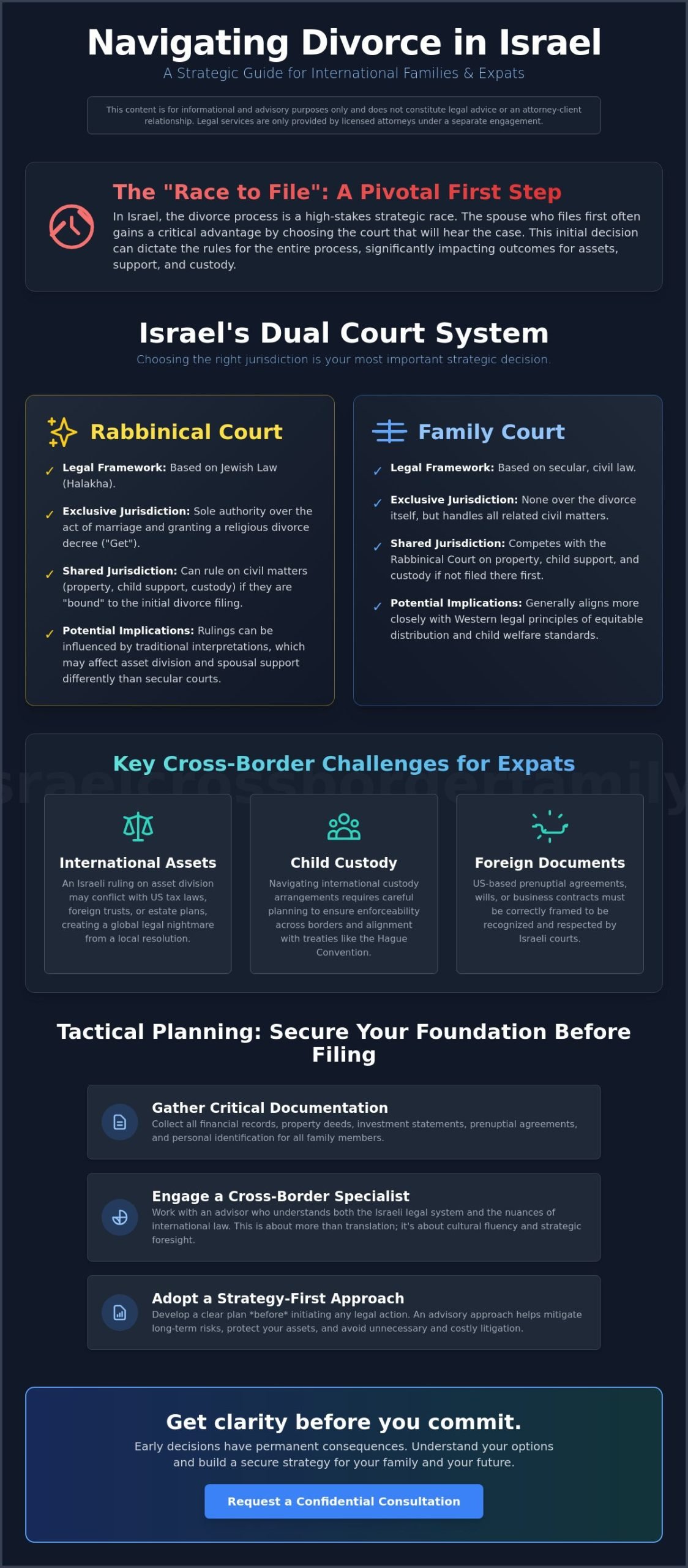
Israel’s legal framework for family matters is unique because it features a dual court system. For Jewish couples, the Rabbinical Court holds exclusive jurisdiction over the marriage itself and the granting of the “Get,” which is the religious divorce decree. However, civil matters such as property division, child support, and custody can be handled by either the Rabbinical Court or The Family Court. This overlap often creates confusion for expats who are used to a single, unified civil court system. An english speaking divorce lawyer tel aviv can help you understand how these two systems interact and which venue may be more appropriate for your specific circumstances.
The choice between these courts isn’t just administrative; it’s strategic. While both courts are bound by certain civil laws, they may approach issues like alimony or asset division with different perspectives. For example, the Rabbinical Court may consider religious obligations that don’t exist in the secular system. Conversely, the Family Court typically applies modern civil principles to property distribution. Understanding these nuances is essential for international families who need to ensure their Israeli ruling aligns with their global financial interests.
The “Race for Jurisdiction” Explained
The “Race for Jurisdiction” is a critical strategic element in an Israeli divorce. In simple terms, the court where the first valid claim is filed usually retains the authority to decide on all related civil matters. If your spouse files in the Rabbinical court first and includes asset division in their claim, that court may decide your financial future. This is why the timing of your initial filing is so important. Under the 2014 Dispute Resolution Law, couples must first file a “Settlement of Dispute” application, which carries a mandatory fee of 119 NIS as of 2026. This is followed by four mandatory mediation sessions over a 45 to 60 day period before any litigation can begin. Gaining a clear strategy during this initial phase is vital for protecting your rights.
Civil Divorce for Non-Jewish Expats and Mixed Couples
Not every expat is subject to the authority of religious courts. For non-Jewish couples or those who married in civil ceremonies abroad, the process is referred to as the “Dissolution of Marriage.” While this typically stays within the secular Family Court system, the legal requirements can still be complex, especially when determining which country’s laws apply to your assets. We offer specific resources on Divorce and Separation for International Families to clarify these procedures for those married in the US, Cyprus, or elsewhere. Identifying your jurisdictional status early can prevent costly mistakes and provide a clearer path forward. If you have questions about how these rules apply to your marriage, you can reach out for a confidential review.
This article is published on an independent advisory platform and does not constitute an attorney-client relationship. Legal services are only provided by licensed attorneys under a separate engagement.
Cross-Border Challenges: Assets, Custody, and Jurisdiction
For an international family in Tel Aviv, the legal process often extends far beyond the borders of Israel, especially when assets are spread across continents or children hold multiple citizenships. This geographical spread introduces a level of complexity that a standard domestic divorce simply does not face. Many expats prioritize finding an english speaking divorce lawyer tel aviv who understands the global implications of a local ruling. The Hague Divorce Convention provides a framework for the recognition of divorces across borders, but applying these international standards requires a sophisticated strategy to avoid conflicting rulings in different countries.
Protecting International Assets and Business Interests
Protecting multi-jurisdictional financial interests is a primary concern for high-net-worth expats. Israeli courts typically follow the rule of equitable distribution, but they may not always grasp the tax implications or regulatory hurdles of US-based assets like 401(k)s, Roth IRAs, or brokerage accounts. The interaction between local family law and the US-Israel Tax Treaty is a specialized area that requires precise handling to prevent double taxation or improper valuation. If you own business equity in a US startup or real estate in London, a standard valuation might not account for the specific liquidity issues you’ll face when trying to divide those interests. You need a professional who can bridge the gap between these two financial worlds while ensuring that your Israeli settlement is enforceable abroad.
International Custody and the Right to Relocate
Custody is perhaps the most sensitive area of cross-border divorce, as the “Best Interests of the Child” is the universal standard but is interpreted differently across legal systems. For many expats, the fear of being “stuck” in Israel or having a spouse relocate with the children is a constant source of stress. Israeli law treats relocation as a major decision that requires either mutual consent or a specific court order. If you’re concerned about how support will be collected if one parent moves abroad, it’s important to understand the mechanisms of Child Support Cross-Border Enforcement. Preventing potential child abduction is also a priority, often involving the Hague Convention on the Civil Aspects of International Child Abduction. This treaty provides a legal mechanism for the return of children taken across borders without consent, serving as a critical safeguard for international families. Understanding these international protections is a vital step in managing your family’s future, and you may want to request an advisory review of your situation to gain more clarity.
This article is published on an independent advisory platform and does not constitute an attorney-client relationship. Legal services are only provided by licensed attorneys under a separate engagement.
Tactical Planning: Steps to Take Before Filing for Divorce
Strategic preparation is the foundation of a successful cross-border resolution. Before you initiate any formal process, focus on data collection and privacy. This phase is often where an english speaking divorce lawyer tel aviv provides the most value by helping you identify which documents will be scrutinized by both Israeli and foreign authorities. You’ll need certified copies of your marriage certificate, several years of US tax returns, and comprehensive bank statements from all jurisdictions where you hold accounts. Gathering these records early prevents them from being withheld later in the process.
Digital privacy is equally critical. In the heat of a separation, many individuals are tempted to use “self-help” evidence, such as accessing a spouse’s private emails or social media accounts. In Israel, this can lead to severe legal repercussions and may result in evidence being ruled inadmissible. It’s vital to secure your own digital footprint, change passwords on personal accounts, and avoid any actions that could be interpreted as a breach of privacy laws. Seeking an advisory session at this stage is different from hiring a litigation attorney; the goal is to build a strategy and manage risks before entering a courtroom.
Financial Disclosure and Document Preparation
You must create a comprehensive list of global assets and debts to understand your true financial position. Identifying “separate property,” such as assets owned before the marriage or received as an inheritance, is essential for protecting your long-term interests. The “Balancing of Resources” principle in Israel dictates that all assets accumulated during the marriage are generally divided equally between spouses upon divorce, regardless of whose name is on the title. Understanding how this principle applies to your specific portfolio is a key part of our advisory process.
The Mandatory Mediation Phase (Dispute Resolution)
Under the Dispute Resolution Law, you cannot immediately jump into litigation. The process begins with a “Settlement of Dispute” application, which triggers a mandatory 60-day stay of proceedings. During this time, you’ll attend sessions with the court’s social workers to explore the possibility of a settled agreement. While this may feel like a delay, you should use this time to refine your long-term legal strategy and prepare for potential outcomes. You can find detailed explanations of this mandatory mediation process on our YouTube channel under the video titled “Dispute Resolution in Israel.” If you’re ready to start organizing your strategy, you can request a confidential case review to begin your tactical planning.
This article is published on an independent advisory platform and does not constitute an attorney-client relationship. Legal services are only provided by licensed attorneys under a separate engagement.
The Advisory Approach: Gaining Clarity Before Commitment
Transitioning from a domestic life to a cross-border divorce requires more than just a litigator; it requires a strategic architect. Many international families find that jumping straight into the adversarial system creates unnecessary friction and long-term financial damage. An independent advisory platform offers a unique perspective by prioritizing risk management and clarity over aggressive courtroom tactics. This approach allows you to understand the full scope of your situation before you commit to a specific english speaking divorce lawyer tel aviv for formal representation. By mapping out potential outcomes across both the US and IL legal systems, you can make decisions based on logic rather than the immediate pressure of an emotional crisis.
The Israel Cross Border Law Firm facilitates the bridge between these divergent legal frameworks, ensuring that a resolution in a Tel Aviv courtroom doesn’t create a tax or regulatory crisis in your home country. This multi-jurisdictional oversight is essential for families with complex lives. Instead of reacting to your spouse’s filings, you gain the ability to act with foresight. A strategy-first approach ensures that every decision, from the timing of a filing to the structure of a custody agreement, is aligned with your long-term global interests.
Strategy First, Representation Second
Making major legal decisions during the initial shock of a separation is a significant risk. An early advisory call serves as a critical buffer, preventing costly cross-border mistakes that are difficult to undo once a case is filed. We focus on helping you understand How the Advisory Works to provide a foundation of knowledge before you engage in the “Race to Jurisdiction” mentioned in previous sections. This model ensures that when you eventually hire an english speaking divorce lawyer tel aviv, your representation is based on a clear, pre-vetted plan for your global assets and child custody arrangements. It’s about building a secure legal foundation before the first document is ever signed.
Protecting Your Future with Informed Choices
Empowering expats to navigate the Israeli legal landscape requires a multi-disciplinary lens that includes legal, financial, and tax considerations. A Confidential Case Review allows you to see the “big picture” of how Israeli rulings will interact with your foreign interests without the confusion of legal jargon. Our goal is to guide you through this transition with dignity and transparency, ensuring you understand your rights and the risks involved at every stage. By gaining clarity early, you protect your future and provide a more stable resolution for your family. Navigating this transition is challenging, but with the right strategy, you can move forward with confidence and a clear sense of direction.
Get clarity before you commit. Request a confidential consultation.
This article is published on an independent advisory platform and does not constitute an attorney-client relationship. Legal services are only provided by licensed attorneys under a separate engagement.
Securing Your Global Future with Strategic Clarity
Navigating a divorce in Israel involves more than just understanding local laws; it requires a comprehensive strategy that accounts for your life across borders. You’ve seen how the “Race for Jurisdiction” and the dual court system can fundamentally alter your financial and parental future. Protecting multi-jurisdictional assets and maintaining international custody requires foresight and a deep understanding of how Israeli rulings interact with foreign legal standards.
By engaging an english speaking divorce lawyer tel aviv who specializes in cross-border family law, you ensure that your voice is accurately represented and your rights are protected in both the US and IL. Moving forward with an advisory-first mindset allows you to manage risks and make informed choices with dignity. Taking the time to gather documentation and understand the mandatory mediation phase will put you in a stronger position for whatever comes next.
Get clarity before you commit. Request a confidential case review.
This article is published on an independent advisory platform and does not constitute an attorney-client relationship. Legal services are only provided by licensed attorneys under a separate engagement.
Frequently Asked Questions
Does an English speaking divorce lawyer in Tel Aviv need to be licensed in both the US and Israel?
While an english speaking divorce lawyer tel aviv must be licensed by the Israel Bar Association to appear in local courts, they don’t strictly need a US license. However, practitioners with multi-jurisdictional qualifications or extensive experience in US-Israel matters provide a critical advantage. They understand the intersection of different legal cultures and can coordinate with your foreign legal teams to ensure a seamless strategy that protects your interests in both nations.
How long does the divorce process typically take in Israel for international couples?
The duration of the process depends heavily on whether the divorce is contested or mutual. As of 2026, an uncontested divorce where both parties agree on all terms generally takes 3 to 6 months to conclude. In contrast, a contested divorce involving complex asset division or custody disputes typically takes 2 to 4 years to finalize in the Israeli court system. These timelines include the mandatory mediation period required by law.
Can I divorce in Israel if we were married in a civil ceremony in the United States?
Yes, you can divorce in Israel even if you had a civil ceremony in the US. This process is known as the “Dissolution of Marriage” and is handled by the secular Family Court rather than the Rabbinical Court. The court will review your foreign marriage documents and apply relevant international private law principles to dissolve the union legally within the borders of IL, ensuring the decree is recognized globally.
Will an Israeli child support order be enforceable if my spouse moves back to the US?
Israeli child support orders are often enforceable in the US through reciprocal agreements and international legal frameworks. Israel is a signatory to various conventions that facilitate the cross-border collection of support payments. It’s essential to have your order drafted with international enforcement in mind to ensure that a move back to the US doesn’t result in a cessation of financial obligations or a loss of your established parental rights.
What is the “Race for Jurisdiction” and how does it affect my divorce?
The “Race for Jurisdiction” occurs because both the Rabbinical and Family Courts can decide on civil matters like property and custody. The spouse who files a comprehensive claim first in their preferred court usually determines where these issues will be litigated. This makes early strategic planning with an english speaking divorce lawyer tel aviv vital for protecting your interests before your spouse takes action in a venue that might be less favorable.
Are US prenuptial agreements recognized by Israeli Family Courts?
US prenuptial agreements are generally recognized by Israeli courts, but they must undergo a specific validation process. The court will examine whether the agreement was signed voluntarily and whether its terms align with basic Israeli public policy. It’s often necessary to have the foreign agreement confirmed by an Israeli court to ensure it’s fully enforceable during the asset division process, especially when dealing with property located in multiple countries or jurisdictions.
Do I have to attend Rabbinical Court if I am not an observant Jew?
If you are Jewish, you must attend the Rabbinical Court to receive the “Get,” regardless of your level of religious observance. While the secular Family Court can handle custody and assets, the religious court has exclusive authority over the act of divorce itself. Non-observant Jews are still subject to this requirement to be considered legally divorced and free to remarry under the laws of IL, preserving their personal legal status.
How are assets like US-based retirement accounts divided in an Israeli divorce?
Assets such as 401(k)s, IRAs, and other US-based retirement accounts are typically included in the “Balancing of Resources” calculation. Israeli law views these as marital assets accumulated during the partnership, even if they’re located abroad. Dividing them requires a sophisticated understanding of US tax implications and the use of specific orders to ensure the division is recognized by US financial institutions without triggering unnecessary penalties or tax liabilities for either party.

Article by
Gabriel Lior
A Personal Journey That Became a Mission
The advisory was founded by an American father Gabriel Lior, LLB, MBA , global entrepreneur, and cross-border advisor who spent more than a decade navigating the Israeli family court system firsthand and now lives in Singapore with his son.
As a divorced parent in a cross-border family, Gabriel faced nearly every legal challenge a foreign parent can encounter in Israel — including child custody disputes, child support proceedings, property matters in Israel and abroad, false accusations, and complex immigration and relocation proceedings.
Over the years, he learned the hard way how difficult it is for non-Israeli parents to understand the system, identify the right legal strategy, and choose the right legal representation — especially when language, culture, and jurisdictional differences are involved. He also witnessed how foreign parents and new immigrants are often disadvantaged or taken advantage of by service providers and institutions simply because they lack local knowledge or fluency.
From Client to Advisor
To truly understand — and survive — the system, Gabriel pursued formal legal education in Israel, completing two Israeli law degrees, alongside a BA and MBA earned in the United States. This was never about becoming a practicing attorney, but about gaining a deep, structural understanding of how the system works — and where it breaks down for foreign parents.
This rare combination of:
Firsthand client experience
Israeli legal and US business education
International business and negotiation training
Decades of commercial execution
created a unique perspective – one that understands both sides of the table.
After years of litigation, persistence, and at times self-representation, he ultimately succeeded in securing custody of his son and relocating abroad through a rare legal victory in the Israeli Supreme Court — becoming one of the first fathers in Israel to do so under these circumstances.
Disclaimer
Important Disclaimer:
The information provided on this website and in its content is for general informational and educational purposes only and does not constitute legal advice, legal opinion, or legal representation.
Gabriel Lior is not licensed to practice law in Israel (nor is he interested in doing so) and does not provide legal services, despite having completed 2 Law Degrees. The services offered are advisory in nature and are intended to provide general guidance, strategic insight, and information regarding cross-border family law considerations.
No attorney-client relationship is formed by accessing this website, reading its content, or communicating with us.
Any decisions made based on this information are at your own discretion and risk. For legal advice specific to your situation, you should consult a licensed attorney in the relevant jurisdiction.
Where appropriate, we may refer clients to independent, licensed attorneys or professionals. Such referrals do not constitute legal representation and no liability is assumed for services provided by third parties.