This article is published on an independent advisory platform and is intended for informational and advisory purposes only. It does not constitute legal representation or legal advice, and its consumption does not create an attorney-client relationship. Legal services are only provided by licensed attorneys under a separate engagement.
Imagine you’ve finally secured a child support order in an Israeli family court, only for the other parent to relocate to the United States or Europe a month later. It’s a common fear for many expats and international families who worry that their hard-won legal protections stop at the border. The reality is that Enforcing Israeli Orders Abroad is a complex process, but it’s entirely possible with the right strategic roadmap. You aren’t alone in feeling uncertain about whether an Israeli judgment truly “travels” or if you’ll be forced to start your legal battle from scratch in a new country.
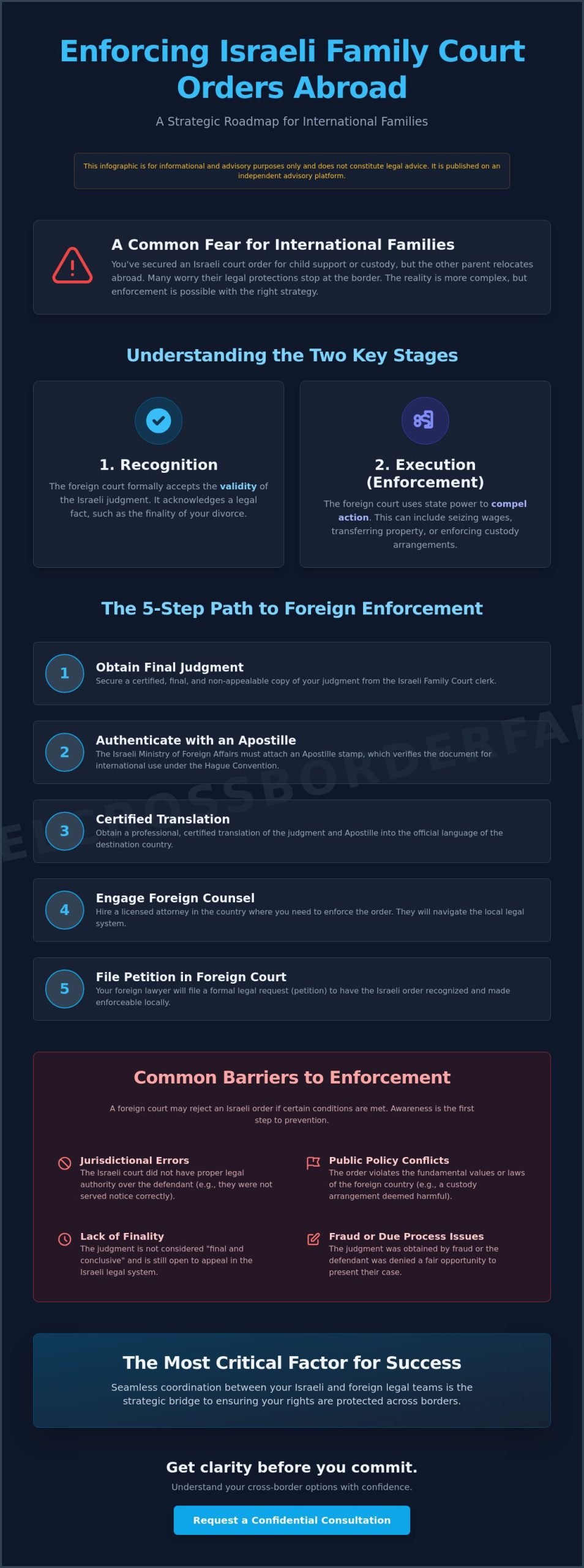
This guide will show you how to navigate these cross-border complexities with confidence. You’ll learn the essential steps and legal frameworks required to make an Israeli family court order recognized and enforceable in foreign jurisdictions. We’ll explore the difference between recognition and execution, the role of treaties like the Hague Convention, and how to maintain the security of your custody and support arrangements. By the end, you’ll have a clear understanding of how to ensure your rights remain protected, no matter where the other party moves.
Key Takeaways
- Understand the vital distinction between legal recognition of your judgment’s validity and the actual execution of its specific terms in a new country.
- Learn how international frameworks like the Hague Convention and the principle of comity provide the legal basis for Enforcing Israeli Orders Abroad.
- Follow a clear administrative roadmap to prepare your documents, including the essential roles of the Israeli court clerk and the Ministry of Foreign Affairs.
- Identify common procedural barriers, such as jurisdictional errors or public policy conflicts, that could lead a foreign court to reject an Israeli order.
- Discover why coordinating between your Israeli and foreign legal teams is the most critical factor in ensuring your custody and support rights remain secure.
This article is published on an independent advisory platform and is intended for informational and advisory purposes only. It does not constitute legal representation or legal advice, and its consumption does not create an attorney-client relationship. Legal services are only provided by licensed attorneys under a separate engagement.
What Does It Mean to Enforce an Israeli Order Abroad?
The process of Enforcing Israeli Orders Abroad involves a formal legal request to a foreign court to recognize and adopt an Israeli judgment as if it were its own. This is not an automatic “copy and paste” procedure. Instead, it is a multi-step litigation process where the “receiving state”—the country where the order needs to be applied—evaluates the Israeli ruling against its own legal standards. Whether you are dealing with a divorce decree, a custody arrangement, or a financial settlement, the foreign court must be convinced that the Israeli proceedings were fair and that the resulting order does not violate local laws.
To better understand this concept, watch this helpful video:
The success of these actions often hinges on the Enforcement of foreign judgments, which is a specialized area of international law. Each jurisdiction has its own criteria for what makes an Israeli order valid. Some countries rely on formal treaties, while others use the principle of comity, which is a discretionary respect that courts show for the judicial acts of other nations. Understanding these nuances is the first step in ensuring your Israeli legal protections remain intact after a move.
Recognition vs. Execution: A Crucial Difference
It is vital to distinguish between recognition and execution. Recognition means the foreign court accepts a legal fact, such as the validity of your divorce. Execution, or enforcement, is the actual use of state power to compel a specific action, such as seizing wages or transferring property. A court might recognize your Israeli divorce status but refuse to enforce a specific asset split if the property is located elsewhere. Your ability to collect support often depends on “In Personam” jurisdiction. This means the court must have legal authority over the individual who owes the money. Decisions made early in your Israeli case, such as how the defendant was served, can dictate your future enforcement options abroad.
Family Law Specifics: Custody and Child Support
Child-related orders are generally treated with a higher level of urgency by international courts. However, they also face unique scrutiny. While an Israeli court may have issued a custody ruling, a foreign court will often apply its own “Best Interests of the Child” standard before agreeing to enforce it. They want to ensure the order aligns with their local fundamental values and public policy. This complexity is why strategic coordination is necessary from the beginning. For those specifically concerned about financial obligations, you can explore the details of child support cross-border enforcement to understand how these rules apply across different legal systems.
This article is published on an independent advisory platform and is intended for informational and advisory purposes only. It does not constitute legal representation or legal advice, and its consumption does not create an attorney-client relationship. Legal services are only provided by licensed attorneys under a separate engagement.
International Frameworks: The Hague Convention and Comity
Not every country has a formal, all-encompassing agreement with Israel regarding family law. When you’re Enforcing Israeli Orders Abroad, you’re often navigating a complex mix of international treaties and local judicial courtesy. While there isn’t a single “global law” that forces every country to obey an Israeli ruling, several established frameworks make the process more predictable and secure for international families.
The Hague Convention and Parental Rights
The 1980 Hague Convention on the Civil Aspects of International Child Abduction is the most powerful tool for protecting custody rights across borders. If a parent removes a child from Israel without permission, this treaty provides a streamlined mechanism to return the child to their “habitual residence.” A valid Israeli custody order acts as a shield, proving that the removal was legally “wrongful.” However, the Convention has clear limits. It focuses primarily on the physical return of the child rather than resolving long-term custody disputes or financial matters. For a deeper look at how this works in practice, you can read our Hague Convention guide.
Understanding Comity and Reciprocity
When a specific treaty doesn’t apply, courts use the principle of “comity.” This is essentially a legal professional courtesy where a court in one country respects the judicial acts of another. For example, states like New York or California often recognize Israeli divorce or support orders even though there’s no federal treaty between the US and Israel. They do this because the Israeli legal system is viewed as reliable and follows due process standards that are familiar to Western courts.
A key factor in this process is reciprocity. Foreign courts often want to know if Israel would treat their orders with the same respect. Proving this to a foreign judge requires demonstrating that the Israeli process was fair. You must show that the defendant was properly served and had a real chance to defend themselves in the Israeli court. Another potential hurdle is the “Mirror Principle,” which ensures the Israeli order doesn’t violate the foreign country’s fundamental public policy. If you’re unsure how these frameworks apply to your specific situation, it’s helpful to request an advisory call to clarify your options.
The US-Israel relationship is unique. While no broad bilateral family law treaty exists, specific agreements like the 2009 Memorandum of Understanding (MOU) on child support create a reliable path for cooperation. This MOU allows the US and Israel to assist each other in enforcing maintenance payments, bridging the gap between two different legal systems without the need for a new trial.
This article is published on an independent advisory platform and is intended for informational and advisory purposes only. It does not constitute legal representation or legal advice, and its consumption does not create an attorney-client relationship. Legal services are only provided by licensed attorneys under a separate engagement.
Preparing Your Israeli Order for Recognition: A 5-Step Process
Moving from a theoretical understanding of international law to the practical reality of Enforcing Israeli Orders Abroad requires a rigorous administrative process. A foreign judge cannot simply look at a Hebrew document and accept its terms. The bridge between the Israeli legal system and a foreign jurisdiction is built on specific certifications that prove the document’s authenticity and finality. If these steps aren’t completed correctly while you’re still in IL, you may find yourself facing significant delays or total rejection when you attempt to use the order in your new home.
The preparation process typically follows these five essential stages:
- Obtain a Certified Copy: You must request a Ha’atek Ne’eman from the Israeli court clerk. This is an official version of the judgment with an original court stamp, not a digital printout from the online system.
- Secure the Apostille: This international seal from the Israeli Ministry of Foreign Affairs validates the authority of the person who signed the court document.
- Request a Certificate of Finality: You must prove the order is no longer subject to appeal. Foreign courts generally refuse to enforce “temporary” or “interim” orders.
- Commission a Professional Translation: A simple word-for-word translation is often insufficient. The document must reflect the legal equivalent of Israeli terms in the target language.
- Review for ‘Enforcement-Friendly’ Language: Before finalizing an agreement in Israel, a cross-border advisor should ensure the wording is clear enough for a foreign agency to execute without ambiguity.
The Role of the Apostille and Certification
An Apostille is often misunderstood. It doesn’t verify that the content of your custody or support order is “correct” or “fair.” Instead, it only verifies that the signature and seal on the document are genuine. In IL, you can obtain this stamp through the Ministry of Foreign Affairs in Jerusalem or, in some cases, through an online application process for digital documents. A common mistake is presenting a document that is too old; some foreign jurisdictions require the certification to be issued within six months of the enforcement filing. If the chain of certification is broken, the foreign court will likely view the Israeli order as a mere piece of paper rather than a binding judgment.
Translation and Legal ‘Equivalency’
Terminology is where many international families encounter friction. For example, the Hebrew term Mezonot is often translated as “child support,” but it can also encompass “spousal maintenance” or specific “extraordinary expenses.” If the translation isn’t precise, a US judge might misinterpret the financial obligations. It’s equally important to include a “Certificate of Finality” from the Israeli court. This document confirms that the time for filing an appeal has passed. Without it, a foreign court may stay the proceedings, leaving you in a legal limbo while they wait for confirmation that the Israeli case is truly closed. Strategic preparation ensures that Israeli legal concepts are presented in a way that aligns with local judicial expectations.
This article is published on an independent advisory platform and is intended for informational and advisory purposes only. It does not constitute legal representation or legal advice, and its consumption does not create an attorney-client relationship. Legal services are only provided by licensed attorneys under a separate engagement.
Common Barriers: Why an Israeli Order Might Be Rejected
Securing a judgment in an Israeli court is a significant milestone, but it doesn’t automatically translate into international compliance. When you’re Enforcing Israeli Orders Abroad, the foreign court acts as a gatekeeper. They aren’t there to re-try your case, but they will ensure the order meets their local standards of fairness and legality. If the original process in IL didn’t respect the defendant’s rights or if the order’s terms clash with local fundamental values, the foreign judge may refuse to recognize it entirely. Understanding these potential pitfalls before you leave the Israeli jurisdiction is the best way to prevent a costly legal stalemate later.
The Rabbinical Court vs. Secular Foreign Courts
One of the most unique challenges in the Israeli legal landscape is the dual system of civil Family Courts and religious Rabbinical Courts. While Rabbinical rulings are fully binding in IL, foreign courts often view them through a different lens. If a financial order is rooted heavily in religious law or tied to the granting of a Gett (divorce), a secular court in the US or Europe might hesitate to enforce it. They may see it as a violation of the separation of church and state or find the terminology too obscure to execute. To avoid this, it’s often necessary to “secularize” the language of an agreement, ensuring that obligations like child support or asset division are described in clear, civil terms that a foreign judge can easily recognize and process.
Jurisdictional Challenges and Service of Process
Service of process is the most frequent point of failure. If a defendant can demonstrate they weren’t properly notified of the Israeli proceedings according to both Israeli and international standards, the foreign court will likely dismiss the enforcement claim. This is especially true for Default Judgments, where the defendant never appeared in court. While these judgments are valid in IL, they’re often viewed with suspicion abroad. You must be able to prove the defendant had a fair chance to be heard. If the Israeli court’s authority over the individual wasn’t clearly established in the written order, the foreign court may decide it lacks the jurisdiction to compel payment or custody changes. Ensuring that every procedural box was checked in the initial case is vital for long-term success.
Public policy, or Ordre Public, is the final hurdle. A foreign court won’t enforce an Israeli order that contradicts its own fundamental laws. For example, if an Israeli custody arrangement is seen as discriminatory under local standards, it might be rejected. If you’re concerned about the international validity of your current order, you should request a confidential consultation to review your strategy and identify any hidden risks before they become barriers.
This article is published on an independent advisory platform and is intended for informational and advisory purposes only. It does not constitute legal representation or legal advice, and its consumption does not create an attorney-client relationship. Legal services are only provided by licensed attorneys under a separate engagement.
The Strategic Bridge: Why You Need Cross-Border Guidance
Navigating two distinct legal systems simultaneously often leads to what professionals call the “Two-Lawyer” problem. Your Israeli attorney is an expert in the laws and procedures of IL, while your US or European attorney understands the specific statutes of their own jurisdiction. However, these two professionals rarely speak the same “legal language” when it comes to how their systems interact. Without a strategic bridge, critical details can be lost in translation, making Enforcing Israeli Orders Abroad far more difficult and expensive than it needs to be.
Strategic coordination is about more than just translating documents; it is about managing the timeline and expectations between two different court systems. For example, an Israeli court might move at a different pace than a court in California or London. If your legal teams aren’t synchronized, you could miss a filing deadline in one country that jeopardizes your standing in the other. An independent advisory platform provides the oversight necessary to ensure that your global strategy remains cohesive and that your local attorneys have the cross-border context they need to succeed.
Bridging the Gap Between Israel and the US
An advisor helps your US attorney understand the specific nuances of an Israeli ruling, ensuring they can present the order to a foreign judge in a way that minimizes friction. This is especially vital when drafting “Consent Agreements” in Israel. If these agreements are written only with the Israeli system in mind, they may lack the specific jurisdictional language required for foreign recognition. By involving an advisor early, you can ensure these documents are “enforcement-friendly” before they are signed and sealed. You can learn more about how the advisory works to support your international transition.
Clarity Before Commitment
Fixing a non-enforceable order after you have already relocated is a complex and costly endeavor. It’s always more efficient to identify potential enforcement hurdles while you still have the attention of the Israeli court and the other party. Early strategy allows you to address jurisdictional risks or terminology conflicts before they become permanent barriers to your rights. This is why confidential case reviews are a critical step for international families managing custody, support, or divorce. For additional guidance and visual explainers on these topics, you can explore the Cross-Border Family Law Insights channel.
The goal is to reach a point of security where you know your Israeli protections will be upheld regardless of where you live. By focusing on strategy and risk mitigation rather than just formal representation, you can make informed choices that protect your family’s future.
Get clarity before you commit. Request a confidential advisory call or reach out via WhatsApp to discuss your cross-border strategy.
Securing Your Family’s Global Future
Ensuring your legal protections follow you across borders requires more than just an Israeli court order. It demands a sophisticated strategy that addresses the systemic differences between the Rabbinical and Civil systems in IL. Success in Enforcing Israeli Orders Abroad hinges on completing the rigorous administrative chain of certification and bridging the gap between two divergent legal cultures. By focusing on the finality of your documents and the precision of your legal terminology, you can prevent your rights from being lost in translation.
Our advisory platform provides specialized expertise in the complexities of US-Israel family law, offering a dedicated focus for expats and international families. We bring a nuanced understanding of both the religious and secular court systems, helping you identify potential enforcement hurdles before they become permanent barriers. Our role is to act as your strategic guide, providing the cross-border insights that local attorneys often lack. This proactive approach ensures that your custody and support arrangements remain secure, no matter where your journey takes you.
Get clarity before you commit. Request a confidential consultation. You don’t have to manage this complex transition without a steady, knowledgeable partner by your side.
This article is published on an independent advisory platform and is intended for informational and advisory purposes only. It does not constitute legal representation or legal advice, and its consumption does not create an attorney-client relationship. Legal services are only provided by licensed attorneys under a separate engagement.
Frequently Asked Questions
Is an Israeli divorce decree automatically valid in the United States?
An Israeli divorce decree is not automatically valid in the United States. While US courts generally respect foreign judgments through the principle of comity, you must still file a petition for recognition in a local state court. The judge will verify that the Israeli court had proper jurisdiction and that both parties received fair notice. This process transforms the Israeli ruling into an enforceable local judgment.
Can I enforce an Israeli child support order if the payer now lives in the US?
You can enforce an Israeli child support order in the US thanks to a 2009 Memorandum of Understanding between the two nations. This agreement facilitates the collection of maintenance payments through state agencies without requiring a full new trial. Enforcing Israeli Orders Abroad through this framework provides a structured path for expats to ensure their financial rights remain protected across international borders.
What is an Apostille and why is it mandatory for Israeli court documents?
An Apostille is an international certification seal that verifies the authenticity of the signature and stamp on your Israeli court documents. It is mandatory because foreign judges have no other way to confirm that a document from IL is a genuine government record. You must obtain this seal from the Ministry of Foreign Affairs before submitting any paperwork to a foreign court or agency.
What happens if a foreign court refuses to recognize my Israeli custody order?
If a foreign court refuses to recognize your Israeli custody order, you may be forced to litigate the custody case from the beginning in the new jurisdiction. The foreign court will likely apply its own local standards to determine the arrangement. This risk highlights the importance of ensuring your original Israeli order is drafted in a way that respects international legal standards and due process.
Do I need to hire a new lawyer in the country where I want to enforce the order?
You will almost certainly need to hire local counsel in the country where you seek enforcement. While your Israeli advisor manages the strategy and document preparation, only a lawyer licensed in the target jurisdiction can file motions and represent you before a local judge. Coordinating between your Israeli team and your foreign lawyer is the most effective way to ensure a smooth transition.
How long does the international recognition process usually take for family law?
The timeline for international recognition typically ranges from six to eighteen months depending on the specific country and the complexity of the case. Enforcing Israeli Orders Abroad is a process that involves multiple stages of document certification, translation, and local court scheduling. Starting the preparation while you are still in IL can significantly reduce the time it takes to achieve a final result.
Can a Rabbinical Court order for alimony be enforced in a secular US court?
Enforcing a Rabbinical Court alimony order in a secular US court presents significant challenges. US judges are often hesitant to execute rulings based on religious law due to the constitutional separation of church and state. To increase your chances of success, the financial obligations should be described in civil, secular terms within a document that a foreign court can easily interpret and execute.
What is the ‘Public Policy’ exception in international law?
The Public Policy exception is a legal rule that allows a court to reject a foreign judgment if it contradicts the fundamental values or laws of that country. For example, if an Israeli order includes terms that a US court deems discriminatory or contrary to local rights, the judge may refuse to enforce those specific provisions. This remains a common barrier in complex cross-border family law matters.

Article by
Gabriel Lior
A Personal Journey That Became a Mission
The advisory was founded by an American father Gabriel Lior, LLB, MBA , global entrepreneur, and cross-border advisor who spent more than a decade navigating the Israeli family court system firsthand and now lives in Singapore with his son.
As a divorced parent in a cross-border family, Gabriel faced nearly every legal challenge a foreign parent can encounter in Israel — including child custody disputes, child support proceedings, property matters in Israel and abroad, false accusations, and complex immigration and relocation proceedings.
Over the years, he learned the hard way how difficult it is for non-Israeli parents to understand the system, identify the right legal strategy, and choose the right legal representation — especially when language, culture, and jurisdictional differences are involved. He also witnessed how foreign parents and new immigrants are often disadvantaged or taken advantage of by service providers and institutions simply because they lack local knowledge or fluency.
From Client to Advisor
To truly understand — and survive — the system, Gabriel pursued formal legal education in Israel, completing two Israeli law degrees, alongside a BA and MBA earned in the United States. This was never about becoming a practicing attorney, but about gaining a deep, structural understanding of how the system works — and where it breaks down for foreign parents.
This rare combination of:
Firsthand client experience
Israeli legal and US business education
International business and negotiation training
Decades of commercial execution
created a unique perspective – one that understands both sides of the table.
After years of litigation, persistence, and at times self-representation, he ultimately succeeded in securing custody of his son and relocating abroad through a rare legal victory in the Israeli Supreme Court — becoming one of the first fathers in Israel to do so under these circumstances.
Disclaimer
Important Disclaimer:
The information provided on this website and in its content is for general informational and educational purposes only and does not constitute legal advice, legal opinion, or legal representation.
Gabriel Lior is not licensed to practice law in Israel (nor is he interested in doing so) and does not provide legal services, despite having completed 2 Law Degrees. The services offered are advisory in nature and are intended to provide general guidance, strategic insight, and information regarding cross-border family law considerations.
No attorney-client relationship is formed by accessing this website, reading its content, or communicating with us.
Any decisions made based on this information are at your own discretion and risk. For legal advice specific to your situation, you should consult a licensed attorney in the relevant jurisdiction.
Where appropriate, we may refer clients to independent, licensed attorneys or professionals. Such referrals do not constitute legal representation and no liability is assumed for services provided by third parties.